The following is a wonderful article written by Govinda Dasi and published in Dandavats in 2016. It was recently posted on Facebook. I thought this was an especially good time for presenting this once again.
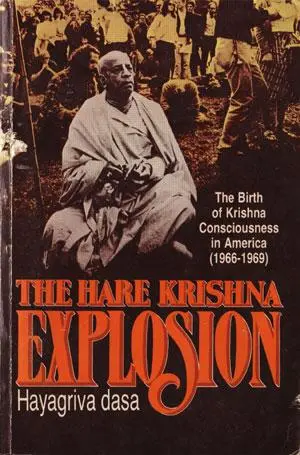
Back in New York, in early 1967, Srila Prabhupada often sat in his room and slowly turned the world globe, studying the geographic demarcations of various countries on the Earth planet. He would sometimes say, “Brahmananda, you will go to Russia, Goursundar, you go to Japan, Rayarama, you will go to Europe…” and so on. Even though he had merely a handful of sincere American youths, most of them in their late teens or early twenties, he had big plans. Clearly, he wanted to open preaching centers in every country on Earth. His vision was huge–he planned to spread the Hare Krishna movement all over the world! But he was especially concerned about Russia.
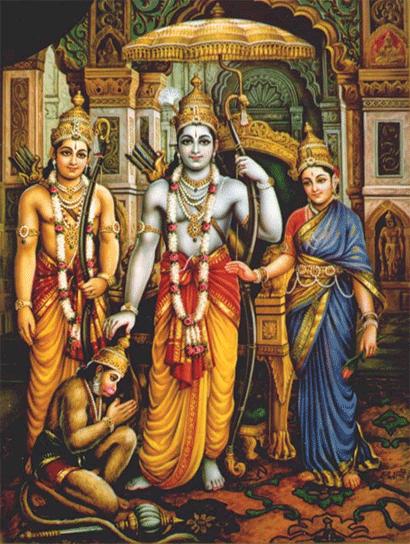
Yesterday was the the appearance day of Lord Ramacandra as many of you know, and in that post we did yesterday taken from the Srimad Bhagavantam (1.3.22), Srila Prabhupada had this to say in his purport about the building of the bridge from India to Sri Lanka;
…Lord Rāmacandra prepared a royal road on the Indian Ocean with stones that floated on the water. The modern scientists have done research in the area of weightlessness, but it is not possible to bring in weightlessness anywhere and everywhere. But because weightlessness is the creation of the Lord by which He can make the gigantic planets fly and float in the air, He made the stones even within this earth to be weightless and prepared a stone bridge on the sea without any supporting pillar. That is the display of the power of God. (from purport SB 1.3.22)
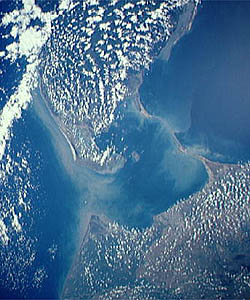
The following is the scientific evidence from NASA supporting the story from the Ramamayana.
Ancient Bridge between India and Sri Lanka
Space images taken by NASA reveal a mysterious ancient bridge in the Palk Strait between India and Sri Lanka. The recently discovered bridge currently named as Adam’s Bridge is made of chain of shoals, c.18 mi (30 km) long.
The bridge’s unique curvature and composition by age reveals that it is man made. The legends as well as Archeological studies reveal that the first signs of human inhabitants in Sri Lanka date back to the a primitive age, about 1,750,000 years ago and the bridge’s age is also almost equivalent.
This information is a crucial aspect for an insight into the mysterious legend called Ramayana, which was supposed to have taken place in treta yuga (more than 1,700,000 years ago).
In this epic, there is a mentioning about a bridge, which was built between Rameshwaram (India) and Srilankan coast under the supervision of a dynamic and invincible figure called Rama who is supposed to be the incarnation of the supreme.
This information may not be of much importance to the archeologists who are interested in exploring the origins of man, but it is sure to open the spiritual gates of the people of the world to have come to know an ancient history linked to the Indian mythology.
So today marks the appearance day of Lord Ramacandra, otherwise known as Rama-Navami. We honor it with a half or full day fast, followed by an nice vegetarian feast, with readings throughout the day of the glorious pastimes of the Lord.
Srimad Bhagavatam By His Divine Grace A.C. Bhaktivedanta Swami Prabhupada Canto 1, Chapter 3, Text 22
nara—human being; devatvam—divinity; āpannaḥ—having assumed the form of; sura—the demigods; kārya—activities; cikīrṣayā—for the purpose of performing; samudra—the Indian Ocean; nigraha-ādīni—controlling, etc.; cakre—did perform; vīryāṇi—superhuman prowess; ataḥ param—thereafter.
In the eighteenth incarnation, the Lord appeared as King Rāma. In order to perform some pleasing work for the demigods, He exhibited superhuman powers by controlling the Indian Ocean and then killing the atheist King Rāvaṇa, who was on the other side of the sea.
Purport The Personality of Godhead Śrī Rāma assumed the form of a human being and appeared on the earth for the purpose of doing some pleasing work for the demigods or the administrative personalities to maintain the order of the universe. Sometimes great demons and atheists like Rāvaṇa and Hiraṇyakaśipu and many others become very famous due to advancing material civilization by the help of material science and other activities with a spirit of challenging the established order of the Lord. For example, the attempt to fly to other planets by material means is a challenge to the established order. The conditions of each and every planet are different, and different classes of human beings are accommodated there for particular purposes mentioned in the codes of the Lord. But, puffed up by tiny success in material advancement, sometimes the godless materialists challenge the existence of God. Rāvaṇa was one of them, and he wanted to deport ordinary men to the planet of Indra (heaven) by material means without consideration of the necessary qualifications. He wanted a staircase to be built up directly reaching the heavenly planet so that people might not be required to undergo the routine of pious work necessary to enter that planet. He also wanted to perform other acts against the established rule of the Lord. He even challenged the authority of Śrī Rāma, the Personality of Godhead, and kidnapped His wife, Sītā. Of course Lord Rāma came to chastise this atheist, answering the prayer and desire of the demigods. He therefore took up the challenge of Rāvaṇa, and the complete activity is the subject matter of the Rāmāyaṇa. Because Lord Rāmacandra was the Personality of Godhead, He exhibited superhuman activities which no human being, including the materially advanced Rāvaṇa, could perform. Lord Rāmacandra prepared a royal road on the Indian Ocean with stones that floated on the water. The modern scientists have done research in the area of weightlessness, but it is not possible to bring in weightlessness anywhere and everywhere. But because weightlessness is the creation of the Lord by which He can make the gigantic planets fly and float in the air, He made the stones even within this earth to be weightless and prepared a stone bridge on the sea without any supporting pillar. That is the display of the power of God.
“Kṛṣṇa is within you. He is sitting within your heart as a friend, not as an enemy. Kṛṣṇa is always your friend. Suhṛdaṁ sarva-bhūtānām (BG 5.29). You are searching out friends to talk with, to joke with, to love. Kṛṣṇa is sitting there for that purpose.
If you love Kṛṣṇa, if you make friendship with Kṛṣṇa, if you love Kṛṣṇa, then your life will be successful. You haven’t got to search out any other friend. The friend is already there. Either you are a boy or a girl, you will find a nice friend within yourself.
That is yoga system, when you realize this friend. So this friend is so nice, as soon as you become little inclined to hear about Him, śṛṇvatāṁ sva-kathāḥ—about Kṛṣṇa, not any other nonsense talks, simply about Kṛṣṇa — then Kṛṣṇa will be so pleased.”
Srila A.C. Bhaktivedanta Swami Maharaja Lecture, New Vrindaban, June 7, 1969
…Another day, when Kṛṣṇa and Balarāma were playing with Their friends, all the boys joined Balarāma and told mother Yaśodā Kṛṣṇa had eaten clay. On hearing this, mother Yaśodā caught hold of Kṛṣṇa’s hand and said, “My dear Kṛṣṇa, why have You eaten earth in a solitary place? Just see, all Your friends including Balarāma are complaining about You.”
Being afraid of His mother, Kṛṣṇa replied, “My dear mother, all these boys, including My elder brother Balarāma, are speaking lies against Me. I have never eaten clay. My elder brother Balarāma, while playing with Me today, became angry, and therefore He has joined with the other boys to complain against Me. They have all combined together to complain so you will be angry and chastise Me.
If you think they are truthful, then you can look within My mouth to see whether I have taken clay or not.” His mother replied, “All right, if You have actually not taken any clay, then just open Your mouth. I shall see.”
Actually, it was my Guru Maharaj speaking through me. But I was not very expert at writing, as he was. Oh, he was a most erudite man, most refined and expert, a gentleman, a Vaikuntha man. Because I had never written before, there were so many grammatical discrepancies, yet I had to write.
The subject matter was so important, so urgent. So I wrote those first three volumes of Srimad Bhagavatam, the First Canto. All of our philosophy, everything you need to know, is in those first three volumes. By Krishna’s grace, I managed to collect money to get them printed, and I took them with me on the boat to New York I didn’t go to America empty-handed. I went with the complete philosophy of Chaitanya Mahaprabhu, written in these rooms, inspired by the Goswamis. Thats what is pushing this Krishna consciousness movement.
Explained in English by His Divine Grace A.C. Bhaktivedanta Swami Prabhupada
Five hundred years ago, Sri Krsna, the Supreme Personality of Godhead, appeared in West Bengal in the role of His own pure devotee—Sri Krsna Caitanya Mahaprabhu. Lord Caitanya is considered the most munificent incarnation of Godhead because He made love for Krsna easily available through the chanting of the maha-mantra—Hare Krsna, Hare Krsna, Krsna Krsna, Hare Hare/ Hare Rama, Hare Rama, Rama Rama, Hare Hare.
When Lord Krsna appeared as Lord Caitanya, His principal associate in spreading the Krsna consciousness movement was Lord Nityananda Prabhu. Lord Nityananda is Lord Caitanya’s expansion. In other words, He is nondifferent from Lord Caitanya. The same Supreme Lord appeared in different forms—as Lord Caitanya and Lord Nityananda—to bestow mercy upon the fallen souls of the material world. This song, therefore, describes the benefits of taking shelter of Lord Nityananda Prabhu.
Srila Narottama dasa Thakura was a great devotee and spiritual master in the disciplic chain coming down from Lord Caitanya. He has written many songs, and they are recognized as authoritative by all Krsna conscious devotees. He sang these songs in simple Bengali language, but the purport—the deep meaning of his songs—is very significant. His Divine Grace A.C. Bhaktivedanta Swami Prabhupada has therefore explained many of these songs in English and taught them to his disciples. (Cassette recordings of Srila Prabhupada singing and explaining these songs are available from Golden Avatar Productions in Los Angeles.)
With the advent of Lord Nityananda’s appearance day coming up on on Monday February 14th, I am already planing the feast we will offer. One of my personal favorite preparations that is usually offered on festival days is sweet rice. It should be chilled before offering so I have decided to cook it today (Sunday) so it can chill in refrigerator overnight. The following recipe is from the original The Hare Krishna Cookbook.
Sweet Rice III
1/4 cup white or Basmati rice
3/4 cup sugar
1/2 gallon milk
15 whole cardamom pods (opt.)
Cook all the rice with one cup of milk for about 20 minutes until soft. Then add the cardamom pods. Gradually, add the remaining amount of milk, stirring occasionally with a wooden spoon over the next hour or two over low heat. Before you remove the sweet rice from heat, add the sugar and stir untill the sugar is completely absorbed. (if cardamom pods were used, remove them before sweet rice cools) Place sweet rice in refrigerator and offer when very cold.
I often marvel at how we can find on this material planet, Earth, examples of both Heaven & Hell. Some people and animals are living in “Heavenly Luxury”, while others are suffering what can only be described as “Hellish Conditions”. Someone once told me, that within every man is the keys to the gates of Heaven, but also the keys to the gates of Hell. Or as I sometimes like to joke, its either Rama or Drama.
Lord Kapila continued: My dear mother, it is sometimes said that we experience hell or heaven on this planet, for hellish punishments are sometimes visible on this planet also.(SB 3.30.29)
A Vaisnava is addressed as maha-bhaga, which means “fortunate.” One who becomes a Vaisnava and is God conscious is understood to be greatly fortunate. Lord Caitanya Mahaprabhu , the chief exponent of Krsna consciousness in this age, has explained that the living entities in various planetary systems all over the universe are rotating in different species of life. A living entity can go wherever he likes—to heaven or to hell—simply by preparing himself for either place. There are many heavenly planets, many hellish planets, and many species of life. Padma Purana estimates the species of life to be 8,400,000, and the living entity is rotating or wandering through these species and creating bodies according to his mentality in his present life. “As you sow, so shall you reap,” is the law that governs here. Catanya Mahaprabhu says that out of these numberless living entities who are transmigrating in the material world, one may be fortunate enough to take to Krsna consciousness. Krsna consciousness is being distributed freely everywhere, yet not everyone takes to it, especially in this age of Kali. Because of this, Śrīmad-Bhagavatam characterizes people in the age of Kali as unfortunate. Therefore Caitanya Mahaprabhu says that only those who are fortunate take to this Krsna consciousness and thus attain a pleasant and blissful life of knowledge. (The Matchless Gift, from chapter 2)
Today marks the Appearance day of Advaita Acharya. The general practice is to observe a half-day fast, and hear the glories of this great vaisnava acharya. We share with you this short biography of his life and pastimes.
Sri Advaita Acharya’s Appearance Day
Sri Advaita Acharya was born in 1434 in Nabagram, Bengal to Sri Kubera Pandit and Srimati Nabha devi. They were originally inhabitants of Nabagram village near Sri Hatta, but later moved to Santipura on the banks of the Ganga.
When Sri Advaita Acharya made His appearance in this world, Srila Madhavendra Puri, Sri Ishvar Puri, Sachi Mata and Sri Jagannatha Mishra also made their advent.
Sri Advaita Acharya was a disciple of Srila Madhavendra Puri and is one of the chief figures amongst the Panchatattva – Sri Krishna Chaitanya, Prabhu Nityananda, Sri Advaita, Gadadhara and Srivasa.
Sri Advaita Acharya studied the Vedas and other scriptures under a scholar named Santacharya in Phulavati village near Santipura, where He was awarded the title ‘Acharya’.
Before the appearance of Sri Gauranga Mahaprabhu, all the Vaishnava devotees in the Navadweep are used to gather at the house of Advaita Acharya. In these meetings, Advaita Acharya preached on the basis of the Bhagavad-gita and Srimad Bhagavatam. The devotees took pleasure in Krishna Katha, worshipping Krishna and chanting the Lord’s names. Sri Chaitanya’s elder brother, Vishvarupa used to regularly visit Advaita Acharya’s house to engage in the chanting and dancing of nama sankirtan.
I ran across this article this morning, and although I don’t know who authored it, I thought it worthy of posting. -V
10 Affirmations for Chanting the Hare Krishna Maha-mantra
Sound has the ability to affect our consciousness to a large extent. The quality of sound vibration that goes into our ears determines the quality of our consciousness. Sound has the highest capturing potency; our ideas, conceptions and visions all come to us from sound. We can transform our lives depending on the sound vibration that we hear. The Yoga texts recommend the Hare Krishna Maha-mantra as the prime sound vibration for this age which is full of anxiety and distress. The Hare Krishna Maha-mantra, Hare Krishna Hare Krishna Krishna Krishna Hare Hare Hare Rama Hare Rama Rama Rama Hare Hare, is a spiritual sound vibration which brings us out of bodily consciousness and attaches our consciousness to the Supreme consciousness.
Chanting of the Hare Krishna Maha-mantra: (1) helps to revive awareness of your spiritual identity; (2) helps to revive awareness of your connection with the Supreme being; and (3) gives awareness of the love Supreme and the dynamics of the reciprocal relationship between your spiritual self and the Supreme spiritual self.
Thus, it is important that we spend time working on our internal attitude and motivation for chanting the Hare Krishna Maha-mantra. In this article, we will explore the practice of affirmations to help improve and increase our presence while chanting. Saying affirmations out loud and meditating on their core meanings before chanting the Hare Krishna Maha-mantra may allow us to further enhance our chanting experience.
Yamuna: Srila Prabhupada, although we are very happy where we are, we are prepared to go wherever you would like to send us in order to have your blessings.
Srila Prabhupada: You westerners are always so restless. Why can’t you stay where you are?
Yamuna: But we have been told that because we don’t have the association of devotees, we cannot make any advancement.
Srila Prabhupada: Association can be two or two hundred. But you must be compatible. If you are twoand are compatible, you can go back to Godhead. But if you are two hundred and not compatible [his eyes open widely], then no one will make any advancement.
Yamuna: But Srila Prabhupada, some of the leaders are saying that we have lost your mercy becauseweleft ISKCON and without your mercy there is no meaning to our lives.
Srila Prabhupada: ISKCON is where you are chanting the Holy Names of Krsna. That is ISKCON. (Yamuna Devi, A Life of Unalloyed Devotion).
Note: This is an instruction to Yamuna devi dasi, who is 100% devoted to Srila Prabhupada. Prabhupada is ISKCON!
The following is an excerpt from a long interview of Ramesvara prabhu made for Srila Prabhupada lilamrta. If you read the whole interview, you will find it full of nectar pastimes of Srila Prabhupada, but the interview, unfortunately, never made it to the lilamrta?
The interview was made in 1979 and was carefully hidden in the Bhaktivedanta archives until it was leaked by a devotee in 2013.
Please bear in mind, as you read the following, that in 1979 when the interview was made, there were no bookchange conflicts, consequently there could have been no hidden motives in Ramesvara prabhu’s statements.
(There is a lot of sweet nectar and good information here, worth a moment of your time. -Vyasasan das)
The paintings sell the books
See, what Prabhupada did was so ingenious, it has to be appreciated from a historical point of view. No one in modern history has ever made philosophy books popular for the mass market. So what Prabhupada did was a stroke of genius and he should be described as…this should be understood to be part of Prabhupada’s genius in knowing how to popularize Krsna consciousness. That he combined the world’s deepest philosophy with paintings. And the paintings added to this philosophy made the books popular, made very deep high-level philosophy books popular to the masses. The average print run and distribution of a major philosophical work is miniscule in this world. In any language it’s miniscule compared to the popular novels and the popular nonfiction works. Philosophy books just are not big sellers. So this was Prabhupada’s genius. It cannot be in any way overstated, because it is an act of genius that he figured out how to have mass popularization of very high philosophy books. Prabhupada actually wanted 50 paintings in every volume. That was Prabhupada’s vision. Genius! No philosopher ever thought of such a thing. And therefore their books never sell. These art paintings were the basis of all the book distribution.
Of course, it was our sincerity and our drive and our desire to please Prabhupada. But the technique was showing people the paintings, attracting their senses, getting them curious and interested and attracted by the art. The more beautiful the art the more you could tell people that this describes the most beautiful, peaceful way of life, the most beautiful spiritual thing, you have to find out these people have. You’d show the paintings and you’d say things like, “This explains how to experience the highest happiness. Just look at this painting. Wouldn’t you like to be there?” The paintings were the basis for the book selling. And Prabhupada is the genius who thought that up.
Ramesvara interview on history of ISKCON and book changes — full text 77
Govinda Dasi: It was at that time, when Swamiji was recovering from stroke in Vrindaban, feeling great separation from Swamiji, that I designed a drawing of Krishna returning home from the forest with thousands of cows. It was indeed a special drawing, for though I had never seen Vrindaban, or even photographs of it, just from Swamiji’s many descriptions of Vrindaban, I was able to create a picture that did indeed look very much like Krishna’s Vrindaban.
While doing this drawing, I was seeing cows and cowlads in my minds’ eye for weeks! I selected one particular cowlad to be Swamiji, and sent him a copy of the picture, denoting that the cowlad on the far right of Krishna was my depiction of him.
Years later, this early drawing of Krishna’s Vrindaban was artfully colored in by some of the later BBT artists, and is still used today in many of the books and temples. It is a painting that is full of bhava. That is because it is Swamiji’s drawing – not mine. It is full of his devotion. Remember, I had never even seen Vrindaban. But he was able to convey it to me so perfectly that the mood of Vrindaban is indeed present in that picture!
And he was also able to guide me from within my mind and heart just how he wanted it done. This is the deeper, more spiritual, understanding of transcendental art. It doesn’t come from us; as artists, we have to open ourselves so that Srila Prabhupada’s devotion comes through us. This mood requires surrender of the arrogant and rebellious attitude that, “I am the doer.” Or, “I am the artist.“
Today in the West people are celebrating “Thanksgiving”. So we are posting a traditional Thanksgiving recipe; Pumpkin Pie (without the eggs). I have been making egg-less pies for the last 39 years, and have tried many different variations. I use 2 tablespoons of sour cream instead of 2 eggs, and one year I used Philadelphia cream cheese instead of evaporated milk, all with good success.
If you want to do everything yourself, there is the do it yourself recipe for a “homemade” pie crust, pumpkin puree, spicing, and sweetened whipped cream.
This is an older article that appeared in Back to Godhead Magizine Vol. 11, No. 7, 1976, but is certainly still pertinent in todays culture. We have included the original pages in image form at bottom of post.
Curing the Crimes of a Lifetime
by Bibhavati-devi dasi
Adapted from Srimad-Bhagavatam, translation and commentary by His Divine Grace A.C. Bhaktivedanta Swami Prabhupada.
With recent disgrace of an American president still fresh in our minds, it is interesting to read of a similar case in ancient times. Five thousand years ago, a blind king named Dhrtarastra dishonored his high post and caused the death of millions. His story is of special importance, even today, because he found an antidote to the crimes of a lifetime, and in his old age became self-realized.
George Harrison had a long relationship with Srila Prabhupada and his Hare Krishna movement.
Very early George became a devotee and used his money for Krisahna by, for example, paying the full cost of printing Srila Prabhupada’s, Krsna Book and by purchasing Bhaktivedanta Manor, ISKCON’s headquarters in England.
George also sang about Krishna in his music. The most famous George Harrison Krishna song is, of course, “My Sweet Lord,” but many of George’s other songs are about Krishna also.
In the 1990’s ISKCON had their first big reunion of the desciples of Srila Prabhupada at Bhaktivedanta Manor, the property donated to ISKCON by George, so naturally George attended.
Not that it was rare, George often chanted Hare Krishna with the devotees, but usually there is no film, no recording. Even in this case we see the security people at Bhaktivedanta Manor trying to stop our brave cameraman from capturing this special moment in history.
We have just discovered new archival footage of George Harrison leading a kirtan and chanting Hare Krishna at that Prabhupada Festival and here it is.
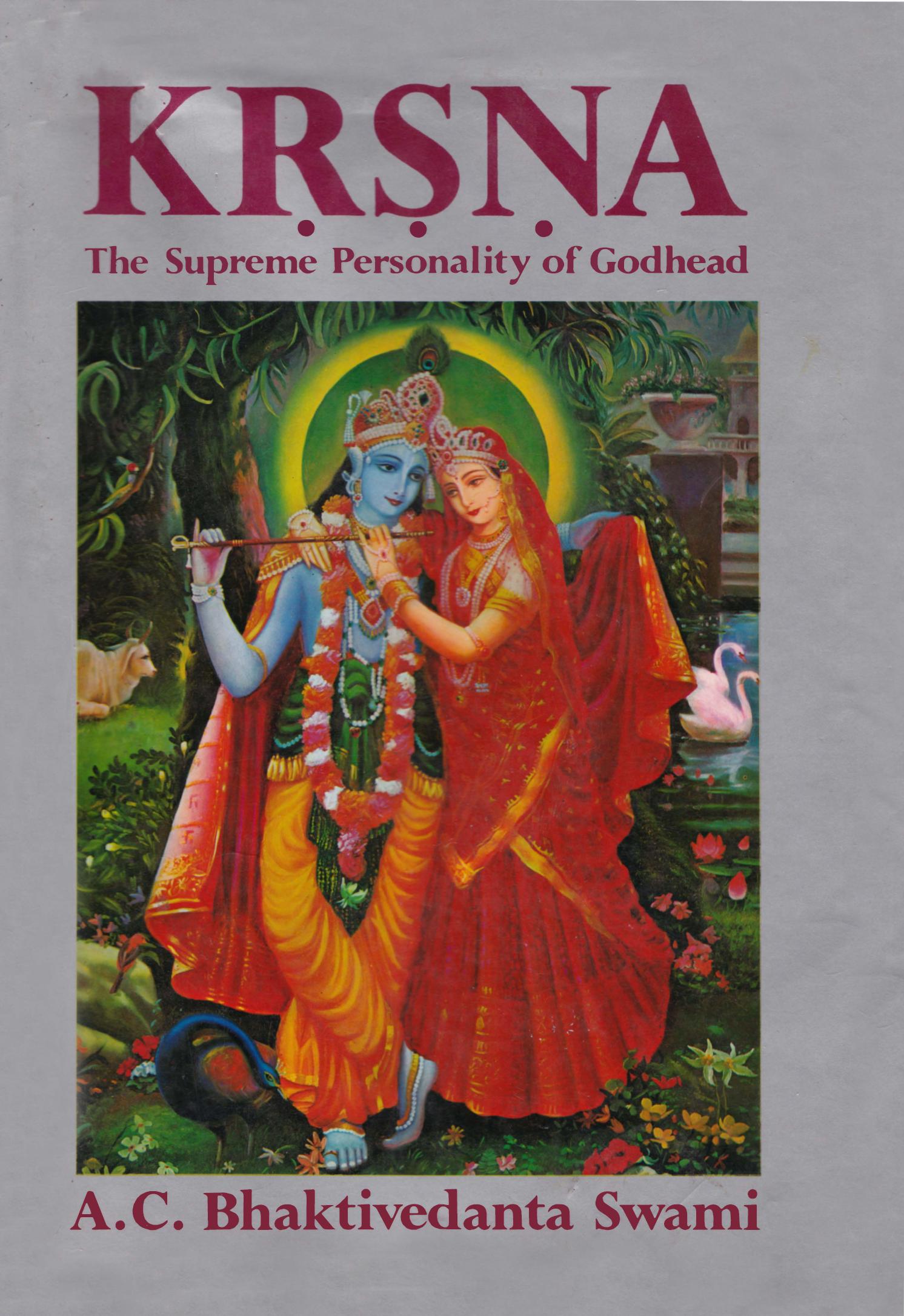
The transcendental pastimes of the Supreme Personality of Godhead Kṛṣṇa are so powerful that simply by hearing, reading and memorizing this book Kṛṣṇa, one is sure to be transferred to the spiritual world, which is ordinarily very difficult to achieve. The description of the pastimes of Lord Kṛṣṇa is so attractive that automatically it gives us an impetus to study repeatedly, and the more we study the pastimes of the Lord, the more we become attached to Him. This very attachment to Kṛṣṇa makes one eligible to be transferred to His abode, Goloka Vṛndāvana.
The very first book I received personally from a devotee, was the Krsna Book, back in 1973 at the Chicago Ohara Airport. It was the most beautiful book I had ever seen, the most beautiful book I have ever read, and in my mind, the most beautiful book ever written. We share with you Chapter 35, Summary Descriptions of Lord Krsnas Pastimes.









 The Hare Krishna Movement