07 Mar 2012
by The Hare Krishna Movement
in Caitanya Mahaprabhu, Chanting Hare Krishna, Krishna Consciousness, Teachings of Lord Chaitanya
Tags: Caitanya Mahaprabhu, Hare Krsna, Hare Rama, Hari, holy names of Krishna, Krishna consciousness, Lord Caitanya, love of God, self realization, spiritual madness, Srila Prabhupada, Teachings of Lord Caitanya

The holy name of the Lord—Hare Kṛṣṇa, Hare Kṛṣṇa, Kṛṣṇa Kṛṣṇa, Hare Hare/ Hare Rāma, Hare Rāma, Rāma Rāma, Hare Hare—is a transcendental vibration because it comes from the transcendental platform, the supreme abode of Kṛṣṇa. Because there is no difference between Kṛṣṇa and His name, the holy name of Kṛṣṇa is as pure, perfect and liberated as Kṛṣṇa Himself.
“It is the transcendental nature of the holy names of Hare Kṛṣṇa, Hare Kṛṣṇa, Kṛṣṇa Kṛṣṇa, Hare Hare/ Hare Rāma, Hare Rāma, Rāma Rāma, Hare Hare to transport a man into spiritual madness. Anyone who sincerely chants this holy name very soon attains elevation to the platform of love of God and becomes mad after God. This madness arising from love of God is the first perfectional stage for a human being.”
Excerpted from; Teachings of Lord Caitanya
By His Divine Grace A. C. Bhaktivedanta Swami Prabhupāda
Chapter Eighteen, The Conversations with Prakāśānanda
…In this age of logic, argument and disagreement, the chanting of Hare Kṛṣṇa is the only means for self-realization. Because this transcendental vibration alone can deliver the conditioned soul, it is considered to be the essence of the Vedānta-sūtra. According to the material conception, there is duality between the name, form, quality, emotions and activities of a person and the person himself, but as far as the transcendental vibration is concerned, there is no such limitation, for it descends from the spiritual world. In the spiritual world there is no difference between the name of the person and the quality of the person. Of course in the material world there is a difference. Because the Māyāvādī philosophers cannot understand this, they cannot utter the transcendental vibration.
More
02 Jan 2012
by The Hare Krishna Movement
in Back to Godhead, Caitanya Mahaprabhu, Chanting Hare Krishna, Hare Krishna Maha Mantra, Sri Siksastakam, Subaldasa Swami, The Hare Krishna Movement
Tags: His Divine Grace A.C. Bhaktivedanta Swami Prabhupada, Krsna consciousness movement, Lord Caitanya, Lord Krsna Caitanya Mahaprabhu, Madhva-Gaudiya-Sampradaya, Sri Siksastakam, Subaldasa Swami

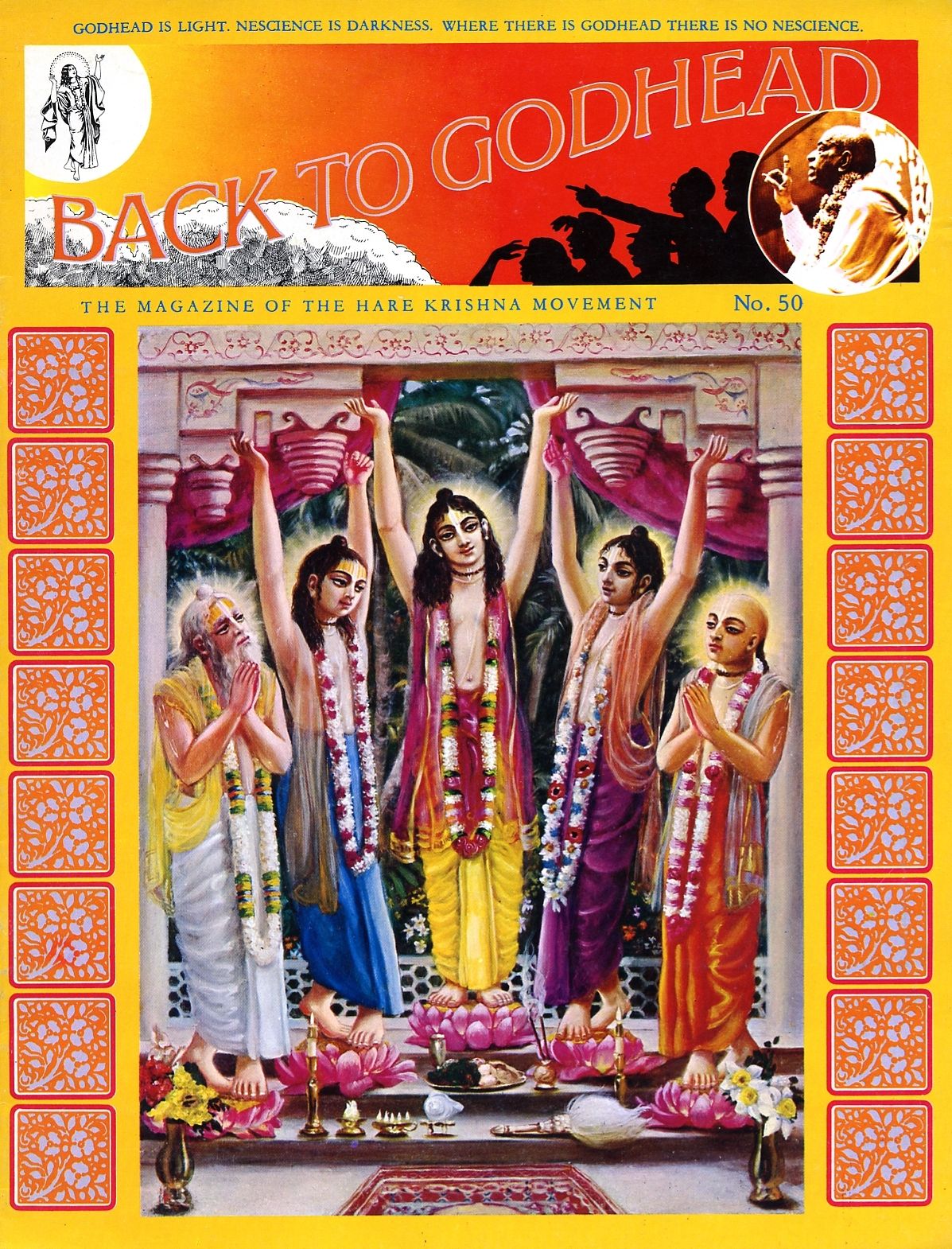
Click on image to enlarge
Lord Caitanya’s Mission and Precepts
Excerpted from ‘Back To Godhead’ magazine, 1973 Vol. 1, No. 49 & 50
As foretold in Vedic scriptures, the Supreme Personality of Godhead appeared on earth 500 years ago in the form of Lord Caitanya, who is God Himself playing the role of a devotee of Godhead. The eight verses entitled Sri Sri Siksastakam, which were the only written instructions of Lord Caitanya, reveal the essence of the Krsna consciousness movement.
Sri Sri Siksastakam
by Sri Krsna Caitanya Mahaprabhu
translated by His Divine Grace A.C. Bhaktivedanta Swami Prabhupada
with purports by His Holiness Subaldasa Svami
1.
ceto-darpana-marjanam bhava-mahadavagni-nirvapanam
sreyah kairava-candrikavitaranam vidyavadhujivanam
anandambudhi-vardhanam pratipadam purnamrtasvadanam
sarvatma-snapanam param vijayate sri-krsna-sankirtanam
Translation
Glory to the Sri Krsna sankirtana, which cleanses the heart of all the dust accumulated for years and extinguishes the fire of conditional life, of repeated birth and death. This sankirtana movement is the prime benediction for humanity at large because it spreads the rays of the benediction moon. It is the life of all transcendental knowledge. It increases the ocean of transcendental bliss, and it enables us to fully taste the nectar for which we are always anxious.
More
08 Dec 2011
by The Hare Krishna Movement
in Chanting Hare Krishna, Sankirtan
Tags: chanting Hare Krishna, Iskcon, Krishna consciousness movement, Locananda dasa, Lord Caitanya, nama-sankirtan, sankirtan, Sri Panca-Tattva, Srila Prabhupada, The Hare Krishna Movement, Vaisnavas
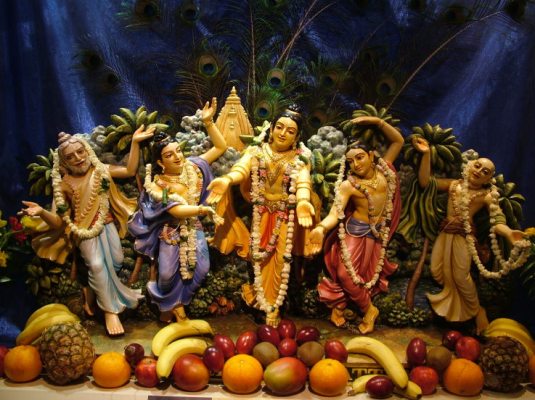
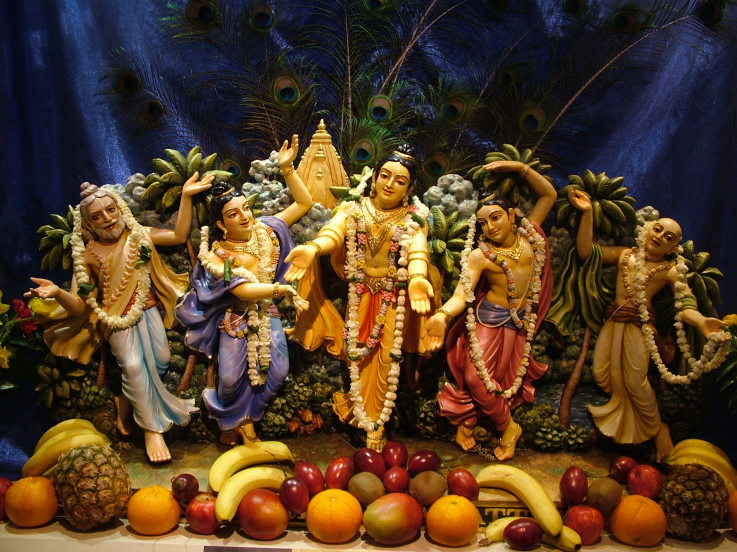
Sri Panca Tattva Wellington New Zealand
…What the Lord Caitanya Mahaprabhu Himself proclaims to be the prime benediction for mankind, and the activity that He Himself appeared in this world to inaugurate, has been very badly neglected by ISKCON’s leaders. To attract devotees, to engage devotees and to elevate the awareness of the public, there is no better method than to perform nama-sankirtana. This same instruction was given to Lord Caitanya by His spiritual master:
“My dear child, continue dancing, chanting and performing sankirtana in association with devotees. Furthermore, go out and preach the value of chanting Krishna-nama, for by this process You will be able to deliver all fallen souls.”
Nama Sankirtana
Editorial (VNN) – by Locanananda Das
Originally Published on Vaishnava News
By reading the Sri Caitanya Caritamrita, one should become convinced that the Krishna consciousness movement is the vehicle through which the mercy of Caitanya Mahaprabhu will deliver the entire world. But events taking place within the movement over the last twenty years have shaken everyone’s faith, and it has become very difficult to take pride in being a member of ISKCON, the organization that Srila Prabhupad risked his life to create. The year of the Centennial having come and gone, ISKCON continues to be plagued by a malaise that is rooted in its leaders’ lack of vision and apparent lack of concern for the spiritual well-being of the devotees. Compounded by the offensive banning of vaisnavas and the enactment of deviant policies, the movement has been thrown into a tailspin from which some think it may not recover.
Personally, I have tremendous faith in the system established by Srila Prabhupad. I am thoroughly convinced that there can be a reconciliation of the parties on the different sides of all current issues, but it will require that we rise above false ego and agree to do what is best for the Krishna consciousness movement.
More
17 Nov 2011
by The Hare Krishna Movement
in Chanting Hare Krishna, Lectures
Tags: Bombay Pandal, chanting Hare Krishna, Hare Krishna Movement, self realization, Srimad Bhagavatam, Supreme Personality of Godhead

The Hare Krishna Movement
“Bombay Pandal Lecture”
By Srila Prabhupada
Bombay, April 6, 1971:
Ladies and gentlemen, we are very much thankful to you for your kindly participating in this great movement, Hare Krishna.
This Hare Krishna Movement is especially meant for this age because for self-realization, although there are many methods recommended in Vedic scriptures, in this age the greatest common factor for self-realization is simply chanting this Hare Krishna mantra.
Actually, our miserable condition of life is due to our forgetfulness. As I said yesterday, day before yesterday, this material existence is a condemned position of the living entities, exactly like a criminal is placed in the prisonhouse. Now, the whole Vedic literature is meant for getting us liberated from this condition of life. So far Bhagavad-gita is concerned, the same aim is there because at the ultimate instruction, Lord Krishna says, sarva-dharman parityajya mam ekam saranam vraja [Bg. 18.66].
More
07 Nov 2011
by The Hare Krishna Movement
in Chanting Hare Krishna, Krishna Consciousness, Sri Caitanya-Caritamrta
Tags: 1975 edition, Caitanya Mahaprabhu His Divine Grace A.C. Bhaktivedanta Swami Prabhupada, chanting Hare Krishna, fruit of Love of Godhead, Maha Mantra, Sri Caitanya-caritamrta

Lord Caitanya Mahaprabhu Chanting and Dancing
Sri Caitanya-caritamrta – 1975 Edition
By His Divine Grace A.C. Bhaktivedanta Swami Prabhupada
Adi-lila 9.48
The Tree of Devotional Service
yei yāhāṅ tāhāṅ dāna kare prema-phala
phalāsvāde matta loka ha-ila sakala
yei—anyone; yāhāṅ—wherever; tāhāṅ—anywhere; dāna—charity; kare—gives in; prema-phala—the fruit of love of Godhead; phala—fruit; āsvāde—by tasting; matta—intoxicated; loka—people; ha-ila—become; sakala—all.
The fruit of love of God is so relishable that wherever a devotee distributes it, those who taste the fruit, anywhere in the world, immediately become intoxicated.
Here the wonderful fruit of love of Godhead distributed by Lord Caitanya Mahāprabhu is described. We have practical experience that anyone who accepts this fruit and sincerely tastes it immediately becomes mad after it and gives up all his bad habits, being intoxicated by Caitanya Mahāprabhu’s gift, the Hare Kṛṣṇa mahā-mantra. The statements of Śrī Caitanya-caritāmṛta are so practical that anyone can test them. As far as we are concerned, we are most confident of the success of the distribution of the great fruit of love of Godhead through the medium of chanting the mahā-mantra-Hare Kṛṣṇa, Hare Kṛṣṇa, Kṛṣṇa Kṛṣṇa, Hare Hare Hare Rāma, Hare Rāma, Rāma Rāma, Hare Hare.
11 Oct 2011
by The Hare Krishna Movement
in Chanting Hare Krishna, Krishna Consciousness
Tags: chant Hare Krishna, chanting Hare Krishna, Hare Krishna, His Divine Grace A.C. Bhaktivedanta Swami Prabhupada, Kali-yuga, kirtanad eva krsnasya
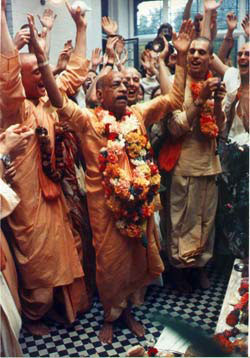
Srila Prabhupada Chanting & Dancing
By His Divine Grace A.C. Bhaktivedanta Swami Prabhupada
Founder-Acarya of the International Society for Krishna Consciousness
“In the sastra it is said this Kali-yuga is full of faults, so many faults. It is the ocean of faults. But there is a very nice thing, asti hy eko mahan gunah, a very great quality. What is that? Kirtanad eva krsnasya mukta-sangah param vrajet [SB 12.3.51]. If you simply chant Hare Krishna mantra, then you become perfect. Is it very difficult? Chant Hare Krishna and you become perfect. But we are so unfortunate, we are not even prepared to chant. This is our position. So you have to make little determination that ‘I shall chant henceforward Hare Krishna mantra.’ Then everything is all right.“
More
10 Sep 2011
by The Hare Krishna Movement
in Chanting Hare Krishna, Sri Caitanya-Caritamrta
Tags: best of the brahmanas, chanting Hare Krishna, Haridas Thakur, His Divine Grace A., holy name of Krsna, Lord Caitanya's devotee, Nama Acharya, Sri Caitanya-caritamrta
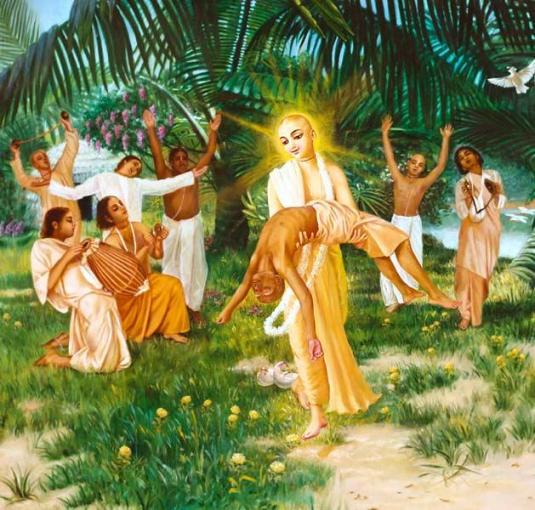
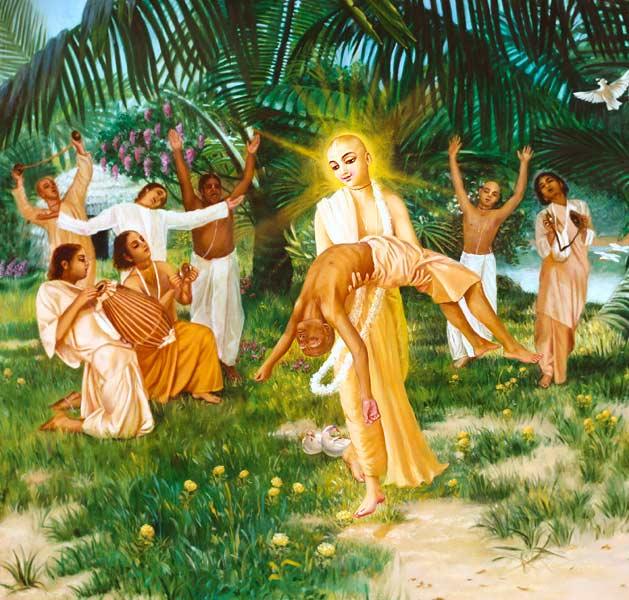
Haridas Thakur is considered to be the namacarya, the spiritual master in chanting the holy name of Krsna. Though he was born in a low class, Muslim family, Lord Caitanya’s devotees respected him as being better than the best of brahmanas. He would not eat or sleep until he finished his daily quota of chanting the name of Krsna 300,000 times. Along with Lord Nityananda, Haridas Thakur spread the chanting of Krsna’s name throughout Bengal. In Jagannatha Puri, where Haridas Thakur spent his later days, Lord Caitanya would regularly send him prasadam and discuss with him topics of Krsna. Haridas Thakur died chanting Krsna’s name in the presence of Sri Caitanya Mahaprabhu. After Haridas Thakur’s death, Lord Caitanya carried his body to the sea and with His own hands buried him in the sand.
Sri Caitanya-caritamrta – 1975 Edition
Antya-lila 3 Text49-
The Glories of Srila Haridasa Thakura
Śrī Caitanya Mahāprabhu derives great pleasure from glorifying His devotees, and among the devotees, Haridāsa Ṭhākura is the foremost.
The transcendental qualities of Haridāsa Ṭhākura are innumerable and unfathomable. One may describe a portion of them, but to count them all is impossible.
In Caitanya-maṅgala, Śrīla Vṛndāvana dāsa Ṭhākura has described the attributes of Haridāsa Ṭhākura to some extent.
No one can describe all the qualities of Haridāsa Ṭhākura. One may say something about them just to purify himself.
O devotees of Śrī Caitanya Mahāprabhu, please hear something about the qualities of Haridāsa Ṭhākura that Śrīla Vṛndāvana dāsa Ṭhākura has not described in detail.
After leaving his home, Haridāsa Ṭhākura stayed for some time in the forest of Benāpola.
Haridāsa Ṭhākura constructed a cottage in a solitary forest. There he planted a tulasī plant, and in front of the tulasī he would chant the holy name of the Lord 300,000 times daily. He chanted throughout the entire day and night.
Purport
The village of Benāpola is situated in the district of Yaśohara, which is now in Bangladesh. Benāpola is near the Banagāṅo station, which is at the border of Bangladesh and may be reached by the eastern railway from Shelda Station in Calcutta. Haridāsa Ṭhākura, being the ācārya of chanting the Hare Kṛṣṇa mahā-mantra, is called Nāmācārya Haridāsa Ṭhākura. From his personal Example we can understand that chanting the Hare Kṛṣṇa mantra and becoming highly elevated in Kṛṣṇa consciousness is very simple. Without difficulty one can sit down anywhere, especially on the bank of the Ganges, Yamunā or any sacred river, devise a sitting place or cottage, plant a tulasī, and before the tulasī chant the Hare Kṛṣṇa mahā-mantra undisturbed.
Haridāsa Ṭhākura used to chant the holy name on his beads 300,000 times daily. Throughout the entire day and night, he would chant the sixteen names of the Hare Kṛṣṇa mahā-mantra. One should not, however, imitate Haridāsa Ṭhākura, for no one else can chant the Hare Kṛṣṇa mahā-mantra 300,000 times a day. Such chanting is for the mukta-puruṣa, or liberated soul. We can follow his example, however, by chanting sixteen rounds of the Hare Kṛṣṇa mahā-mantra on beads every day and offering respect to the tulasī plant. This is not at all difficult for anyone, and the process of chanting the Hare Kṛṣṇa mahā-mantra with a vow before the tulasī plant has such great spiritual potency that simply by doing this one can become spiritually strong. Therefore we request the members of the Hare Kṛṣṇa movement to follow Haridāsa Ṭhākura’s example rigidly. Chanting sixteen rounds does not take much time, nor is offering respects to the tulasī plant difficult. The process has immense spiritual potency. One should not miss this opportunity.
Note: As Srila Prabhupada points out in his purport to Adi-lila 10, 43;
“Certainly the chanting of 300,000 holy names of the Lord is wonderful. No ordinary person can chant so many names, nor should one artificially imitate Haridāsa Ṭhākura’s behavior. It is essential, however, that everyone fulfill a specific vow to chant the Hare Kṛṣṇa mantra. Therefore we have prescribed in our Society that all our students must chant at least sixteen rounds daily. Such chanting must be offenseless in order to be of high quality. Mechanical chanting is not as powerful as chanting of the holy name without offenses.”
09 Sep 2011
by The Hare Krishna Movement
in Bhaktivinoda Thakura, Chanting Hare Krishna
Tags: bhaktivinoda, Hare Krishna Maha-mantra, Krishna's holy name, Rama, Srila Bhaktivinoda Thakura, Srimati Radharani
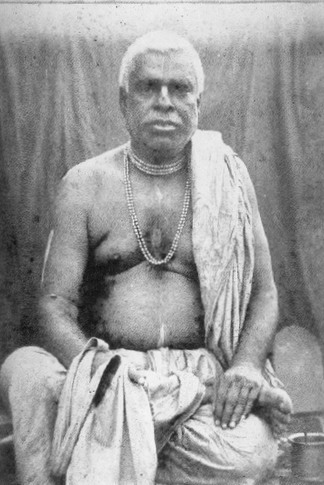
Hare Krsna Maha-mantra
Purport by Srila Bhaktivinoda Thakura
हरे कृष्ण हरे कृष्ण कृष्ण कृष्ण हरे हरे |
हरे राम हरे राम राम राम हरे हरे ||
hare kṛṣṇa hare kṛṣṇa kṛṣṇa kṛṣṇa hare hare
hare rāma hare rāma rāma rāma hare hare
The Hare Kṛṣṇa mantra is known as the mahāmantra, or the greatest of sound vibrations. The mahamantra is a thirty-two syllable mantra chanted requesting Harā (another name of His supreme pleasure energy, personified by Srimati Radharani), and the Supreme Lord (given by two of His names, Krsna, the All-Attractive One, and Rama, the Reservoir of Pleasure) an opportunity to serve Them.
There are four cosmic ages, namely, Satya Yuga, Treta Yuga, Dvapara Yuga, and Kali Yuga. Satya Yuga is known as the “Golden Age”, for values of truth and virtues were at the peak. In Treta Yuga (the age where Lord Sri Ramacandra appeared), vice was introduced. Then, Dvapara Yuga (the age when Sri Krsna appeared on Earth) took place, where vice and virtue was leveled off. Following Dvapara Yuga is the darkest age, known as Kali Yuga. It began approximately five thousand years ago, after Sri Krsna left the world. Throughout each age, the prescribed method of salvation changed. In Satya Yuga, strict penances and austerities was the path of salvation. Then, Treta Yuga introduced the concept of conducting sacrifices as mentioned in scriptures. Dvapara Yuga’s method of salvation comprised of developing personal relations with the Lord.
In Kali Yuga, however, lifespan, intelligence, and qualities are significantly lowered. Therefore, performing severe penance and austerities is impractical. Conducting sacrifices per scriptures is immensely difficult, for those scriptures are not easily accessible, and conductors of such sacrifices are not present on Earth. Receiving personal association and forming relations with the Lord was only fortunate for a few. Therefore, such methods are not practical and applicable for this age. Therefore, the Brhad Naradiya Purana has claimed:
harer nāma harer nāma harer nāmaiva kevalam
kalau nāsty eva nāsty eva nāsty eva gatir anyathā
“Only the Holy Name, Only the Holy Name, Only the Holy Name, is the only way. There is no other way, no other way, no other way in this Age of Kali”
Therefore, it is clearly indicated that in Kali Yuga, the only method of salvation is by chanting the holy name of God. However, the most powerful mantra for salvation was hidden in confidentiality until this age. It wasn’t until the late fifteenth century when the mahamantra was openly revealed by Lord Caitanya Mahaprabhu. Typically, the Lord does not incarnate on Earth during Kali Yuga, until the very end. However, this Kali Yuga was especially fortunate to have Lord Caitanya Mahaprabhu’s incarnation of gold appear on earth. Through His mission to spread the movement of devotional service in degraded age, He brought the Hare Krsna mahamantra openly for all to benefit.
Pasted from http://kksongs.org/mantra/hk_expl.html
19 Aug 2011
by The Hare Krishna Movement
in Chanting Hare Krishna, Sri Caitanya-Caritamrta
Tags: Caitanya Caritamrta, Hare Krishna, Hare Rama, holy name, liberation, Maha Mantra, Srila Prabhupada

The holy name of Lord Krishna is an attractive feature for many saintly, liberal people. It is the annihilator of all sinful reactions and is so powerful that save for the dumb who cannot chant it, it is readily available to everyone, including the lowest type of man, the candala. The holy name of Krishna is the controller of the opulence of liberation, and it is identical with Krishna.
Simply by touching the holy name with one’s tongue, immediate effects are produced. Chanting the holy name does not depend on initiation, pious activities or the purascarya regulative principles generally observed before initiation. The holy name does not wait for all these activities. It is self-sufficient. (Caitanya-caritmrta Mad.15.110)
Hare Krishna, Hare Krishna, Krishna Krishna, Hare Hare,
Hare Rama, Hare Rama, Rama Rama, Hare Hare…
23 Jun 2011
by The Hare Krishna Movement
in Chanting Hare Krishna, Lectures, Srimati Radharani
Tags: bhagavad-gita, Caitanya Mahaprabhu, chanting Hare Krishna, hara, Hare, Hare Krishna Mantra, man-mana bhava mad=bhakto, O Radha-Krishna, Radha, Radharani, Radhastami, Srila Prabhupada, taking shelter of Krishna
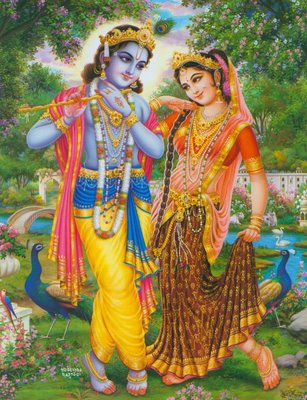
Lectures on Bhagavad-gita As It Is, (Bhagavad-gita 4.10)
Calcutta, September 23, 1974
By His Divine Grace A. C. Bhaktivedanta Swami Prabhupada
By taking shelter of Krishna, one has to become absorbed in thinking of Krishna. That is not very difficult. Man-mana bhava mad-bhakto mad-yaji mam namaskuru [ Bhagavad-gita 18.65]. It is not at all difficult. You simply chant Hare Krishna mantra. You’ll be man-maya. This is so nice thing. Therefore Chaitanya Mahaprabhu has recommended,
harer nama harer nama harer namaiva kevalam
kalau nasty eva nasty eva nasty eva gatir anyatha [ Chaitanya-charitamrita Adi-lila 17.21]
So our request is… Everyone who is present here… Today is Radhastami. So pray to Radharani. And She is hare, hara. This hare, this word, is Radharani. Hara, Radharani. Radha or Hara: the same thing. So Hare Krishna. So we are praying to Radharani, “My Mother, Radharani, and Krishna.” Hare Krishna. “O Krishna, O the Lord.” Hare Krishna, Hare Krishna, the same thing, repetition. “O Radharani, O Krishna.” “O Radha-Krishna.” “Radhe-Krishna” or “Hare Krishna,” the same thing. Hare Krishna, Hare Krishna, Krishna Krishna, Hare Hare. Again addressing, “O Krishna, O Krishna, O Radharani.” Hare Rama. The same thing, again. Hare Rama. Rama is also Krishna. Rama is Rama, Rama is Balarama. They are all Krishna. Hare Rama, Hare Rama, Rama Rama, Hare Hare.
So this repetition of addressing Radha and Krishna or Hare Krishna is to pray, “My dear Lord, … and the energy, the spiritual energy of the Lord, kindly engage me in Your service.” That’s all. “I am now embarrassed with this material service. Please engage me in Your service.”
This is good sense. We are servants here. We are engaged in so many services. But it is not giving us comfort. Na trapa nopashanti. The service which we are rendering to others, they are not satisfied, I am not satisfied. This is material service. But if you give service to Krishna… Svalpam apy asya dharmasya trayate mahato bhayat. A little service can save you from the greatest danger. This is the formula.
More
18 Jun 2011
by The Hare Krishna Movement
in Back to Godhead, Chanting Hare Krishna
Tags: devotees, Hare Krishna, impersonalists, Krsna, Kurappiah Chockalingam, Om, omkara, pranava, spiritual vibration, Srimati Radharani

Om or Hare Krishna?
By Kurappiah Chockalingam
Though the sacred sound om is often associated with impersonalists, only the devotees understand its full import.
The Gosvamis of Vrndavana have analyzed om (a-u-m) as follows: The letter a refers to Krsna, the master of all planets and all living entities. The letter u indicates Srimati Radharani, the pleasure potency of Krsna, and m indicates the living entities. Thus omkara represents Krsna; His name, fame, pastimes, potencies, and devotees; and everything else pertaining to Him.
THROUGHOUT THE VEDAS there is much mention of the syllabel om. This spiritual vibration, which is sometimes called omkara or pranava, comprises three Sanskrit sounds – a, u, and ma (the a in ma is silent). When these three sounds are combined, the result is the single-syllabled vibration om.
An unusual attribute of om is that it has no direct translation from Sanskrit into English. And though every Vedantist will accept om to be a representation of God, exactly how om is viewed differs according to various schools to thought. These schools can be classified into two main categories, the Mayavadi, or impersonalist, and the Vaisnava, or devotee.
The impersonalist, as the name suggests, is happy to treat om as an impersonal, formless, representation of the Absolute Truth. Therefore, the Mayavadi will very openly chant om, being careful to avoid names such as Krsna and Rama, which according to them, are limited. A Mayavadi might explain his theory of pranava om like this: “Since this whole universe has been created by Him (God), whatever there is in the universe is Him alone.
As such, He has no name. But if He has to have a name, then all names are His, for He alone is appearing in all forms. The first sound in most languages is a; the last sound to leave as our mouth closes is m; u is the center of the two. Together, they represent all the basic sounds from which words are produced. And threfore, these three sounds, making up the syllable om, represent the entire universe of names and forms.”
More
28 May 2011
by The Hare Krishna Movement
in Book Distribution, Chanting Hare Krishna
Tags: Book Distribution, Brahmananda, devotees, Govinda dasa, Hare Krishna's, Krishna consciousness, Mahavidya dasa, prabhupada, Sampradaya sun, sankirtan, sankirtan party, Survanamanjari dasi

Sri Krsna Sankirtan!
By: SurvarnamanjariI Dasi
May 27, 2011 — NEW ZEALAND (SUN) —
In the response to “Invisible Hare Krishnas” and “Publicly Representing ISKCON”, I’d like to comment. It is true, that Harinam has taken a back seat, we see it all around different ISKCON communities, but the wonderful thing is that we have the ability to go out there and do harinam. There is nothing stopping us but our minds.
(Note: both above mentioned articles follow this one.)
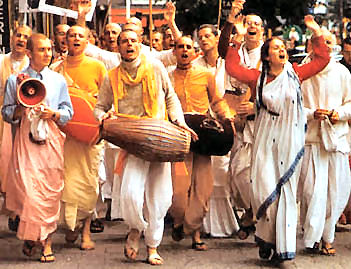
There may be politics, controllers, sentimentalist, fanatics, “fringies”, innocent, enthusiastic or confused members among us in this Sankirtan Movement…and that includes all of us to some degree, but the amazing thing is…we can pick up the mrdangas and karatalas and sing the names of God in the streets, just like Lord Caitanya wants us to. We just have to want to do it.
My husband and I and a dear devotee friend of ours, we go out on harinam in a small town in New Zealand. The response is lovely. People smile, do a little dance, we do a few books, have a laugh and feel joyful afterwards. We are going to start a small chanting group soon… if we can do it, anyone can!
Yes, it is sad about how things are not like the old days, but we don’t live in the old days anymore… we live in 2011 and we need to get proactive to save ourselves and to spread the love to others.
Yes, there is politics in some temples…so what! Take Prabhupada’s books, take your instruments and chant! Why must politics stop our ability to chant and spread the Holy names around? The Holy Names are not owned by anyone…just chant! :)
A lot of people around here, they don’t even know what a Hare Krsna is and the other day a man came up to us and said, “Hey! where have you guys been? I saw you guys in the 80’s last! Glad you are still around!”
A man came running towards us one day and said, “Do you guys have that…that…um….as it…um as it is book?”
Yep, he wanted a Bhagavad Gita As it is!
Yet another man came towards us one day and he was a big guy with tattoos and had a kind of angry expression on his face. By the time he got to us, he smiled and said, “Hey! I met our head honcho guy…you know…your main man.” Since my husband got initiated in the 80’s he assumed this guy met one of the then ISKCON Zonal gurus, but the man said “No, the Indian man, very humble man. He was very humble.”
We showed him a picture of Srila Prabhupada and he exclaimed, “Yes! That’s Him!”
So, there are special people out there, people Lord Caitanya and Prabhupada need to touch through the Holy Names, through the books.
There may be so many things about our society that we can’t understand. Why who did what and why things are the way they are. We may never learn the answers. But the International Society of Krsna Consciousness is Lord Caitanya’s MOVEMENT… we have got to MOVE along with it. It will move with or without us.
If a certain group of people think they own it…well, guess what, they don’t! If you can’t fit into the mainstream devotee circles, start a circle you can fit into and chant chant chant. :)
None but ourselves can free our mind.
All glories to the Sri Krsna Sankirtan, which cleanses the heart!
Just pick up your Mrdangas and Karatalas and chant, oh descendants of Prabhupada!
All glories to all the devotees of the Lord!
More
30 Apr 2011
by The Hare Krishna Movement
in Chanting Hare Krishna
Tags: chanting Hare Krishna, Hansadutta, Hare Krishna Hare Krishna Krishna Krishna Hare Hare Hare Rama Hare Rama Rama Rama Hare Hare, sound incarnation, sound vibration, transcendental touchstone

Why Chant Hare Krishna?
By Sriman Hansadutta Prabhu
God is absolute, and therefore anything directly connected with Him, such as His holy name, form, pastimes, paraphernalia and entourage, is identical with Him. In the material world of duality, objects are different from their names. A thirsty man’s cry–“Water! Water! Water!”–will never satisfy his thirst, because the name water and the substance water are completely different. In the absolute world, however, there are no such differences. There an object and its name, or a person and his name, are one. Therefore, simply by vibrating the holy name of God, one associates with God directly.
nama chintaminih krishnash
chaitanya-rasa-vigrahah
pumah shuddho nitya-mukto
‘bhinnatvan nama-naminoh
The holy name of Krishna is like a transcendental touchstone, for it is Krishna Himself, the reservoir of all pleasure. Krishna’s name is complete, and it is the form of transcendental mellows. It is always pure and liberated from all material contamination. This is because the name of Krishna and Krishna Himself are identical.–Padma Purana
Lord Chaitanya Mahaprabhu, an incarnation of Krishna, recommended that one chant the maha-mantra twenty-four hours a day and thus make one’s life perfect. He said:
One can chant the holy name of God in a humble state of mind, thinking himself lower than the straw in the street. One should be more tolerant than a tree, devoid of all sense of false prestige, and always ready to offer all respects to others. In such a humble state of mind one can chant the holy name of the Lord constantly.–Shikshastaka, Verse 3
Chanting Hare Krishna gradually frees one from material concepts and elevates one to samadhi, a trance-like state in which one realizes the Supersoul (Paramatma, or Krishna residing in the heart) through his transcendental mind and intelligence. God realization is the goal of yoga. The living entity is called jivatma (the atomic self), and Krishna is called Paramatma (the Supreme Self). In perfect Krishna consciousness, one realizes the eternal relationship between the atomic soul and the Supreme Soul, Krishna, without misidentifying himself with the Supreme.
In this age, the best method of practicing yoga is to chant and hear the holy names of God, as found in the maha-mantra: Hare Krishna, Hare Krishna, Krishna Krishna, Hare Hare/ Hare Rama, Hare Rama, Rama Rama, Hare Hare. This is the beginning of bhakti-yoga, or Krishna consciousness. There are no hard and fast rules for chanting. One can chant at any time or in any place. One need not give up his job or family, because the chanting automatically purifies one’s life, adjusting unwanted and unnecessary difficulties. The authorized scriptures of the world’s civilized nations give various names for God, but the Vedic scriptures especially recommend the chanting of Hare Krishna, Hare Krishna, Krishna Krishna, Hare Hare/ Hare Rama, Hare Rama, Rama Rama, Hare Hare. We therefore humbly request you to chant this maha-mantra and be happy.
23 Apr 2011
by The Hare Krishna Movement
in Chanting Hare Krishna, Devotee Books, Devotee's, Vishnujana Swami
Tags: Book Distribution, Dhristadyumna das, Diamond Jim's, Labangalatika dd, Madhudvisa, prabhupada, Radha-Damodar Vilasa, sankirtan, sankirtan party, Sukadeva, Sunset Strip, Vaiyasaki das, vishnujana swami

Vishnujana Swami: Chanting Hare Krishna on the Street 8-10 Hours DAILY!
From Radha-Damodar Vilasa by Vaiyasaki dasa Adhikari
In the early days sankirtan [chanting Hare Krishna and distributing books in public] is everybody’s prime function. All the devotees are inspired by Vishnujana’s love and dedication to sankirtan.
More
23 Apr 2011
by The Hare Krishna Movement
in Chanting Hare Krishna, The Hare Krishna Movement
Tags: chanting Hare Krishna, Hare Krishna, Maha Mantra, prabhupada, spiritual sound, Srimad Bhagavatam, The Hare Krishna Movement, transcendental vibration

What is the meaning of Hare Krishna?
It is the short form of the maha-mantra, the great spiritual sound of final liberation:
Hare Krishna Hare Krishna Krishna Krishna Hare Hare
Hare Rama Hare Rama Rama Rama Hare Hare
“By vibrating this transcendental sound, the meaning of everything, both material and spiritual, is revealed. This Hare Krishna is nondifferent from the Personality of Godhead.” (from Bhaktivedanta Prabhupada Commentary, Srimad Bhagavatam 4.24.40)
What is the deeper meaning of the Hare Krishna mantra?
Caitanya Mahaprabhu teaches us that we should only beg God for His service life after life. This is the actual meaning of the Hare Krsna maha-mantra. When we are chanting Hare Krsna, Hare Krsna, Krsna Krsna, Hare Hare. Hare Rama, Hare Rama, Rama, Rama, Hare Hare, we are actually addressing God and His energy, Hara. Hara is Krsna’s internal potency, Srimati Radharani or Laksmi. Jaya radhe! This is daivi prakrti, and the devotees take shelter of the daivi prakrti, Srimati Radharani. Thus the Vaisnavas worship Radha-Krsna, Laksmi-Narayana and Sita-Rama. In the beginning of the Hare Krsna maha-mantra we first address the internal energy of Krsna, Hare. Thus we say, “O Radharani! O Hare! O energy of the Lord!” When we address someone in this way, he usually says, “Yes, what do you want?” The answer is, “Please engage me in Your service.” This should be our prayer. We should not say, “O energy of the Lord, O Krsna, please give me money. Please give me a beautiful wife. Please give me many followers. Please give me some prestigious position. Please give me the presidency.” These are all material hankerings, which should be avoided. Lord Buddha advocated that we give up all material desires. It is not possible to become desireless, but it is possible to give up material desires. It is the nature of the living entity to desire; it is not possible to be desireless. If one is desireless, he is dead. Desirelessness means purifying one’s desire, and desire is purified when we only desire the service of Krsna. (from “Teachings of Lord Kapila”)
Why is the Hare Krishna mantra so special?
Lord Krsna says in Bhagavad-gita (7.8), pranavah sarva-vedesu: ‘In all the Vedic mantras, I am represented by pranava, or omkara.’ Thus chanting of the Vedic mantras beginning with omkara is directly chanting of Krsna’s name. There is no difference. Whether one chants omkara or addresses the Lord as ‘Krsna’, the meaning is the same, but Sri Caitanya Mahaprabhu has recommended that in this age one chant the Hare Krsna mantra (harer nama eva kevalam). Although there is no difference between Hare Krsna and the Vedic mantras beginning with omkara, Sri Caitanya Mahaprabhu, the leader of the spiritual movement for this age, has recommended that one chant Hare Krsna, Hare Krsna, Krsna Krsna, Hare Hare. Hare Rama, Hare Rama, Rama Rama, Hare Hare. (from Bhaktivedanta Prabhupada Commentary, Srimad Bhagavatam 6.5.26)
Pasted from; http://www.harekrsna.de/artikel/faq.htm
28 Mar 2011
by The Hare Krishna Movement
in Chanting Hare Krishna, Krishna Consciousness, The Hare Krishna Movement
Tags: chanting Hare Krishna, Iskcon, krishnasmercy.org, Lord Caitanya, Srila Prabhupada, The Hare Krishna Movement

By Krishna’smercy.org
A.C. Bhaktivedanta Swami, more affectionately known as Srila Prabhupada, is the founder of the International Society for Krishna Consciousness, ISKCON, or more popularly known as The Hare Krishna Movement. The movement was inaugurated in India by Lord Caitanya almost five hundred years ago. The age that we currently live in is full of quarrel and dissent and the only means of self-realization is through the constant chanting of the holy name of God.
Hare Krishna, Hare Krishna, Krishna Krishna, Hare Hare/Hare Rama, Hare Rama, Rama Rama, Hare Hare
More
04 Mar 2011
by The Hare Krishna Movement
in Chanting Hare Krishna, Krishna Consciousness
Tags: Caitanya-caritamrita, chanting Hare Krishna, hansadutta das, Hare Hare, Hare Krishna, Hare Rama, Krishna consciousness, Krishna Krishna, Srila Prabhupada

Krishna Consciousness in a Nutshell
By Sriman Hansadutta Prabhu
Self-realization the Aim of Life
Krishna consciousness is the original consciousness of every living being, and it is explained in different Vedic literatures. One of these literatures is the Chaitanya-charitamrita. Chaitanya-charitamrita means “characteristic of the eternal living force”. Every living being is eternal by nature, and because he is eternal, he cannot be happy in this material world, which is a temporary arrangement, however wonderful it may be. It is the duty of every living entity to learn the science of Krishna, or the science of the self, and to make himself perfect. He will attain freedom from the temporary world of material creation by reviving his original love of Krishna. In this way, he will return home, back to Godhead, which is the aim of all human endeavors, be they scientific, economic, artistic or cultural.
No one lives forever
Every living creature is subjected to four basic miseries, beginning with birth, continuing into old age and disease, and ending in death. No one wants to be miserable—everyone wants to be happy—but material nature functions in such a way that no one can be happy.
Ignoring this basic truth, modern thinkers, politicians, scientists, educators and artists are all struggling against the stringent laws of nature. They think by material adjustments they will find the happiness they hanker for. In spite of all comforts and the advancement of science, economics and politics, no one is happy—if for no other reason than life is temporary.
More
18 Feb 2011
by The Hare Krishna Movement
in Chanting Hare Krishna
Tags: bangalore, Iskcon, japa, kirtan, Krishna, Lord Caitanya, no hard and fast rules for chanting Hare Krishna, Rama, The Hare Krishna Movement
Bsn
You can chant these holy names of the Lord anywhere and at any time, but it is best to set a specific time of the day to regularly chant. Early morning hours are ideal.
The chanting can be done in two ways: singing the mantra, called kirtana (usually done in a group), and saying the mantra to oneself, called japa (which literally means “to speak softly”). Concentrate on hearing the sound of the holy names. As you chant, pronounce the names clearly and distinctly, addressing Krishna in a prayerful mood. When your mind wanders, bring it back to the sound of the Lord’s names. Chanting is a prayer to Krishna that means “O energy of the Lord [Hare], O all-attractive Lord [Krishna], O Supreme Enjoyer [Rama], please engage me in Your service.” The more attentively and sin¬cerely you chant these names of God, the more spiritual progress you will make.
More
03 Feb 2011
by The Hare Krishna Movement
in Chanting Hare Krishna, Krishna Consciousness, Spiritual Life
Tags: Caitanya Mahaprabhu, Gauranga, Lord Krishna, loving ecstasies, spiritual dream, Srimati Radharani, vaisnava aparadha

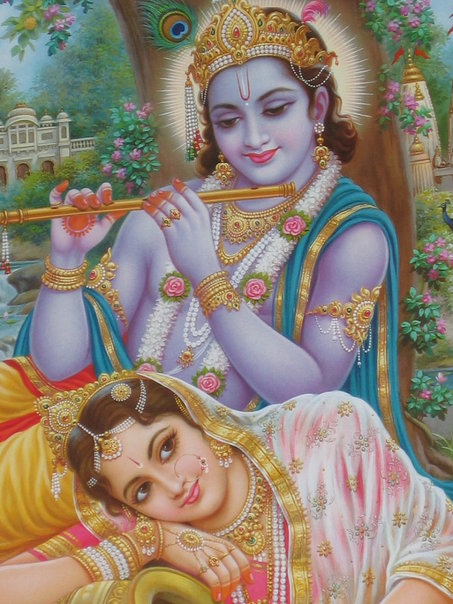
Once Srimati Radharani woke up with a start.
She was next to Sri Krishna on the flower bedecked pastimes bed – and looked
with deep questioning eyes into His eyes:
“O My beloved,” She asked, “I dreamt of someone extraordinarily – I am
ashamed to admit, He stole My heart. Could it be You, of whom I dreamt – but
in a different form? It must be!”
Krishna was smiling: “Tell Me more.”
More
Previous Older Entries Next Newer Entries










 The Hare Krishna Movement