Excerpted from Back to Godhead Magazine 1975 Vol. 10 No. 2
Five hundred years ago, Sri Krsna, the Supreme Personality of Godhead, appeared in West Bengal in the role of His own pure devotee—Sri Krsna Caitanya Mahaprabhu. Lord Caitanya is considered the most munificent incarnation of Godhead because He made love for Krsna easily available through the chanting of the maha-mantra—Hare Krsna, Hare Krsna, Krsna Krsna, Hare Hare/ Hare Rama, Hare Rama, Rama Rama, Hare Hare.
When Lord Krsna appeared as Lord Caitanya, His principal associate in spreading the Krsna consciousness movement was Lord Nityananda Prabhu. Lord Nityananda is Lord Caitanya’s expansion. In other words, He is nondifferent from Lord Caitanya. The same Supreme Lord appeared in different forms—as Lord Caitanya and Lord Nityananda—to bestow mercy upon the fallen souls of the material world. This song, therefore, describes the benefits of taking shelter of Lord Nityananda Prabhu.
Srila Narottama dasa Thakura was a great devotee and spiritual master in the disciplic chain coming down from Lord Caitanya. He has written many songs, and they are recognized as authoritative by all Krsna conscious devotees. He sang these songs in simple Bengali language, but the purport—the deep meaning of his songs—is very significant. His Divine Grace A.C. Bhaktivedanta Swami Prabhupada has therefore explained many of these songs in English and taught them to his disciples. (Cassette recordings of Srila Prabhupada singing and explaining these songs are available from Golden Avatar Productions in Los Angeles.)
…Sometimes an ever-liberated personal associate of the Supreme Personality of Godhead descends into this universe just as the Lord descends. Although working for the liberation of conditioned souls, the messenger of the Supreme Lord remains untouched by the material energy. Generally ever-liberated personalities live in the spiritual world as associates of Lord Kṛṣṇa, and they are known as kṛṣṇa-pāriṣada, associates of the Lord. Their only business is enjoying Lord Kṛṣṇa’s company, and even though such eternally liberated persons come within this material world to serve the Lord’s purpose, they enjoy Lord Kṛṣṇa’s company without stoppage. The ever-liberated person who works on Kṛṣṇa’s behalf enjoys Lord Kṛṣṇa’s company through his engagement.
… The conditioned soul subjected to the threefold material miseries is ceaselessly kicked by māyā, and this is his disease. If by chance he meets a saintly person who works on Kṛṣṇa’s behalf to deliver conditioned souls, and if he agrees to abide by his order, he can gradually approach the Supreme Personality of Godhead, Kṛṣṇa.(from purport to Madhya-lila 22.14-15)
The following article I found very interesting. It is very informative, and is worth reprinting here.
The Samurai: Protectors of the Cow by Jahnava Nitai das
If I were to tell you, that once, no other country, save India, revered the cow as much as Japan, I could understand your disbelief. Today, we think of Japan as a meat-eating culture. However, this image is a product of the last 150 years of American influence. The traditional Japanese culture held the cow as the most sacred animal. What follows next is the true story of among the greatest protectors of the cow – the Samurai.
In The Footsteps Of The Buddha
When Buddhism left India for the Far East it had a profound influence on all of the countries it encountered including China, Korea and Japan. Buddhism entered Japan around the year 552 A.D. In April 675 A.D. the Japanese Emperor Tenmu banned the consumption of all meat from four legged animals including cows, horses, dogs, and monkeys, as well as domestic birds such as chickens and roosters. Each succeeding emperor would periodically reinforce this ban until by the 10th Century all meat eating had been eliminated.
In mainland China and Korea the Buddhist monks adhered to the principle of ‘ahimsa’ or non-violence in their eating habits but theses strictures were not placed on the population as a whole. In Japan, however, the Emperor was very strict in guiding his subjects towards the Buddha’s teachings of non-violence. The killing of mammals was considered extremely sinful, birds moderately sinful, and fish somewhat sinful. The Japanese did eat whale, which today we know are mammals, but at the time were considered very large fish.
The Japanese also made a distinction between animals reared in the household and wild animals. To kill a wild animal such as a bird was sinful. However, to kill an animal raised from birth was considered abominable – tantamount to killing a member of the family. As such, the diet of the Japanese was mostly rice, noodles, fish, and on occasion wild fowl.
Last night as I was falling asleep, this prayer just popped into my head:
SRI RUPA PRANAMA
sri-caitanya-mano-‘bhistam sthapitum yena bhtu-tale svayam rupah kada mahyam dadati sva-padantikam
sri-caitanya-of Lord Caitanya; manah– mind; abhistam-what is desired; sthapitam-established; yena-by whom; bhu-tale-on the surface of the globe; svayam-himself; rupah-Srila Rupa Gosvami; kada-when; mahyam-unto me; dadati-will give; sva-his own; pada-lotus feet; antikam-proximity to.
When will Srila Rupa Gosvami Prabhupada, who has established within this material world the mission to fulfill the desire of Lord Caitanya, give me shelter under his lotus feet?
And as I drifted off to sleep I was thinking about Srila Rupa Goswami, I don’t know why. But I woke still thinking about him. The following is an article from Back to Godhead Magizine.
Obstacles on the Path of Eternity An Excerpt from Srila Rupa Gosvami’s Upadesamrta from Back to Godhead Magazine Vol. 1, No.88, 1973
[SRILA RUPA GOSVAMI was one of six exalted devotees especially chosen through the Krsna conscious chain of spiritual masters to teach the devotional service of the Supreme Lord in a scientific manner. Although all of these six great devotees were erudite scholars and prolific writers, Srila Rupa Gosvami is the most prominent, for he most greatly appreciated the nectar of Krsna consciousness. His Upadesamrta (Nectarean Instructions), a short work of only eleven verses, teaches the basic principles for arousing one’s dormant love of Krsna, the Supreme Lord. Written in Sanskrit some 400 years ago, it has now been translated into English, with an illuminating explanation of each verse, by His Divine Grace A.C. Bhaktivedanta Swami Prabhupada.]
The following is one of the most quoted verses by Srila Prabhupada, from the Srimad Bhagavatam, and it is also one of the longest purports as well. Very important verse!
śrī-prahrādaḥ uvāca—Prahlāda Mahārāja said; śravaṇam—hearing; kīrtanam—chanting; viṣṇoḥ—of LordViṣṇu (not anyone else); smaraṇam—remembering; pāda-sevanam—serving the feet; arcanam—offering worship (with ṣoḍaśopacāra, the sixteen kinds of paraphernalia); vandanaṁ—offering prayers; dāsyam—becoming the servant; sakhyam—becoming the best friend; ātma-nivedanam—surrendering everything, whatever one has; iti—thus; puṁsā arpitā—offered by the devotee; viṣṇau—unto Lord Viṣṇu (not to anyone else); bhaktiḥ—devotional service; cet—if; nava-lakṣaṇā—possessing nine different processes; kriyeta—one should perform; bhagavati—unto the Supreme Personality of Godhead; addhā—directly or completely; tat—that; manye—I consider; adhītam—learning; uttamam—topmost.
Prahlāda Mahārāja said: Hearing and chanting about the transcendental holy name, form, qualities, paraphernalia and pastimes of Lord Viṣṇu, remembering them, serving the lotus feet of the Lord, offering the Lord respectful worship with sixteen types of paraphernalia, offering prayers to the Lord, becoming His servant, considering the Lord one’s best friend, and surrendering everything unto Him (in other words, serving Him with the body, mind and words)—these nine processes are accepted as pure devotional service. One who has dedicated his life to the service of Kṛṣṇa through these nine methods should be understood to be the most learned person, for he has acquired complete knowledge.
When Prahlāda Mahārāja was asked by his father to say something from whatever he had learned, he considered that what he had learned from his spiritual master was the best of all teachings…(from purport)
O son of Kuntī [Arjuna], I am the taste of water, the light of the sun and the moon, the syllable om in the Vedic mantras; I am the sound in ether and ability in man.(Bg 7.8)
“Water is our life. So when you take water, quench your thirst, you can immediately thank God because that taste is God. So immediately you can remember, “O my dear Lord, You have created so nice thing, water. Oh, I am so thirsty. It is quenching my thirst. Thank You.” Is it very difficult? But the nonsense, they will not do even this. They’ll say, “Oh, God is dead.” Therefore we are suffering. We are so ungrateful that we even do not give thanks. In the ordinary way, if somebody gives me a glass of water when I am thirsty—it is etiquette—I say, “Thank you.” And God has given us so vast mass of water in the ocean, in the sea, in the sky. Without water we cannot live. There is no thanksgiving. There is no thanksgiving.” (Śrīla Prabhupāda, 68/08/20 – Lecture SB 07.09.12-13 – Montreal)
Recently I was staying at a friends house, and in the room where I was spending the night there was one book by Giriraj Swami entitled “Watering the Seed”. I happened to open it and began reading from the Preface:
…from that first meeting with Srila Prabhupada, my whole life’s purpose became to bring people to meet Srila Prabhupada. And I was able to do that for many years. But when he passed away, I wondered ‘what will be my service now?’. My whole service had been to bring people to Srila Prabhupada.
Now I understand that Srila Prabhupada is always present, and that by speaking of him, hearing about him, remembering him, and, most significantly, by studying his books and following his instructions, we can experience his presence. So I can continue doing what I was doing when he was personally present-introducing soul’s to Srila Prabhupada-and that is what I feel most natural doing. Because I know that somehow or other, if someone comes in touch with Srila Prabhupada, his life will become successful. (Watering the Seed, Preface)
Now, I am always encouraged when I hear my Godbrothers speaking in this way, because this is how I have always felt, and continue to feel. That my main purpose, as a disciple, is to bring people to Srila Prabhupada, and there-by bringing them to Krishna.
Sometime ago, I ran across this wonderful web site Prabhupada.io. It has it all, images, text, conversations, lectures, letters, etc. It is truly an Archive of Srila Prabhupada’s Original unedited words. Highly Recommended!
Building a Sacred Digital Archive for the Next 10,000 Years
The path to creating Prabhupada.io began with a simple recognition: Srila Prabhupada’s teachings are not merely books—they are eternal law books that deserve preservation and accessibility for millennia to come.
The Vision: A True Digital Archive
What distinguishes a true digital archive from a mere collection of files? It requires, among other things:
Comprehensive indexing that reveals the interconnected web of spiritual knowledge
Clean, searchable source texts extracted with care from the original works
Intuitive navigation that serves both newcomers and scholars
Open accessibility that removes barriers between seekers and sacred wisdom
Future-proof architecture built to endure for generations
Question: How Many Persons are Benefitted from Book Distribution?…………
Prabhupada: Whoever gets a book is benefitted. If he reads the book he is benefitted still more, or if he gives the book to someone else for reading, both he and the other person is benefitted. Even if one does not read the book but simply holds if and sees it, he is benefitted. If he simply gives small donation towards the work of Krsna consciousness he is benefitted. And anyone who distributes these transcendental literatures, he is also benefitted. ( Letter to: German Disciples — Bombay May 6, 1977)
Thank you to whoever posted this on Facebook. I didn’t catch the name of person posting this, but this is real good!
THE BHAGAVAD GITA IN TEN POINTS On July 13, 1947 Srila Prabhupada wrote a letter to Raja Mohendra Pratap and explained the Bhagavad-gita to him in ten points. The following is Srila Prabhupada’s summary of ten conclusions in the Bhagavad-gita.
1) God is one and everything is in Him and He is in everything.
2) To render transcendental service unto God is to serve everything that be, just like to water the root of the tree is to water the different branches and numerous leaves of the tree or to supply food to the stomach is to vitalize all the senses and the sense organs of the body.
3) The parts are automatically served when the Whole is served but when the parts are served the whole may not be served or not served at all.
4) The parts and the Whole being eternally related, it is the eternal duty of the parts to render service unto the Whole.
5) A recipient of the services of the parts, God’s sat-cit-ananda vigraha, i.e., the all-attractive Cognizant and all-blissful Personality eternal. He can reveal Himself by His own potency without any help of the external potency called maya in order to be cognizable by the limited potency of the parts and as such He is not only the greatest of all but he is the smallest of all. That is His prerogative.
6) He is better realized when He by His causeless mercy agrees to descend in this mortal world but He is never realized by the partial speculations of the empiric philosophers, however systematic and long-termed it may be.
7) Sri Krishna is the Personality of Godhead and is the Summum Bonum Cause of all Causes proved by fact and figures in the statement of Bhagavad-gita, but He reserves the right of not being exposed to the sensual speculations of the empiric philosophers.
One should therefore surrender unto Him if one wants to know Him as He is and that is the real process to approach the Infinite by the infinitesimals.
9) Sri Krishna is easily available by the religion of love, i.e., by love and service as conceived by the damsels of Vraja who had practically no education whatsoever and much less any claim for high class birthright.
10) The highest service that can be rendered to the mankind is, therefore, to preach the philosophy and religion of Bhagavad-gita for all the times, all the places and all the people.
That supreme abode is called unmanifested and infallible, and it is the supreme destination. When one goes there, he never comes back. That is My supreme abode. (Bhagavad-gita 8.21)
Purport
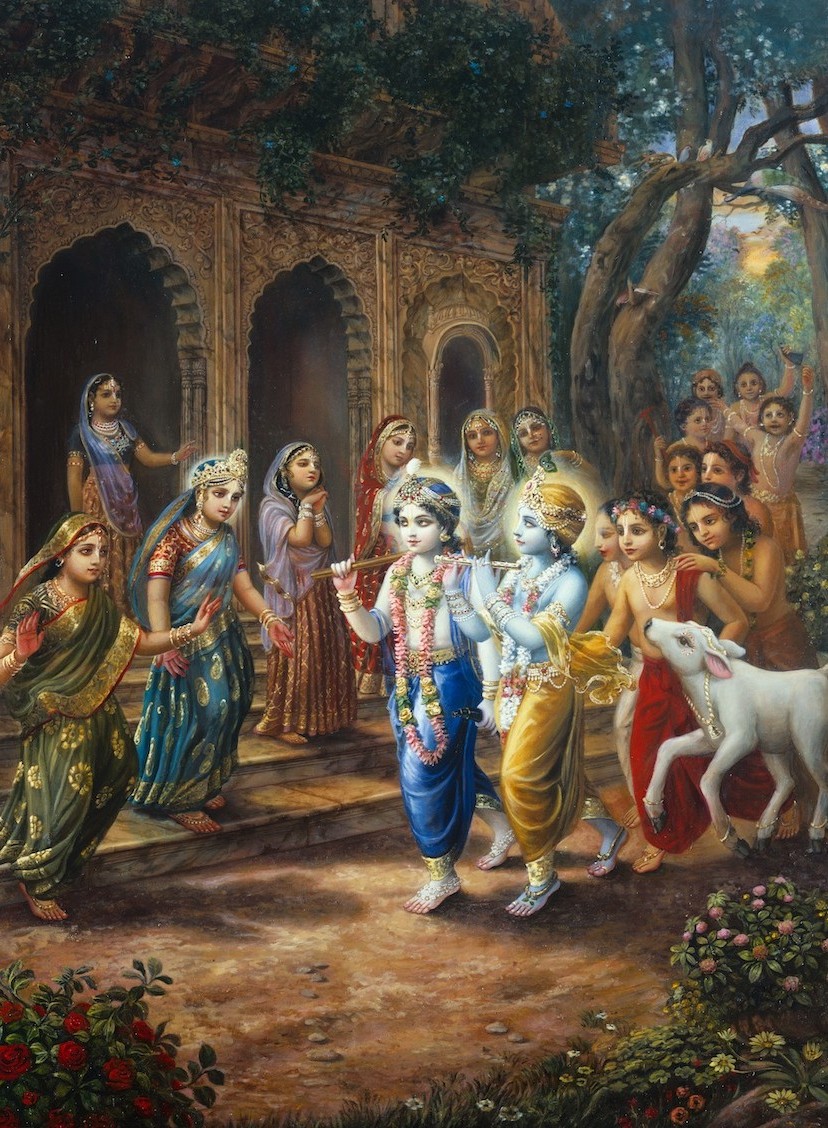
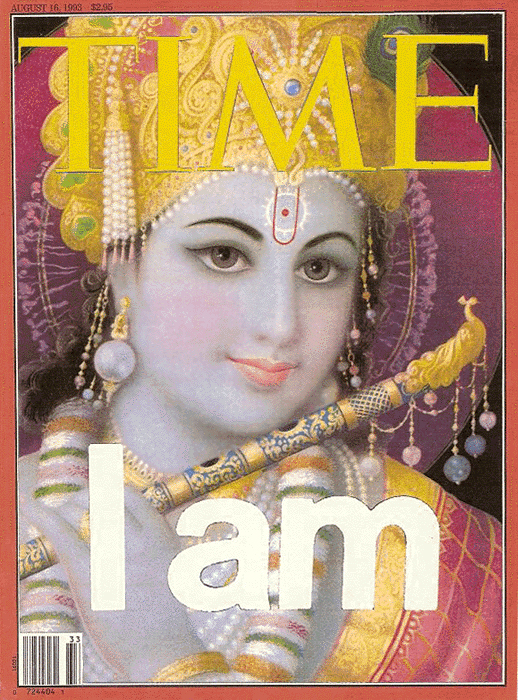
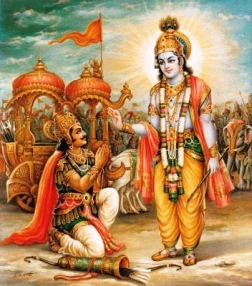
The supreme abode of the Personality of Godhead, Kṛṣṇa, is described in the Brahma-saṁhitā as cintāmaṇi-dhāma, a place where all desires are fulfilled. The supreme abode of Lord Kṛṣṇa known as Goloka Vṛndāvana is full of palaces made of touchstone. There are also trees which are called “desire trees” that supply any type of eatable upon demand, and there are cows known as surabhi cows which supply a limitless supply of milk. In this abode, the Lord is served by hundreds of thousands of goddesses of fortune (Lakṣmīs), and He is called Govinda, the primal Lord and the cause of all causes. The Lord is accustomed to blow His flute (venum kvanantam). His transcendental form is the most attractive in all the worlds—His eyes are like the lotus petals and the color of His body like clouds. He is so attractive that His beauty excels that of thousands of cupids. He wears saffron cloth, a garland around His neck and a peacock feather in His hair. In the Gītā Lord Krṣṇa gives only a small hint of His personal abode (Goloka Vṛndāvana) which is the supermost planet in the spiritual kingdom. A vivid description is given in the Brahma-saṁhitā. Vedic literature states that there is nothing superior to the abode of the Supreme Godhead, and that that abode is the ultimate destination. When one attains to it, he never returns to the material world. Kṛṣṇa’s supreme abode and Kṛṣṇa Himself are non different, being of the same quality. On this earth, Vṛndāvana, ninety miles southeast of Delhi, is a replica of that supreme Goloka Vṛndāvana located in the spiritual sky. When Kṛṣṇa descended on this earth, He sported on that particular tract of land known as Vṛndāvana in the district of Mathurā, India.
Happy New Year to all are readers. Wishing you all a prosperous new year filled with happiness and love. And may your Krishna Consciousness increase with each passing day.
When I think of New Years, I am reminded of what a short time a year is in the greater scheme of eternity. In the Bhagavad-gita there is a brief description of the duration of time in the material universe.
…The duration of the material universe is limited. It is manifested in cycles of kalpas. A kalpa is a day of Brahmā, and one day of Brahmā consists of a thousand cycles of four yugas or ages: Satya, Tretā, Dvāpara, and Kali. The cycle of Satya is characterized by virtue, wisdom and religion, there being practically no ignorance and vice, and the yuga lasts 1,728,000 years. In the Tretā-yuga vice is introduced, and this yuga lasts 1,296,000 years. In the Dvāpara-yuga there is an even greater decline in virtue and religion, vice increasing, and this yuga lasts 864,000 years. And finally in Kali-yuga (the yuga we have now been experiencing over the past 5,000 years) there is an abundance of strife, ignorance, irreligion and vice, true virtue being practically nonexistent, and this yuga lasts 432,000 years. (from purport Bg 8.17)
Even if I could grasp the extent of time in the material universe, that is just a fraction of the unlimited eternal time that continues after the termination of the yuga.
…Then the process is set rolling again. These four yugas, rotating a thousand times, comprise one day of Brahmā, the creator god, and the same number comprise one night. Brahmā lives one hundred of such “years” and then dies. These “hundred years” by earth calculations total to 311 trillion and 40 million earth years. By these calculations the life of Brahmā seems fantastic and interminable, but from the viewpoint of eternity it is as brief as a lightning flash. In the causal ocean there are innumerable Brahmās rising and disappearing like bubbles in the Atlantic. Brahmā and his creation are all part of the material universe, and therefore they are in constant flux. (from purport Bg 8.17)
The above calculations Srila Prabhupada uses and I quote;
…seems fantastic and interminable, but from the viewpoint of eternity it is as brief as a lightning flash.







 The Hare Krishna Movement