Protectors of the Cow

samurai_04

The following article I found very interesting. It is very informative, and is worth reprinting here.

The Samurai: Protectors of the Cow
by Jahnava Nitai das

If I were to tell you, that once, no other country, save India, revered the cow as much as Japan, I could understand your disbelief. Today, we think of Japan as a meat-eating culture. However, this image is a product of the last 150 years of American influence. The traditional Japanese culture held the cow as the most sacred animal. What follows next is the true story of among the greatest protectors of the cow – the Samurai.

In The Footsteps Of The Buddha

When Buddhism left India for the Far East it had a profound influence on all of the countries it encountered including China, Korea and Japan. Buddhism entered Japan around the year 552 A.D. In April 675 A.D. the Japanese Emperor Tenmu banned the consumption of all meat from four legged animals including cows, horses, dogs, and monkeys, as well as domestic birds such as chickens and roosters. Each succeeding emperor would periodically reinforce this ban until by the 10th Century all meat eating had been eliminated.

In mainland China and Korea the Buddhist monks adhered to the principle of ‘ahimsa’ or non-violence in their eating habits but theses strictures were not placed on the population as a whole. In Japan, however, the Emperor was very strict in guiding his subjects towards the Buddha’s teachings of non-violence. The killing of mammals was considered extremely sinful, birds moderately sinful, and fish somewhat sinful. The Japanese did eat whale, which today we know are mammals, but at the time were considered very large fish.

The Japanese also made a distinction between animals reared in the household and wild animals. To kill a wild animal such as a bird was sinful. However, to kill an animal raised from birth was considered abominable – tantamount to killing a member of the family. As such, the diet of the Japanese was mostly rice, noodles, fish, and on occasion wild fowl.

More

Building a Sacred Digital Archive for the Next 10,000 Years

Sometime ago, I ran across this wonderful web site Prabhupada.io. It has it all, images, text, conversations, lectures, letters, etc. It is truly an Archive of Srila Prabhupada’s Original unedited words. Highly Recommended!

Building a Sacred Digital Archive for the Next 10,000 Years

The path to creating Prabhupada.io began with a simple recognition: Srila Prabhupada’s teachings are not merely books—they are eternal law books that deserve preservation and accessibility for millennia to come.

The Vision: A True Digital Archive

What distinguishes a true digital archive from a mere collection of files? It requires, among other things:

  • Comprehensive indexing that reveals the interconnected web of spiritual knowledge
  • Clean, searchable source texts extracted with care from the original works
  • Intuitive navigation that serves both newcomers and scholars
  • Open accessibility that removes barriers between seekers and sacred wisdom
  • Future-proof architecture built to endure for generations
More

The Gopis Enchanted by the Flute

Without a doubt, this is my favorite book ever. I never get tired of reading from the Krsna Book. It seems to get sweeter every time.

Krsna was very pleased with the atmosphere of the forest, where flowers bloomed and bees and drones hummed very jubilantly. While the birds, trees and branches were all looking very happy, Krsna, tending the cows and accompanied by Sri Balarama and the cowherd boys, began to vibrate His transcendental flute. After hearing the vibration, the gopis in Vrndavana remembered Him and began to talk amongst themselves about how nicely Krsna was playing His flute. When the gopis were describing the sweet vibration of Krsna’s flute’; they also remembered their pastimes with Him; thus their minds became disturbed, and they were unable to fully describe the beautiful vibrations. While discussing the transcendental vibration, they also remembered how Krsna dressed, decorated with a peacock feather on His head, just like a dancing actor, and with blue flowers pushed over His ear. His garment glowed yellow-gold, and He was garlanded with a vaijayanti necklace. Dressed in such an attractive way, Krsna filled up the holes of His flute with the nectar emanating from His lips. So they remembered Him, entering Vrndavana forest, which is always glorified by the footprints of Krsna and His friends.

More

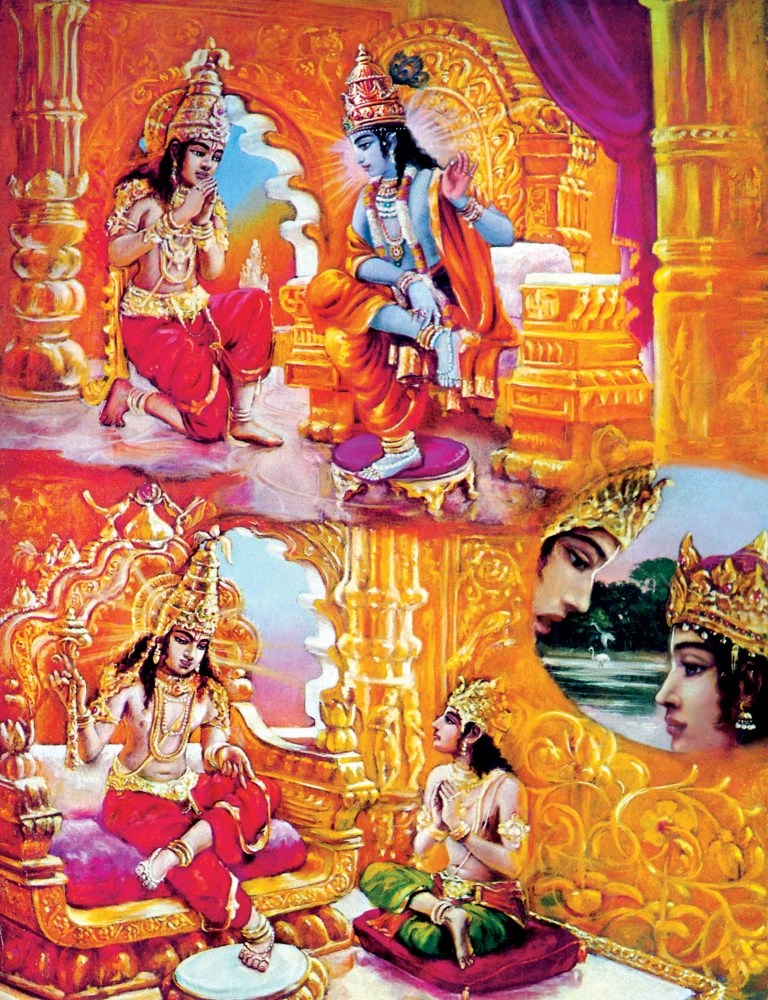
The Disciplic Succession

The Disciplic Succession

Those who are followers of His Divine Grace A.C. Bhaktivedanta Swami Prabhupada, and read from his books with faith and conviction, are receiving Transcendental Knowledge through the disciplic succession. Evaṁ paramparā-prāptam imaṁ rājarṣayo viduḥ. (Bhagavad-gīta, 4.2)

1) Kṛṣṇa, 2) Brahmā, 3) Nārada; 4) Vyāsa, 5) Madhva, 6) Padmanābha, 7) Nṛhari, 8) Mādhava, 9) Akṣobhya, 10) Jayatīrtha, 11) Jñānasindhu, 12) Dayānidhi, 13) Vidyānidhi, 14) Rājendra, 15) Jayadharma, 16) Puruṣottama, 17) Brahmaṇyatīrtha, 18) Vyāsatīrtha, 19) Lakṣmīpati, 20) Mādhavendra Purī, 21) Īśvara Purī, (Nityānanda, Advaita), 22) Lord Caitanya, 23) Rūpa (Svarūpa, Sanātana), 24) Raghunātha, Jīva, 25) Kṛṣṇadāsa, 26) Narottama, 27) Viśvanātha, 28) (Baladeva) Jagannātha, 29) Bhaktivinode, 30) Gaurakiśora, 31) Bhaktisiddhānta Sarasvatī, 32) His Divine Grace A. C. Bhaktivedanta Swami Prabhupāda.

Bhagavad-gita As It Is 1972 Edition
By His Divine Grace A.C. Bhaktivedanta Swami Prabhupada
Chapter Four, Text 1-2

More

Sri-guru-carana-padma (Sri Guru Puja)

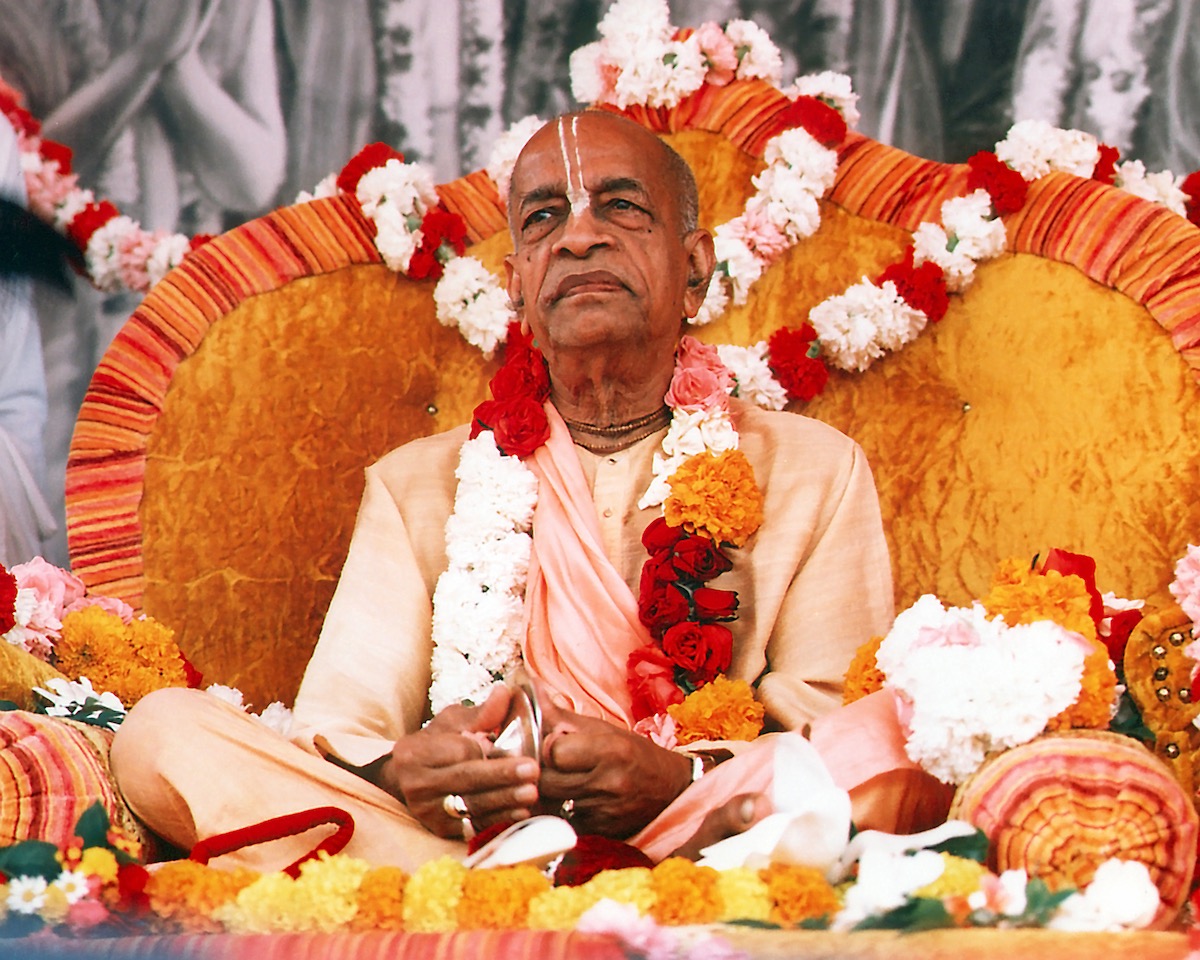
Bury Place Vyasasana

This is a very nice song composed by Narottama dasa Thakura, which is sung daily in all of the Hare Krishna Temples around the world. What is interesting about transcendental sound vibration, is that it never gets old. This song is as relishable today, as it was 50 years ago. Actually even more relishable, as the meaning of the words become more and more realized.

The lotus feet of our spiritual master are the only way by which we can attain pure devotional service. I bow to his lotus feet with great awe and reverence. By his grace one can cross the ocean of material suffering and obtain the mercy of Krsna

. My only wish is to have my consciousness purified by the words emanating from his lotus mouth. Attachment to his lotus feet is the perfection that fulfills all desires.

He opens my darkened eyes and fills my heart with transcendental knowledge. He is my Lord birth after birth. From him ecstatic prema emanates; by him ignorance is destroyed. The Vedic scriptures sing of his character.

Our spiritual master is the ocean of mercy, the friend of the poor, and the lord and master of the devotees. O master! Be merciful unto me. Give me the shade of your lotus feet. Your fame is spread all over the three worlds.

Full song with synonyms;

More

Tyranny and Tyrannical Rule

With all the political discussion going on this election year, I have been paying attention to some of the language. There are some words being used that I think I know, you know, words, we heard before, think we understand, but never actually took the time to look up in dictionary. Words like tyrant, autocracy, totalitarianism, liberality, etc. So this morning I took some time to look up the definition of some of these words. I began with the word “Tyranny”.

Dictionary definition

tyr-ran-ny

noun: tyranny; plural noun: tyrannies

  1. cruel and oppressive government or rule.

Similar:

absolutism, absolute power, autocracy, dictatorship, undemocratic rule, reign of terror, totalitarianism, Fascism, oppression, suppression, repression, subjugation, enslavement, authoritarianism, high-handedness, imperiousness, bullying, harshness, strictness, severity, cruelty, brutality, ruthlessness, injustice.

Opposite:

democracy, liberality

Simple definition: a government in which all power is in the hands of a single ruler. 2. : harsh, cruel, and severe government or conduct. 3. : a tyrannical act.

More

108 Imporant Slokas from the 1972 Bhagavad-gita As It Is

Click on image to go to Post

Click on image to go to Post

The Hare Krishna Cookbook

Songs of the Vaisnava Acaryas

Bhagavad-gita As It Is 1972 Edition “Online”

click on image

click on image to visit site

Srimad Bhagavatam Online

click on image

Raja-Vidya the King of Knowledge

click on image

click on image

Blog Stats

  • 4,590,982 hits

Enter your email address to subscribe to this blog and receive notifications of new posts by email.

Join 3,908 other subscribers

Important Slokas from the Brahma-samhita

click on image

click on image

Slokas from the Sri Isopanisad

click on image

click on image

Prayers By Queen Kunti (Slokas)

click on image

Gajendra’s Prayers of Surrender (Slokas)

click on image

A Short Statement of the Philosophy of Krishna Consciousness

click on image

click on image

July 9th Letter

click on image

click on image

The Hare Krishna Explosion

Reference Material/Study Guide

click on image

click on image

  • LINKS