The following is one of the most quoted verses by Srila Prabhupada, from the Srimad Bhagavatam, and it is also one of the longest purports as well. Very important verse!
śrī-prahrādaḥ uvāca—Prahlāda Mahārāja said; śravaṇam—hearing; kīrtanam—chanting; viṣṇoḥ—of LordViṣṇu (not anyone else); smaraṇam—remembering; pāda-sevanam—serving the feet; arcanam—offering worship (with ṣoḍaśopacāra, the sixteen kinds of paraphernalia); vandanaṁ—offering prayers; dāsyam—becoming the servant; sakhyam—becoming the best friend; ātma-nivedanam—surrendering everything, whatever one has; iti—thus; puṁsā arpitā—offered by the devotee; viṣṇau—unto Lord Viṣṇu (not to anyone else); bhaktiḥ—devotional service; cet—if; nava-lakṣaṇā—possessing nine different processes; kriyeta—one should perform; bhagavati—unto the Supreme Personality of Godhead; addhā—directly or completely; tat—that; manye—I consider; adhītam—learning; uttamam—topmost.
Prahlāda Mahārāja said: Hearing and chanting about the transcendental holy name, form, qualities, paraphernalia and pastimes of Lord Viṣṇu, remembering them, serving the lotus feet of the Lord, offering the Lord respectful worship with sixteen types of paraphernalia, offering prayers to the Lord, becoming His servant, considering the Lord one’s best friend, and surrendering everything unto Him (in other words, serving Him with the body, mind and words)—these nine processes are accepted as pure devotional service. One who has dedicated his life to the service of Kṛṣṇa through these nine methods should be understood to be the most learned person, for he has acquired complete knowledge.
When Prahlāda Mahārāja was asked by his father to say something from whatever he had learned, he considered that what he had learned from his spiritual master was the best of all teachings…(from purport)
Today I shall speak to you of the history of a boy devotee named Prahlāda Mahārāja. He was born in a family that was stubbornly atheistic. There are two kinds of men in this world: the demons and the demigods. What is the difference between them? The main difference is that the demigods, or godly persons, are devoted to the Supreme Lord, whereas the demons are atheistic. They do not believe in God because they are materialists. These two classes of men always exist in this world. At the present moment, due to the Age of Kali (Age of Quarrel), the number of demons has increased, but the classification has existed since the beginning of creation. The incident I am narrating to you occurred very, very long ago, a few million years after the time of creation.
Prahlāda Mahārāja was the son of the most atheistic person and the most materially powerful as well. Because the society was materialistic, this boy had no opportunity to glorify the Supreme Lord. The characteristic of a great soul is that he is very eager to broadcast glorification of the Supreme Lord. Lord Jesus Christ, for example, was very eager to broadcast the glorification of God, but demoniac people misunderstood him and crucified him.
For anyone following the election this year, I think we can all agree, it has been interesting to say the least. For a post today I went to the Srimad Bhagavatam, Seventh Canto, where Prahada began to speak to his friends and teachers about the glories of devotional service to the Supreme Lord…
Politics involves accepting one group of men as enemies and another group as friends. Everything in politics is based on this philosophy, and the entire world, especially at the present, is engrossed in it. The public is concerned with friendly countries and friendly groups or enemy countries and enemy groups, but as stated in Bhagavad-gītā, a learned person does not make distinctions between enemies and friends. Devotees, especially, do not create friends and enemies. A devotee sees that every living being is part and parcel of Kṛṣṇa (mamaivāṁśo jīva-bhūtaḥ [15.7]). Therefore a devotee treats friends and enemies equally by trying to educate them both in Kṛṣṇa consciousness. Of course, atheistic men do not follow the instructions of pure devotees, but instead consider a devotee their enemy. A devotee, however, never creates a situation of friendship and enmity. (from purport SB 7.5.3)
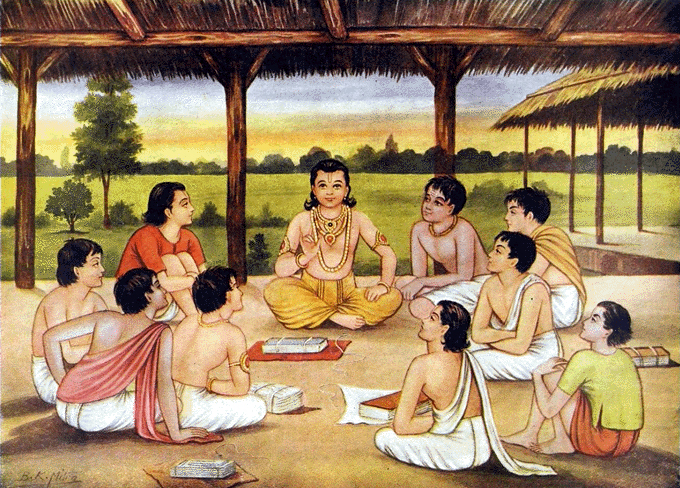
Although the teachers tried to educate the boy Prahlāda in politics, economics and other material activities, he did not care for their instructions. Instead, he continued to be a pure devotee. Prahlāda Mahārāja never liked the idea of discriminating between one’s friends and enemies. Because he was spiritually inclined, he was equal toward everyone. (from chapter summmary)
It seems that every time I start a new volume of the Srimad Bhagavatam, I open it and read the Preface first. I must have read the preface now many times, but every time I read it, it seems fresh and new. One could argue that it because my memory is poor, or, that is just the nature of transcendental literature. But what is interesting is to me this morning, is how I never looked up the verse that Srila Prabhupada quotes in his Preface:
This morning I was curious, so I went to the Seventh Canto, Chapter 6, Text 1, and it read:
Prahlāda Mahārāja said: One who is sufficiently intelligent should use the human form of body from the very beginning of life—in other words, from the tender age of childhood—to practice the activities of devotional service, giving up all other engagements. The human body is most rarely achieved, and although temporary like other bodies, it is meaningful because in human life one can perform devotional service. Even a slight amount of sincere devotional service can give one complete perfection.
Prahlāda Mahārāja said: Hearing and chanting about the transcendental holy name, form, qualities, paraphernalia and pastimes of Lord Viṣṇu, remembering them, serving the lotus feet of the Lord, offering the Lord respectful worship with sixteen types of paraphernalia, offering prayers to the Lord, becoming His servant, considering the Lord one’s best friend, and surrendering everything unto Him (in other words, serving Him with the body, mind and words)—these nine processes are accepted as pure devotional service. One who has dedicated his life to the service of Kṛṣṇa through these nine methods should be understood to be the most learned person, for he has acquired complete knowledge.
“Like father like son,” the saying goes. So how was it that the most sinister personality ever to darken the universe fathered a great saint?
Adapted from Srimad-Bhagavatam, translation and commentary
By His Divine Grace A.C. Bhaktivedanta Swami Prabhupada.
A vicious storm raged through the darkness. Pierce winds hissed again and again and uprooted gigantic trees. Thick clouds covered the sky, and lightning flashed as though laughing. The ocean with its high waves wailed as if stricken with sorrow. Jackals and dogs howled ominously, and birds flew shrieking from their nests. The twin demons Hiranyakasipu and Hiranyaksa were being born.
Day by day, year after year, they grew more powerful, more evil, and more dominant over all the other demons, who made alliances with them. Then, under the direction of Hiranyaksa and Hiranyakasipu, the demons set out to conquer the demigods, their archenemies and the administrators of the universe. In their war for universal power, the demons enjoyed many victories, but at last Lord Visnu [Krsna] Himself killed Hiranyaksa. His brother’s death overwhelmed Hiranyakasipu with grief and rage. He bit his lips and gazed upward with eyes whose blazing anger filled the sky with smoke. He took up his trident, glanced around fiercely, bared his terrible teeth, and began to speak to his demon friends.







 The Hare Krishna Movement