The Appearance of Lord Caitanya

The Appearance of Lord Caitanya

Lord Sri Caitanya Mahaprabhu is Krishna Himself, and He is teaching how to develop love of God by a very simple method…chanting the names of the Lord. Only five hundred years ago Lord Caitanya Mahāprabhu, prophesied that the Hare Kṛṣṇa mantra would resound throughout every town and village in the world. At a time when Western man was directing his exploratory spirit toward studying the physical universe and circumnavigating the globe, in India Śrī Caitanya was inaugurating and masterminding a revolution directed inward. His movement swept the subcontinent, gained millions of followers, and profoundly influenced the future of religious and philosophical thinking, both in India and the West. In the following talk, presented in November 1969 at London’s Conway Hall, Śrīla Prabhupāda describes the divine appearance of Śrī Caitanya.

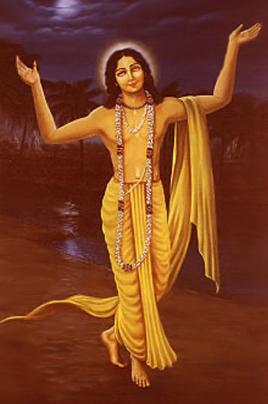
Śrī Caitanya Mahāprabhu, the golden avatāra, appeared in India nearly five hundred years ago. It is the custom in India that when a child is born, an astrologer is called for. When Lord Kṛṣṇa, the Supreme Personality of Godhead, appeared five thousand years ago, Gargamuni was called by His father, and he said, “This child formerly incarnated in three complexions, such as red and golden, and now He has appeared in blackish color.” Kṛṣṇa’s color is described in the scriptures as blackish, just like the color of a cloud. Lord Caitanya is understood to be Kṛṣṇa appearing in golden complexion.

There is much evidence in Vedic literature that Caitanya Mahāprabhu is an incarnation of Kṛṣṇa, and this is confirmed by scholars and devotees. In the Śrīmad-Bhāgavatam it is confirmed that the incarnation of Kṛṣṇa, or God, in this present age, Kali-yuga, will always engage in describing Kṛṣṇa. He is Kṛṣṇa, but as a devotee of Kṛṣṇa He describes Himself. And in this age His bodily complexion will not be blackish. This means that it may be white, it may be red, or it may be yellow, because these four colors—white, red, yellow, and black—are the colors assumed by the incarnations for the different ages. Therefore, since the red, white, and blackish colors were already taken by former incarnations, the remaining color, golden, is assumed by Caitanya Mahāprabhu. His complexion is not blackish, but He is Kṛṣṇa.

More

The Transcendental Nature of the Holy Names of Krishna

The holy name of the Lord—Hare Kṛṣṇa, Hare Kṛṣṇa, Kṛṣṇa Kṛṣṇa, Hare Hare/ Hare Rāma, Hare Rāma, Rāma Rāma, Hare Hare—is a transcendental vibration because it comes from the transcendental platform, the supreme abode of Kṛṣṇa. Because there is no difference between Kṛṣṇa and His name, the holy name of Kṛṣṇa is as pure, perfect and liberated as Kṛṣṇa Himself.

“It is the transcendental nature of the holy names of Hare Kṛṣṇa, Hare Kṛṣṇa, Kṛṣṇa Kṛṣṇa, Hare Hare/ Hare Rāma, Hare Rāma, Rāma Rāma, Hare Hare to transport a man into spiritual madness. Anyone who sincerely chants this holy name very soon attains elevation to the platform of love of God and becomes mad after God. This madness arising from love of God is the first perfectional stage for a human being.”

Excerpted from; Teachings of Lord Caitanya
By His Divine Grace A. C. Bhaktivedanta Swami Prabhupāda
Chapter Eighteen, The Conversations with Prakāśānanda

…In this age of logic, argument and disagreement, the chanting of Hare Kṛṣṇa is the only means for self-realization. Because this transcendental vibration alone can deliver the conditioned soul, it is considered to be the essence of the Vedānta-sūtra. According to the material conception, there is duality between the name, form, quality, emotions and activities of a person and the person himself, but as far as the transcendental vibration is concerned, there is no such limitation, for it descends from the spiritual world. In the spiritual world there is no difference between the name of the person and the quality of the person. Of course in the material world there is a difference. Because the Māyāvādī philosophers cannot understand this, they cannot utter the transcendental vibration.

More

Sri Sri Siksastakam

Click on image to enlarge

Lord Caitanya’s Mission and Precepts
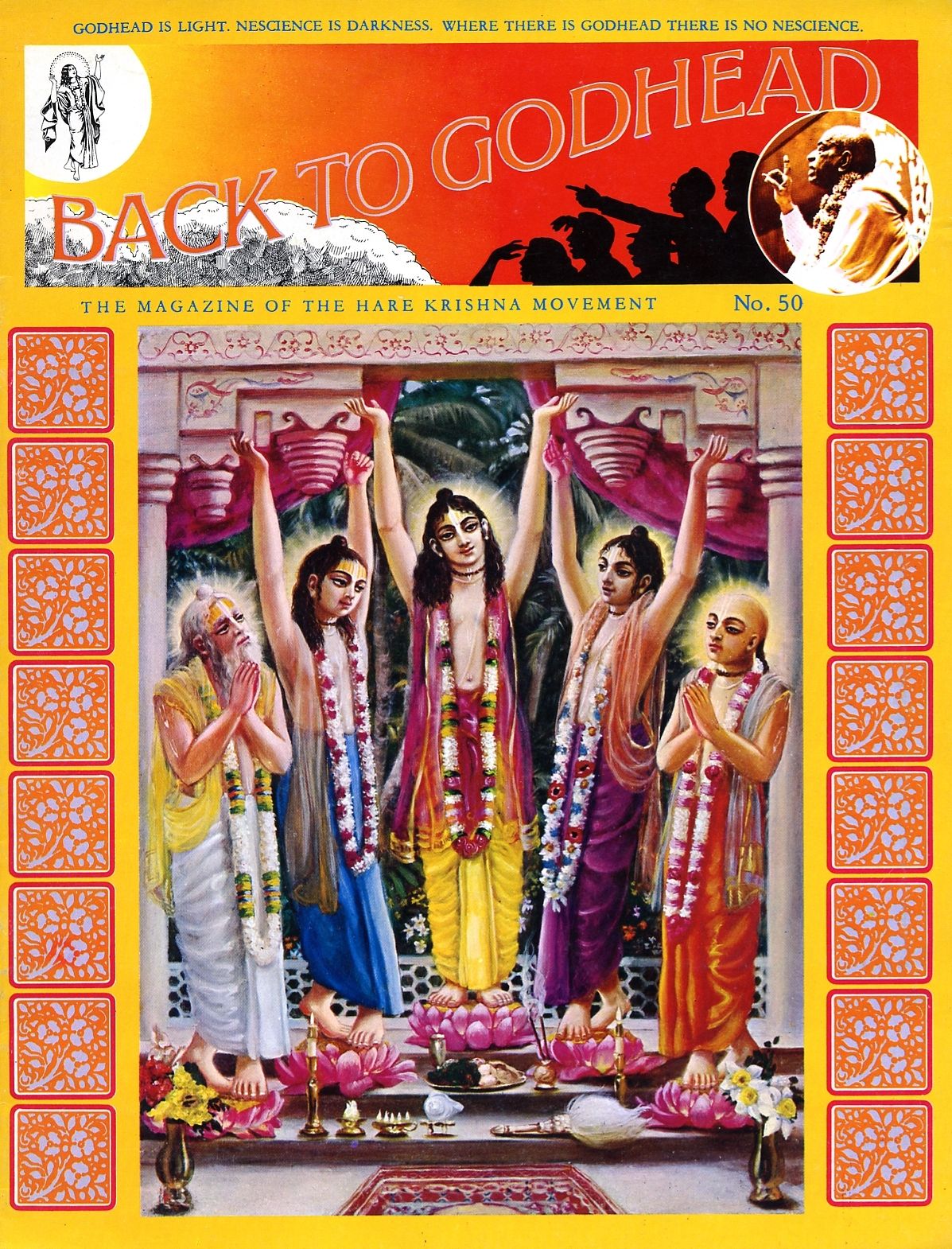
Excerpted from ‘Back To Godhead’ magazine, 1973 Vol. 1, No. 49 & 50

As foretold in Vedic scriptures, the Supreme Personality of Godhead appeared on earth 500 years ago in the form of Lord Caitanya, who is God Himself playing the role of a devotee of Godhead. The eight verses entitled Sri Sri Siksastakam, which were the only written instructions of Lord Caitanya, reveal the essence of the Krsna consciousness movement.

Sri Sri Siksastakam

by Sri Krsna Caitanya Mahaprabhu
translated by His Divine Grace A.C. Bhaktivedanta Swami Prabhupada
with purports by His Holiness Subaldasa Svami

1.
ceto-darpana-marjanam bhava-mahadavagni-nirvapanam
sreyah kairava-candrikavitaranam vidyavadhujivanam
anandambudhi-vardhanam pratipadam purnamrtasvadanam
sarvatma-snapanam param vijayate sri-krsna-sankirtanam

Translation

Glory to the Sri Krsna sankirtana, which cleanses the heart of all the dust accumulated for years and extinguishes the fire of conditional life, of repeated birth and death. This sankirtana movement is the prime benediction for humanity at large because it spreads the rays of the benediction moon. It is the life of all transcendental knowledge. It increases the ocean of transcendental bliss, and it enables us to fully taste the nectar for which we are always anxious.

More

The Ecstatic Dancing of the Lord at Ratha-yātrā

Śrī Caitanya-caritāmṛta: Madhya-līlā Text 1-69
By His Divine Grace A. C. Bhaktivedanta Swami Prabhupada

The Ecstatic Dancing of the Lord at Ratha-yātrā

May the Supreme Personality of Godhead, Śrī Kṛṣṇa Caitanya, who danced in front of the car of Śrī Jagannātha, be all glorified! By seeing His dancing, not only was the whole universe held in wonder, but Lord Jagannātha Himself became very much astonished.

All glories to Śrī Kṛṣṇa Caitanya and Prabhu Nityānanda! All glories to Advaitacandra! And all glories to the devotees of Lord Śrī Caitanya Mahāprabhu!

All glories to the listeners of Caitanya-caritāmṛta. Please hear the description of the dancing of Lord Caitanya Mahāprabhu at the Ratha-yātrā festival. His dancing is very enchanting. Please hear of it with great attention.

More

Disappearance Day of Srila Madhavendra Puri


Disappearance Day of Srila Madhavendra Puri

Madhavendra Puri appeared almost mad in his love of God. He loudly chanted and sang the names and glories of the Lord without thinking of the time or place. Sometimes in his ecstasy he didn’t know whether it was day or night. Sometimes he laughed and sometimes he wept. Sometimes he danced wildly and sometimes he fell to the ground unconscious. He took absolutely no interest in anything not connected with Krishna, and for fear of talking about anything other than the Lord, he always lived without a companion. He would eat only if someone offered him food—otherwise he would simply fast.

In many remarkable ways Krishna returned Madhavendra Puri’s intense love. Once Madhavendra was fasting and meditating beneath a tree in the forest of Vrindavana, where thousands of years before Krishna had played as a child. Suddenly a beautiful cowherd boy (gopala) came with a pot of milk and placed it before Madhavendra. “Please drink the milk I have brought you,” the boy said. Seeing the beauty of the boy, Madhavendra Puri became satisfied in his mind, and hearing these sweet words, he forgot all hunger and thirst. Then within an instant, the boy left the place and did not return. Madhavendra Puri’s heart was filled with wonder. Later, he realized who the boy actually was and cried out in; great ecstatic love: “I saw Lord Krishna directly—but I could not recognize I Him!”

Western religion usually teaches us that God is someone to fear and revere. In India, though, great spiritual masters have long taught that we can go beyond this limited conception and worship God as our master, friend, or child. And about five hundred years ago Madhavendra Puri taught that we can even worship God as our dear beloved.

More

Appearance Day of Srinivas Acarya

Appearance Day of Srinivas Acarya
(compiled by Gauridas Pandit dasa)

Appearance

In a small village of Chakhandi lived a pious Brahman names Gangadhar Bhattacharya and his wife Lakshmi-priya. Both were great devotees of Caitanya Mahaprabhu and Gangadhar was fortunate to witness the sannyasa ceremony of Mahaprabhu in Katwa. He returned filled with such love for Mahaprabhu that the villagers renamed him Caitanya Das. Later the childless couple traveled to Puri to serve Mahaprabhu, and here they received a benediction from Him to soon expect the birth of a great personality. Thus blessed, in the first decade of 1500, Shrinivas was born.

Youth

Shrinivas grew up to be the brightest, most beautiful and beloved boy of Chakhandi. He studied under the famed Dhananjaya Vidyavachaspati, who would later admit that there was nothing he could teach Shrinivas, “since the boy already knows more than I can ever hope to learn”. Due to his fame, Shrinivas came in contact with Narahari Sarakar, an intimate associate and devotee of Mahaprabhu. He accepted Narahari as an instructing guru and later approached him for initiation. Narahari however declined saying that it was Mahaprabhu’s will that he be initiated by Gopal Bhatta Goswami in Vrindavana. He also instructed Shrinivas to meet Mahaprabhu in Puri. On reaching Puri, he took shelter of Gadadhara Pandit, since Lord Chaitanya had already left the planet, to study the Bhagavatam under him. However the only copy of Bhagavatam in Puri had been rendered ineligible by the tears of ecstasy that Mahaprabhu and Gadadhara had shed while reading it. So Shrinivas returned to Bengal to procure the only other copy from Narahari. However by the time he returned, Gadadhara Pandit, unable to bear the separation with His Lord any more had also left the planet.

More

“Lord Caitanya-Life Force”


Caitanya Caritamrta Adi 7.1
Mayapur, March 1, 1974
Srila Prabhupada’s discourse follows below:

Pradyumna: Translation: “Let me first offer my respectful obeisances unto Lord Caitanya Mahaprabhu, who is the ultimate goal of life for one bereft of all possessions in this material world and is the only meaning for one advancing in spiritual life. Thus let me write about His magnanimous contribution of devotional service in love of God.”

Prabhupada:
agaty-eka-gatim natva
hinarthadhika-sadhakam
sri-caitanyam likhyate asya
prema-bhakti-vadanyata
[Cc. Adi 7.1]

So Sri Caitanya Mahaprabhu… This is the place of Sri Caitanya Mahaprabhu, appearance site of Sri Caitanya Mahaprabhu, Sridhama Mayapur. So in this place this is the appropriate literature, Sri-caitanya-caritamrta. We may try to discuss during these holy days. Last year some gentleman suggested, after seeing my all literatures, that “You kindly write a translation of Sri-Caitanya-caritamrta.”

More

A short sketch of the life and teachings of Lord Caitanya


A short sketch of the life and teachings of Lord Caitanya,
The Preacher of Śrīmad-Bhāgavatam
By His Divine Grace A.C. Bhaktivedanta Swami Prabhupada

Lord Śrī Caitanya Mahāprabhu, the great apostle of love of God and the father of the congregational chanting of the holy name of the Lord, advented Himself at Śrīdhāma Māyāpura, a quarter in the city of Navadvīpa in Bengal, on the Phālgunī Pūrṇimā evening in the year 1407 Śakābda (corresponding to February 1486 by the Christian calendar).

More

Next Newer Entries

108 Imporant Slokas from the 1972 Bhagavad-gita As It Is

Click on image to go to Post

Click on image to go to Post

The Hare Krishna Cookbook

Songs of the Vaisnava Acaryas

Bhagavad-gita As It Is 1972 Edition “Online”

click on image

click on image to visit site

Srimad Bhagavatam Online

click on image

Raja-Vidya the King of Knowledge

click on image

click on image

Blog Stats

  • 4,571,087 hits

Enter your email address to subscribe to this blog and receive notifications of new posts by email.

Join 3,906 other subscribers

Important Slokas from the Brahma-samhita

click on image

click on image

Slokas from the Sri Isopanisad

click on image

click on image

Prayers By Queen Kunti (Slokas)

click on image

Gajendra’s Prayers of Surrender (Slokas)

click on image

A Short Statement of the Philosophy of Krishna Consciousness

click on image

click on image

July 9th Letter

click on image

click on image

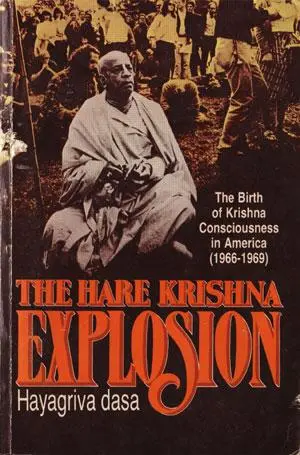
The Hare Krishna Explosion

Reference Material/Study Guide

click on image

click on image

  • LINKS