09 Oct 2013
by The Hare Krishna Movement
in A.C. Bhaktivedanta Swami Prabhupada, nitya siddha, Spiritual Master
Tags: A.C. Bhaktivedanta Swami Prabhupada, eternal associates, kripa siddha, letter to Mukunda das, nitya baddha, nitya siddha, nitya-siddhas, oil in water, oil on water, Padma Purana, sadhan siddha, Satyabhama, vain quotes
In my reading I came across the word siddha and nitya siddha. By now I should know what this word means, but still…I wanted some clarification. So I went to Vani Quotes and did a search. One of the best definitions I could find came from the following letter to Mukunda dasa:
Letter to Mukunda
by His Divine Grace A. C. Bhaktivedanta Swami Prabupada
New Vrindaban 10 June, 1969
…Your next question, whether the Spiritual Master was formerly a conditioned soul, actually a bona fide Spiritual Master is never a conditioned soul. There are three kinds of liberated persons. They are called 1) sadhan siddha, 2) kripa siddha, and 3) nitya siddha. Sadhan siddha means one who has attained perfection by executing the regulative principles of devotional service. Kripa siddha means one who has attained perfection by the special mercy of Krishna and the Spiritual Master, and nitya siddha means one who was never contaminated. The symptoms of nitya siddha is that from the beginning of his life he is attached to Krishna, and he is never tired of rendering service to Krishna. So we have to know what is what by these symptoms. But when one is actually on the siddha platform there is no such distinction as to who is sadhan, kripa, or nitya siddha. When one is siddha, there is no distinction what is what. Just like when the river water glides down to the Atlantic Ocean nobody can distinguish which portion was the Hudson River or some other river. Neither is there any necessity to make any such distinction. Actually, every living entity is eternally uncontaminated, although he may be in the material touch. This is the version of the Vedas. Asanga ayam purusha—the living entity is uncontaminated. Just like when there is a drop of oil in water you can immediately distinguish the oil from the water, and the water never mixes with the oil. Similarly, a living entity, although in material contact, is always distinct from the matter.
This was an amazing answer. For more on the meaning of nitya siddha More
08 Oct 2013
by The Hare Krishna Movement
in A.C. Bhaktivedanta Swami Prabhupada, Back to Godhead, Bhagavad-gita
Tags: A.C. Bhaktivedanta Swami Prabhupada, Arjuna, as it is, bhagavad-gita, Bhaktivedanta purports, Krishna, Lord Krsna, mental agonies, Puranas, Srila Prabhupada, Srimad Bhagavatam, Upanisads, Vedanta-sutras, Vedic literatures, Vedic wisdom

1973 Back to Godhead cover
This morning I was reading from the Srimad Bhagavatam Canto 1, Chapter 15, Text 27, wherein Srila Prabhupada was describing the glories and importance of the the Bhagavad-gita As It Is. The following is some excerpts from this amazing purport, followed by full text and purport. I found this one purport to be a very nice synopsis of the entire Bhagavad-gita As It Is.
…The Lord left behind Him the instructions of the Bhagavad-gītā not for the benefit of Arjuna alone, but also for all time and in all lands. The Bhagavad-gītā, being spoken by the Supreme Personality of Godhead, is the essence of all Vedic wisdom. It is nicely presented by the Lord Himself for all who have very little time to go through the vast Vedic literatures like the Upaniṣads, Purāṇas and Vedānta-sūtras.
…the Bhagavad-gītā can be consulted in all critical times, not only for solace from all kinds of mental agonies, but also for the way out of great entanglements which may embarrass one in some critical hour.
…The merciful Lord left behind Him the great teachings of the Bhagavad-gītā so that one can take the instructions of the Lord even when He is not visible to material eyesight.
…There is no difference between the sound representation of the Lord and the Lord Himself. One can derive the same benefit from the Bhagavad-gītā as Arjuna did in the personal presence of the Lord.
…The Bhagavad-gītā begins with the problems of life by discriminating the soul from the elements of matter and proves by all reason and argument that the soul is indestructible in all circumstances and that the outer covering of matter, the body and the mind, change for another term of material existence which is full of miseries. The Bhagavad-gītā is therefore meant for terminating all different types of miseries, and Arjuna took shelter of this great knowledge, which had been imparted to him during the Kurukṣetra battle. (from Purport to SB 1.15.27)
Full verse and purport More
08 Oct 2013
by The Hare Krishna Movement
in Radhika Stava, Rupa Goswami, Srimati Radharani
Tags: Gokula, Madhava, Radha, radha and krishna in swing, Radha Krishna, radhe jaya jaya madhava-dayite, Rupa Gosvami, Songs of the Vaisnava Acaryas, Srimati Radharani, the glory of Srimati Radharani

click on image to enlarge
Radhika Stava: the Glory of Srimati Radharani
by Srila Rupa Goswami
Glories, Glories to Sri Radharani, the beloved of Madhava and most worshipable of the the cowherd girls of Gokula Mandala!
Decorated by the dress of Lord Damodara’s increasing ecstasy, You are the lady of the house of Lord Hari and the groves of Vrndavana.
From the ocean of Vrsabhanu has arisen a new moon which is overwhelming the qualities of Lalita and Visakha.
O Goddess, Your qualities are described by Sanaka and Sanatana Rsis and by Sanatana Goswami. Please bestow your mercy upon me.
Full song in Sanskrit More
07 Oct 2013
by The Hare Krishna Movement
in Srila Prabhupada, Tilaka
Tags: gopi-candana, ornamentation of the soul, prabhupada putting on tilaka, sanctification and protection, tilak, tilaka, tilok
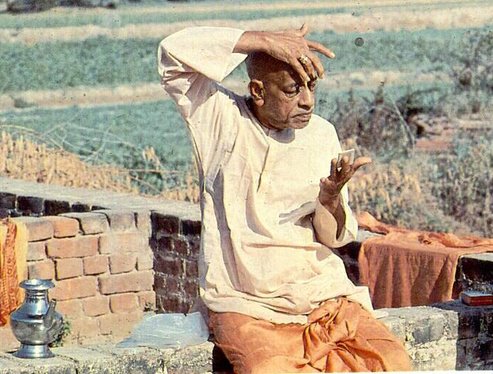
Putting on Tilaka
Tilaka is sometimes called the ornamentation of the spirit soul. The decoration, made by applying wet clay mixture, marks the body as a temple of Viṣṇu, the Supreme Lord. The Vaiṣṇava devotee marks his body in twelve places for sanctification and protection, and one who is wearing tilaka can at once be identified as a devotee of the Lord. Just as one can recognize that the strength of the government is behind a uniformed policeman, one can understand that the strength of God is behind a devotee marked with tilaka.
One should pour a little water into the palm of his/her left hand and rub gopī-candana (mud from Dvārakā) into it. When making tilaka the following mantra from the Uttara Khaṇḍa of the Padma Purāṇa should be chanted:
More
06 Oct 2013
by The Hare Krishna Movement
in A.C. Bhaktivedanta Swami Prabhupada, Bhagavad-gita, Dasya (Friendship), Srimad Bhagavatam
Tags: A.C. Bhaktivedanta Swami Prabhupada, Arjuna, awe and reverence, conjugal love, dasya, friendship, God is great, Krishna, neutral stage, parental affection, sakhya, santa-rasa, servitude, srngara, vatsalya

There are five basic relationships a devotee might have with the Lord; namely in the neutral stage (sānta-rasa), which is the stage of awe and reverence. Knowing that God is Great. Then there are four transcendental mellows (rasas); servitude (dāsya), friendship (sakhya), parental affection (vātsalya) and conjugal love (śṛṅgāra).
Kṛṣṇa and Arjuna are related in friendship.
Arjuna was in a relationship with the Lord as friend. Of course there is a gulf of difference between this friendship and the friendship found in the material world. This is transcendental friendship which cannot be had by everyone. Of course everyone has a particular relationship with the Lord, and that relationship is evoked by the perfection of devotional service. But in the present status of our life, we have not only forgotten the Supreme Lord, but we have forgotten our eternal relationship with the Lord. Every living being, out of many, many billions and trillions of living beings, has a particular relationship with the Lord eternally. That is called svarūpa. By the process of devotional service, one can revive that svarūpa, and that stage is called svarūpa-siddhi-perfection of one’s constitutional position. So Arjuna was a devotee, and he was in touch with the Supreme Lord in friendship. (from Introduction to Bhagavad-gita As It Is)
The following verse is one of my most favorite from the Bhagavad-gita As It Is.
I have in the past addressed You as “O Kṛṣṇa,” “O Yādava,” “O my friend,” without knowing Your glories. Please forgive whatever I may have done in madness or in love. I have dishonored You many times while relaxing or while lying on the same bed or eating together, sometimes alone and sometimes in front of many friends. Please excuse me for all my offenses.
I find this verse to be a beautiful expression of what is Bhakti Yoga. It is a personal loving exchange with the Lord. There are two ways to approach the Lord. One can approach the Lord with awe and reverence (sānta-rasa), or with a more personal approach; love and affection.
Kṛṣṇa’s devotees relate to Kṛṣṇa in various relationships.. Kṛṣṇa and Arjuna are related in friendship. As the father tolerates, or the husband or master tolerates, so Kṛṣṇa tolerates. Very Beautiful!
Bhagavad-gita As It Is Texts 40-45 More
04 Oct 2013
by The Hare Krishna Movement
in A.C. Bhaktivedanta Swami Prabhupada, Krsna Consciousness, Sri Caitanya-Caritamrta, The Reservoir of Pleasure
Tags: A.C. Bhaktivedanta Swami Prabhupada, Adi-lila 4.19, devotee, devotional service, natural affection, personal friend, pet son, Sri Caitanya-caritamrta, worship the lord with affection

“In whatever transcendental mellow My devotee worships Me, I reciprocate with him. That is My natural behavior. (Sri Caitanya-caritamrta Adi-lila 4.19)
…The Lord, by His inherent nature, reveals Himself before His devotees according to their inherent devotional service. The Vṛndāvana pastimes demonstrated that although generally people worship God with reverence, the Lord is more pleased when a devotee thinks of Him as his pet son, personal friend or most dear fiance and renders service unto Him with such natural affection. The Lord becomes a subordinate object of love in such transcendental relationships. (from purport)
Full verse and purport More
02 Oct 2013
by The Hare Krishna Movement
in A.C. Bhaktivedanta Swami Prabhupada, Arsha Prayoga, Book Changes, Book Distribution, Books by Srila Prabhupada, Quotes by Srila Prabhupada
Tags: A.C. Bhaktivedanta Swami Prabhupada, book changes, Book Distribution, do not change my books, grammatical discrepancy, instruction of the Supreme Personality of Godhead, not to change the ideas, quotes by Srila Prabhupada, Srila Prabhupada's books
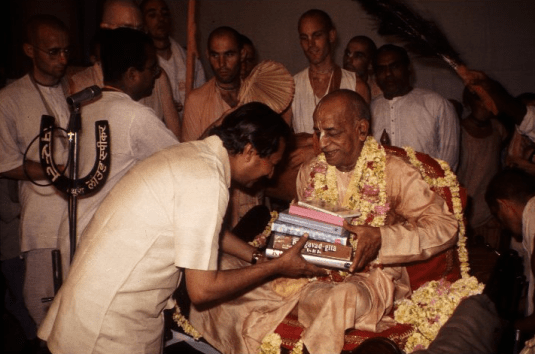
This is an older compilation of quotes and excerpts that first appeared on BookChanges.com back in 2009. I do not think one can overemphasize the importance of the Book Change issue.
For instance the way Arjuna accepted the Bhagavad-gita from Krsna was: “O Krishna, I totally accept as truth all that you have told me… ” [Bhagavad-gita 10.14]
This is the way of receiving transcendental knowledge.
Just this morning on Sampradaya Sun there was an article with this quote:
“Service means you must take order from the master. That is service. Otherwise it is mental concoction. Actually, the servant requests, “How can I serve you?” So when the master orders, “You serve me like this,” then you do that, that is service. And if you manufacture your service, that is not service. That is your sense gratification. Yasya prasādād bhagavat-prasādaḥ. You have to see how he is pleased. Now if he wants a glass of water and if you bring a nice glass of milk, you can say milk is better than water, you take it. That is not service. He wants water, you give him water. Don’t manufacture better thing.” (Lecture, Bhagavad-gita 15.15, August 5, 1976, New Mayapur, France)
So in the interest of preserving the words of our spiritual master we present this compilation of quotes. Some highlight editing has been done by me. -Vyasasan das
Srila Prabhupada on Editing His Books
Excerpted quotes by His Divine Grace A. C. Bhaktivedanta Swami Prabhupada
The Principle is No Change
“One should accept the instructions of the Supreme Personality of Godhead by bowing down at the lotus feet of the Lord. This means that anything spoken by the Personality of Godhead should be taken as it is, with great care and attention and with great respect. It is not our business to amend the words of the Supreme Personality of Godhead or make additions or alterations, as it has become a custom for many so-called scholars and swamis who comment on the words of Bhagavad-gita. Here the practical example of how to accept the instruction of the Supreme Personality of Godhead is shown by Prthu Maharaja. This is the way to receive knowledge through the parampara system.” (Purport SB 4.20.17)
More
01 Oct 2013
by The Hare Krishna Movement
in A.C. Bhaktivedanta Swami Prabhupada, Devotional Service, Teachings of Lord Kapila
Tags: A.C. Bhaktivedanta Swami Prabhupada, bhakti, Bharatavarsa, devotional service, hearing and chanting, India, Kapila, Krishna, Krsna, nine processes of devotional service, parampara system, sravanam kirtanam visnoh, Teachings of Lord Kapila, the son of devahuti, the supreme Lord

…We can understand the pastimes of the Lord by following one or some of the authorized devotional processes.
śravaṇaṁ kīrtanaṁ viṣṇoḥ
smaraṇaṁ pāda-sevanam
arcanaṁ vandanaṁ dāsyaṁ
sakhyam ātma-nivedanam
[SB 7.5.23]
“Hearing, chanting and remembering the holy name, form, pastimes, qualities and entourage of the Lord, offering service according to the time, place and performer, worshiping the Deity, offering prayers, always considering oneself the eternal servant of Kṛṣṇa, making friends with Him and dedicating everything unto Him—these are the nine processes of devotional service.” (Bhāg. 7.5.23)
…hearing and chanting, are the beginning of bhakti, devotional service. Therefore it is said: tāni me śraddadhānasya kīrtanyāny anukīrtaya. The word anukīrtaya means to follow the paramparā system… The Supreme Lord is more anxious to give us education and enlightenment than we are to receive them. He gives us His literature, His devotees and the paramparā system, but it is up to us to take advantage of these. The Kṛṣṇa consciousness movement is intended to give society the proper understanding of the Absolute Truth. We are not presenting a manufactured, bogus philosophy. Why should we unnecessarily waste our time concocting some philosophy? There is so much to be learned that has already been given by the supreme authority. All we have to do is take this Vedic literature, try to learn it and distribute it. That is Caitanya Mahāprabhu’s mission.
Teachings of Lord Kapila, the Son of Devahūti
By His Divine Grace A. C. Bhaktivedanta Swami Prabhupāda
Chapter Three, Text 3
Full chapter More
01 Oct 2013
by The Hare Krishna Movement
in Bhaktisiddhanta Sarasvati Thakura, Brahma-samhita, Krishna Consciousness
Tags: best dancer, Bhaktisiddhanta, Brahma-samhita, Govinda, holder of the flute, muralidhara, natavara, Syamasundara, tribhanga, triple bending

I worship Govinda, the primeval Lord, who is Śyāmasundara, Kṛṣṇa Himself with inconceivable innumerable attributes, whom the pure devotees see in their heart of hearts with the eye of devotion tinged with the salve of love. (Bs 5.38)
…The phrase “in their hearts” means Kṛṣṇa is visible in proportion as their hearts are purified by the practice of devotion. The sum and substance of this śloka is that the form of Kṛṣṇa, who is Śyāmasundara, Naṭavara (Best Dancer), Muralīdhara (Holder of the Flute) and Tribhaṅga (Triple-bending), is not a mental concoction but is transcendental, and is visible with the eye of the soul of the devotee under trance. (from purport)
Full Verse and purport More
Next Newer Entries







 The Hare Krishna Movement