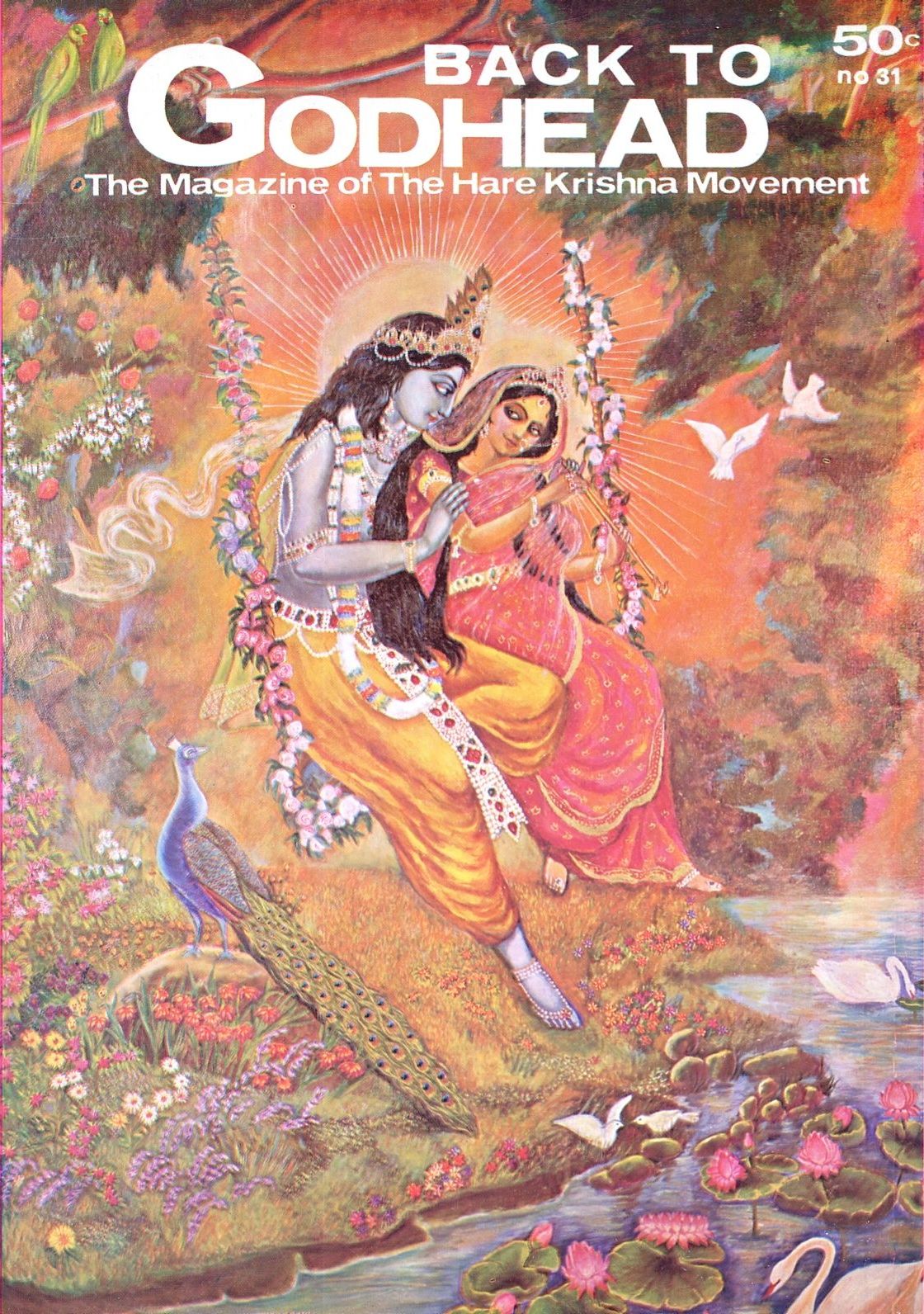
Gopinatha, Lord of the Gopis

click image to enlarge

Gopinatha, Lord of the Gopis
By Srila Bhaktivinoda Thakura

(1)
gopīnāth, mama nivedana śuno
viṣayī durjana, sadā kāma-rata,
kichu nāhi mora guṇa

O Gopinatha, Lord of the gopis, please hear my prayer, I am a materialistic rascal, always full of lust. I have no good qualifications.

(2)
gopīnāth, āmāra bharasā tumi
tomāra caraṇe, loinu śaraṇa,
tomāra kińkora āmi

O Gopinatha! You are my only resort. As Your eternal servant, I take shelter of Your Lotus feet.

(3)
gopīnāth, kemone śodhibe more
nā jāni bhakati, karme jaḍa-mati,
porechi soḿsāra-ghore

O Gopinatha! How can I uplift myself? I don’t know anything regarding devotional service, I am weak minded and have fallen into a pit of illusion.

(4)
gopīnāth, sakali tomāra māyā
nāhi mama bala, jñāna sunirmala,
swādīna nahe e kāyā

O Gopinatha! Everything here is but Your illusory energy. I have no power or pure knowledge, and I am bound by a material body.

More

A Call to Spiritual Life

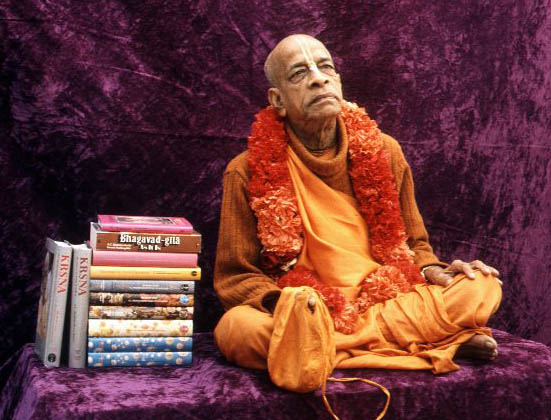
…So if we are serious, if we actually want to be happy, we must take to the cultivation of spiritual understanding, an understanding of Krsna consciousness. Of course, in every country of the world there is some religious system, some system for understanding spiritual life. But unfortunately, almost nobody is interested in spiritual life because people have been induced to become addicted to material, or sensual, activities. They are going further and further away from spiritual life and becoming more and more confused. Disappointment is rising all over the world.

So to mitigate this disappointment and confusion, one has to take to Krsna consciousness. Try to understand the philosophy of Krsna consciousness, and act accordingly. Then you will be happy.

A Call to Spiritual Life 

By His Divine Grace A.C. Bhaktivedanta Swami Prabhupada
An address given in September 1973 (upon arriving for his first visit in Stockholm).

Thank you very much for kindly receiving me on this first visit of mine to your country.

The Krsna consciousness movement is gradually spreading all over the world, but it is a little difficult to understand the purport of this movement because it is completely on the spiritual platform. Generally, people do not understand what the spiritual platform is. But it is quite simple. Every one of us every living being is a combination of two things: matter and spirit. Matter we can understand, but on account of our long association with matter we cannot understand what spirit is.

More

Transcendental Chanting of the Holy Name of the Lord

click on image to visit online store

…In this verse, Śrī Śukadeva Gosvāmī recommends the transcendental chanting of the holy name of the Lord. By offenseless chanting and hearing of the holy name of the Lord, one becomes acquainted with the transcendental form of the Lord, and then with the attributes of the Lord, and then with the transcendental nature of His pastimes, etc. Here it is mentioned that one should constantly chant the holy name of the Lord after hearing it from authorities. This means that hearing from the authorities is the first essential.

Anyone who hears Śrīmad-Bhāgavatam attentively from its bona fide reciter is sure to become a sincere devotee of the Lord, who is able to award liberation. There was none so attentive as Mahārāja Parīkṣit in the matter of hearing Śrīmad-Bhāgavatam, and there was none so qualified as Śukadeva Gosvāmī to recite the text of Śrīmad-Bhāgavatam. Therefore, anyone who follows in the footsteps of either the ideal reciter or the ideal hearer, Śukadeva Gosvāmī and Mahārāja Parīkṣit respectively, will undoubtedly attain salvation like them.

O King, constant chanting of the holy name of the Lord after the ways of the great authorities is the doubtless and fearless way of success for all, including those who are free from all material desires, those who are desirous of all material enjoyment, and also those who are self-satisfied by dint of transcendental knowledge.

Srimad Bhagavatam
By His Divine Grace A.C. Bhaktivedanta Swami Prabhupada
Second Canto, Chapter One, Text 10-11

The First Step in God Realization

More

Controversy Theory

…(At the Mayapur GBC meeting in 1977 Srila Prabhupada made their duty clear): The real thing is to somehow or other introduce these books… and in the long run that will be the real beneficial thing for the whole world. Now we are very much wanting to distribute full force and push book distribution without fear of public reaction… Our book distribution means that he has helped our attempt to expand the glorification of Krsna. Or if he is reading our book that is also glorification of Krsna… Our attempt is to awaken people to understand Krsna. There is no other way — hearing, glorifying Krsna through book distribution.

…the unique position of Srila Prabhupada — empowered to teach to the whole world the ultimate siddhanta as originally taught by the Supreme Lord Himself — is not carefully understood in his own movement, especially by those who were born after his disappearance. This, even though many of his disciples are still present. The result has been that newcomers in recent decades have inherited a poor fund of knowledge about Srila Prabhupada’s exalted position and his priorities for his ISKCON, notwithstanding abundant evidence of his unequalled accomplishments and documented instructions.
During his manifest presence devotees had a much clearer understanding, even though the movement, entirely new to them, was without the extensive facilities of temples, books, experienced adherents, etc., all of which are now the norm.

Controversy Theory
By Rupanuga das (ACBSP)
Jul 04, 2012 — JACKSONVILLE, FLORIDA, USA (SUN)

During a Bhagavatam lecture (1.16.11) January 8, 1974 in Los Angeles, Srila Prabhupada said, “There is a controversy among the Vaisnava community about Lord Caitanya Mahaprabhu, just as the Nimbarka Sampradaya, they say “We accept Lord Caitanya as a great devotee.” But the Gaudiya Sampradaya, we say that Lord Caitanya is the Supreme Personality of Godhead because it is stated in the Sastra.”

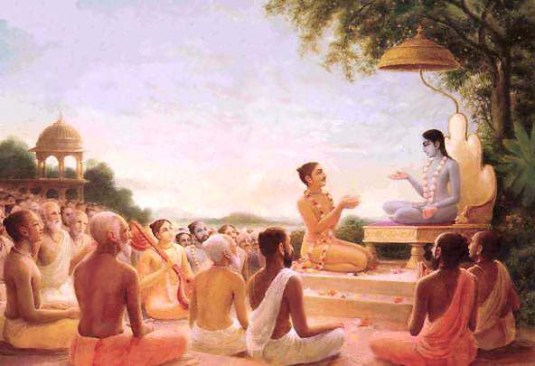
Lord Caitanya’s advent is predicted and described in many Sastras, including the Kurma Purana Padma Purana, Sama Veda, Visvasara Tantra, Jaimini-bharata, Visnu-yamala, Brahma-rahasya, et al. For example, in the Saura Purana it is said: “The Supreme Personality of Godhead appears in two forms. He is either dark Lord Krsna, who is always worshipped by all, or He is fair Lord Gaura, a brahmana who knows the meaning of all the Vedas.” And in the Matsya Purana: “In the Kali-yuga I will take birth in a place where three rivers meet. I will be fair and tall. I will have a shaven head. I will be very merciful. I will eagerly chant the Holy Names.”

Therefore, the authority and order of the Sastra is clear, Lord Caitanya is to be accepted as the Supreme Personality of Godhead. Yet, the controversy goes on because the sastra is either overlooked or ignored, both of which indicate a poor fund of knowledge.

More
Karma-Yoga


Bhagavad-gita As It Is – Macmillan 1972 Edition
By His Divine Grace A.C. Bhaktivedanta Swami Prabhupada
Chapter 3

TEXT 1
arjuna uvāca
jyāyasī cet karmaṇas te
matā buddhir janārdana
tat kiṁ karmaṇi ghore māṁ
niyojayasi keśava

arjunaḥ—Arjuna; uvāca—said; jyāyasī—speaking very highly; cet—although; karmaṇaḥ—than fruitive action; te—your; matā—opinion; buddhiḥ—intelligence; janārdana—O Kṛṣṇa; tat—therefore; kim—why; karmaṇi—in action; ghore—ghastly; mām—me; niyojayasi—engaging me; keśava—O Kṛṣṇa.

TRANSLATION

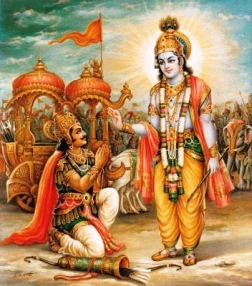
Arjuna said: O Janārdana, O Keśava, why do You urge me to engage in this ghastly warfare, if You think that intelligence is better than fruitive work?

PURPORT

The Supreme Personality of Godhead Śrī Kṛṣṇa has very elaborately described the constitution of the soul in the previous chapter, with a view to deliver His intimate friend Arjuna from the ocean of material grief. And the path of realization has been recommended: buddhi-yoga, or Kṛṣṇa consciousness. Sometimes Kṛṣṇa consciousness is misunderstood to be inertia, and one with such a misunderstanding often withdraws to a secluded place to become fully Kṛṣṇa conscious by chanting the holy name of Lord Kṛṣṇa. But without being trained in the philosophy of Kṛṣṇa consciousness, it is not advisable to chant the holy name of Kṛṣṇa in a secluded place where one may acquire only cheap adoration from the innocent public. Arjuna also thought of Kṛṣṇa consciousness or buddhi-yoga, or intelligence in spiritual advancement of knowledge, as something like retirement from active life and the practice of penance and austerity at a secluded place. In other words, he wanted to skillfully avoid the fighting by using Kṛṣṇa consciousness as an excuse. But as a sincere student, he placed the matter before his master and questioned Kṛṣṇa as to his best course of action. In answer, Lord Kṛṣṇa elaborately explained karma-yoga, or work in Kṛṣṇa consciousness, in this Third Chapter.

More

Next Newer Entries

108 Imporant Slokas from the 1972 Bhagavad-gita As It Is

Click on image to go to Post

Click on image to go to Post

The Hare Krishna Cookbook

Songs of the Vaisnava Acaryas

Bhagavad-gita As It Is 1972 Edition “Online”

click on image

click on image to visit site

Srimad Bhagavatam Online

click on image

Raja-Vidya the King of Knowledge

click on image

click on image

Blog Stats

  • 4,551,943 hits

Enter your email address to subscribe to this blog and receive notifications of new posts by email.

Join 3,910 other subscribers

Important Slokas from the Brahma-samhita

click on image

click on image

Slokas from the Sri Isopanisad

click on image

click on image

Prayers By Queen Kunti (Slokas)

click on image

Gajendra’s Prayers of Surrender (Slokas)

click on image

A Short Statement of the Philosophy of Krishna Consciousness

click on image

click on image

July 9th Letter

click on image

click on image

The Hare Krishna Explosion

Reference Material/Study Guide

click on image

click on image

  • LINKS