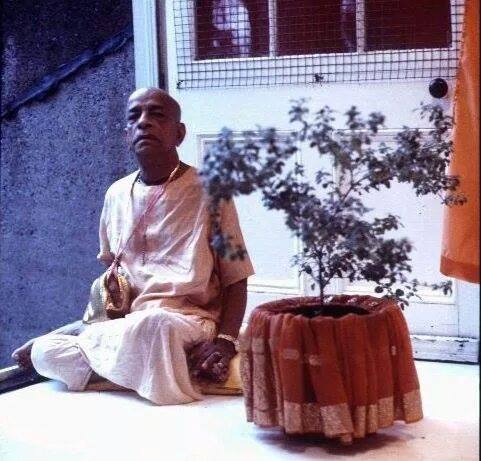
Prabhupada: Tulasi Devi is a pure devotee of Krishna and she should be treated with the same respect given to all Krishna’s pure devotees. Simply by worshiping her faithfully, a devotee can get himself free of from all material miseries. In the Nectar of Devotion I have given two verses from the Skanda Purana, one of which is: “Tulasi is auspicious in all respects. Simply by seeing, simply by touching, simply by remembering, simply by praying to, simply by bowing before, simply by hearing about, or simply by sowing the tree, there is always auspiciousness. Anyone who comes in touch with the Tulasi tree in the above mentioned ways lives eternally in the Vaikuntha world.” So from this verse we can understand how pure is the service which Tulasi offers to Sri Krishna. So we should always endeavor after becoming servant of Tulasi Devi. I do not know who has taught you that part of a Tulasi plant may be cut off and then replanted? From the Tulasi plant you can cut off only leaves for offering them to Krishna, never for cutting and planting. That is an offense. The manjaris (seeds) can be offered in water and it makes the water fragrant and tasteful. And the manjaris can be planted for growing new Tulasi plants. Yes, the prayer you have enclosed is bona fide. Tulasi Devi never goes back to Godhead, she is always with Godhead. She is a pure devotee and thus she has appeared on this planet to render service to Krishna by being offered in all temples throughout the world by being offered up to the lotus feet of Krishna. ( Letter to: Radhavallabha — Bombay 6 January, 1972)
Tulasi Devi
14 Oct 2023 Leave a comment
in A. C. Bhaktivedanta Swami Prabhupada, Tulasi Tags: letter by Srila Prabhupada, manjaris, pure devotee, Tulasi, Tulasi devi, tulasi plants
Sri Hamsadutta
20 Jul 2013 1 Comment
in Krishna, Kusakratha das, Rupa Goswami, Sri Hamsadutta, Srimati Radharani Tags: Akrura, ashoka flowers, Autumn, Autumn cloud, autumn evening pastimes, Balarama, bandhuka flower, bimba-fruit lips, bliss, buddha, cuckoo, dadamba flowers, Damodara, garments splendid as gold, Garuda, girimalli gflowers, gokulas's eyes, gopas, gopis, Govinda, jasmine vines, kadamba tree, kaliya lake, Kalki, Kamadeva, kaustubha jewel, king of the swans, Krishna, krishna's feet, kubja, Kurma, lalita, lord hari, Lord Krishna, lotus-faced one, lover of the gopis, madhuvana, manasa-sarovara, Matsya, Mount Kailasa, Mukunda, Nrisimha, peacock feather crown, peacock feathers, pillar arms, Radha, Radharani, Radhika, Ramacandra, rasa dance, rasa-lila, Sakara Mallika, shaphari fishes, shark earrings, silk garments, Srila Rupa Gosvami, swans, tamala tree, tilaka, Tulasi devi, tulasi leaves, Uddhava, Vamana, Varaha, vijayate, Vrindavana, Yamuna
This very beautiful translation of “Sri Hamsadutta” by Srila Rupa Goswami, is the work of His Grace Kusakratha prabhu (ACBSP).
Some of the literature, that Kuskratha Prabhu has translated, is so confidentially elevated that many devotees are not yet ready to grasp it. Nevertheless, these immortal works now stand as a vast body of reference material for the Vaisnava community to consult. Aside from accurately transmitting the words of the acaryas, Kusakratha has also rendered thousands of pages of glorification of Krishna through his personal English poetic composition. Some of these compositions have been published though many have not, as of yet.
More on Kuskratha Prabhu at bottom of post…but this is just a sampling of the Sri Hamsadutta before we post it here in its entirety.
May a certain blissful person in splendid yellow silk garments, the soles of His lotus feet glorious as a host of red roses, His form dark as a tamala tree, and His mouth playfully curved in a gentle smile, appear in my heart. (Text One)
Appearance of Sri Caitanya Mahaprabhu and the Glories of Srimati Tulasi
31 Jan 2013 Leave a comment
in Advaita Acarya, Caitanya Mahaprabhu, Chanting Hare Krishna, Sri Caitanya-Caritamrta, Srimati Tulasi Devi Tags: A.C. Bhaktivedanta Swami Prabhupada Sri Caitanya's descent, Advaita Acarya, appears by the desire of His devotee, Caitanya Mahaprabhu, protector of religion, srimati tulasi, tulasi buds in water from the ganges, Tulasi devi
…Whenever the Supreme Personality of Godhead descends in His human form, He sends ahead all His devotees, who act as His father, teacher and associates in many roles. Such personalities appear before the descent of the Supreme Personality of Godhead. Before the appearance of Lord Śrī Kṛṣṇa Caitanya Mahāprabhu, there appeared His devotees like Śrī Mādhavendra Purī; His spiritual master, Śrī Īśvara Purī; His mother, Śrīmatī Śacīdevī; His father, Śrī Jagannātha Miśra; and Śrī Advaita Ācārya.
Advaita Ācārya having appeared, He found the world devoid of devotional service to Śrī Kṛṣṇa because people were engrossed in material affairs.
Everyone was engaged in material enjoyment, whether sinfully or virtuously. No one was interested in the transcendental service of the Lord, which can give total relief from the repetition of birth and death.
Seeing the activities of the world, the Ācārya felt compassion and began to ponder how He could act for the people’s benefit.
[Advaita Ācārya thought:] “If Śrī Kṛṣṇa were to appear as an incarnation, He Himself could preach devotion by His personal example.
“In this Age of Kali there is no religion other than the chanting of the holy name of the Lord, but how in this age will the Lord appear as an incarnation?
“I shall worship Kṛṣṇa in a purified state of mind. I shall constantly petition Him in humbleness.
“My name, ‘Advaita,’ will be fitting if I am able to induce Kṛṣṇa to inaugurate the movement of the chanting of the holy name.”
“Śrī Kṛṣṇa, who is very affectionate toward His devotees, sells Himself to a devotee who offers Him merely a tulasī leaf and a palmful of water.”
Advaita Ācārya considered the meaning of the verse in this way: Not finding any way to repay the debt He owes to one who offers Him a tulasī leaf and water, Lord Kṛṣṇa thinks, “There is no wealth in My possession that is equal to a tulasī leaf and water.”
Thus the Lord liquidates the debt by offering Himself to the devotee. Considering this, the Ācārya began worshiping the Lord.
Thinking of the lotus feet of Śrī Kṛṣṇa, He constantly offered tulasī buds in water from the Ganges.
He appealed to Śrī Kṛṣṇa with loud calls and thus made it possible for Kṛṣṇa to appear.
Therefore the principal reason for Śrī Caitanya’s descent is this appeal by Advaita Ācārya. The Lord, the protector of religion, appears by the desire of His devotee.
Glories of Srimati Tulasi Devi
14 Jan 2011 Leave a comment
in Devotional Service, Krishna Consciousness Tags: devotees tulasi leaf, Srimati Radharani, Tulasi devi, Vrindavan
Glories of Srimati Tulasi Devi
By Bharath Singh
Srimati Tulasi devi is one of the most exalted devotees of Sri Krishna. All scriptures stress the importance of getting the mercy of Tulasi devi if one is to make progress on the path of devotion. In the Skanda Purana it is said:
“Tulasi is auspicious in all respects. Simply by seeing, simply by touching, simply by remembering, simply by praying to, simply by bowing before, simply by hearing about or simply by sowing this tree, there is always auspiciousness. Anyone who comes in touch with the Tulasi tree in the above-mentioned ways lives eternally in the Vaikuntha world.”
Above this material world is the eternal spiritual world comprised of millions of Vaikuntha planets. The topmost planet in Vaikuntha is Goloka, which is presided over by Sri Krishna in His original Form. Here resides Vrinda devi, an intimate associate of and an expansion of Srimati Radharani. Her partial expansion is Tulasi devi in the Vaikuntha planets and they are all considered non-different from Her. Five thousand years Ago, when Sri Krishna descended on Earth to perform His pastimes, Vrinda devi created the proper environment for His pastimes in Vrindavana.