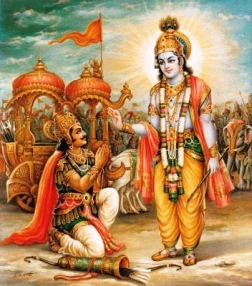
Lord Kṛṣṇa’s Transcendental Counchshell

Krsna's conchshell

This is a nice description of Lord Kṛṣṇa’s transcendental counchshell, and of how He was received by the citizens of Dvārakā. Beautiful!

Sūta Gosvāmī said: Upon reaching the border of His most prosperous metropolis, known as the country of the Ānartas [Dvārakā], the Lord sounded His auspicious conchshell, heralding His arrival and apparently pacifying the dejection of the inhabitants.

The white and fat-boweled conchshell, being gripped by the hand of Lord Kṛṣṇa and sounded by Him, appeared to be reddened by the touch of His transcendental lips. It seemed that a white swan was playing in the stems of red lotus flowers.

The citizens of Dvārakā, having heard that sound which threatens fear personified in the material world, began to run towards Him fast, just to have a long desired audience with the Lord, who is the protector of all devotees.

…The sound heralded by Lord Kṛṣṇa was something like the heralding of the sunrise in the morning. This sound of the Lord is identical with the Lord. We are always fearful due to our ignorance of the next problem. The whole material existence is full of problems, and thus the fear problem is always prominent. This is due to our association with the illusory energy of the Lord, known as māyā or external energy, yet all fear is vanished as soon as there is the sound of the Lord, represented by His holy name, as it was sounded by Lord Śrī Caitanya Mahāprabhu in the following sixteen words:

Hare Kṛṣṇa, Hare Kṛṣṇa, Kṛṣṇa Kṛṣṇa, Hare Hare
Hare Rāma, Hare Rāma, Rāma Rāma, Hare Hare

We can take advantage of these sounds and be free from all threatening problems of material existence.

SB 1.11.1-3 Full text and purport

More
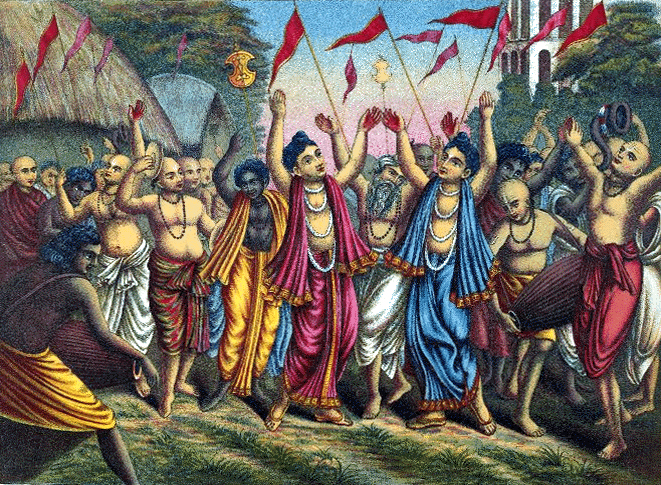
Hari Nama

Lord Caitanya and Nityananda

…It is all Grace of Sri Chaitanya Mahaprabhu. Srila Haridas Thakur said that the transcendental sound of Hari Nama would even purify the heart of birds and beasts. Today this statement of Thakur Haridas is corroborated. These American can not understand even a word’s meaning of the Sankirtan and yet they were so much attracted? It is all Sri Chaitanya Mahaprabhu’s power (from The Beginning, Srila Prabhupada Diaries 1966)

More

The Meaning of the Hare Krishna Mantra

Srila Prabhupada room conversation

So this sound, this Hare Krsna, Hare Krsna, Krsna Krsna, Hare Hare. Hare Rama, Hare Rama, Rama Rama, Hare Hare, is the sound representation of the Supreme Lord.

Lecture on Maha-mantra
By His Divine Grace A.C. Bhaktivedanta Swami Prabhupada
Recorded September 8th, 1966, New York

Prabhupada: Now, some of you members have asked me to explain the meaning of this chanting, Hare Krishna, Hare Krsna, Krsna Krsna, Hare Hare. Hare Rama, Hare Rama, Rama Rama, Hare Hare. Now, this sound is transcendental sound, transcendental sound, incarnation, sound incarnation of the Absolute Truth. Just try to understand what is incarnation. Incarnation means… The Sanskrit word is avatara, and that is translated into English as “incarnation.” Of course, the root meaning of incarnation I cannot exactly explain to you, but the root meaning of the… (aside:) The root meaning of avatara is “which comes from the transcendental sky, the spiritual sky to the material sky.” That is called avatara. Avatarana. Avatarana. Just like… Avatarana means “coming from up to down.” That is called avatarana. And avatara is understood that when God or His bona fide representative comes from that sky to this material plane, that is called avatara.

More

The Transmission of Transcendental Sound

Srila Prabhupada Vani

This very nice compilation of Quotes, compiled by Rakshana Prabhu, appeared today on the Sampradaya Sun. We reprint it here in its entirety.

The Transmission of Transcendental Sound
by Rakshana das
Jul 08, 2013 — AUSTRALIA (SUN)

The quotes contained in this paper are support for the efficacy of the many forms of transcendental sound vibration imparted by the spiritual master and the Lord, especially the vibration of pure Vedic scripture as spoken by Srila Prabhupada. They are not a challenge or alternative to the eternal principle of accepting a ‘bona fide’ spiritual master and surrendering unto him. Nor are they meant to obfuscate the potential for higher understanding and taste experienced in saintly association.

Unfortunately, devotees in some Gaudiya Vaisnava societies believe that transcendental sound cannot be fully potent unless the speaker is physically present within earshot. Of equal concern is the ISKCON strategy of creating ever-new imaginative directives aimed at corralling followers into subservient impotence.

Some of the quotes are well known to quite a few devotees, although repetition of transcendental knowledge is never redundant. These quotes are simply a window toward understanding the glorious variety of spiritual relationships sanctioned by the Lord, and an opportunity to admire the qualities of all genuine devotees, regardless of status of initiation.

More

Attaining Love for the Supreme

1972 Original Srimad Bhagavatam cover

The ultimate result of devotional service is to develop genuine love for the Supreme Personality…And love is the only word that can be properly used to indicate the relation between Lord Kṛṣṇa and the living entities.

Loving devotional service to the Lord begins with hearing about the Lord. There is no difference between the Lord and the subject matter heard about Him. Therefore, hearing about Him means immediate contact with Him by the process of vibration of the transcendental sound…

…The conclusion is that simply by hearing the Vedic literature Śrīmad-Bhāgavatam, one can have direct connection with the Supreme Personality of Godhead Śrī Kṛṣṇa, and thereby one can attain the highest perfection of life by transcending worldly miseries, illusion and fearfulness. These are practical tests for one who has actually given a submissive hearing to the readings of the Śrīmad-Bhāgavatam.

Full text and purport More

Om, Oṁkāra, or the Praṇava, is the Seed of Transcendental Realization

…Oṁkāra, or the praṇava, is the seed of transcendental realization, and it is composed of the three transcendental letters a-u-m. By its chanting by the mind, in conjunction with the breathing process, which is a transcendental but mechanical way of getting into trance, as devised by the experience of great mystics, one is able to bring the mind, which is materially absorbed, under control.

Oṁkāra is the seed of all transcendental sound and it is only the transcendental sound which can bring about the desired change of the mind and the senses. Mind or desire cannot be stopped, but to develop a desire to function for spiritual realization, the quality of engagement by the mind has to be changed.

In the Bhagavad-gītā, the praṇava (oṁkāra) has been accepted as the direct, literal representation of the Supreme Absolute Truth. One who is not able to chant directly the holy name of the Lord, as recommended above, can easily chant the praṇava (oṁkāra). This oṁkāra is a note of address, such as “O my Lord,” just as oṁ hari om means “O my Lord, the Supreme Personality of Godhead.” As we have explained before, the Lord’s holy name is identical with the Lord Himself. So also is oṁkāra. But persons who are unable to realize the transcendental personal form or name of the Lord on account of their imperfect senses (in other words, the neophytes) are trained to the practice of self-realization by this mechanical process of regulating the breathing function and simultaneously repeating the praṇava (oṁkāra) within the mind.

More

108 Imporant Slokas from the 1972 Bhagavad-gita As It Is

Click on image to go to Post

Click on image to go to Post

The Hare Krishna Cookbook

Songs of the Vaisnava Acaryas

Bhagavad-gita As It Is 1972 Edition “Online”

click on image

click on image to visit site

Srimad Bhagavatam Online

click on image

Raja-Vidya the King of Knowledge

click on image

click on image

Blog Stats

  • 4,551,423 hits

Enter your email address to subscribe to this blog and receive notifications of new posts by email.

Join 3,909 other subscribers

Important Slokas from the Brahma-samhita

click on image

click on image

Slokas from the Sri Isopanisad

click on image

click on image

Prayers By Queen Kunti (Slokas)

click on image

Gajendra’s Prayers of Surrender (Slokas)

click on image

A Short Statement of the Philosophy of Krishna Consciousness

click on image

click on image

July 9th Letter

click on image

click on image

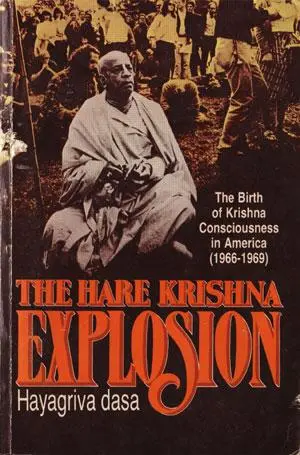
The Hare Krishna Explosion

Reference Material/Study Guide

click on image

click on image

  • LINKS