Transcendental Love (Bhava)

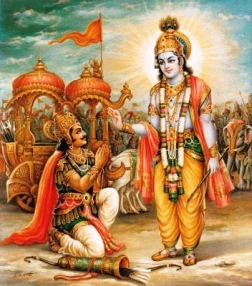
Radha Krishna Bhava

Here is a new word for your Vaisnava Vocabulary: Bhāva. In the Glossary in the back of the Bhagavad-gita As It Is, 1972 Edition, the word Bhāva is defined as; the preliminary stage of transcendental love of Godhead. Bhāva is a big word and has various meanings

The last stage of the devotional life is called bhāva, or transcendental love of Godhead.

“In the beginning one must have a preliminary desire for self-realization.This taste leads one further forward to attachment for Kṛṣṇa consciousness, which is matured in bhāva, or the preliminary stage of transcendental love of God. Real love for God is called premā, the highest perfectional stage of life.” In the premā stage there is constant engagement in the transcendental loving service of the Lord. So, by the slow process of devotional service, under the guidance of the bona fide spiritual master, one can attain the highest stage, being freed from all material attachment, from the fearfulness of one’s individual spiritual personality, and from the frustrations resulting from void philosophy. Then one can ultimately attain to the abode of the Supreme Lord. (Bhagavad-gita 4.11)

So it seem that bhāva is not only the preliminary stage of transcendental love of Godhead but we find that this preliminary stage of transcendental love is also the path to the highest perfectional stage of life, pure love or premā. There are two ways to approach the Lord, one is with awe and reverence and the other is with affection; bhāva. One who approaches the Lord with affection, is sure to advance spiritually.

In the Srimad Bhagavatam we find many references to the word Bhāva and highlighted some of them here.

More
Unalloyed Affection in the Land of Vṛndāvana

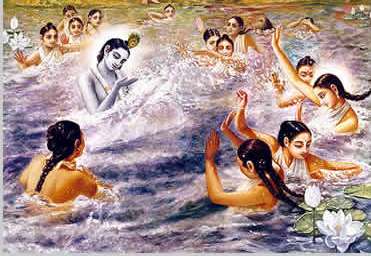
Krsna splashing the gopis by Shyamarani devi

…In His boyhood at Vṛndāvana, Lord Kṛṣṇa was notorious as a teasing friend in transcendental love to all the girls His age. His love for them was so intense that there is no comparison to that ecstasy, and the damsels of Vraja were so much attached to Him that their affection excelled that of the great demigods like Brahmā and Śiva. Lord Kṛṣṇa finally admitted His defeat before the transcendental affection of the gopīs and declared that He was unable to repay them for their unalloyed affection. (from purport SB 3.2.14)

More

The Damsels of Vraja

gopis of vrndavan

click on image to enlarge

In our attempt to stay focused on the childhood pastimes of Lord Krsna throughout this month of Damodara, we were reading from the Third Canto of the Srimad-Bhagavatam, chapter 2, entitled; “Remembrance of Lord Kṛṣṇa”. The great devotee Uddhava, was asked by Vidura, to speak on the messages of Lord Krsna. The following is but one of the verses and purports from this famous chapter.

…In His boyhood at Vṛndāvana, Lord Kṛṣṇa was notorious as a teasing friend in transcendental love to all the girls His age. His love for them was so intense that there is no comparison to that ecstasy, and the damsels of Vraja were so much attached to Him that their affection excelled that of the great demigods like Brahmā and Śiva. Lord Kṛṣṇa finally admitted His defeat before the transcendental affection of the gopīs and declared that He was unable to repay them for their unalloyed affection. (from purport to SB 3.2.14)

Full text and purport More

The Bliss Tasted by Śrīmatī Rādhārāṇī

Lord Krsna Caitanya

In one of our previous posts “The Confidential Reasons for Lord Caitanya’s Appearance” The chapter summary described that:

Lord Caitanya appeared for three principal purposes of His own. The first purpose was to relish the position of Śrīmatī Rādhārāṇī, who is the prime reciprocator of transcendental love of Śrī Kṛṣṇa. Lord Kṛṣṇa is the reservoir of transcendental loving transactions with Śrīmatī Rādhārāṇī.

The third reason that Lord Caitanya appeared was to enjoy the bliss tasted by Rādhārāṇī…Kṛṣṇa is the transcendental male, and Rādhārāṇī is the transcendental female. Therefore, to know the transcendental pleasure of loving Kṛṣṇa, Lord Kṛṣṇa Himself appeared as Lord Caitanya, accepting the emotions and bodily luster of Śrīmatī Rādhārāṇī.

Today in honor of the appearance of Srimati Radharani, we are posting more from this nectarean chapter More

Sri Caitanya-Caritamrta Adi Lila 7.22

Sri Caitanya-Caritamrta Adi Lila 7.22
By His Divine Grace A.C. Bhaktivedanta Swami Prabhupada

TRANSLATION

Śrī Pañca-tattva themselves danced again and again and thus made it easier to drink nectarean love of Godhead. They danced, cried, laughed and chanted like madmen, and in this way they distributed love of Godhead.

PURPORT

People generally cannot understand the actual meaning of chanting and dancing. Describing the Gosvāmīs, Śrī Śrīnivāsa Ācārya stated, kṛṣṇotkīrtana-gāna-nartana-parau: not only did Lord Caitanya Mahāprabhu and His associates demonstrate this chanting and dancing, but the six Gosvāmīs also followed in the next generation. The present Kṛṣṇa consciousness movement follows the same principle, and therefore simply by chanting and dancing we have received good responses all over the world. It is to be understood, however, that this chanting and dancing do not belong to this material world. They are actually transcendental activities, for the more one engages in chanting and dancing, the more he can taste the nectar of transcendental love of Godhead.

108 Imporant Slokas from the 1972 Bhagavad-gita As It Is

Click on image to go to Post

Click on image to go to Post

The Hare Krishna Cookbook

Songs of the Vaisnava Acaryas

Bhagavad-gita As It Is 1972 Edition “Online”

click on image

click on image to visit site

Srimad Bhagavatam Online

click on image

Raja-Vidya the King of Knowledge

click on image

click on image

Blog Stats

  • 4,551,227 hits

Enter your email address to subscribe to this blog and receive notifications of new posts by email.

Join 3,909 other subscribers

Important Slokas from the Brahma-samhita

click on image

click on image

Slokas from the Sri Isopanisad

click on image

click on image

Prayers By Queen Kunti (Slokas)

click on image

Gajendra’s Prayers of Surrender (Slokas)

click on image

A Short Statement of the Philosophy of Krishna Consciousness

click on image

click on image

July 9th Letter

click on image

click on image

The Hare Krishna Explosion

Reference Material/Study Guide

click on image

click on image

  • LINKS