Characteristics of Pure Devotional Service

Nectar of Devotion
By: His Divine Grace A. C. Bhaktivedanta Swami Prabhupada
Chapter One

Characteristics of Pure Devotional Service

In Śrīmad-Bhāgavatam, Third Canto, Twenty-ninth Chapter, verses 12 and 13, Śrīla Kapiladeva, while instructing His mother, has given the following characteristics of pure devotional service: “My dear mother, those who are My pure devotees, and who have no desire for material benefit or philosophical speculation, have their minds so much engaged in My service that they are never interested in asking Me for anything—except to be engaged in that service. They do not even beg to live in My abode with Me.”

There are five kinds of liberation, namely to become one with the Lord, to live with the Supreme Lord on the same planet, to have the same features as the Lord, to enjoy the same opulences as the Lord and to live as a companion of the Lord. A devotee, what to speak of rejecting material sense gratification, does not even want any of the five kinds of liberation. He is satisfied simply by discharging loving service to the Lord. That is the characteristic of pure devotion.

In the above statement by Kapiladeva from Śrīmad-Bhāgavatam, the actual position of a pure devotee is described, and the primary characteristics of devotional service are also defined. Further characteristics of devotional service are described by Rūpa Gosvāmī with evidences from different scriptures. He states that there are six characteristics of pure devotional service, which are as follows:

(1) Pure devotional service brings immediate relief from all kinds of material distress.

(2) Pure devotional service is the beginning of all auspiciousness.

(3) Pure devotional service automatically puts one in transcendental pleasure.

(4) Pure devotional service is rarely achieved.

(5) Those in pure devotional service deride even the conception of liberation.

(6) Pure devotional service is the only means to attract Kṛṣṇa.

Kṛṣṇa is all-attractive, but pure devotional service attracts even Him. This means that pure devotional service is even transcendentally stronger than Kṛṣṇa Himself, because it is Kṛṣṇa’s internal potency.

More

The Nectar of Instruction

…anger can be controlled. We cannot stop anger altogether, but if we simply become angry with those who blaspheme the Lord or the devotees of the Lord, we control our anger in Kṛṣṇa consciousness. Lord Caitanya Mahāprabhu became angry with the miscreant brothers Jagāi and Mādhāi, who blasphemed and struck Nityānanda Prabhu. In His Śikṣāṣṭaka Lord Caitanya wrote, tṛṇād api sunīcena taror api sahiṣṇunā: “One should be humbler than the grass and more tolerant than the tree.” One may then ask why the Lord exhibited His anger. The point is that one should be ready to tolerate all insults to one’s own self, but when Kṛṣṇa or His pure devotee is blasphemed, a genuine devotee becomes angry and acts like fire against the offenders.

The Nectar Of Instruction
By His Divine Grace A.; C. Bhaktivedanta Swami Prabhupada

Text One

More

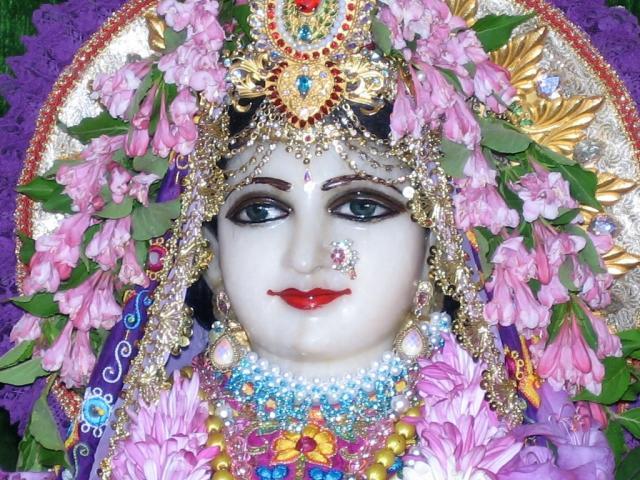
Srimati Radharani

The descriptions of the beauty of Radharani are wonderfully poetic and descriptive. Actually, the residents of Vrindavana care more for Radharani than they do for Lord Krishna. They know that Krishna can be influenced through Radharani. They know that Radha can bring one to Krishna. She is also the compassionate nature of the Lord, and thus more easily approached than trying to reach Lord Krishna directly.

Srimati Radharani
By Stephen Knapp

Srimati Radharani is the Supreme Goddess. She is most always seen with Lord Krishna. It is described that She is the Chief Associate and devotee of Lord Krishna, and topmost of all Goddesses. Her name means the She is the most excellent worshiper of Lord Krishna. However, She is also an expansion of the Lord’s energy. Since She is also an extension of Krishna, She is the feminine aspect of God. Thus, in the Gaudiya Vaishnava tradition, God is both male and female. They are One, but Krishna expands into two, Himself and Radharani, for the sake of divine loving pastimes. If They remained as One, then there is no relationship, there are no pastimes, and there can be no dynamic exchange of love. (Caitanya-caritamrita, Adi-lila, 4.55-56) Actually, if we all remained merged or amalgamated into one single force or light, then there is no further need of anything else. There certainly would be no need for the material manifestation to provide the innumerable conditioned souls with the means to seek out the way to satisfy their senses, minds, emotions, desires for self-expression, intellectual pursuits, and on and on.

More

Narada-bhakti-sutra Text 5


Narada-bhakti-sutra Text 5
Translation & Purport by His Divine Grace A. C. Bhaktivedanta Swami Prabhupada

TRANSLATION

A person engaged in such pure devotional service neither desires anything for sense gratification, nor laments for any loss, nor hates anything, nor enjoys anything on his personal account, nor becomes very enthusiastic in material activity.

PURPORT

According to Śrīla Rūpa Gosvāmī, there are six impediments to the discharge of devotional service, and also six activities favorable to progress in devotional service.

The first impediment is atyāhāra, overeating or accumulating more wealth than we need. When we give free rein to the senses in an effort to enjoy to the highest degree, we become degraded. A devotee should therefore eat only enough to maintain his body and soul together; he should not allow his tongue unrestricted license to eat anything and everything it likes. The Bhagavad-gītā and the great ācāryas, or spiritual masters, have prescribed certain foods for human beings, and one who eats these foods eats in the mode of goodness. These foods include grains, fruits, vegetables, milk products, and sugar—and nothing more. A devotee does not eat extravagantly; he simply eats what he offers to the Supreme Lord, Kṛṣṇa. He is interested in kṛṣṇa-prasādam (food offered to the Lord) and not in satisfying his tongue. Therefore he does not desire anything extraordinary to eat.
Similarly, a devotee does not wish to accumulate a large bank balance: he simply earns as much as he requires. This is called yāvad-artha or yuktāhāra. In the material world everyone is very active in earning more and more money and in increasing eating and sleeping and gratifying the senses; such is the mission of most people’s lives. But these activities should be absent from the life of a devotee.

More

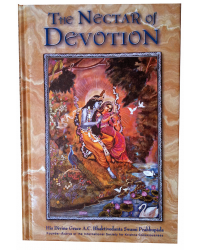
The Nectar of Devotion


Original 1970 Edition
The Nectar of Devotion
by His Divine Grace A.C. Bhaktivedanta Swami Prabhupada

This book is especially intended for those who are engaged in The Hare Krishna Movement. The text is flooded with nectarean stories, philosophy and poetic verses about Krsna and His pure devotees-all taken from the Vedic literatures, It is a summary study of Bhakti-rasamrta-sindhu, which was written in Sanskrit by Srila Rupa Goswami, the chief of the six direct disciples of Lord Caitanya Mahaprabhu. Lord Caitanya, who apeared in India 500 years ago, is revealed by Vedic scriptures to be an incarnation of God in the role of His own devotee. He and His followers are thus most authorized to teach us how to become perfect in spiritual life.

The subject matter is love of God. the Basic principle of the living condition is that we have a general propensity to love someone. At the present moment, human society teaches one to love his country or family or his personal self, but there is no information where to repose the loving propensity so that everyone can become happy. That missing point is God or Krsna. The Nectar of Devotion teaches us how to stimulate our original love for krsna and how to be situated in that position where we can enjoy our blissful life. The presentation of this authoritative information about the Supreme Personality of Godhead, Krsna and our relationship with Him is simply the mercy of His pure devotee, His Divine Grace A.C. Bhaktivedanta Swami Prabhupada, the acarya for the present age, who is coming in disciplic succession from Caitanya Mahaprabhu Himself.

“The funds for printing this book have been kindly donated in loving memory of Her Grace Gangamayee Devi Dase and Her Grace Krsna Krpa Devi Dasi by their friends and families. We continue to be inspired and are grateful to those fortunate souls who, with loving devotion, present and distribute the literary works of Srila Prabhupada” -Annada Devi Dasi, December 5, 2009 Vrindavan

30 color plates
495 pages
High Quality Hardcover Edition
Glossary
Also Available Wholesale by the case!

Available online at http://www.theharekrishnamovement.com/nectar-of-devotion

More

Next Newer Entries

108 Imporant Slokas from the 1972 Bhagavad-gita As It Is

Click on image to go to Post

Click on image to go to Post

The Hare Krishna Cookbook

Songs of the Vaisnava Acaryas

Bhagavad-gita As It Is 1972 Edition “Online”

click on image

click on image to visit site

Srimad Bhagavatam Online

click on image

Raja-Vidya the King of Knowledge

click on image

click on image

Blog Stats

  • 4,551,513 hits

Enter your email address to subscribe to this blog and receive notifications of new posts by email.

Join 3,909 other subscribers

Important Slokas from the Brahma-samhita

click on image

click on image

Slokas from the Sri Isopanisad

click on image

click on image

Prayers By Queen Kunti (Slokas)

click on image

Gajendra’s Prayers of Surrender (Slokas)

click on image

A Short Statement of the Philosophy of Krishna Consciousness

click on image

click on image

July 9th Letter

click on image

click on image

The Hare Krishna Explosion

Reference Material/Study Guide

click on image

click on image

  • LINKS