Easter Sunday

Jesus in meditation

Today as most of the Western World celebrates Easter Sunday, we thought we word honor the life of Lord Jesus Christ with some select writings by our spiritual master A.C. Bhaktivedanta Swami Prabhupada.

The Śrīmad-Bhāgavatam states that any bona fide preacher of God consciousness must have the qualities of titikṣā (tolerance) and karuṇā (compassion). In the character of Lord Jesus Christ we find both these qualities. He was so tolerant that even while he was being crucified, he didn’t condemn anyone. And he was so compassionate that he prayed to God to forgive the very persons who were trying to kill him. (Of course, they could not actually kill him. But they were thinking that he could be killed, so they were committing a great offense.) As Christ was being crucified he prayed, “Father, forgive them. They know not what they are doing.”

…Of course, the message that Christ preached was just according to his particular time, place, and country, and just suited for a particular group of people. But certainly he is the representative of God. Therefore we adore Lord Jesus Christ and offer our obeisances to him.

Once, in Melbourne, a group of Christian ministers came to visit me. They asked, “What is your idea of Jesus Christ?” I told them, “He is our guru. He is preaching God consciousness, so he is our spiritual master.” The ministers very much appreciated that.

Actually, anyone who is preaching God’s glories must be accepted as a guru. Jesus Christ is one such great personality. We should not think of him as an ordinary human being. The scriptures say that anyone who considers the spiritual master to be an ordinary man has a hellish mentality. If Jesus Christ were an ordinary man, then he could not have delivered God consciousness. (Science of Self Realization, Chapter 4, “Understanding Krsna and Christ)

Full Chapter

More
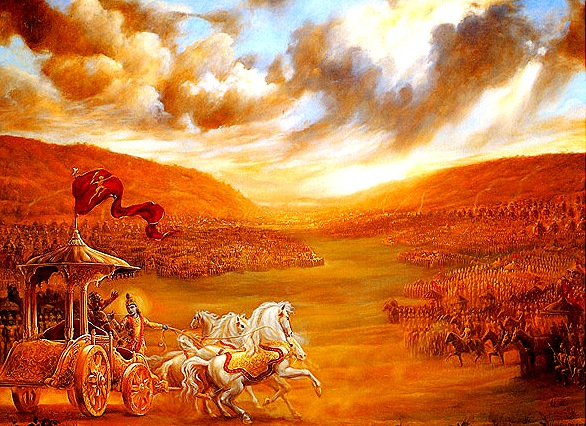
The Passing Away of Bhismadeva

click on image to enlarge

…The dealings of Lord Kṛṣṇa and Bhīṣmadeva on the Battlefield of Kurukṣetra are interesting because the activities of Lord Śrī Kṛṣṇa appeared to be partial to Arjuna and at enmity with Bhīṣmadeva; but factually all this was especially meant to show special favor to Bhīṣmadeva, a great devotee of the Lord. The astounding feature of such dealings is that a devotee can please the Lord by playing the part of an enemy.

Srimad Bhagavatam
By His Divine Grace A.C. Bhaktivedanta Swami Prabhupada
First Canto, Chapter 9, Text 38

The Passing Away of Bhismadeva

More

Lord Krishna’s Merciful Glance

…The Lord diminished the duration of life of the opposite party by His merciful glance. It is said that all the fighters who assembled on the Battlefield of Kurukṣetra attained salvation by personally seeing the Lord at the time of death. Therefore, His diminishing the duration of life of Arjuna’s enemy does not mean that He was partial to the cause of Arjuna. Factually He was merciful to the opposite party because they would not have attained salvation by dying at home in the ordinary course of life. Here was a chance to see the Lord at the time of death and thus attain salvation from material life. Therefore, the Lord is all good, and whatever He does is for everyone’s good.

Srimad Bhagavatam
By His Divine Grace A.C. Bhaktivedanta Swami Prabhupada
Canto 1, Chapter 9, Text 35

The Passing Away of Bhismadeva in the Presence of Lord Krsna

sapadi sakhi-vaco niśamya madhye
nija-parayor balayo rathaṁ niveśya
sthitavati para-sainikāyur akṣṇā
hṛtavati pārtha-sakhe ratir mamāstu

sapadi—on the battlefield; sakhi-vacaḥ—command of the friend; niśamya—after hearing; madhye—in the midst; nija—His own; parayoḥ—and the opposite party; balayoḥ—strength; ratham—chariot; niveśya—having entered; sthitavati—while staying there; para-sainika—of the soldiers on the opposite side; āyuḥ—duration of life; akṣṇā—by looking over; hṛtavati—act of diminishing; pārtha—of Arjuna, son of Pṛthā (Kuntī); sakhe—unto the friend; ratiḥ—intimate relation; mama—my; astu—let there be.

In obedience to the command of His friend, Lord Śrī Kṛṣṇa entered the arena of the Battlefield of Kurukṣetra between the soldiers of Arjuna and Duryodhana, and while there He shortened the life spans of the opposite party by His merciful glance. This was done simply by His looking at the enemy. Let my mind be fixed upon that Kṛṣṇa.

Purport

In the Bhagavad-gītā (1.21-25) Arjuna ordered the infallible Lord Śrī Kṛṣṇa to place his chariot between the phalanxes of the soldiers. He asked Him to stay there until he had finished observing the enemies he had to face in the battle. When the Lord was so asked, He at once did so, just like an order carrier. And the Lord pointed out all the important men on the opposite side, saying, “Here is Bhīṣma, here is Droṇa,” and so on. The Lord, being the supreme living being, is never the order supplier or order carrier of anyone, whoever he may be. But out of His causeless mercy and affection for His pure devotees, sometimes He carries out the order of the devotee like an awaiting servant. By executing the order of a devotee, the Lord becomes pleased, as a father is pleased to carry out the order of his small child. This is possible only out of pure transcendental love between the Lord and His devotees, and Bhīṣmadeva was quite aware of this fact. He therefore addressed the Lord as the friend of Arjuna.

More

108 Imporant Slokas from the 1972 Bhagavad-gita As It Is

Click on image to go to Post

Click on image to go to Post

The Hare Krishna Cookbook

Songs of the Vaisnava Acaryas

Bhagavad-gita As It Is 1972 Edition “Online”

click on image

click on image to visit site

Srimad Bhagavatam Online

click on image

Raja-Vidya the King of Knowledge

click on image

click on image

Blog Stats

  • 4,551,829 hits

Enter your email address to subscribe to this blog and receive notifications of new posts by email.

Join 3,910 other subscribers

Important Slokas from the Brahma-samhita

click on image

click on image

Slokas from the Sri Isopanisad

click on image

click on image

Prayers By Queen Kunti (Slokas)

click on image

Gajendra’s Prayers of Surrender (Slokas)

click on image

A Short Statement of the Philosophy of Krishna Consciousness

click on image

click on image

July 9th Letter

click on image

click on image

The Hare Krishna Explosion

Reference Material/Study Guide

click on image

click on image

  • LINKS