“Value of accepting a bona fide spiritual Master is more than we can calculate”


Vrindaban, Tuesday, 12 February, 1974:

Dear Ravendra Gupta, please accept my blessings. I have only recently received your letter of February 6, 1974, due to travelling.

I am very glad to hear you are following my instructions by chanting 16 rounds daily. In order to chant offenselessly, so that the chanting will have the greatest effect, one must avoid the four sinful activities.

You have asked “How serious would it be for me if I should miss the golden opportunity to become your initiated disciple?” You should know that the value of accepting a bona fide spiritual master is more than we can calculate.

More

There is no difficulty

There is no difficulty

Madhudvisa prabhu (repeating question to Srila Prabhupada): “We have been here for many lifetimes performing sinful activities. So is it possible to counteract all those sinful activities in one lifetime, or does it require many…?”

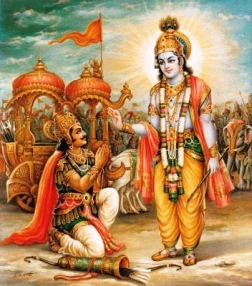
Srila Prabhupada: “One minute. That is Krishna consciousness movement. One minute. You are not reading Bhagavad Gita? What Krishna says? sarva dharman parityajya mam ekam saranam vraja aham tvam sarva papebhyo moksayisyami (BG 18.66) ‘You surrender unto Me. Give up your all business. I will give you relief from all sinful reaction immediately.’ So it requires one minute. ‘My dear Krishna, I was forgotten. Now I understand. I fully surrender unto you.’ Then you become immediately free from all sinful reactions.

Without any reservation, without any politics, if you fully surrender, Krishna is assuring, aham tvam sarva papebhyo moksayisyami ma sucah. He reassures, ‘Don’t worry whether I will be able to give you relief from all reaction’; ma sucah, finished, guaranteed. You do this. So how much time it requires to surrender to Krishna? Immediately you can do that. Surrender means you surrender and work as Krishna says.

That is surrender. What Krishna says to do? man mana bhava mad bhakto mad yaji mam namaskuru (BG 18.65); four things: ‘You always think of Me, and you become My devotee, you worship Me, and offer your respect, full obeisances unto Me’ You do these four things. That is full surrender. Mam evaisyasi asamsaya: ‘Then you come to Me without any doubt.’ Everything is there. Krishna has given everything fully. If you accept it, then life is very simple. There is no difficulty. Yes?”

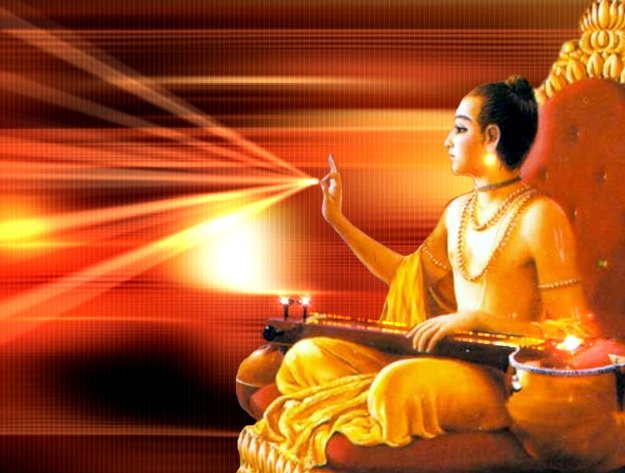
Narada-bhakti-sutra Text 2

Narada-bhakti-sutra Text 2
Translation & Purport by His Divine Grace A.C. Bhaktivedanta Swami

TRANSLATION

Devotional service manifests as the most elevated, pure love for God.

PURPORT

As stated before, after attaining the highest stage of self-realization, one becomes situated in devotional service to the Lord. The perfection of devotional service is to attain love of God. Love of God involves the Supreme Personality of Godhead, the devotee, and the process of devotional service. Self-realization, the brahma-bhūta stage, is the beginning of spiritual life; it is not the perfectional stage. If a person understands that he is not his body and that he has nothing to do with this material world, he becomes free from material entanglement. But that realization is not the perfectional stage.
The perfectional stage begins with activity in the self-realized position, and that activity is based on the understanding that a living entity is eternally the subordinate servitor of the Supreme Lord. Otherwise, there is no meaning to self-realization. If one is puffed up with the idea that he is the Supreme Brahman, or that he has become one with Nārāyaṇa, or that he has merged into the brahmajyoti effulgence, then he has not grasped the perfection of life. As the Śrīmad-Bhāgavatam (10.2.32) states,

More

The Process of Devotional Service

Narada-bhakti-sutra
Translation and Purport by His Divine Grace A.C. Bhaktivedanta Swami Prabhupada

Text One

TRANSLATION

Now, therefore, I will try to explain the process of devotional service.
PURPORT

Devotional service to the Supreme Personality of Godhead is explained in the Bhagavad-gītā, where the Lord says that a self-realized person is always in the transcendental state known as brahma-bhūta, which is characterized by joyfulness. When one is self-realized he becomes joyful. In other words, he is free from the material contamination of lamentation and hankering. As long as we are in material existence, we lament for the losses in our life and hanker for that which we do not have. A self-realized person is joyful because he is free from material lamentation and hankering.

More

Transcendental Teachings of Prahlāda Mahārāja

Transcendental Teachings of Prahlāda Mahārāja
by His Divine Grace A. C. Bhaktivedanta Swami Prabhupāda

Chapter 2
“We Are Spoiling Our Lives”

Therefore, instead of being very anxious to stimulate our senses to increase material happiness, we should try to attain spiritual happiness by practicing Kṛṣṇa consciousness. As Prahlāda Mahārāja says, “Although your life in this human body is temporary, it is very valuable. So instead of trying to increase your material sense enjoyment, your duty is to dovetail your activities in some way in Kṛṣṇa consciousness.”

Our higher intelligence comes with his human body. Because we have higher consciousness, we should try for the higher enjoyment in life, which is spiritual enjoyment. And how can that spiritual enjoyment be achieved? One should absorb himself in serving the Supreme Lord, who gives the pleasure of liberation. We should turn our attention to achieving the lotus feet of Kṛṣṇa, who can give us liberation from this material world.

More

How To Offer Your Food To The Lord

How to Offer Your Food To The Lord

Everything comes from God (Krishna), the air we breath, the water we drink, and the food we eat. But this process of Krishna Consciousness or bhakti-yoga, is the method for re-awakeing our dormant love for God. When you love someone, then there is service. Isn’t this so? A mother loves her baby, and cares for the babies needs; she baths the baby, dresses the baby, feeds the baby etc. So this process of Krishna Consciousness is giving back to the Supreme Lord, in the mood of loving devotional service. Although the Supreme Lord is providing everything, still a devotee thinks, “I want to give something back. I want to offer something to the Lord” Not that we just take from the Lord, ‘O Lord thank you for our daily bread’. No, a devotee wants to bake some bread for the Lord, cook some rice and offer it to the Lord, offer some fruits, and flowers, and water for the Lords pleasure. This is the begining of Love, through service.

A young boy meets a young girl, and he gives her a flower, carries her books, gives her gifts and offers her service. Similary, we want to love God, so we begin with gifts and service, to develope our love and devotion. So this process of offering very nicely prepeared foods to the Lord is Bhakti Yoga. Yoga means ‘union’, and Bhakti means through loving devotional service. It is a very blissful process. I want to Love God, so let me offer some service, some flowers, some nicely cooked food,etc. And we can link up with God (yoga) by thinking of Him, offering prayers, chanting His holy names, and offering the food we eat.

More

The Departure of Bhadra Priya Devi Dasi

The Departure of Bhadra Priya Devi Dasi, Srila Prabhupada’s daughter
by Nirmala, Sumati and Devarsi das

Bhadra Priya joined ISKCON in 1972 in Montreal, Canada. Shortly thereafter she moved to the temple in Toronto where she was initiated by His Divine Grace Srila Prabhupada in 1973. She did many different types of service including nam sankirtan and book distribution. One special service that she was known for was cooking milk sweets for Radha Ksira Cora Gopinath for up to 10 hours each day. She was really absorbed in this service and was especially happy when she was able to create a different type of sweet for the Lord’s pleasure.

More

Eight Beautiful Verses Glorifying Lord Nityananda

Eight Beautiful Verses Glorifying Lord Nityananda
By Vrndavan Dasa Thakur

1. I worship Lord Nityananda, the unlimited root of the tree of devotional service. He appears like an autumn moon, very splendid and free from any taint. Maddened with pure love for Lord Hari, His eyes constantly roll about and he walks as gracefully as an elephant. He is the Absolute Truth, His face is smiling, and holding a staff in His hand, He disperses the influence of the age of Kali.

2. I worship Lord Nityananda, the unlimited root of the tree of devotional service. He is the abode of the mellows of devotional service, no one can be compared to Him and He is the be all and end all for His devotees. He is the Lord of Jahnava Devi, the goddess Who considers Nityananda more dear than life. He is always maddened with pure love of Godhead and the unintelligent non-devotees, cannot understand that He is the Supreme Personality of Godhead Himself.

3. I worship Lord Nityananda, the unlimited root of the tree of devotional service. He is very dear to Lord Caitanya Mahaprabhu, the son of Sacidevi and He is worshipped by the entire universe. He is very cheerful and He delivers the souls immersed in the Kali-yuga. By chanting the holy name of Lord Hari, He removes the false ego born from the ocean of material life.

4. I worship Lord Nityananda, the unlimited root of the tree of devotional service. He spoke to Lord Caitanya saying, “O, brother! The people will become infected with all the sins of Kali-yuga. How will they be able to atone for these sins? Please give them some way by which they can easily approach You.”

5. I worship Lord Nityananda, the unlimited root of the tree of devotional service. He went to each and every house and raised His arms saying, “O, brothers! If you will, please constantly chant the holy name of Lord Hari! If you do this, you will become free from the ocean of birth and death in the material world. Please give this gift of your liberation to Me.”

6. I worship Lord Nityananda, the unlimited root of the tree of devotional service. He is like Agastya Muni who forcibly swallows the ocean of material existence, and He is the rising full moon which is the friend of the lotus flowers and which increases the ocean, which is the welfare of the saintly devotees. He is the blazing sun which removes the darkness which is the community of demons.

7. I worship Lord Nityananda, the unlimited root of the tree of devotional service. He traveled on every path singing and dancing and repeating, “Hari! Hari!” Without considering His own interests, He was merciful to the people and he gave them His merciful side long glance.

8. I worship Lord Nityananda, the unlimited root of the tree of devotional service. He held the beautiful lotus hand of His brother, Caitanya Mahaprabhu, and when They glanced at each others faces, Their hearts became full of transcendental bliss. They wandered through the towns of Bengal and delighted the people there.

These eight verses glorifying Lord Nityananda are the abode of the mellows of devotional service and they are the wealth of the pure devotees expert at relishing these mellows. These verses are very excellent, transcendental, and unprecidented. May the two lotus feet of Lord Nityananda continually appear in the hearts of those who read these verses and remember the Lord.

Pasted from http://www.harekrsna.com/philosphy/caitanya/astakam.htm

On Chanting Hare Krishna

On Chanting Hare Krishna

On Chanting Hare Krishna Booklet

Great for Distribuiton!!! 800 booklets per case!

Wholesale for Book Distributors “On Chanting Hare Krishna” is a small 16 page full-color booklet which gives a wonderful introduction to the Hare Krishna movement and it’s Founder-Acharya, His Divine Grace A.C. Bhaktivedanta Swami Prabhupada. It was originally published in balck & white. Now for the first time it is available in FULL COLOR!

Special thanks to Palaka Das for financing this printing.

800 booklets to the Case!
Price: $45.00
Author: A.C. Bhaktivedanta Swami Prabhupada and disciples
Full-color Booklet 5″x7″
Pages: 16

This case of booklets can be purchased online by visiting http://www.theharekrishnamovement.com

Bhakti; Summit of Yoga


Bhakti Notes:
by Vaisesika Dasa

FAQ: Why does it seem that Srila Prabhupada’s translations, word for word renditions and purports all seem to point only to Bhakti?

Answer: Srila Prabhupada’s purpose in presenting the Bhagavad gita As It Is, was to bring out Krsna’s ultimate conclusion of the Gita. This is the meaning of “As It Is.”

Some have speculated that in the Gita Krsna presents many paths and that any one of them is as good as another. However, Krsna clearly presents Bhakti as yoga’s summit even when He explains other processes like Karma Yoga and Dhyana Yoga to Arjuna.

In fact, all such processes are meant to bring one to surrender to the Lord in loving devotional service. The more one advances in devotional service, the more one is considered by Krsna to be advanced in yoga.

At the end of the sixth chapter in which Krsna has explained the arduous process of astanga yoga and meditation, He says:

Yoginam api sarvesam mad-gatenantar-atmana
sraddhavan bhajate yo mam sa me yutatamo matah

“And of all yogis, the one with great faith who always abides in Me, thinks of Me within himself, and renders transcendental loving service to Me- he is the most intimately united with Me in yoga and is the highest of all. That is my opinion.” Bg. 6.47

More

Hope and Change


Hope and Change
Posted by krishnasmercy on July 13, 2010

“A conditioned soul cannot deliver another conditioned soul. Only Krishna or His bona fide representative can deliver him.” (King Prithu, The Nectar of Devotion, Ch 9)

Most of us are familiar with the term “the blind leading the blind.” This refers to a person who has no vision directing others on where to go. The people that are lost are considered blind in the sense that they cannot see the light, the true path in life. When they ask for help, directions to the supreme destination, they are led astray by someone who is also blind. In order to find the proper path, we must seek out someone who has eyes, a vision which allows them to see things as they are. The Vedas tell us that only God possesses this vision and that He is kind enough to grant these spiritual eyes to His faithful adherents, the bona fide spiritual masters.

What are the prescriptions given by the liberated souls? In this age, the primary recommendation is that we should constantly engage in Krishna’s service. This discipline is known as bhakti-yoga, and its primary component is the regular chanting of God’s names, “Hare Krishna Hare Krishna, Krishna Krishna, Hare Hare, Hare Rama Hare Rama, Rama Rama, Hare Hare”. We shouldn’t mistakenly take bhakti-yoga to be a passing fad or a part-time activity. The liberated souls are free from conditioned life because they spend all their time working for Krishna. Obviously this is a very high level of devotion which can’t be achieved overnight, but the desire to reach this end must be there. The reason that chanting is the foremost spiritual practice is that it can be performed anywhere and at any time of the day. Moreover, there is no time limit to this chanting. We can take up the various gymnastics exercises that are part of hatha-yoga, but after half an hour we’ll get tired and move on to something else.

Bhakti-yoga, or devotional service, is meant to take up all of our time. The key is to always be conscious of God, no matter what we are doing. This is the difference between bhoga/tyaga and bhakti. Bhakti also brings about enjoyment and involves things that we like to do, but the difference is in the area of consciousness. With bhoga, we think of ourselves as the lord and master, and the same with tyaga. Many people take great pride in their renunciation capabilities. “I can go without eating anything for days; I only sleep four hours a day; I don’t eat meat”, etc. These things are certainly very nice, but our renunciation must have a purpose, otherwise the false ego kicks in and we start taking ourselves to be the masters of everything.

Bhakti-yoga involves service. We can’t see God in our conditioned state, so we are advised to consult with those who can. Our first business is to serve the eternally liberated soul, the spiritual master. How do we tell who is a bona fide spiritual master? Aside from being liberated, the spiritual master is a pure devotee of Krishna. What does it mean to be a pure devotee? This is actually quite easy to figure out. To gauge whether or not someone is a devotee, simply ask yourself what their aim in life is. What is the driving force behind that person’s activities? If the answer to these questions is love for Krishna, then you know the person is a devotee. A spiritual master may rub us the wrong way from time to time, saying things that offend us, but if their intention is to make Krishna happy, then we must take them to be liberated.

The liberated souls are so kind that they don’t want to hog the glory for themselves. Their business is to make other people liberated as well. In this way, they are the greatest freedom fighters, helping the distraught living entities out of the ditch. A spiritual master that all of us can approach is His Divine Grace A.C. Bhaktivedanta Swami Prabhupada. He lives forever through His countless books and recorded lectures. We should all make good use of these resources and fix ourselves up to the highest position.

Bhagavad-gita [Ch.2 Text 4o]


TEXT 40

nehābhikrama-nāśo ‘sti
pratyavāyo na vidyate
sv-alpam apy asya dharmasya
trāyate mahato bhayāt

SYNONYMS
na—there is not; iha—in this world; abhikrama—endeavoring; nāśaḥ—loss; asti—there is; pratyavāyaḥ—diminution; na—never; vidyate—there is; svalpam—little; api—although; asya—of this; dharmasya—of this occupation; trāyate—releases; mahataḥ—of very great; bhayāt—from danger.

TRANSLATION
In this endeavor there is no loss or diminution, and a little advancement on this path can protect one from the most dangerous type of fear.

PURPORT
Activity in Kṛṣṇa consciousness, or acting for the benefit of Kṛṣṇa without expectation of sense gratification, is the highest transcendental quality of work. Even a small beginning of such activity finds no impediment, nor can that small beginning be lost at any stage. Any work begun on the material plane has to be completed, otherwise the whole attempt becomes a failure. But any work begun in Kṛṣṇa consciousness has a permanent effect, even though not finished. The performer of such work is therefore not at a loss even if his work in Kṛṣṇa consciousness is incomplete. One percent done in Kṛṣṇa consciousness bears permanent results, so that the next beginning is from the point of two percent; whereas, in material activity, without a hundred percent success, there is no profit. Ajāmila performed his duty in some percentage of Kṛṣṇa consciousness, but the result he enjoyed at the end was a hundred percent, by the grace of the Lord. There is a nice verse in this connection in Śrīmad-Bhāgavatam:

tyaktvā sva-dharmaṁ caraṇāmbujaṁ harer
bhajan na pakko ‘tha patet tato yadi
yatra kva vābhadram abhūd amuṣya kiṁ
ko vārtha āpto ‘bhajatāṁ sva-dharmataḥ

“If someone gives up self-gratificatory pursuits and works in Kṛṣṇa consciousness and then falls down on account of not completing his work, what loss is there on his part? And, what can one gain if one performs his material activities perfectly?” (Bhāg. 1.5.17) Or, as the Christians say, “What profiteth a man if he gain the whole world yet suffers the loss of his eternal soul?”

Material activities and their results end with the body. But work in Kṛṣṇa consciousness carries the person again to Kṛṣṇa consciousness, even after the loss of the body. At least one is sure to have a chance in the next life of being born again as a human being, either in the family of a great cultured brāhmaṇa or in a rich aristocratic family that will give one a further chance for elevation. That is the unique quality of work done in Kṛṣṇa consciousness.

Next Newer Entries

108 Imporant Slokas from the 1972 Bhagavad-gita As It Is

Click on image to go to Post

Click on image to go to Post

The Hare Krishna Cookbook

Songs of the Vaisnava Acaryas

Bhagavad-gita As It Is 1972 Edition “Online”

click on image

click on image to visit site

Srimad Bhagavatam Online

click on image

Raja-Vidya the King of Knowledge

click on image

click on image

Blog Stats

  • 4,612,871 hits

Enter your email address to subscribe to this blog and receive notifications of new posts by email.

Join 3,906 other subscribers

Important Slokas from the Brahma-samhita

click on image

click on image

Slokas from the Sri Isopanisad

click on image

click on image

Prayers By Queen Kunti (Slokas)

click on image

Gajendra’s Prayers of Surrender (Slokas)

click on image

A Short Statement of the Philosophy of Krishna Consciousness

click on image

click on image

July 9th Letter

click on image

click on image

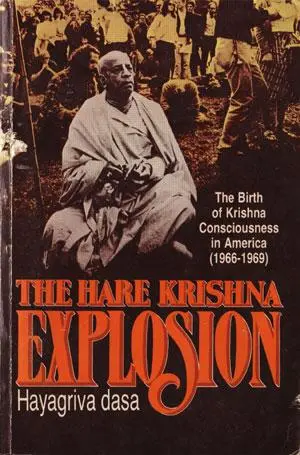
The Hare Krishna Explosion

Reference Material/Study Guide

click on image

click on image

  • LINKS