Golden Avatar

Sri Caitanya-caritamrta – 1975 Edition
By His Divine Grace A.C.Bhaktivedanta Swami Prabhupada
Adi 3.52

TRANSLATION

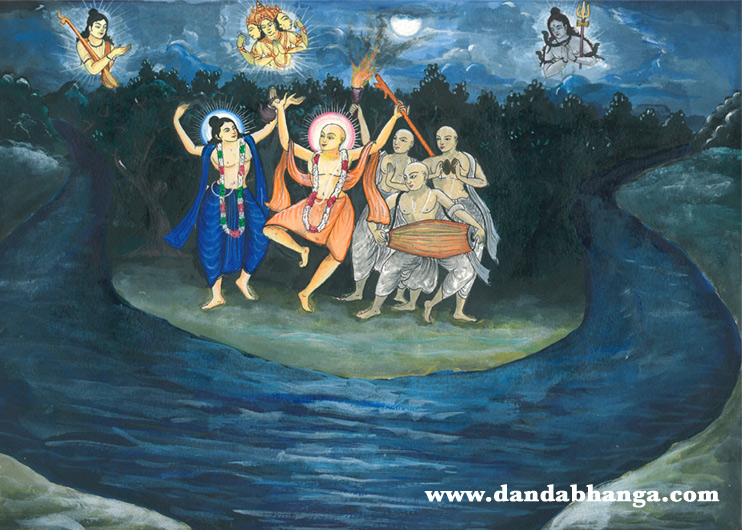
“In the Age of Kali, intelligent persons perform congregational chanting to worship the incarnation of Godhead who constantly sings the name of Kṛṣṇa. Although His complexion is not blackish, He is Kṛṣṇa Himself. He is accompanied by His associates, servants, weapons and confidential companions.”

PURPORT

This text is from Śrīmad-Bhāgavatam (11.5.32). Śrīla Jīva Gosvāmī has explained this verse in his commentary on the Bhāgavatam, known as the Krama-sandarbha, wherein he says that Lord Kṛṣṇa also appears with a golden complexion. That golden Lord Kṛṣṇa is Lord Caitanya, who is worshiped by intelligent men in this age. That is confirmed in Śrīmad-Bhāgavatam by Garga Muni, who said that although the child Kṛṣṇa was blackish, He also appears in three other colors-red, white and yellow. He exhibited His white and red complexions in the Satya and Tretā ages respectively. He did not exhibit the remaining color, yellow-gold, until He appeared as Lord Caitanya, who is known as Gaura Hari.

Śrīla Jīva Gosvāmī explains that kṛṣṇa-varṇam means Śrī Kṛṣṇa Caitanya. Kṛṣṇa-varṇa and Kṛṣṇa Caitanya are equivalent. The name Kṛṣṇa appears with both Lord Kṛṣṇa and Lord Caitanya Kṛṣṇa. Lord Śrī Caitanya Mahāprabhu is the Supreme Personality of Godhead, but He always engages in describing Kṛṣṇa and thus enjoys transcendental bliss by chanting and remembering His name and form. Lord Kṛṣṇa Himself appears as Lord Caitanya to preach the highest gospel.

Lord Caitanya always chants the holy name of Kṛṣṇa and describes it also, and because He is Kṛṣṇa Himself, whoever meets Him will automatically chant the holy name of Kṛṣṇa and later describe it to others. He injects one with transcendental Kṛṣṇa consciousness, which merges the chanter in transcendental bliss. In all respects, therefore, He appears before everyone as Kṛṣṇa, either by personality or by sound. Simply by seeing Lord Caitanya one at once remembers Lord Kṛṣṇa. One may therefore accept Him as viṣṇu-tattva. In other words, Lord Caitanya is Lord Kṛṣṇa Himself.

Sāṅgopāṅgāstra-pārṣadam further indicates that Lord Caitanya is Lord Kṛṣṇa. His body is always decorated with ornaments of sandalwood and with sandalwood paste. By His superexcellent beauty He subdues all the people of the age. In other descents the Lord sometimes used weapons to defeat the demoniac, but in this age the Lord subdues them with His all-attractive figure as Caitanya Mahāprabhu. Śrīla Jīva Gosvāmī explains that His beauty is His astra, or weapon, to subdue the demons. Because He is all-attractive, it is to be understood that all the demigods lived with Him as His companions. His acts were uncommon and His associates wonderful. When He propagated the saṅkīrtana movement, He attracted many great scholars and ācāryas, especially in Bengal and Orissa. Lord Caitanya is always accompanied by His best associates like Lord Nityānanda, Advaita, Gadādhara and Śrīvāsa.

Śrīla Jīva Gosvāmī cites a verse from the Vedic literature which says that there is no necessity of performing sacrificial demonstrations or ceremonial functions. He comments that instead of engaging in such external, pompous exhibitions, all people, regardless of caste, color or creed, can assemble together and chant Hare Kṛṣṇa to worship Lord Caitanya. Kṛṣṇa-varṇaṁ tviṣākṛṣṇam indicates that prominence should be given to the name of Kṛṣṇa. Lord Caitanya taught Kṛṣṇa consciousness and chanted the name of Kṛṣṇa.

Therefore, to worship Lord Caitanya, everyone should together chant the mahā-mantra-Hare Kṛṣṇa, Hare Kṛṣṇa, Kṛṣṇa Kṛṣṇa, Hare Hare Hare Rāma, Hare Rāma, Rāma Rāma, Hare Hare. To propagate worship in churches, temples or mosques is not possible, because people have lost interest in that. But anywhere and everywhere, people can chant Hare Kṛṣṇa. Thus worshiping Lord Caitanya, they can perform the highest activity and fulfill the highest religious purpose of satisfying the Supreme Lord.

Śrīla Sārvabhauma Bhaṭṭācārya, a famous disciple of Lord Caitanya, said, “The principle of transcendental devotional service having been lost, Śrī Kṛṣṇa Caitanya has appeared to deliver again the process of devotion. He is so kind that He is distributing love of Kṛṣṇa. Everyone should be attracted more and more to His lotus feet, as humming bees are attracted to a lotus flower.”

Incarnation of Sound

Why Chant Hare Krishna?
By Sriman Hansadutta Prabhu

God is absolute, and therefore anything directly connected with Him, such as His holy name, form, pastimes, paraphernalia and entourage, is identical with Him. In the material world of duality, objects are different from their names. A thirsty man’s cry–“Water! Water! Water!”–will never satisfy his thirst, because the name water and the substance water are completely different. In the absolute world, however, there are no such differences. There an object and its name, or a person and his name, are one. Therefore, simply by vibrating the holy name of God, one associates with God directly.

nama chintaminih krishnash
chaitanya-rasa-vigrahah
pumah shuddho nitya-mukto
‘bhinnatvan nama-naminoh

The holy name of Krishna is like a transcendental touchstone, for it is Krishna Himself, the reservoir of all pleasure. Krishna’s name is complete, and it is the form of transcendental mellows. It is always pure and liberated from all material contamination. This is because the name of Krishna and Krishna Himself are identical.–Padma Purana

Lord Chaitanya Mahaprabhu, an incarnation of Krishna, recommended that one chant the maha-mantra twenty-four hours a day and thus make one’s life perfect. He said:

One can chant the holy name of God in a humble state of mind, thinking himself lower than the straw in the street. One should be more tolerant than a tree, devoid of all sense of false prestige, and always ready to offer all respects to others. In such a humble state of mind one can chant the holy name of the Lord constantly.–Shikshastaka, Verse 3

Chanting Hare Krishna gradually frees one from material concepts and elevates one to samadhi, a trance-like state in which one realizes the Supersoul (Paramatma, or Krishna residing in the heart) through his transcendental mind and intelligence. God realization is the goal of yoga. The living entity is called jivatma (the atomic self), and Krishna is called Paramatma (the Supreme Self). In perfect Krishna consciousness, one realizes the eternal relationship between the atomic soul and the Supreme Soul, Krishna, without misidentifying himself with the Supreme.

In this age, the best method of practicing yoga is to chant and hear the holy names of God, as found in the maha-mantra: Hare Krishna, Hare Krishna, Krishna Krishna, Hare Hare/ Hare Rama, Hare Rama, Rama Rama, Hare Hare. This is the beginning of bhakti-yoga, or Krishna consciousness. There are no hard and fast rules for chanting. One can chant at any time or in any place. One need not give up his job or family, because the chanting automatically purifies one’s life, adjusting unwanted and unnecessary difficulties. The authorized scriptures of the world’s civilized nations give various names for God, but the Vedic scriptures especially recommend the chanting of Hare Krishna, Hare Krishna, Krishna Krishna, Hare Hare/ Hare Rama, Hare Rama, Rama Rama, Hare Hare. We therefore humbly request you to chant this maha-mantra and be happy.

Hare Krishna Mantra


What is the meaning of Hare Krishna?

It is the short form of the maha-mantra, the great spiritual sound of final liberation:
 
Hare Krishna Hare Krishna Krishna Krishna Hare Hare
Hare Rama Hare Rama Rama Rama Hare Hare

“By vibrating this transcendental sound, the meaning of everything, both material and spiritual, is revealed. This Hare Krishna is nondifferent from the Personality of Godhead.” (from Bhaktivedanta Prabhupada Commentary, Srimad Bhagavatam 4.24.40)

What is the deeper meaning of the Hare Krishna mantra?

Caitanya Mahaprabhu teaches us that we should only beg God for His service life after life. This is the actual meaning of the Hare Krsna maha-mantra. When we are chanting Hare Krsna, Hare Krsna, Krsna Krsna, Hare Hare. Hare Rama, Hare Rama, Rama, Rama, Hare Hare, we are actually addressing God and His energy, Hara. Hara is Krsna’s internal potency, Srimati Radharani or Laksmi. Jaya radhe! This is daivi prakrti, and the devotees take shelter of the daivi prakrti, Srimati Radharani. Thus the Vaisnavas worship Radha-Krsna, Laksmi-Narayana and Sita-Rama. In the beginning of the Hare Krsna maha-mantra we first address the internal energy of Krsna, Hare. Thus we say, “O Radharani! O Hare! O energy of the Lord!” When we address someone in this way, he usually says, “Yes, what do you want?” The answer is, “Please engage me in Your service.” This should be our prayer. We should not say, “O energy of the Lord, O Krsna, please give me money. Please give me a beautiful wife. Please give me many followers. Please give me some prestigious position. Please give me the presidency.” These are all material hankerings, which should be avoided. Lord Buddha advocated that we give up all material desires. It is not possible to become desireless, but it is possible to give up material desires. It is the nature of the living entity to desire; it is not possible to be desireless. If one is desireless, he is dead. Desirelessness means purifying one’s desire, and desire is purified when we only desire the service of Krsna. (from “Teachings of Lord Kapila”)

Why is the Hare Krishna mantra so special?

Lord Krsna says in Bhagavad-gita (7.8), pranavah sarva-vedesu: ‘In all the Vedic mantras, I am represented by pranava, or omkara.’ Thus chanting of the Vedic mantras beginning with omkara is directly chanting of Krsna’s name. There is no difference. Whether one chants omkara or addresses the Lord as ‘Krsna’, the meaning is the same, but Sri Caitanya Mahaprabhu has recommended that in this age one chant the Hare Krsna mantra (harer nama eva kevalam). Although there is no difference between Hare Krsna and the Vedic mantras beginning with omkara, Sri Caitanya Mahaprabhu, the leader of the spiritual movement for this age, has recommended that one chant Hare Krsna, Hare Krsna, Krsna Krsna, Hare Hare. Hare Rama, Hare Rama, Rama Rama, Hare Hare. (from Bhaktivedanta Prabhupada Commentary, Srimad Bhagavatam 6.5.26) 

Pasted from; http://www.harekrsna.de/artikel/faq.htm

His Divine Grace A.C. Bhaktivedanta Swami Prabhupada


By Krishna’smercy.org

A.C. Bhaktivedanta Swami, more affectionately known as Srila Prabhupada, is the founder of the International Society for Krishna Consciousness, ISKCON, or more popularly known as The Hare Krishna Movement. The movement was inaugurated in India by Lord Caitanya almost five hundred years ago. The age that we currently live in is full of quarrel and dissent and the only means of self-realization is through the constant chanting of the holy name of God.

Hare Krishna, Hare Krishna, Krishna Krishna, Hare Hare/Hare Rama, Hare Rama, Rama Rama, Hare Hare

More

Krishna Consciousness in a Nutshell

Krishna Consciousness in a Nutshell
By Sriman Hansadutta Prabhu

Self-realization the Aim of Life

Krishna consciousness is the original consciousness of every living being, and it is explained in different Vedic literatures. One of these literatures is the Chaitanya-charitamrita. Chaitanya-charitamrita means “characteristic of the eternal living force”. Every living being is eternal by nature, and because he is eternal, he cannot be happy in this material world, which is a temporary arrangement, however wonderful it may be. It is the duty of every living entity to learn the science of Krishna, or the science of the self, and to make himself perfect. He will attain freedom from the temporary world of material creation by reviving his original love of Krishna. In this way, he will return home, back to Godhead, which is the aim of all human endeavors, be they scientific, economic, artistic or cultural.

No one lives forever

Every living creature is subjected to four basic miseries, beginning with birth, continuing into old age and disease, and ending in death. No one wants to be miserable—everyone wants to be happy—but material nature functions in such a way that no one can be happy.

Ignoring this basic truth, modern thinkers, politicians, scientists, educators and artists are all struggling against the stringent laws of nature. They think by material adjustments they will find the happiness they hanker for. In spite of all comforts and the advancement of science, economics and politics, no one is happy—if for no other reason than life is temporary.

More

Krishna Consciousness-The Yoga for the Modern Age

Krishna Consciousness-The Yoga for the Modern Age
The Science of Self Realization by His Divine Grace A.C. Bhaktivedanta Swami Prabhupada
from the chapter “Practicing Yoga in the Age of Quarrel”

harer nāma harer nāma
harer nāmaiva kevalam
kalau nāsty eva nāsty eva
nāsty eva gatir anyathā
[Adi 17.21]

“In this age of Kali there is no other religion than glorifying the Lord by utterance of His holy name, and that is the injunction of all the revealed scriptures. There is no other way, there is no other way, there is no other way.” This verse appears in the Bṛhan-nāradīya Purāṇa. Harer nāma harer nāma harer nāmaiva kevalam. Simply chant Hare Kṛṣṇa. There is no other alternative. Kalau nāsty eva nāsty eva nāsty eva gatir anyathā. In this age, Kali, there is no other alternative for self-realization. So we have to accept it.

There is another similar verse in the Śrīmad-Bhāgavatam. In the Twelfth Canto, Third Chapter, Parīkṣit Mahārāja was informed by Śukadeva Gosvāmī of the faults of this age, and now all the symptoms of the age of Kali are apparent. In the conclusive portion, however, Śukadeva Gosvāmī said, kaler doṣa-nidhe rājann asti hy eko mahān guṇaḥ: “My dear king, this age, Kali, is full of faulty things, but there is one good opportunity.” What is that? Kīrtanād eva kṛṣṇasya mukta-saṅgaḥ paraṁ vrajet: “Simply by chanting this Hare Kṛṣṇa mantra one can become liberated and go back to Godhead.”

More

Ouotes by Srila Prabhupada

“The more you become in service attitude for Krishna; Krishna will reveal Himself to you. Krishna is within you and He is awaiting your surrender and service, and as soon as He sees that you are seriously in serving mood, you will understand everything about Krishna – His qualities, His form, His pastimes, His entourage, and His abode.”

– in a Letter to:  Sachisuta, Montreal, June 17, 1968
 
 
“We are trapped souls in a state of forgetfulness of Krishna, and Krishna is giving you the chance now to re-establish your relationship with Him by this chanting process. So take full advantage of it and be happy.”
 
– in a Letter to Prahladananda, Feb. 14, 1969

Kirtan: Ancient Medicine for Modern Man

Kirtan: Ancient Medicine for Modern Man
By Hansadutta Prabhu 

 The singing and dancing of Hare Krishna is known as Kirtan. My spiritual master Srila Prabhupada said, “This is not ordinary dancing; this is the dancing of the soul, a soul awakened to his original consciousness, Krishna consciousness.” There is no motive in performing Kirtan. It is the song and dance of ecstasy, the dance of the soul. The soul is dancing; therefore the body is dancing. Actually, the body cannot dance without the soul. A body without the soul is a dead body.

More

Next Newer Entries

108 Imporant Slokas from the 1972 Bhagavad-gita As It Is

Click on image to go to Post

Click on image to go to Post

The Hare Krishna Cookbook

Songs of the Vaisnava Acaryas

Bhagavad-gita As It Is 1972 Edition “Online”

click on image

click on image to visit site

Srimad Bhagavatam Online

click on image

Raja-Vidya the King of Knowledge

click on image

click on image

Blog Stats

  • 4,641,403 hits

Enter your email address to subscribe to this blog and receive notifications of new posts by email.

Join 3,908 other subscribers

Important Slokas from the Brahma-samhita

click on image

click on image

Slokas from the Sri Isopanisad

click on image

click on image

Prayers By Queen Kunti (Slokas)

click on image

Gajendra’s Prayers of Surrender (Slokas)

click on image

A Short Statement of the Philosophy of Krishna Consciousness

click on image

click on image

July 9th Letter

click on image

click on image

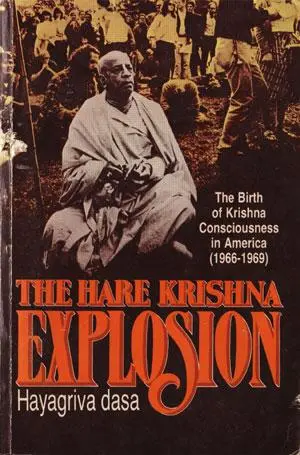
The Hare Krishna Explosion

Reference Material/Study Guide

click on image

click on image

  • LINKS