Devastating Rainfall in Vrndavana

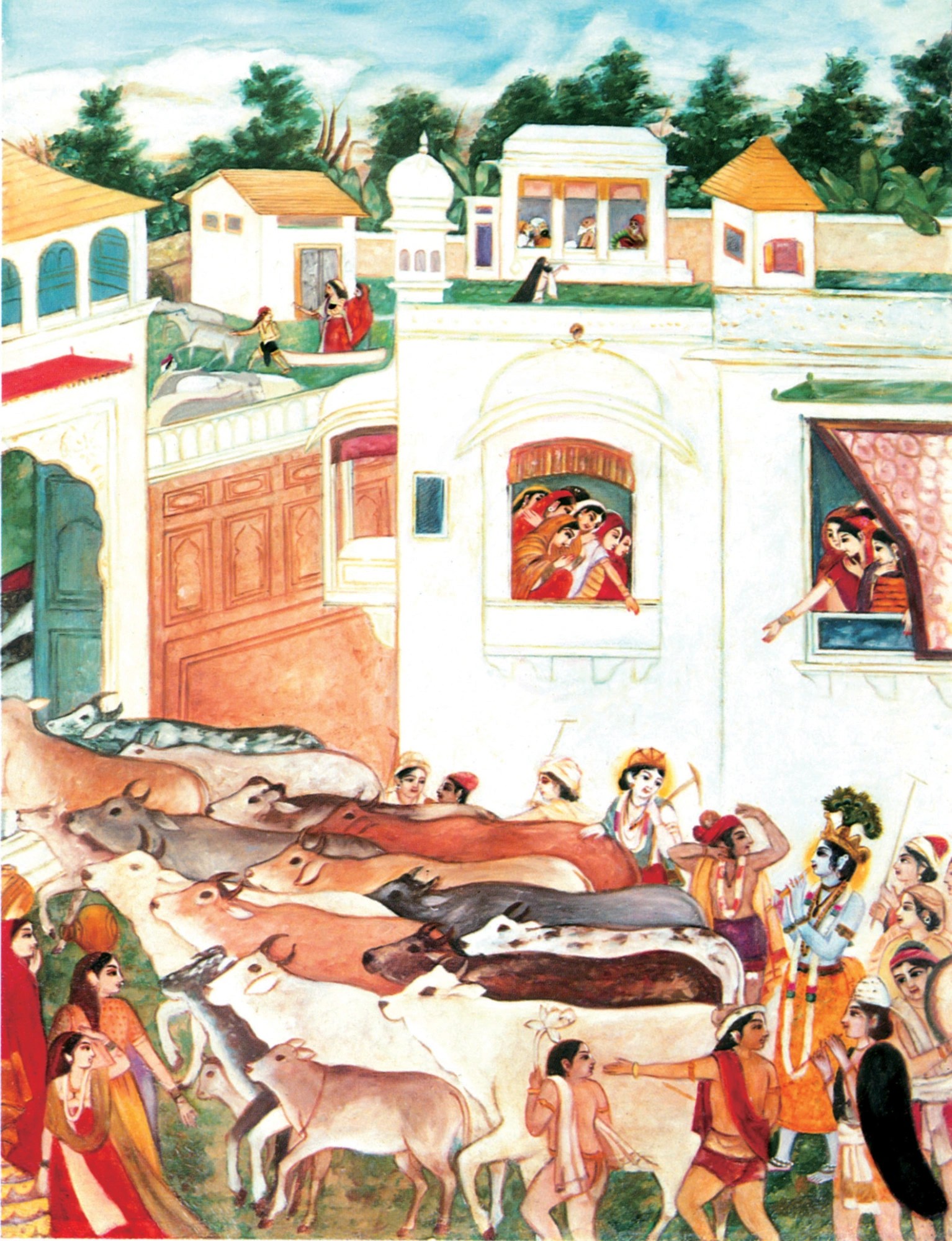
Today we celebrate Govardhana-puga, when Krishna exhibited His transcendental pastime of lifting Govardhana Hill to protect the inhabitants of Vrndavan.

The sacrifice known as Govardhana Pūjā is observed in the Kṛṣṇa consciousness movement. Lord Caitanya has recommended that since Kṛṣṇa is worshipable, so His land, Vṛndāvana and Govardhana Hill, are also worshipable. To confirm this statement, Lord Kṛṣṇa said that Govardhana Pūjā is as good as worship of Him. From that day, the Govardhana Pūjā has been still going on and is known as Annakūṭa. In all the temples of Vṛndāvana or outside of Vṛndāvana, huge quantities of food are prepared in this ceremony and are very sumptuously distributed to the general population. Sometimes the food is thrown to the crowds, and they enjoy collecting it off the ground. From these instances, we can understand that prasādam offered to Kṛṣṇa never becomes polluted or contaminated, even if it is thrown on the ground. The people, therefore, collect it and eat with great satisfaction. (from Kṛṣṇa, The Supreme Personality of Godhead, chapter 24)

On this auspicious day, we like to read from KRSNA Book, and I have included the entire 25th chapter emtitled, “Devastating Rainfall in Vrndavana”.

More

Instructions to the Devotees of the Hare Krishna Movement

Excerpted from Back to Godhead Magizine

New York City, March 31, 1974

by His Holiness Visnujana Svami.

“One may artificially repress the desires of the senses, although the taste for sensual enjoyment remains; but by ceasing such enjoyments, experiencing a higher taste, one is fixed in consciousness.” (Bhagavad-gita 2.59)

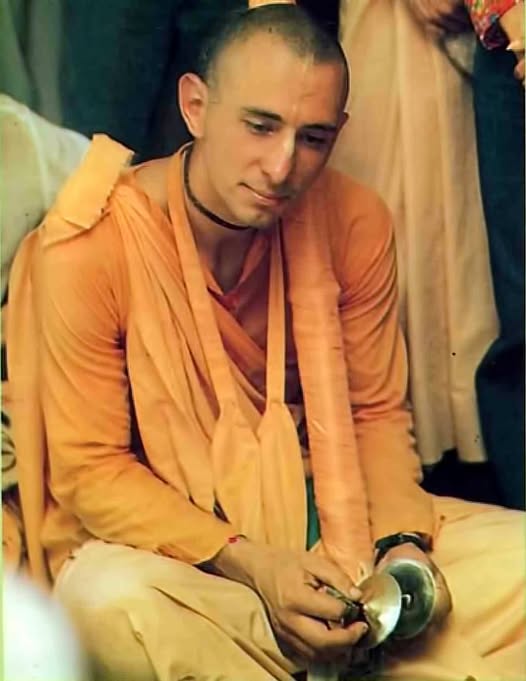
Visnujana Swami: “When one experiences ruci, which, means a taste for Spiritual life, he can rise above the attraction of the illusory energy by the mercy of the Lord. Then he is able to feel vairagya. Vairagya is the strength that protects us, even when we are neophytes in Krishna consciousness, from breaking the Krishna conscious regulative principles and being attracted to the flickering sensual enjoyments of the mundane world. Ruci, and vairagya-the taste for spiritual life and the strength to maintain it-are rarely achieved.

If you had a huge diamond and were carrying it around with you on the street, people might flock to see such a diamond. Ruci and vairagya, however, are much more valuable diamonds. But although you are all walking through the streets with these valuable gifts, unfortunately no one is interested, in following you to take advantage of them. Ruci and vairagya are such wonderful gems, however, that if you give them away to others, these gems will still stay with you.

More

Relationships With God (Krishna)

This morning I was thinking about the different relationships one can have with the Lord. In “The Nectar of Devotion”, Srila Prabhupada describes the five primary kinds of devotional service-namely, neutrality, servitude, fraternity, parenthood and conjugal love. Over the course of the next five posts, I want to explore these five primary relationships.

But for today, I want to start with this nice verse from the Bhagavad-gita, where these five types of relationships are mentioned in purport.

For one who remembers Me without deviation, I am easy to obtain, O son of Pṛthā, because of his constant engagement in devotional service. (Bg 8.14)

…Bhakti-yoga is very simple and pure and easy to perform. One can begin by simply chanting Hare Kṛṣṇa. Kṛṣṇa is very merciful to those who engage in His service, and He helps in various ways that devotee who is fully surrendered to Him so he can understand Him as He is. The Lord gives such a devotee sufficient intelligence so that ultimately the devotee can attain Him in His spiritual kingdom.

…Generally, the bhakti-yogīs are engaged in five different ways: 1) śānta-bhakta, engaged in devotional service in neutrality; 2) dāsya-bhakta, engaged in devotional service as servant; 3) sākhya-bhakta, engaged as friend; 4) vātsalya-bhakta, engaged as parent; and 5) mādhurya-bhakta, engaged as conjugal lover of the Supreme Lord. (from purport)

Full text and purport

More

The Evolutionary Process

Some years back I was reading from one book and the author was explaining how within each of us, we have the Keys to the gates of the Kingdom of Heaven, and we also have the Keys to the gates of Hell. It is our choice at every moment which we choose to use. Evolution can work both ways.

The Evolutionary Process

…All living entities within this material world are undergoing the cycle of birth and death according to the laws of nature. This struggle of birth and death in different species may be called the evolutionary process, but in the Western world it has been wrongly explained. Darwin’s theory of evolution from animal to man is incomplete because the theory does not present the reverse condition, namely evolution from man to animal.

Human life, which is obtained in the course of the evolutionary process, is a chance for elevation (svargāpavarga) or for degradation (tiraścām punar asya ca). If one uses this human form of life properly, he can elevate himself to the higher planetary systems, where material happiness is many thousands of times better than on this planet, or one may cultivate knowledge by which to become free from the evolutionary process and be reinstated in one’s original spiritual life. This is called apavarga, or liberation. (from purport to SB 7.13.25)

More

Consciousness

This morning as I went out to feed the birds, I saw a dead bird on the patio who must have crashed into the window, and it just got to thinking about what is the difference between a dead body and a live body? Consciousness. So I did a little research on that word. The simple definition of the word is:

“Consciousness is the state of being aware of oneself, one’s body, and the outside world.”

OK that is the simple definition. But in the Bhagavad-gita As It Is, Srila Prabhupada gives us a more advanced understanding:

Know that which pervades the entire body is indestructible. No one is able to destroy the imperishable soul.” (Bg. 2.17)

PURPORT

This verse more clearly explains the real nature of the soul, which is spread all over the body. Anyone can understand what is spread all over the body: it is consciousness. Everyone is conscious of the pains and pleasures of the body in part or as a whole. This spreading of consciousness is limited within one’s own body. The pains and pleasures of one body are unknown to another. Therefore, each and every body is the embodiment of an individual soul, and the symptom of the soul’s presence is perceived as individual consciousness

…This very small spiritual spark is the basic principle of the material body, and the influence of such a spiritual spark is spread all over the body as the influence of the active principle of some medicine spreads throughout the body. This current of the spirit soul is felt all over the body as consciousness, and that is the proof of the presence of the soul. Any layman can understand that the material body minus consciousness is a dead body, and this consciousness cannot be revived in the body by any means of material administration. Therefore, consciousness is not due to any amount of material combination, but to the spirit soul. . Neither Vedic knowledge nor modern science denies the existence of the spirit soul in the body, and the science of the soul is explicitly described in the Bhagavad-gita by the Personality of Godhead Himself.

So we can conclude, that that consciousness is the presence of the soul.

108 Imporant Slokas from the 1972 Bhagavad-gita As It Is

Click on image to go to Post

Click on image to go to Post

The Hare Krishna Cookbook

Songs of the Vaisnava Acaryas

Bhagavad-gita As It Is 1972 Edition “Online”

click on image

click on image to visit site

Srimad Bhagavatam Online

click on image

Raja-Vidya the King of Knowledge

click on image

click on image

Blog Stats

  • 4,571,213 hits

Enter your email address to subscribe to this blog and receive notifications of new posts by email.

Join 3,906 other subscribers

Important Slokas from the Brahma-samhita

click on image

click on image

Slokas from the Sri Isopanisad

click on image

click on image

Prayers By Queen Kunti (Slokas)

click on image

Gajendra’s Prayers of Surrender (Slokas)

click on image

A Short Statement of the Philosophy of Krishna Consciousness

click on image

click on image

July 9th Letter

click on image

click on image

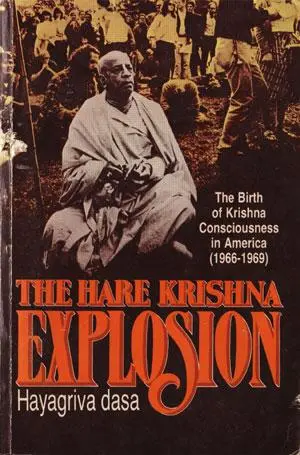
The Hare Krishna Explosion

Reference Material/Study Guide

click on image

click on image

  • LINKS