30 Jan 2012
by The Hare Krishna Movement
in A.C. Bhaktivedanta Swami Prabhupada, Advaita Acarya, Sri Caitanya-Caritamrta
Tags: A.C. Bhaktivedanta Swami Prabhupada, Adi. 12-13, Advaita Acarya, devotional service, Lord Advaita Acarya, Lords devotee, Maha-Visnu, maya, Sri Caitanya-caritamrta

Thinking of the lotus feet of Śrī Kṛṣṇa, He constantly offered tulasī buds in water from the Ganges.
While most of the world celebrated the Appearance day of Advaita Acarya yesterday…according to the BBT Art Calendar the variant date for our area is today. (go figure?) So we are posting some verses from the Sri Caitanya-caritamrta in honor of His appearance.
Sri Caitanya-caritamrta – 1975 Edition
By His Divine Grace A.C. Bhaktivedanta Swami Prabhupada
Adi-lila Chapter 1, Text 12-13
mahā-viṣṇur jagat-kartā
māyayā yaḥ sṛjaty adaḥ
tasyāvatāra evāyam
advaitācārya īśvaraḥ
mahā-viṣṇuḥ—Mahā-Viṣṇu, the resting place of the efficient cause; jagat-kartā—the creator of the cosmic world; māyayā—by the illusory energy; yaḥ—who; sṛjati—creates; adaḥ—that universe; tasya—His; avatāraḥ—incarnation; eva—certainly; ayam—this; advaita-ācāryaḥ—of the name Advaita Ācārya; īśvaraḥ—the Supreme Lord, the resting place of the material cause.
Lord Advaita Ācārya is the incarnation of Mahā-Viṣṇu, whose main function is to create the cosmic world through the actions of Māyā.
advaitaṁ hariṇādvaitād
ācāryaṁ bhakti-śaṁsanāt
bhaktāvatāram īśaṁ tam
advaitācāryam āśraye
advaitam—known as Advaita; hariṇā—with Lord Hari; advaitāt—from being nondifferent; ācāryam—known as Ācārya; bhakti-śaṁsanāt—from the propagation of devotional service to Śrī Kṛṣṇa; bhakta-avatāram—the incarnation as a devotee; īśam—to the Supreme Lord; tam—to Him; advaita-ācāryam—to Advaita Ācārya; āśraye—I surrender.
Because He is nondifferent from Hari, the Supreme Lord, He is called Advaita, and because He propagates the cult of devotion, He is called Ācārya. He is the Lord and the incarnation of the Lord’s devotee. Therefore I take shelter of Him.
Pasted from; Prabhupada Books
18 Dec 2011
by The Hare Krishna Movement
in Krishna, Krishna Consciousness, Sri Caitanya-Caritamrta
Tags: aguru, camphor, enchanter of Cupid, His Divine Grace A.C. Bhaktivedanta Swami Prabhupada, Krsna's scent, Krsna's transcendental body, Lord Caitanya Mahaprabhu, lotuses, musk, sandalwood, Sri Caitanya-caritamrta
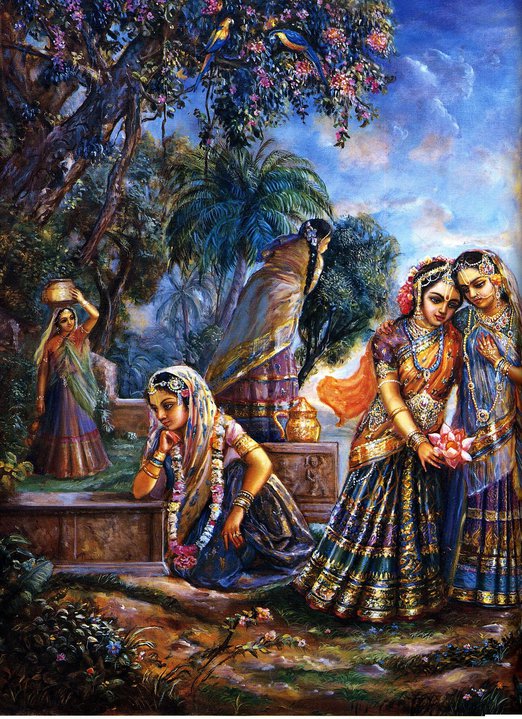
” ‘The scent of Kṛṣṇa’s transcendental body surpasses the aroma of musk and attracts the minds of all women. The eight lotus like parts of His body distribute the fragrance of lotuses mixed with that of camphor. His body is anointed with aromatic substances like musk, camphor, sandalwood and aguru. O My dear friend, that Personality of Godhead, also known as the enchanter of Cupid, always increases the desire of My nostrils.’
Sri-Caitanya-caritamrta 1975 Edition
By His Divine Grace A.C. Bhaktivedanta Swami Prabhupada
Antya 19 Text 88-106
The Inconceivable Behavior of Lord Sri Caitanya Mahaprabhu
The entire garden was filled with the scent of Lord Śrī Kṛṣṇa’s transcendental body. When Srī Caitanya Mahāprabhu smelled it, He fell unconscious at once.
The scent of Kṛṣṇa’s body, however, incessantly entered His nostrils, and the Lord became mad to relish it.
Śrīmatī Rādhārāṇī expressed to Her gopī friends how She hankers for the transcendental scent of Kṛṣṇa’s body. Śrī Caitanya Mahāprabhu recited that same verse and made its meaning clear.
More
24 Nov 2011
by The Hare Krishna Movement
in Songs of the Vaisnava Acaryas, Sri Caitanya-Caritamrta, Vegetarian Cooking
Tags: Advaita Acarya, Caitanya Caritamrta, ecstasy of Sri Caitanya Mahaprabhu, grhastha-asrama, Krishna, Lord Chaianya Mahaprabhu, Lord Nityananda, Prasadam, sak, Srila Prabhupada, vegetarian Thanksgiving

Today being Thanksgiving, we decided to post a story of one of the “Most Famous Feasts” in recent Vaisnava history, cooked by the wife of Advaita Acarya, Sita. Followed by the song composed by Srila Bhaktivinoda Thakura, “Prasada-sevya part 2” honoring this event.
Sri Caitanya-caritamrta – 1975 Edition
By His Divine Grace A.C. Bhaktivedanta Swami Prabhupada
Lord Sri Caitanya Mahaprabhu’s Stay at the House of Advaita Acarya
Madhya 3, Text 38-136
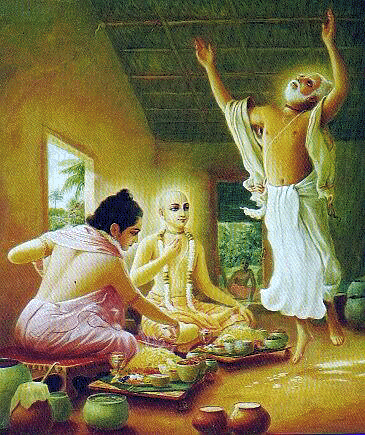
Advaita Ācārya said, “You have been fasting continuously for three days in Your ecstasy of love for Kṛṣṇa. I therefore invite You to My home, where You may kindly take Your alms. Come with Me to My residence.”
Advaita Prabhu continued, “At My home I have just cooked one palmful of rice. The vegetables are always very simple. There is no luxurious cooking-simply a little liquid vegetable and spinach.”
Saying this, Śrī Advaita Ācārya took the Lord into the boat and brought the Lord to His residence. There Advaita Ācārya washed the feet of the Lord and was consequently very happy within.
All the eatables were first cooked by the wife of Advaita Ācārya. Then Śrīla Advaita Ācārya personally offered everything to Lord Viṣṇu.
More
07 Nov 2011
by The Hare Krishna Movement
in Chanting Hare Krishna, Krishna Consciousness, Sri Caitanya-Caritamrta
Tags: 1975 edition, Caitanya Mahaprabhu His Divine Grace A.C. Bhaktivedanta Swami Prabhupada, chanting Hare Krishna, fruit of Love of Godhead, Maha Mantra, Sri Caitanya-caritamrta

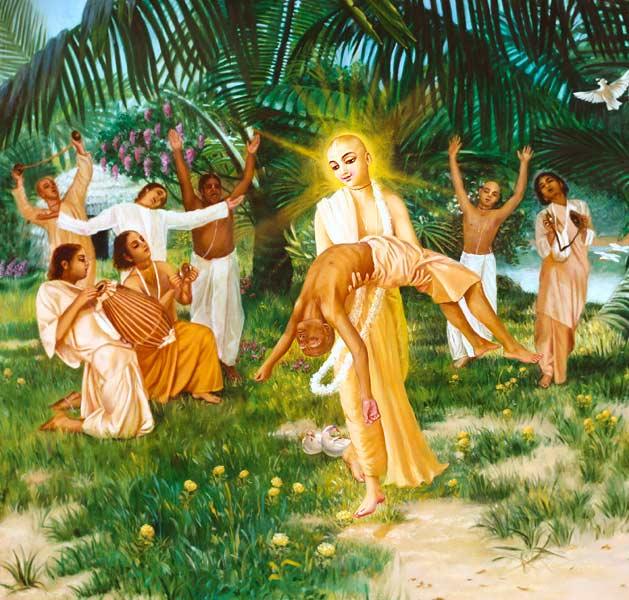
Lord Caitanya Mahaprabhu Chanting and Dancing
Sri Caitanya-caritamrta – 1975 Edition
By His Divine Grace A.C. Bhaktivedanta Swami Prabhupada
Adi-lila 9.48
The Tree of Devotional Service
yei yāhāṅ tāhāṅ dāna kare prema-phala
phalāsvāde matta loka ha-ila sakala
yei—anyone; yāhāṅ—wherever; tāhāṅ—anywhere; dāna—charity; kare—gives in; prema-phala—the fruit of love of Godhead; phala—fruit; āsvāde—by tasting; matta—intoxicated; loka—people; ha-ila—become; sakala—all.
The fruit of love of God is so relishable that wherever a devotee distributes it, those who taste the fruit, anywhere in the world, immediately become intoxicated.
Here the wonderful fruit of love of Godhead distributed by Lord Caitanya Mahāprabhu is described. We have practical experience that anyone who accepts this fruit and sincerely tastes it immediately becomes mad after it and gives up all his bad habits, being intoxicated by Caitanya Mahāprabhu’s gift, the Hare Kṛṣṇa mahā-mantra. The statements of Śrī Caitanya-caritāmṛta are so practical that anyone can test them. As far as we are concerned, we are most confident of the success of the distribution of the great fruit of love of Godhead through the medium of chanting the mahā-mantra-Hare Kṛṣṇa, Hare Kṛṣṇa, Kṛṣṇa Kṛṣṇa, Hare Hare Hare Rāma, Hare Rāma, Rāma Rāma, Hare Hare.
10 Sep 2011
by The Hare Krishna Movement
in Chanting Hare Krishna, Sri Caitanya-Caritamrta
Tags: best of the brahmanas, chanting Hare Krishna, Haridas Thakur, His Divine Grace A., holy name of Krsna, Lord Caitanya's devotee, Nama Acharya, Sri Caitanya-caritamrta
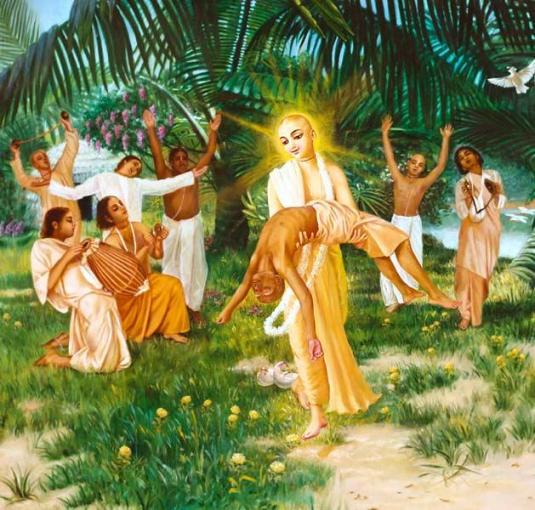
Haridas Thakur is considered to be the namacarya, the spiritual master in chanting the holy name of Krsna. Though he was born in a low class, Muslim family, Lord Caitanya’s devotees respected him as being better than the best of brahmanas. He would not eat or sleep until he finished his daily quota of chanting the name of Krsna 300,000 times. Along with Lord Nityananda, Haridas Thakur spread the chanting of Krsna’s name throughout Bengal. In Jagannatha Puri, where Haridas Thakur spent his later days, Lord Caitanya would regularly send him prasadam and discuss with him topics of Krsna. Haridas Thakur died chanting Krsna’s name in the presence of Sri Caitanya Mahaprabhu. After Haridas Thakur’s death, Lord Caitanya carried his body to the sea and with His own hands buried him in the sand.
Sri Caitanya-caritamrta – 1975 Edition
Antya-lila 3 Text49-
The Glories of Srila Haridasa Thakura
Śrī Caitanya Mahāprabhu derives great pleasure from glorifying His devotees, and among the devotees, Haridāsa Ṭhākura is the foremost.
The transcendental qualities of Haridāsa Ṭhākura are innumerable and unfathomable. One may describe a portion of them, but to count them all is impossible.
In Caitanya-maṅgala, Śrīla Vṛndāvana dāsa Ṭhākura has described the attributes of Haridāsa Ṭhākura to some extent.
No one can describe all the qualities of Haridāsa Ṭhākura. One may say something about them just to purify himself.
O devotees of Śrī Caitanya Mahāprabhu, please hear something about the qualities of Haridāsa Ṭhākura that Śrīla Vṛndāvana dāsa Ṭhākura has not described in detail.
After leaving his home, Haridāsa Ṭhākura stayed for some time in the forest of Benāpola.
Haridāsa Ṭhākura constructed a cottage in a solitary forest. There he planted a tulasī plant, and in front of the tulasī he would chant the holy name of the Lord 300,000 times daily. He chanted throughout the entire day and night.
Purport
The village of Benāpola is situated in the district of Yaśohara, which is now in Bangladesh. Benāpola is near the Banagāṅo station, which is at the border of Bangladesh and may be reached by the eastern railway from Shelda Station in Calcutta. Haridāsa Ṭhākura, being the ācārya of chanting the Hare Kṛṣṇa mahā-mantra, is called Nāmācārya Haridāsa Ṭhākura. From his personal Example we can understand that chanting the Hare Kṛṣṇa mantra and becoming highly elevated in Kṛṣṇa consciousness is very simple. Without difficulty one can sit down anywhere, especially on the bank of the Ganges, Yamunā or any sacred river, devise a sitting place or cottage, plant a tulasī, and before the tulasī chant the Hare Kṛṣṇa mahā-mantra undisturbed.
Haridāsa Ṭhākura used to chant the holy name on his beads 300,000 times daily. Throughout the entire day and night, he would chant the sixteen names of the Hare Kṛṣṇa mahā-mantra. One should not, however, imitate Haridāsa Ṭhākura, for no one else can chant the Hare Kṛṣṇa mahā-mantra 300,000 times a day. Such chanting is for the mukta-puruṣa, or liberated soul. We can follow his example, however, by chanting sixteen rounds of the Hare Kṛṣṇa mahā-mantra on beads every day and offering respect to the tulasī plant. This is not at all difficult for anyone, and the process of chanting the Hare Kṛṣṇa mahā-mantra with a vow before the tulasī plant has such great spiritual potency that simply by doing this one can become spiritually strong. Therefore we request the members of the Hare Kṛṣṇa movement to follow Haridāsa Ṭhākura’s example rigidly. Chanting sixteen rounds does not take much time, nor is offering respects to the tulasī plant difficult. The process has immense spiritual potency. One should not miss this opportunity.
Note: As Srila Prabhupada points out in his purport to Adi-lila 10, 43;
“Certainly the chanting of 300,000 holy names of the Lord is wonderful. No ordinary person can chant so many names, nor should one artificially imitate Haridāsa Ṭhākura’s behavior. It is essential, however, that everyone fulfill a specific vow to chant the Hare Kṛṣṇa mantra. Therefore we have prescribed in our Society that all our students must chant at least sixteen rounds daily. Such chanting must be offenseless in order to be of high quality. Mechanical chanting is not as powerful as chanting of the holy name without offenses.”
19 Aug 2011
by The Hare Krishna Movement
in Chanting Hare Krishna, Sri Caitanya-Caritamrta
Tags: Caitanya Caritamrta, Hare Krishna, Hare Rama, holy name, liberation, Maha Mantra, Srila Prabhupada

The holy name of Lord Krishna is an attractive feature for many saintly, liberal people. It is the annihilator of all sinful reactions and is so powerful that save for the dumb who cannot chant it, it is readily available to everyone, including the lowest type of man, the candala. The holy name of Krishna is the controller of the opulence of liberation, and it is identical with Krishna.
Simply by touching the holy name with one’s tongue, immediate effects are produced. Chanting the holy name does not depend on initiation, pious activities or the purascarya regulative principles generally observed before initiation. The holy name does not wait for all these activities. It is self-sufficient. (Caitanya-caritmrta Mad.15.110)
Hare Krishna, Hare Krishna, Krishna Krishna, Hare Hare,
Hare Rama, Hare Rama, Rama Rama, Hare Hare…
02 Jul 2011
by The Hare Krishna Movement
in Guru & Disciple, Sri Caitanya-Caritamrta
Tags: Acharya, Adi-lila 1.46, guru, spiritual master, Sri Caitanya-caritamrta, Srila Prabhupada

Śrī Caitanya-caritāmṛta
By His Divine Grace A. C. Bhaktivedanta Swami Prabhupada
Only out of His immense compassion does the Personality of Godhead reveal Himself as the spiritual master. Therefore in the dealings of an ācārya there are no activities but those of transcendental loving service to the Lord. He is the Supreme Personality of Servitor Godhead. It is worthwhile to take shelter of such a steady devotee, who is called āśraya-vigraha, or the manifestation or form of the Lord of whom one must take shelter.
Ādi-līlā Chapter One Text 46
ācāryaṁ māṁ vijānīyān
nāvamanyeta karhicit
na martya-buddhyāsūyeta
sarva-deva-mayo guruḥ
SYNONYMS
ācāryam—the spiritual master; mām—Myself; vijānīyāt—one should know; na avamanyeta—one should never disrespect; karhicit—at any time; na—never; martya-buddhyā—with the idea of his being an ordinary man; asūyeta—one should be envious; sarva-deva—of all demigods; mayaḥ—representative; guruḥ—the spiritual master.
TRANSLATION
“One should know the ācārya as Myself and never disrespect him in any way. One should not envy him, thinking him an ordinary man, for he is the representative of all the demigods.”
PURPORT
This is a verse from Śrīmad-Bhāgavatam (11.17.27) spoken by Lord Kṛṣṇa when He was questioned by Uddhava regarding the four social and spiritual orders of society. He was specifically instructing how a brahmacārī should behave under the care of a spiritual master. A spiritual master is not an enjoyer of facilities offered by his disciples. He is like a parent. Without the attentive service of his parents, a child cannot grow to manhood; similarly, without the care of the spiritual master one cannot rise to the plane of transcendental service.
The spiritual master is also called ācārya, or a transcendental professor of spiritual science. The Manu-saṁhitā (2.140) explains the duties of an ācārya, describing that a bona fide spiritual master accepts charge of disciples, teaches them the Vedic knowledge with all its intricacies, and gives them their second birth. The ceremony performed to initiate a disciple into the study of spiritual science is called upanīti, or the function that brings one nearer to the spiritual master. One who cannot be brought nearer to a spiritual master cannot have a sacred thread, and thus he is indicated to be a śūdra. The sacred thread on the body of a brāhmaṇa, kṣatriya or vaiśya is a symbol of initiation by the spiritual master; it is worth nothing if worn merely to boast of high parentage. The duty of the spiritual master is to initiate a disciple with the sacred thread ceremony, and after this saṁskāra, or purificatory process, the spiritual master actually begins to teach the disciple about the Vedas. A person born a śūdra is not barred from such spiritual initiation, provided he is approved by the spiritual master, who is duly authorized to award a disciple the right to be a brāhmaṇa if he finds him perfectly qualified. In the Vāyu Purāṇa an ācārya is defined as one who knows the import of all Vedic literature, explains the purpose of the Vedas, abides by their rules and regulations, and teaches his disciples to act in the same way.
More
26 Jun 2011
by The Hare Krishna Movement
in Caitanya Mahaprabhu, Festivals, Sri Caitanya-Caritamrta
Tags: Balarama, ecstatic dancing of Lord Caitanya, His Divine Grace A.C. Bhaktivedanta Swami Prabhupada, Lord Jaganath, Ratha-yatra, Sri Caitanya-carimrta, Sri Jagannatha, Subadra, Surpreme Personality of Godhead
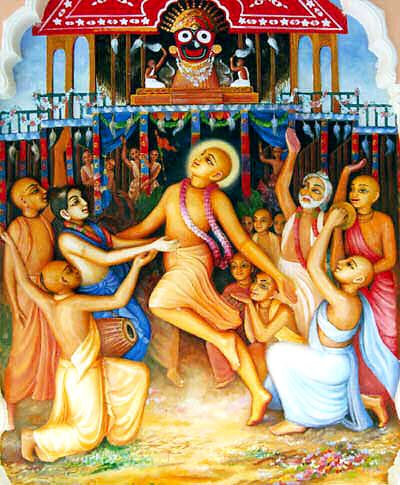
Śrī Caitanya-caritāmṛta: Madhya-līlā Text 1-69
By His Divine Grace A. C. Bhaktivedanta Swami Prabhupada
The Ecstatic Dancing of the Lord at Ratha-yātrā
May the Supreme Personality of Godhead, Śrī Kṛṣṇa Caitanya, who danced in front of the car of Śrī Jagannātha, be all glorified! By seeing His dancing, not only was the whole universe held in wonder, but Lord Jagannātha Himself became very much astonished.
All glories to Śrī Kṛṣṇa Caitanya and Prabhu Nityānanda! All glories to Advaitacandra! And all glories to the devotees of Lord Śrī Caitanya Mahāprabhu!
All glories to the listeners of Caitanya-caritāmṛta. Please hear the description of the dancing of Lord Caitanya Mahāprabhu at the Ratha-yātrā festival. His dancing is very enchanting. Please hear of it with great attention.
More
07 Jun 2011
by The Hare Krishna Movement
in Sri Caitanya-Caritamrta
Tags: A.C. Bhaktivedanta Swami Prabhupada, envious, jealous people in the dress of Vaisnavas, Krsna consciousness movement, Rupa Goswami, Sanatana Goswami, Sri Caitanya-caritamrta, Vaisnavas

Sri Caitanya-caritamrta – 1975 Edition
By His Divine Grace A. C. Bhaktivedanta Swami Prabhupada
Madhya 1: The Later Pastimes of Lord Sri Caitanya Mahaprabhu
The spiritual master initiates the disciple to deliver him, and if the disciple executes the order of the spiritual master and does not offend other Vaiṣṇavas, his path is clear.
“There are many jealous people in the dress of Vaisnavas in this Krsna consciousness movement, and they should be completely neglected. There is no need to serve a jealous person who is in the dress of a Vaisnava.”
One should neglect an envious person. A preacher’s duty is to love the Supreme Personality of Godhead, make friendships with Vaiṣṇavas, show mercy to the innocent and reject or neglect those who are envious or jealous.
TEXT 218
dui jane prabhura kṛpā dekhi’ bhakta-gaṇe
‘hari’ ‘hari’ bale sabe ānandita-mane
SYNONYMS
dui jane—unto the two persons; prabhura—of the Lord; kṛpā—the mercy; dekhi’-seeing; bhakta-gaṇe—all the devotees; hari hari—the holy name of the Lord; bale—chant; sabe—all; ānandita—cheerful; mane—in the mind.
TRANSLATION
When all of the devotees saw the mercy of the Lord upon the two brothers, they were very much gladdened, and they began to chant the holy name of the Lord, “Hari! Hari!”
PURPORT
Śrīla Narottama dāsa Ṭhākura says, chāḍiyā vaiṣṇava sevā nistāra pāyeche kebā: unless one serves a Vaiṣṇava, he cannot be delivered. The spiritual master initiates the disciple to deliver him, and if the disciple executes the order of the spiritual master and does not offend other Vaiṣṇavas, his path is clear. Consequently Śrī Caitanya Mahāprabhu requested all the Vaiṣṇavas present to show mercy toward the two brothers, Rūpa and Sanātana, who had just been initiated by the Lord. When a Vaiṣṇava sees that another Vaiṣṇava is a recipient of the Lord’s mercy, he becomes very happy. Vaiṣṇavas are not envious. If a Vaiṣṇava, by the mercy of the Lord, is empowered by Him to distribute the Lord’s holy name all over the world, other Vaiṣṇavas become very joyful-that is, if they are truly Vaiṣṇavas. One who is envious of the success of a Vaiṣṇava is certainly not a Vaiṣṇava himself, but an ordinary mundane man. Envy and jealousy are manifested by mundane people, not by Vaiṣṇavas. Why should a Vaiṣṇava be envious of another Vaiṣṇava who is successful in spreading the holy name of the Lord? An actual Vaiṣṇava is very pleased to accept another Vaiṣṇava who is bestowing the Lord’s mercy. A mundane person in the dress of a Vaiṣṇava should not be respected but rejected. This is enjoined in the śāstra (upekṣā). The word upekṣā means neglect. One should neglect an envious person. A preacher’s duty is to love the Supreme Personality of Godhead, make friendships with Vaiṣṇavas, show mercy to the innocent and reject or neglect those who are envious or jealous. There are many jealous people in the dress of Vaiṣṇavas in this Kṛṣṇa consciousness movement, and they should be completely neglected. There is no need to serve a jealous person who is in the dress of a Vaiṣṇava. When Narottama dāsa Ṭhākura says chāḍiyā vaiṣṇava sevā nistāra payeche kebā, he is indicating an actual Vaiṣṇava, not an envious or jealous person in the dress of a Vaiṣṇava.
03 Jun 2011
by The Hare Krishna Movement
in Advaita Acarya, Advaita Acharya, Diksha, Guru & Disciple, Siksa, Sri Caitanya-Caritamrta
Tags: A.C. B, Adi lila, Advaita Acarya, disciples, Gaudiya Matha, guru, haktivedanta Swami Prabhupada, litigation, missionary activities, spiritual master, Sri Caitanya-caritamrta
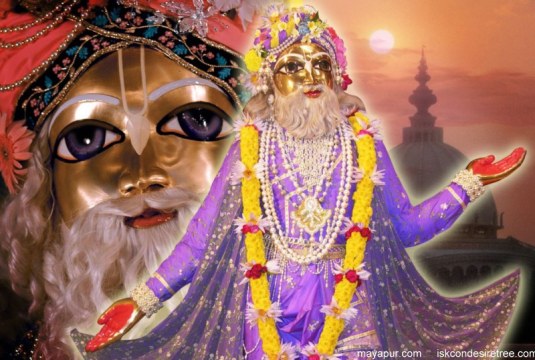
The order of the spiritual master is the active principle in spiritual life. Anyone who disobeys the order of the spiritual master immediately becomes useless. (Adi 12.10)
…the followers of Advaita Ācārya divided into two parties. Such disagreement among the disciples of one ācārya is also found among the members of the Gauḍīya Maṭha. In the beginning, during the presence of Oṁ Viṣṇupāda Paramahaṁsa Parivrājakācārya Aṣṭottara-śata Śrī Śrīmad Bhaktisiddhānta Sarasvatī Ṭhākura Prabhupāda, all the disciples worked in agreement; but just after his disappearance, they disagreed. One party strictly followed the instructions of Bhaktisiddhānta Sarasvatī Ṭhākura, but another group created their own concoction about executing his desires. Bhaktisiddhānta Sarasvatī Ṭhākura, at the time of his departure, requested all his disciples to form a governing body and conduct missionary activities cooperatively. He did not instruct a particular man to become the next ācārya. But just after his passing away, his leading secretaries made plans, without authority, to occupy the post of ācārya, and they split into two factions over who the next ācārya would be. Consequently, both factions were asāra, or useless, because they had no authority, having disobeyed the order of the spiritual master. Despite the spiritual master’s order to form a governing body and execute the missionary activities of the Gauḍīya Maṭha, the two unauthorized factions began litigation that is still going on after forty years with no decision. (Adi 12.8 purport)
More
14 May 2011
by The Hare Krishna Movement
in Lectures, Sri Caitanya-Caritamrta
Tags: Caitanya Caritamrta, Goswami, immortal, International Society for Krishna Consciousness, Krsnadas Kaviraja, living force, living force in immortality, material condition, Srila Prabhupada

Sri Caitanya-caritāmṛta
By HIs Divine Grace A.C. Bhaktivedanta Swami Prabhupada
(Originally delivered as five morning lectures on the Caitanya-caritāmṛta-the authoritative biography of Lord Caitanya Mahāprabhu by Kṛṣṇadāsa Kavirāja Gosvāmī-before the International Society for Krishna Consciousness, New York City, April 10-14, 1967.)
Introduction
The word caitanya means “living force.” As living entities, we can move, but a table cannot because it does not possess living force. Movement and activity may be considered signs or symptoms of the living force. Indeed, it may be said that there can be no activity without the living force. Although the living force is present in the material condition, it is not amṛta, immortal. The words caitanya-caritāmṛta, then, may be translated as “the character of the living force in immortality.”
But how is this living force displayed immortally? It is not displayed by man or any other creature in this material universe, for none of us are immortal in these bodies. We possess the living force, we perform activities, and we are immortal by our nature and constitution, but the material condition into which we have been put does not allow our immortality to be displayed. It is stated in the Kaṭha Upaniṣad that eternality and the living force belong both to ourselves and God. Although this is true in that both God and ourselves are immortal, there is a difference. As living entities, we perform many activities, but we have a tendency to fall down into material nature. God has no such tendency. Being all-powerful, He never comes under the control of material nature. Indeed, material nature is but one display of His inconceivable energies.
From the ground we may see only clouds in the sky, but if we fly above the clouds we can see the sun shining. From the sky, skyscrapers and cities seem very tiny; similarly, from God’s position this entire material creation is insignificant. The tendency of the conditioned living entity is to come down from the heights, where everything can be seen in perspective. God, however, does not have this tendency. The Supreme Lord is not subject to fall down into illusion (māyā), any more than the sun is subject to fall beneath the clouds. Because the Supreme Lord is not subject to illusion, He is unconditioned; because we, as finite living entities, are prone to fall into illusion, we are called conditioned. Impersonalist philosophers (Māyāvādīs) maintain that both the living entity and God Himself are under the control of māyā when they come into this material world. This may be true of the living entity, but it is not true of God, for in all instances the material energy is working under His direction. Those who think the Supreme Lord is subject to material conditioning are called fools by Kṛṣṇa Himself in the Bhagavad-gītā (9.11):
More
05 May 2011
by The Hare Krishna Movement
in Sri Caitanya-Caritamrta
Tags: Adi-lila 3.52, bhagavatam, Caitanya Mahaprabhu, chanting Hare Krishna, golden complexion, Lord Caitanya, sankirtan, Sri Caitanya-caritamrta, Srila Prabhupada
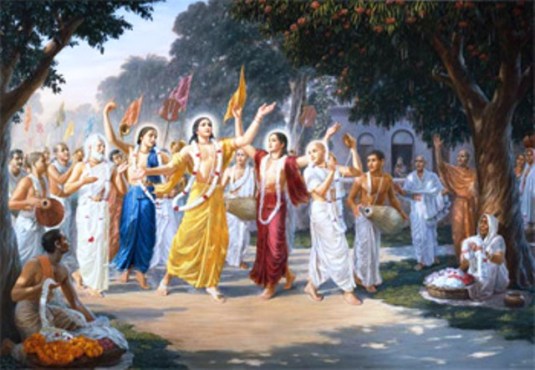
Sri Caitanya-caritamrta – 1975 Edition
By His Divine Grace A.C.Bhaktivedanta Swami Prabhupada
Adi 3.52
TRANSLATION
“In the Age of Kali, intelligent persons perform congregational chanting to worship the incarnation of Godhead who constantly sings the name of Kṛṣṇa. Although His complexion is not blackish, He is Kṛṣṇa Himself. He is accompanied by His associates, servants, weapons and confidential companions.”
PURPORT
This text is from Śrīmad-Bhāgavatam (11.5.32). Śrīla Jīva Gosvāmī has explained this verse in his commentary on the Bhāgavatam, known as the Krama-sandarbha, wherein he says that Lord Kṛṣṇa also appears with a golden complexion. That golden Lord Kṛṣṇa is Lord Caitanya, who is worshiped by intelligent men in this age. That is confirmed in Śrīmad-Bhāgavatam by Garga Muni, who said that although the child Kṛṣṇa was blackish, He also appears in three other colors-red, white and yellow. He exhibited His white and red complexions in the Satya and Tretā ages respectively. He did not exhibit the remaining color, yellow-gold, until He appeared as Lord Caitanya, who is known as Gaura Hari.
Śrīla Jīva Gosvāmī explains that kṛṣṇa-varṇam means Śrī Kṛṣṇa Caitanya. Kṛṣṇa-varṇa and Kṛṣṇa Caitanya are equivalent. The name Kṛṣṇa appears with both Lord Kṛṣṇa and Lord Caitanya Kṛṣṇa. Lord Śrī Caitanya Mahāprabhu is the Supreme Personality of Godhead, but He always engages in describing Kṛṣṇa and thus enjoys transcendental bliss by chanting and remembering His name and form. Lord Kṛṣṇa Himself appears as Lord Caitanya to preach the highest gospel.
Lord Caitanya always chants the holy name of Kṛṣṇa and describes it also, and because He is Kṛṣṇa Himself, whoever meets Him will automatically chant the holy name of Kṛṣṇa and later describe it to others. He injects one with transcendental Kṛṣṇa consciousness, which merges the chanter in transcendental bliss. In all respects, therefore, He appears before everyone as Kṛṣṇa, either by personality or by sound. Simply by seeing Lord Caitanya one at once remembers Lord Kṛṣṇa. One may therefore accept Him as viṣṇu-tattva. In other words, Lord Caitanya is Lord Kṛṣṇa Himself.
Sāṅgopāṅgāstra-pārṣadam further indicates that Lord Caitanya is Lord Kṛṣṇa. His body is always decorated with ornaments of sandalwood and with sandalwood paste. By His superexcellent beauty He subdues all the people of the age. In other descents the Lord sometimes used weapons to defeat the demoniac, but in this age the Lord subdues them with His all-attractive figure as Caitanya Mahāprabhu. Śrīla Jīva Gosvāmī explains that His beauty is His astra, or weapon, to subdue the demons. Because He is all-attractive, it is to be understood that all the demigods lived with Him as His companions. His acts were uncommon and His associates wonderful. When He propagated the saṅkīrtana movement, He attracted many great scholars and ācāryas, especially in Bengal and Orissa. Lord Caitanya is always accompanied by His best associates like Lord Nityānanda, Advaita, Gadādhara and Śrīvāsa.
Śrīla Jīva Gosvāmī cites a verse from the Vedic literature which says that there is no necessity of performing sacrificial demonstrations or ceremonial functions. He comments that instead of engaging in such external, pompous exhibitions, all people, regardless of caste, color or creed, can assemble together and chant Hare Kṛṣṇa to worship Lord Caitanya. Kṛṣṇa-varṇaṁ tviṣākṛṣṇam indicates that prominence should be given to the name of Kṛṣṇa. Lord Caitanya taught Kṛṣṇa consciousness and chanted the name of Kṛṣṇa.
Therefore, to worship Lord Caitanya, everyone should together chant the mahā-mantra-Hare Kṛṣṇa, Hare Kṛṣṇa, Kṛṣṇa Kṛṣṇa, Hare Hare Hare Rāma, Hare Rāma, Rāma Rāma, Hare Hare. To propagate worship in churches, temples or mosques is not possible, because people have lost interest in that. But anywhere and everywhere, people can chant Hare Kṛṣṇa. Thus worshiping Lord Caitanya, they can perform the highest activity and fulfill the highest religious purpose of satisfying the Supreme Lord.
Śrīla Sārvabhauma Bhaṭṭācārya, a famous disciple of Lord Caitanya, said, “The principle of transcendental devotional service having been lost, Śrī Kṛṣṇa Caitanya has appeared to deliver again the process of devotion. He is so kind that He is distributing love of Kṛṣṇa. Everyone should be attracted more and more to His lotus feet, as humming bees are attracted to a lotus flower.”
29 Apr 2011
by The Hare Krishna Movement
in Guru & Disciple, Sri Caitanya-Caritamrta
Tags: books by Srila Prabhupada, Caitanya-caritamrita, guru, maha-bhagavata, prabhupada, qualifications of disciple, spiritual master, symptoms of a bona fide spiritual master

The guru must be situated on the topmost platform of devotional service. There are three classes of devotees, and the guru must be accepted from the topmost class. The first-class devotee is the spiritual master for all kinds of people.
The disciple must have the following qualifications. He must give up interest in the material bodily conception. He must give up material lust, anger, greed, illusion, madness and envy. He should be interested only in understanding the science of God, and he should be ready to consider all points in this matter. He should no longer think, “I am this body,” or, “This thing belongs to me.” One must love the spiritual master with unflinching faith, and one must be very steady and fixed. The bona fide disciple should be inquisitive to understand transcendental subject matter. He must not search out faults among good qualities, and he should no longer be interested in material topics. His only interest should be Kṛṣṇa, the Supreme Personality of Godhead.
From Sri Caitanya-caritamrta – 1975 Edition
Madhya 24.330
By His Divine Grace A.C. Bhaktivedanta Swami Prabhupada
TEXT 330
guru-lakṣaṇa, śiṣya-lakṣaṇa, doṅhāra parīkṣaṇa
sevya–bhagavān, sarva-mantra-vicāraṇa
SYNONYMS
guru-lakṣaṇa—the symptoms of a bona fide spiritual master; śiṣya-lakṣaṇa—the symptoms of a bona fide disciple; doṅhāra—of both; parīkṣaṇa—the testing; sevya-bhagavān—the Supreme Personality of Godhead is worshipable; sarva-mantra-vicāraṇa—consideration of the different types of mantras.
TRANSLATION
“In your book there should be the characteristics of the bona fide guru and the bona fide disciple. Then, before accepting a spiritual master, one can be assured of the spiritual master’s position. Similarly, the spiritual master can also be assured of the disciple’s position. The Supreme Personality of Godhead, Kṛṣṇa, should be described as the worshipable object, and you should consider the bīja-mantra for the worship of Kṛṣṇa, Rāma or any other expansion of the Supreme Personality of Godhead.
PURPORT
In the Padma Purāṇa, the characteristics of the guru, the bona fide spiritual master, have been described:
mahā-bhāgavata-śreṣṭho
brāhmaṇo vai gurur nṛṇām
sarveṣām eva lokānām
asau pūjyo yathā hariḥ
mahā-kula-prasūto ‘pi
sarva-yajñeṣu dīkṣitaḥ
sahasra-śākhādhyāyī ca
na guruḥ syād avaiṣṇavaḥ
The guru must be situated on the topmost platform of devotional service. There are three classes of devotees, and the guru must be accepted from the topmost class. The first-class devotee is the spiritual master for all kinds of people. It is said: gurur nṛṇām. The word nṛṇām means “of all human beings.” The guru is not limited to a particular group. It is stated in the Upadeśāmṛta of Rūpa Gosvāmī that a guru is a gosvāmī, a controller of the senses and the mind. Such a guru can accept disciples from all over the world. Pṛthivīṁ sa śiṣyāt. This is the test of the guru.
More
02 Apr 2011
by The Hare Krishna Movement
in Devotional Service, Sri Caitanya-Caritamrta, Uncategorized
Tags: arcanam, atma-nivedanam, chanting the names of the Lord, dasyam, kirtanam, pada-sevanam, sakhyam, Sarvabhauma Bhattacarya, smaranam, sravanam, vandanam, vysnoh

Sri Caitanya-caritamrta
Madhya-lila Ch. 6, Text 241-242
TEXT 241
bhakti-sādhana-śreṣṭha śunite haila mana
prabhu upadeśa kaila nāma-saṅkīrtana
TRANSLATION
Then the Bhaṭṭācārya asked Caitanya Mahāprabhu, “Which item is most important in the execution of devotional service?” The Lord replied that the most important item was the chanting of the holy name of the Lord.
PURPORT
There are nine items to be executed in devotional service. These are enumerated in the following verse from Śrīmad-Bhāgavatam (7.5.23):
śravaṇaṁ kīrtanaṁ viṣṇoḥ
smaraṇaṁ pāda-sevanam
arcanaṁ vandanaṁ dāsyaṁ
sakhyam ātma-nivedanam
Hearing the glories of the Lord, chanting, remembering, serving the lotus feet of the Lord, offering worship in the temple, offering prayers, becoming a servant of the Lord, becoming the Lord’s friend, and sarvātma-nivedana, offering oneself fully at the lotus feet of the Lord-these are the nine devotional processes. In The Nectar of Devotion, When Sārvabhauma Bhaṭṭācārya asked the Lord which item was most important, Śrī Caitanya Mahāprabhu immediately answered that the most important item is the chanting of the holy names of the Lord-Hare Kṛṣṇa, Hare Kṛṣṇa, Kṛṣṇa Kṛṣṇa, Hare Hare Hare Rāma, Hare Rāma, Rāma Rāma, Hare Hare. He then quoted the following verse from the Bṛhan-nāradīya Purāṇa (Thirty-eighth Chapter, verse 126) to confirm His statement.
More
19 Mar 2011
by The Hare Krishna Movement
in Caitanya Mahaprabhu, Sri Caitanya-Caritamrta
Tags: Adi-lila 7.1, Caitanya Caritamrta, life force, magnanimity of Sri Caitanya, Sri Caitanya Mahaprabhu, Sridhama Mayapur, Srila Prabhupada discourse, teaching of Lord Caitanya, ultimate goal of life
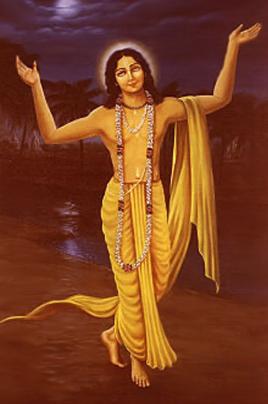
Caitanya Caritamrta Adi 7.1
Mayapur, March 1, 1974
Srila Prabhupada’s discourse follows below:
Pradyumna: Translation: “Let me first offer my respectful obeisances unto Lord Caitanya Mahaprabhu, who is the ultimate goal of life for one bereft of all possessions in this material world and is the only meaning for one advancing in spiritual life. Thus let me write about His magnanimous contribution of devotional service in love of God.”
Prabhupada:
agaty-eka-gatim natva
hinarthadhika-sadhakam
sri-caitanyam likhyate asya
prema-bhakti-vadanyata
[Cc. Adi 7.1]
So Sri Caitanya Mahaprabhu… This is the place of Sri Caitanya Mahaprabhu, appearance site of Sri Caitanya Mahaprabhu, Sridhama Mayapur. So in this place this is the appropriate literature, Sri-caitanya-caritamrta. We may try to discuss during these holy days. Last year some gentleman suggested, after seeing my all literatures, that “You kindly write a translation of Sri-Caitanya-caritamrta.”
More
15 Mar 2011
by The Hare Krishna Movement
in Sri Caitanya-Caritamrta
Tags: Caitanya Mahaprabhu, devotional service, diksa guru, Gopinath, Ishvara Puri, Madhavendra Puri, Malaya Mountains, Orissa, sankirtan movement of Chaitanya Mahaprabhu, Vrindavan

Sri Madhavendra Puri
Disappearance day – 17th March, 2011
Madhavendra Puri Discovers Gopala
Madhavendra Puri also known as Madhavendra Puri Goswami appeared in the 14th century.
After making an extensive pilgrimage of India as a sannyasi he passed his life in Vrindavana and Orissa. The main source of knowledge about him is Chaitanya Charitamrita. He belongs to the Madhva line being a disciple of Lakshmipati Tirtha and he was the founder of the Vaishnava centre at Mathura, Vrindavana. He is considered a fountainhead of devotional worship of Krishna and he has started the worship of the Gopala deity, better known as Shrinathji. He is attributed to the discovery of the famous deity of Gopala near Govardhana that was later worshiped by Vallabhacharya, follower of Vishnuswami in Rudra sampradaya, who in turn was influenced by devotional mood of Vrindavana. He is also famed for receiving direct instructions and gifts from the deity of Gopinatha, who commanded him to travel for the supply of scarce sandal wood paste from Orissa to the Malaya Mountains.
Initiating the sankirtana movement
Madhavendra Puri is accepted as the initiator of the movement of Chaitanya Mahaprabhu, who accepted Madhavendra’s intimate disciple, Ishvara Puri as his diksa guru. He was preaching the principles of Gaudiya Vaishnavism prior to Lord Chaitanya.
More
02 Mar 2011
by The Hare Krishna Movement
in Books by Srila Prabhupada, Sri Caitanya-Caritamrta
Tags: back to Godhead, Lord Caitanya, Madhya-lila, madman, mercy, Sri Caitanya-carimrta, Srila Prabhupada, Srimad Bhagavatam
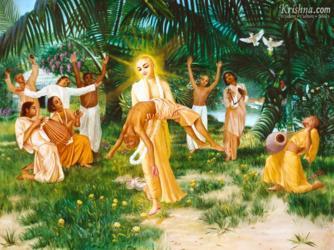
Sri Caitanya-caritmrta
by His Divine Grace A.C. Bhaktivedanta Swami Prabhupada
Madhaya-lila Vol. 5 Text 237-239
TRANSLATION TEXT 237
“Be patient and return home. Don’t be a crazy fellow. By and by you will be able to cross the ocean of material existence.
PURPORT
As stated in Śrīmad-Bhāgavatam (10.14.58):
samāśritā ye pada-pallava-plavaṁ
mahat-padaṁ puṇya-yaśo-murāreḥ
bhavāmbudhir vatsa-padaṁ paraṁ padaṁ
padaṁ padaṁ yad vipadāṁ na teṣām
This material world is just like a big ocean. It begins with Brahmaloka and extends to Pātālaloka, and there are many planets, or islands, in this ocean. Not knowing about devotional service, the living entity wanders about this ocean, just as a man tries to swim to reach the shore. Our struggle for existence is similar to this. Everyone is trying to get out of the ocean of material existence. One cannot immediately reach the coast, but if one endeavors, he can cross the ocean by Śrī Caitanya Mahāprabhu’s mercy. One may be very eager to cross this ocean, but he cannot attain success by acting like a madman. He must swim over the ocean very patiently and intelligently under the instructions of Śrī Caitanya Mahāprabhu or His representative. Then, one day, he will reach the shore and return home, back to Godhead.
More
21 Feb 2011
by The Hare Krishna Movement
in Sri Caitanya-Caritamrta
Tags: chanting & dancing, Krishna consciousness, love of God, nectar, six goswami's, Sri Caitanya Caritamrta, Sri Panca-tatva, Sri Srinivasa Acarya, transcendental love

Sri Caitanya-Caritamrta Adi Lila 7.22
By His Divine Grace A.C. Bhaktivedanta Swami Prabhupada
TRANSLATION
Śrī Pañca-tattva themselves danced again and again and thus made it easier to drink nectarean love of Godhead. They danced, cried, laughed and chanted like madmen, and in this way they distributed love of Godhead.
PURPORT
People generally cannot understand the actual meaning of chanting and dancing. Describing the Gosvāmīs, Śrī Śrīnivāsa Ācārya stated, kṛṣṇotkīrtana-gāna-nartana-parau: not only did Lord Caitanya Mahāprabhu and His associates demonstrate this chanting and dancing, but the six Gosvāmīs also followed in the next generation. The present Kṛṣṇa consciousness movement follows the same principle, and therefore simply by chanting and dancing we have received good responses all over the world. It is to be understood, however, that this chanting and dancing do not belong to this material world. They are actually transcendental activities, for the more one engages in chanting and dancing, the more he can taste the nectar of transcendental love of Godhead.

Next Newer Entries











 The Hare Krishna Movement