The Deliverance of Śiśupāla

click on image to enlarge

…Śiśupāla went crazy because of Kṛṣṇa’s being elected the supreme first-worshiped person in that meeting, and he spoke so irresponsibly that it appeared that he had lost all his good fortune. Being overcast with misfortune, Śiśupāla continued to insult Kṛṣṇa further, and Lord Kṛṣṇa patiently heard him without protest. Just as a lion does not care when a flock of jackals howl, Lord Kṛṣṇa remained silent and unprovoked. Kṛṣṇa did not reply to even a single accusation made by Śiśupāla, but all the members present in the meeting, except a few who agreed with Śiśupāla, became very agitated because it is the duty of any respectable person not to tolerate blasphemy against God or His devotee. Some of them, who thought that they could not properly take action against Śiśupāla, left the assembly in protest, covering their ears with their hands in order not to hear further accusations. Thus they left the meeting condemning the action of Śiśupāla. It is the Vedic injunction that whenever there is blasphemy of the Supreme Personality of Godhead, one must immediately leave. If he does not do so, he becomes bereft of his pious activities and is degraded to the lower condition of life.

All the kings present, belonging to the Kuru dynasty, Matsya dynasty, Kekaya dynasty and Sṛñjaya dynasty, became very angry and immediately took up their swords and shields to kill Śiśupāla. Śiśupāla was so foolish that he did not become even slightly agitated, although all the kings present were ready to kill him. He did not care to think of the pros and cons of his foolish talking, and when he saw that all the kings were ready to kill him, instead of stopping, he stood to fight with them and took up his sword and shield. When Lord Kṛṣṇa saw that they were going to engage in fighting in the arena of the auspicious Rājasūya yajña, He personally pacified them. Out of His causeless mercy He Himself decided to kill Śiśupāla. When Śiśupāla was abusing the kings who were about to attack him, Lord Kṛṣṇa took up His disc, which was as sharp as the blade of a razor, and immediately separated the head of Śiśupāla from his body.

…Śukadeva Gosvāmī assured Mahārāja Parīkṣit that the pastimes of Lord Kṛṣṇa–the killing of Śiśupāla and Jarāsandha and the releasing of the imprisoned kings–are all transcendental vibrations, and anyone who hears these narrations from the authorized persons will be immediately freed from all the reactions of the sinful activities of his life.

Kṛṣṇa, The Supreme Personality of Godhead 1970 Edition
By His Divine Grace A.C. Bhaktivedanta Swami Prabhupada
Vol. 2, Chapter 19

The Deliverance of Śiśupāla

Full Chapter More

Summer Season

The astronomical summer (Northern Hemisphere) begins today Wednesday, June 20, 2012, and ends Friday, September 21, 2012.

…The summer season in India is not very much welcomed because of the excessive heat, but in Vṛndāvana everyone was pleased because summer there appeared just like spring. This was possible only because Lord Kṛṣṇa and Balarāma, who are the controllers even of Lord Brahmā and Lord Śiva, were residing there. In Vṛndāvana there are many falls which are always pouring water, and the sound is so sweet that it covers the sound of the crickets. And because water flows all over, the forest always looks very green and beautiful.

The inhabitants of Vṛndāvana were never disturbed by the scorching heat of the sun or the high summer temperatures. The lakes of Vṛndāvana are surrounded by green grasses, and various kinds of lotus flowers bloom there, such as the kalhāra-kañjotpala, and the air blowing in Vṛndāvana carries the aromatic pollen of those lotus flowers. When the particles of water from the waves of the Yamunā, the lakes and the waterfalls, touched the bodies of the inhabitants of Vṛndāvana, they automatically felt a cooling effect. Therefore they were practically undisturbed by the summer season. (from: KRSNA The Supreme Personality of Godhead)

Full Chapter More
Songs by the Gopīs

…The exemplary character of devotional service manifested by the devotees of Vṛndāvana is the purest type of devotion. It is enjoined in authoritative śāstra that devotional service must be ahaituka and apratihata. This means that devotional service to Kṛṣṇa cannot be checked by political or religious convention. The stage of devotional service is always transcendental. The gopīs particularly showed pure devotional service towards Kṛṣṇa, so much so that Kṛṣṇa Himself remained indebted to them. Lord Caitanya thus said that the devotional service manifested by the gopīs in Vṛndāvana excelled all other methods of approaching the Supreme Personality of Godhead.

Kṛṣṇa The Supreme Personality of Godhead 1970 Edition
By His Divine Grace A.C. Bhaktivedanta Swami Prabhupada
Vol.1, Chapter 31

Songs by the Gopīs

One gopī said, “My dear Kṛṣṇa, ever since You took Your birth in this land of Vrajabhūmi, everything appears to be glorious. The land of Vṛndāvana has become glorious, and it is as if the goddess of fortune is personally always existing here. But it is only we who are very unhappy, because we are searching for You, but cannot see You with our greatest effort. Our life is completely dependent upon You; therefore we request that You again come to us.”

More

The Gopīs Attracted by the Flute

Click on image to enlarge

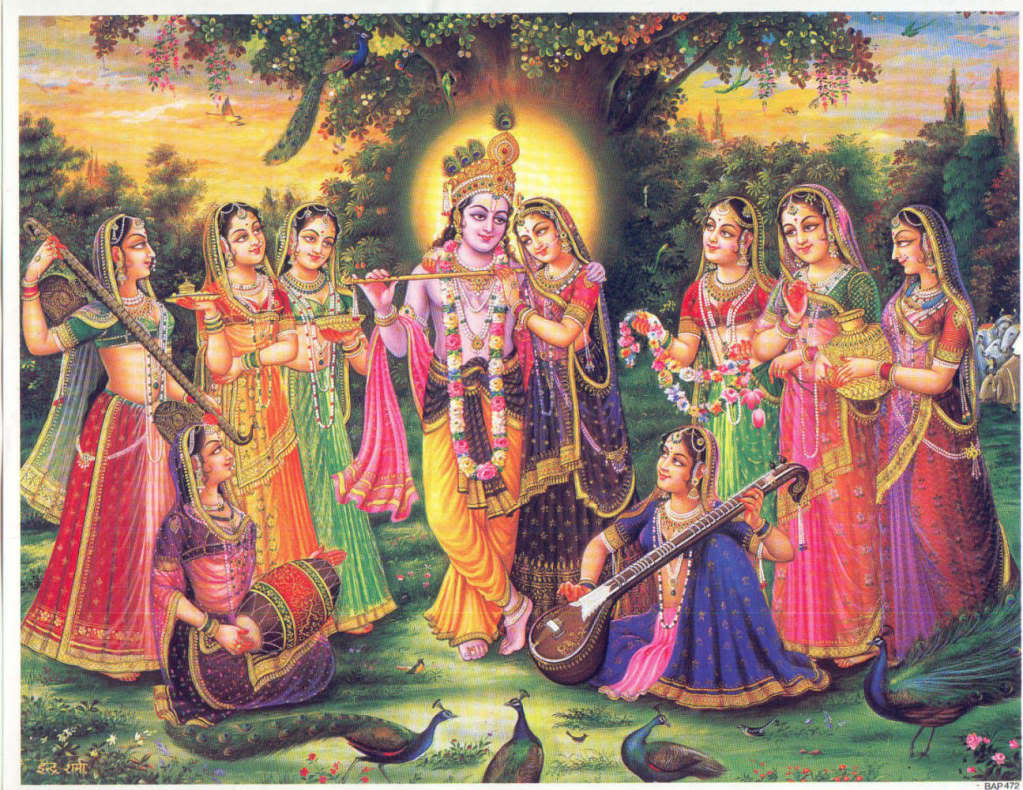
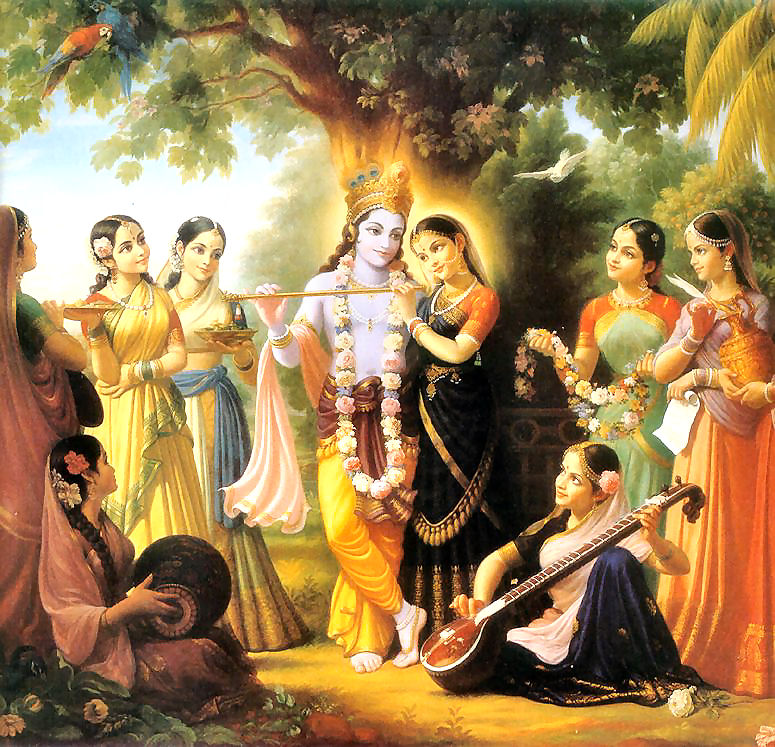
…Kṛṣṇa was very expert in playing the flute, and the gopīs were captivated by the sound vibration, which was not only attractive to them, but to all living creatures who heard it. One of the gopīs told her friends, ”The highest perfection of the eyes is to see Kṛṣṇa and Balarāma entering the forest and playing Their flutes and tending the cows with Their friends.“

Persons who are constantly engaged in the transcendental meditation of seeing Kṛṣṇa, internally and externally, by thinking of Him playing the flute and entering the Vṛndāvana forest, have really attained the perfection of samādhi.

Kṛṣṇa, the Supreme Personality of Godhead
By His Divine Grace A.C. Bhaktivedanta Swami Prabhupada
Chapter 21

The Gopīs Attracted by the Flute

Kṛṣṇa was very pleased with the atmosphere of the forest where flowers bloomed and bees and drones hummed very jubilantly. While the birds, trees and branches were all looking very happy, Kṛṣṇa, tending the cows, accompanied by Śrī Balarāma and the cowherd boys, began to vibrate His transcendental flute. After hearing the vibration of the flute of Kṛṣṇa, the gopīs in Vṛndāvana remembered Him and began to talk amongst themselves about how nicely Kṛṣṇa was playing His flute. When the gopīs were describing the sweet vibration of Kṛṣṇa’s flute, they also remembered their pastimes with Him; thus their minds became disturbed, and they were unable to describe completely the beautiful vibrations. While discussing the transcendental vibration, they remembered also how Kṛṣṇa dressed, decorated with a peacock feather on His head, just like a dancing actor, and with blue flowers pushed over His ear. His garment glowed yellow-gold, and He was garlanded with a vaijayantī necklace. Dressed in such an attractive way, Kṛṣṇa filled up the holes of His flute with the nectar emanating from His lips. So they remembered Him, entering the forest of Vṛndāvana, which is always glorified by the footprints of Kṛṣṇa and His companions.

More

True Love

Today being Valentines Day, and with everyone absorbed in a loving mood, we thought we would post something about True Love.

…Everyone and everything is attracted to Kṛṣṇa–that is the perfect description of Kṛṣṇa’s attraction. The example of the gopīs is very instructive to persons who are trying to be absorbed in Kṛṣṇa consciousness. One can very easily associate with Kṛṣṇa simply by remembering His transcendental pastimes. Everyone has a tendency to love someone. That Kṛṣṇa should be the object of love is the central point of Kṛṣṇa consciousness. By constantly chanting the Hare Kṛṣṇa mantra and remembering the transcendental pastimes of Kṛṣṇa, one can be fully in Kṛṣṇa consciousness and thus make his life sublime and fruitful.

KRSNA The Supreme Personality of Godhead
By His Divine Grace A.C. Bhaktivedanta Swami Prabhupada
Chapter 34

The Gopīs’ Feelings of Separation

The gopīs of Vṛndāvana were so attached to Kṛṣṇa that they were not satisfied simply with the rāsa dance at night. They wanted to associate with Him and enjoy His company during the daytime also. When Kṛṣṇa went to the forest with His cowherd boy friends and cows, the gopīs did not physically take part, but their hearts went with Him. And because their hearts went, they were able to enjoy His company through strong feelings of separation. To acquire this strong feeling of separation is the teaching of Lord Caitanya and His direct disciplic succession of Gosvāmīs. When we are not in physical contact with Kṛṣṇa, we can associate with Him like the gopīs, through feelings of separation. Kṛṣṇa’s transcendental form, qualities, pastimes, and entourage are all identical with Him. There are nine different kinds of devotional service. Devotional service to Kṛṣṇa in feelings of separation elevates the devotee to the highest perfectional level, to the level of the gopīs.

More

Lord Kṛṣṇa and Balarāma Meet the Inhabitants of Vṛndāvana

“For one who remembers Me without deviation, I am easy to obtain, O son of Prtha, because of his constnt engagement in devotional service. (Bhagavad-gita 8.14)

…The special qualification of the pure devotee is that he is always thinking of Kṛṣṇa without considering the time or place. There should be no impediments. He should be able to carry out his service anywhere and at any time. Some say that the devotee should remain in holy places like Vṛndāvana or some holy town where the Lord lived, but a pure devotee can live anywhere and create the atmosphere of Vṛndāvana by his devotional service. It was Śrī Advaita who told Lord Caitanya, “Wherever You are, O Lord-there is Vṛndavana.” (From Purport)

So to help us in remembering the Lord, we are posting this very nice chapter from “KRSNA The Supreme Personality of Godhead” by His Divine Grace A.C. Bhaktivedanta Swami, who is teaching us how to always think of Krishna.

…All the members of the Yadu dynasty were naturally very beautiful, and yet on this occasion, when they appeared duly decorated with gold necklaces and flower garlands, dressed in valuable clothing and properly armed with their respective weapons, their natural beauty and personalities were a hundred times enhanced. The members of the Yadu dynasty came to Kurukṣetra in their gorgeously decorated chariots resembling the airplanes of the demigods, pulled by big horses that moved like the waves of the ocean, and some of them rode on sturdy, stalwart elephants that moved like the clouds in the sky. Their wives were carried on beautiful palanquins by beautiful men whose features resembled those of the Vidyādharas. The entire assembly looked as beautiful as an assembly of the demigods of heaven…

KRSNA The Supreme Personality of Godhead (1970 Edition)
By His Divine Grace A.C. Bhaktivedanta Swami Prabhupada
Vol.2 Chapter 27

Lord Kṛṣṇa and Balarāma Meet the Inhabitants of Vṛndāvana

Once upon a time while Lord Kṛṣṇa and Balarāma were living peacefully in Their great city of Dvārakā, there was the rare occasion of a full solar eclipse, such as takes place at the end of every kalpa, or day of Brahmā. At the end of every kalpa the sun is covered by a great cloud, and incessant rain covers the lower planetary systems up to Svargaloka. By astronomical calculation, people were informed about this great eclipse prior to its taking place, and therefore everyone, both men and women, decided to assemble at the holy place in Kurukṣetra known as Samanta-pañcaka.

More

Remembering Krishna

In the previous article, Srila Prabhupada is describing the nine types of devotional service recommended ….(hearing, chanting, remembering, worshiping, praying, serving, engaging as a servitor of the Lord, establishing friendly relations with the Lord, offering everything to the Lord). These are all easy to practice and should be joyfully performed. So with this in mind we are posting one of Krishna’s unlimited pastimes, to help us in remembering the Lord.

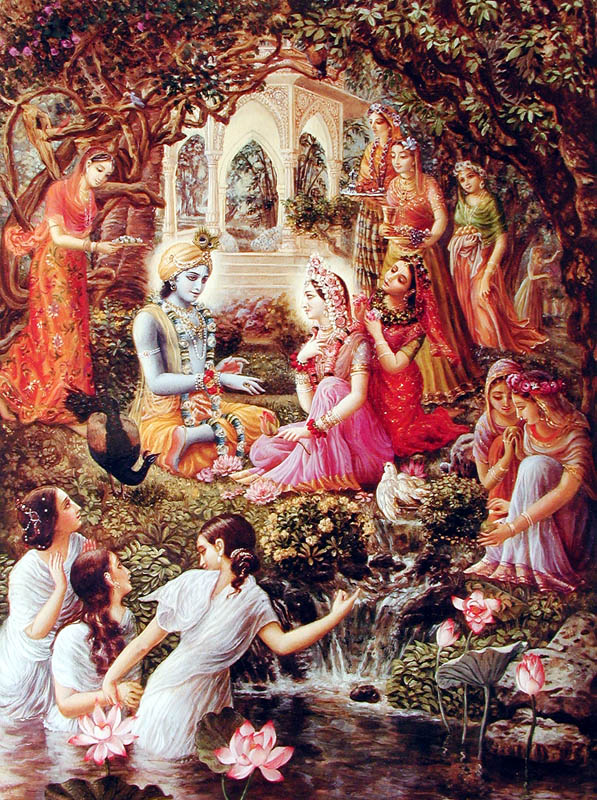
Both the gopīs and Kṛṣṇa entered the water of the Yamunā just to relieve their fatigue from the rāsa dance. The lily flower garlands around the necks of the gopīs were strewn to pieces due to their embracing the body of Kṛṣṇa, and the flowers were reddish from being smeared with the kuṅkuma on their breasts. The bumblebees were humming about in order to get honey from the flowers. Kṛṣṇa and the gopīs entered the water of Yamunā just as an elephant enters a water tank with his many female companions. Both the gopīs and Kṛṣṇa forgot their real identity, playing in the water, enjoying each others’ company and relieving the fatigue of rāsa dancing. The gopīs began to splash water on the body of Kṛṣṇa, all the while smiling, and Kṛṣṇa enjoyed this. As Kṛṣṇa was taking pleasure in the joking words and splashing water, the demigods in the heavenly planets began to shower flowers. The demigods thus praised the superexcellent rāsa dance of Kṛṣṇa, the supreme enjoyer, and His pastimes with the gopīs in the water of Yamunā. (Krsna The Supreme Personality of Godhead Chapter 32)

Image courtsy of Syamarani devi http://www.bhaktiart.net

Giving Shelter to Others

They have dedicated their lives to the welfare of others. They are the perfect example of noble life.

One may take excellent lessons from the pious trees, who offer innumerable benefits, such as fruits, flowers, cooling shade and medicinal extracts. Even when a tree is suddenly cut down and dragged away, the tree does not protest but continues to give service to others in the form of firewood. Thus, one should become the disciple of such magnanimous trees and learn from them the qualities of saintly conduct. (Srimad Bhagavatam)

Taking shelter of the shade of the trees, Kṛṣṇa became very happy. While walking He began to address the inhabitants of Vṛndāvana. “My dear Stokakṛṣṇa, My dear Varūthapa, My dear Bhadrasena, My dear Sudāmā, My dear Subala, My dear Arjuna, My dear Viśāla, My dear Ṛṣabha–just look at these most fortunate trees of Vṛndāvana. They have dedicated their lives to the welfare of others. Individually they are tolerating all kinds of natural disturbances, such as hurricanes, torrents of rain, scorching heat and piercing cold, but they are very careful to relieve our fatigues and give us shelter. My dear friends, I think they are glorified in this birth as trees. They are so careful to give shelter to others that they are like noble, highly elevated charitable men who never deny charity to one who approaches them. No one is denied shelter by these trees. They supply various kinds of facilities to human society, such as leaves, flowers, fruit, shade, roots, bark, flavor extracts and fuel. They are the perfect example of noble life. They are like a noble person who has sacrificed everything possible–his body, mind, activities, intelligence and words–in engaging in the welfare of all living entities.”

More

Wonderful Kṛṣṇa

“O Lord, although You are able to give all kinds of benedictions, I do not pray to You for liberation, nor eternal life in Vaikuntha, nor any other boon. My only prayer is that Your childhood pastimes may constantly appear in my mind. O Lord, I do not even want to know Your feature of Paramatma. I simply wish that Your childhood pastimes may ever be enacted in my heart.” (Sri Damodarastakam, verse 4)

KRSNA, The Supreme Personality of Godhead – 1970 Edition
By His Divine Grace A.C. Bhaktivedanta Swami Prabhupada
Vol 1, Chapter 26

Wonderful Kṛṣṇa

Without understanding the intricacies of Kṛṣṇa, the Supreme Personality of Godhead, and without knowing His uncommon spiritual opulences, the innocent cowherd boys and men of Vṛndāvana began to discuss the wonderful activities of Kṛṣṇa which surpass the activities of all men.

One of them said, “My dear friends, considering His wonderful activities, how is it possible that such an uncommon boy would come and live with us in Vṛndāvana? It is really not possible. Just imagine! He is now only seven years old! How was it possible for Him to lift Govardhana Hill in one hand and hold it up just like the king of elephants holds a lotus flower? To lift a lotus flower is a most insignificant thing for an elephant, and similarly Kṛṣṇa lifted Govardhana Hill without exertion. When He was simply a small baby and could not even see properly, He killed a great demon, Pūtanā. While sucking her breast, He also sucked out her life-air. Kṛṣṇa killed the Pūtanā demon exactly as eternal time kills a living creature in due course. When He was only three months old, He was sleeping underneath a hand-driven cart. Being hungry for His mother’s breast, He began to cry and throw His legs upwards. And from the kicking of His small feet the cart immediately broke apart and fell to pieces. When He was only one year old, He was carried away by the Tṛṇāvarta demon disguised as a whirlwind, and although He was taken very high in the sky, He simply hung on the neck of the demon and forced him to fall from the sky and immediately die. Once His mother, being disturbed by His stealing butter, tied Him to a wooden mortar, and the child pushed it towards a pair of trees known as yamala arjuna and caused them to fall. Once, when He was engaged in tending the calves in the forest along with His elder brother, Balarāma, a demon named Bakāsura appeared, and Kṛṣṇa at once bifurcated the demon’s beaks. When the demon known as Vatsāsura entered among the calves tended by Kṛṣṇa with a desire to kill Him, He immediately detected the demon, killed him, and threw him into a tree. When Kṛṣṇa, along with His brother, Balarāma, entered the Tālavana forest, the demon known as Dhenukāsura, in the shape of an ass, attacked Them and was immediately killed by Balarāma, who caught his hind legs and threw him in a palm tree. Although the Dhenukāsura demon was assisted by his cohorts, also in the shape of asses, all were killed, and the Tālavana forest was then open for the use of the animals and inhabitants of Vṛndāvana. When Pralambāsura entered amongst His cowherd boy friends, He caused his death by Balarāma. Thereafter, Kṛṣṇa saved His friends and cows from the severe forest fire, and He chastised the Kāliya serpent in the lake of Yamunā and forced him to leave the vicinity of the Yamunā River; He thereby made the water of the Yamunā poisonless.”

More

Description of Autumn


Because of the appearance of the autumn season, the water of the ocean becomes calm and quiet, just as a person developed in self-realization is no longer disturbed by the three modes of material nature.

When the sky is clear of all clouds, the stars at night shine very beautifully; similarly, when a person is actually situated in Kṛṣṇa consciousness, he is cleared of all dirty things, and he becomes as beautiful as the stars in the autumn sky.

KRSNA, The Supreme Personality of Godhead – 1970 Edition
By His Divine Grace A.C. Bhaktivedanta Swami Prabhupada
Vol. 1 Chapter 20

Description of Autumn

…Everything becomes naturally beautiful with the appearance of the autumn season. Similarly, when a materialistic person takes to Kṛṣṇa consciousness and spiritual life, he also becomes as clear as the sky and water in autumn. The autumn season takes away the rolling of dark clouds in the sky as well as the polluted water. Filthy conditions on the ground also become cleansed. Similarly, a person who takes to Kṛṣṇa consciousness immediately becomes cleansed of all dirty things within and without. Kṛṣṇa is therefore known as Hari. “Hari” means “he who takes away.” Kṛṣṇa immediately takes away all unclean habits from anyone who takes to Kṛṣṇa consciousness. The clouds of autumn are white, for they do not carry any water. Similarly, a retired man, being freed from all responsibility of family affairs (namely, maintaining the home, wife and children) and taking completely to Kṛṣṇa consciousness, becomes freed from all anxieties and looks as white as clouds in autumn. Sometimes in autumn the falls come down from the top of the hill to supply clean water, and sometimes they stop. Similarly, sometimes great saintly persons distribute clear knowledge, and sometimes they are silent. The small ponds which were filled with water because of the rainy season, gradually dry up in autumn. As for the tiny aquatics living in the reservoirs, they cannot understand that their numbers are diminishing day by day, as the materially engrossed persons cannot understand that their duration of life is being reduced day by day.

More

Next Newer Entries

108 Imporant Slokas from the 1972 Bhagavad-gita As It Is

Click on image to go to Post

Click on image to go to Post

The Hare Krishna Cookbook

Songs of the Vaisnava Acaryas

Bhagavad-gita As It Is 1972 Edition “Online”

click on image

click on image to visit site

Srimad Bhagavatam Online

click on image

Raja-Vidya the King of Knowledge

click on image

click on image

Blog Stats

  • 4,559,098 hits

Enter your email address to subscribe to this blog and receive notifications of new posts by email.

Join 3,909 other subscribers

Important Slokas from the Brahma-samhita

click on image

click on image

Slokas from the Sri Isopanisad

click on image

click on image

Prayers By Queen Kunti (Slokas)

click on image

Gajendra’s Prayers of Surrender (Slokas)

click on image

A Short Statement of the Philosophy of Krishna Consciousness

click on image

click on image

July 9th Letter

click on image

click on image

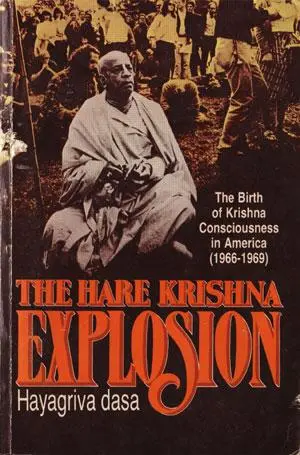
The Hare Krishna Explosion

Reference Material/Study Guide

click on image

click on image

  • LINKS