
Today we are exploring the Neutral stage of Love of God, (santa-rasa), as explained in chapter 35 of “The Nectar of Devotion”.
“When the yogi sees the eternal form of Visnu and appreciates the Lord’s beauty in awe and veneration, he is situated in the neutral stage of love of God.”
…Some great sages have attained this neutral position by practicing austerity, penance and meditation to control the senses. Such sages are generally called mystic yogīs, and in most cases they are inclined to appreciate the spiritual pleasure of the impersonal feature of the absolute truth. They are practically unaware of the transcendental pleasure derived from personal contact with the Supreme Godhead.
When some great saintly persons who had undergone penances and austerities saw the four-handed transcendental form of Visnu, they began to remark as follows: “This four-handed form of the Lord, manifested in a bluish color, is the reservoir of all pleasure and the center of our living force. Actually, when we see this eternal form of Visnu, we, along with many other paramahaṁsas, become immediately captivated by the beauty of the Lord.” This appreciation of Lord Visnu by saintly persons is an instance of situation in santa-rasa, or the neutral stage of devotional service. In the beginning, those who are aspiring for salvation try to get out of the material entanglement by performing painful austerities and penances, and ultimately they come to the impersonal status of spiritual realization. At this brahma-bhuta [SB 4.30.20] stage of liberation from the material entanglement, the symptoms, as explained in the Bhagavad-gita, are that one becomes joyous beyond any hankering or lamentation and gains a universal vision. When the devotee is situated in the santa-rasa, or neutral stage of devotional service, he appreciates the Visnu form of the Lord.
Those who are situated on the platform of santa-rasa get their impetus for advancement in devotional service by smelling the tulasi offered at the lotus feet of the Lord, by hearing the sound of His conchshell, by seeing a sanctified place in some mountain or hill, by observing a forest like the ones in Vrndavana, by going to a place of pilgrimage, by visiting the course of the Ganges River, by being victorious over the dictations of bodily demands (i.e., eating, sleeping, mating and defending), by understanding the devastation of eternal time, and by constantly associating with devotees engaged in Krsna consciousness. All these different items are favorable in elevating saintly persons situated in santa-rasa to the advanced stage of devotional service.
There are certain symptoms of great sages who are situated in santa-rasa devotional service, and these symptoms are exhibited as follows: they concentrate their eyesight on the tip of the nose, and they behave just like an avadhuta. Avadhuta means a highly elevated mystic who does not care for any social, religious or Vedic conventions. Another symptom is that such persons are very careful to step forward when giving speeches. When they speak, they join together the forefinger and thumb. (This is called the jnana-mudra position.) They are not against the atheists, nor are they particularly inclined to the devotees. Such persons give stress to liberation and detachment from the materialistic way of life. They are always neutral and have no affection for nor misidentification with anything material. They are always grave, but fully absorbed in thoughts of the Supreme Personality of Godhead. These uncommon features develop in devotees who are situated in santa-rasa.
When a Brahman–realized devotee who has come to the stage of steady trance comes into contact with the eternal form of Krsna, his transcendental pleasure increases millions of times. One great sage once inquired from another, “My dear friend, do you think that after I perfect the eightfold yoga performance I shall be able to see the eternal form of the Supreme Personality of Godhead?” This enquiry from the sage is an instance of inquisitiveness in a devotee situated in the neutral stage of devotional service.
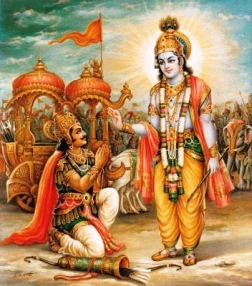
When Lord Krsna, along with His elder brother Balarama and sister Subhadra, came to Kuruksetra in a chariot on the occasion of a solar eclipse, many mystic yogīs also came. When these mystic yogīs saw Lord Krsna and Balarama, they exclaimed that now that they had seen the excellent bodily effulgence of the Lord, they had almost forgotten the pleasure derived from impersonal Brahman realization. In this connection one of the mystics approached Krsna and said, “My dear Lord, You are always full with transcendental bliss, excelling all other spiritual positions. And so, simply by seeing You from a distant place, I have come to the conclusion that there is no need of my being situated in the transcendental bliss of impersonal Brahman.“
As we will see in the coming chapters of “The Nectar of Devotion”, the stage of santa-rasa (neutral love of God), is the preliminary stage of love of God.



 The Hare Krishna Movement