Second Avenue Fire Sacrifice (Chapter 4)

The Hare Krishna Explosion
by Hayagriva Prabhu

Part I: New York, 1966
Chapter 4

Second Avenue Fire Sacrifice

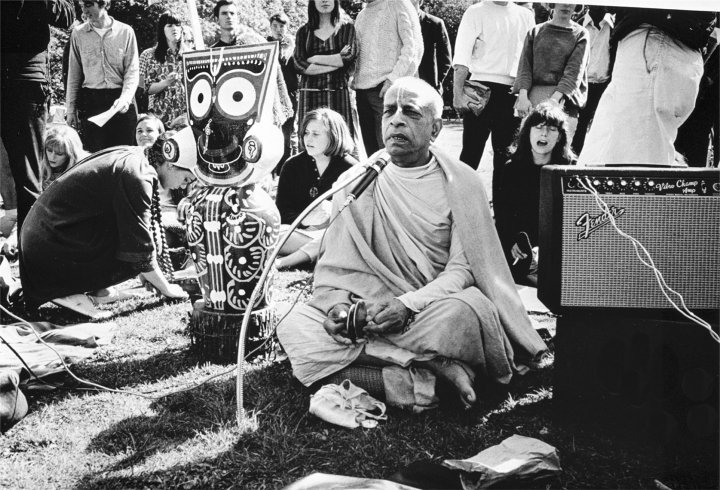
September 8, 1966. Janmastami. Lord Krishna, we learn, is not born like an ordinary child. He appears. Five thousand years ago, in Mathura, India, He appeared as four-armed Narayana, attired in His transcendental garments. At His mother’s request, He assumed a two-armed form, like an ordinary child. Sri Krishna is most obliging to His devotees.

“Today we will fast,” Swamiji tells us. “Normally we do not fast all day. Krishna consciousness is not for one who eats too much or too little. Gandhi fasted many days for political reasons, but we don’t. In Bhagavad-gita, that kind of fasting is considered rajasic, or passionate. We fast according to regulations: Ekadasi, the eleventh day of the full moon, we take no grains. That is a partial fast. And Janmastami, there is complete fast all day until midnight. So today we will fast and chant, and tomorrow there will be initiation.”

There are eleven of us to be initiated. Roy buys us beads for chanting, a hundred and eight round wooden beads the size of marbles. Standing in the courtyard behind the temple, I string them into a rosary called a japa-mala. While chanting, I carefully slide each bright, red bead up the string and then knot it. It takes hours to complete knotting all the beads. When I ask Swamiji why there are a hundred and eight, he tells me that they represent the gopis, the Vrindaban cowherd girls beloved of Lord Krishna.

More

Who is Crazy? (Chapter 3)

The Hare Krishna Explosion
by Hayagriva das

Part I: New York, 1966
Chapter 3

Who is Crazy?

Twenty-six Second Avenue. Matchless Gifts. No doubt, to most New Yorkers, nothing more than the kind of squalid storefront someone might open a pawnshop in. What with traffic noise and our neighbors—Cosmos Parcels Express Corporation, Gonzalez Funeral Home, Weitzner Brothers Memorials, The Red Star Bar, and a Mobil gas station—no one would think it Vaikuntha. But for us, Matchless Gifts becomes a temple, a part of Vrindaban, because of Swamiji’s presence and the words spoken here.

Keith, Wally, and I rummage through the Mott Street apartment, gather souvenirs from the recent India trip—two rugs, a dozen paintings, three silk wall hangings, and two brass hookah tops—and take them to Second Avenue.

Then, unknown to Swamjji, we start decorating the Matchless Gifts storefront, turning it into a temple befitting Krishna’s messenger. That is, as far as we are able.

More

Transcendental Invitations (Chapter 2)

The Hare Krishna Explosion
by Hayagriva das

Part I: New York, 1966
Chapter 2

Transcendental Invitations

The next morning, when I go alone to see the Swami, he seems to be expecting me. Directly and simply, he begins to explain that he needs help in spreading Krishna consciousness around the world. Noticing that he has been typing, I offer to type for him, and he hands me the manuscript of the First Chapter, Second Canto, of Vyasadeva’s Srimad-Bhagavatam.

“You can type this?”

“Oh yes,” I say.

He is delighted. We roll a small typewriter table out of the corner, and I begin work. His manuscript is single spaced without margins on flimsy, yellowing Indian paper. It appears that the Swami tried to squeeze every word possible onto the pages. I have to use a ruler to keep from losing my place.

The first words read: “O the king.” I naturally wonder whether “O” is the king’s name, and “the king” stands in apposition. After concluding that “O King” is intended instead, I consult the Swami.

“Yes,” he says. “Change it, then.”

As I retype another paragraph, I notice certain grammatical discrepancies, perhaps typical of Bengalis who learned English from British headmasters in the early 1900s. Considerable editing is required to get the text to conform with current American usage. After pointing out a few changes, I tell the Swami that if he so desired, I could make all the proper corrections.

“Very good,” he says, smiling. “Do it! Put it nicely.”

Thus my editorial services begin.

More

Visitor From Calcutta (Chapter 1)

The Hare Krishna Explosion
by Hayagriva dasa

Part I: New York, 1966
Chapter 1

Visitor From Calcutta

I first see him just after crossing the Bowery at Houston Street. As he passes before the iron-mesh fence of a playground, I distinctly glimpse the aura of saintliness. I watch him through the rushing traffic and stumbling derelicts.

He strolls almost jauntily down the sidewalk. He is an old man whom age has never touched. Aloof from the people and bustle about him, he walks proudly, independently, his hand in a cloth beadbag. He wears the saffron robes of a sannyasi, and on his feet are quaint, pointed white shoes.

Only seven months ago, I had seen many saffron-robed monks and holymen walking the dirt roads of Hardwar and Rishikesh, and stopping beside the Ganges to bathe. For me, that had been a futile journey to the mystic East in search of the all-knowing guru.

But now—what’s this?

I look again at the pointed white shoes. Did this man follow me all the way from North India? Or did he just suddenly descend from the clouds onto Manhattan sidewalks? I decide I must speak to him.

More

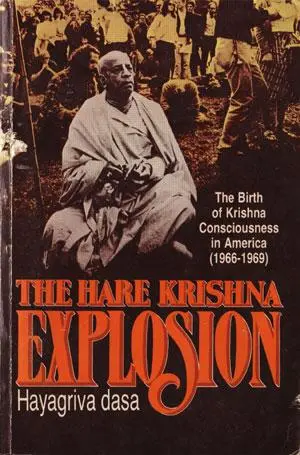
The Hare Krishna Explosion

The Hare Krishna Explosion
The Birth of Krishna Consciousness in America 1966 – 1969

by Hayagriva das

tad viddhi pranipatena
pariprashnena sevaya
upadekshyanti te jnanam
jnaninas tattva-darshinah

Just try to learn the truth by approaching a spiritual master. Inquire from him submissively and render service unto him. The self-realized soul can impart knowledge unto you because he has seen the truth. (Bhagavad-gita 4.34)

NOTE

The first draft of The Hare Krishna Explosion was written in July, 1969, just after Srila Prabhupada’s first visit to New Vrindaban. At that time, I realized that the details of the beginnings of the Krishna Consciousness Movement had best be recorded while events were still fresh. Working from notebooks, diaries and memory, I compiled the first draft within a month. Then the manuscript remained packed away, until Srila Prabhupada left this mortal world in November, 1977. During those interim years, both the manuscript and my mind had accumulated some dust, but convinced of the value of anything dealing with Srila Prabhupada, I began again, and completed the second draft in 1979. For the next five years, as the Hare Krishna Movement continued to expand, I kept polishing and expanding the manuscript. Clearly, the Hare Krishna explosion was not about to fizzle. “Just as Krishna is always expanding,” Srila Prabhupada had said, “anything related to Krishna is also expanding.” In 1966, unknown to us, Prabhupada had truly launched a dynamic world religion.

More

Next Newer Entries

108 Imporant Slokas from the 1972 Bhagavad-gita As It Is

Click on image to go to Post

Click on image to go to Post

The Hare Krishna Cookbook

Songs of the Vaisnava Acaryas

Bhagavad-gita As It Is 1972 Edition “Online”

click on image

click on image to visit site

Srimad Bhagavatam Online

click on image

Raja-Vidya the King of Knowledge

click on image

click on image

Blog Stats

  • 4,552,210 hits

Enter your email address to subscribe to this blog and receive notifications of new posts by email.

Join 3,910 other subscribers

Important Slokas from the Brahma-samhita

click on image

click on image

Slokas from the Sri Isopanisad

click on image

click on image

Prayers By Queen Kunti (Slokas)

click on image

Gajendra’s Prayers of Surrender (Slokas)

click on image

A Short Statement of the Philosophy of Krishna Consciousness

click on image

click on image

July 9th Letter

click on image

click on image

The Hare Krishna Explosion

Reference Material/Study Guide

click on image

click on image

  • LINKS