The Gopīs Attracted by the Flute


KRSNA, The Supreme Personality of Godhead – 1970 Edition
By His Divine Grace A. C. Bhaktivedanta Swami Prabhupada

The Gopīs Attracted by the Flute

Kṛṣṇa was very pleased with the atmosphere of the forest where flowers bloomed and bees and drones hummed very jubilantly. While the birds, trees and branches were all looking very happy, Kṛṣṇa, tending the cows, accompanied by Śrī Balarāma and the cowherd boys, began to vibrate His transcendental flute. After hearing the vibration of the flute of Kṛṣṇa, the gopīs in Vṛndāvana remembered Him and began to talk amongst themselves about how nicely Kṛṣṇa was playing His flute. When the gopīs were describing the sweet vibration of Kṛṣṇa’s flute, they also remembered their pastimes with Him; thus their minds became disturbed, and they were unable to describe completely the beautiful vibrations. While discussing the transcendental vibration, they remembered also how Kṛṣṇa dressed, decorated with a peacock feather on His head, just like a dancing actor, and with blue flowers pushed over His ear. His garment glowed yellow-gold, and He was garlanded with a vaijayantī necklace. Dressed in such an attractive way, Kṛṣṇa filled up the holes of His flute with the nectar emanating from His lips. So they remembered Him, entering the forest of Vṛndāvana, which is always glorified by the footprints of Kṛṣṇa and His companions.

More

Krsna is All Attractive


Srimad Bhagavatam
By His Divine Grace A.C. Bhaktivedanta Swami Prabhupada
Canto 1, Chapter 5, Text 26

The Lord descends on this material world out of His causeless mercy and displays His various transcendental pastimes as a human being so that human beings attracted towards Him become able to go back to Godhead.

O Vyāsadeva, in that association and by the mercy of those great Vedāntists, I could hear them describe the attractive activities of Lord Kṛṣṇa And thus listening attentively, my taste for hearing of the Personality of Godhead increased at every step.

Lord Śrī Kṛṣṇa, the Absolute Personality of Godhead, is attractive not only in His personal features, but also in His transcendental activities. It is so because the Absolute is absolute by His name, fame, form, pastimes, entourage, paraphernalia, etc. The Lord descends on this material world out of His causeless mercy and displays His various transcendental pastimes as a human being so that human beings attracted towards Him become able to go back to Godhead. Men are naturally apt to hear histories and narrations of various personalities performing mundane activities, without knowing that by such association one simply wastes valuable time and also becomes addicted to the three qualities of mundane nature. Instead of wasting time, one can get spiritual success by turning his attention to the transcendental pastimes of the Lord. By hearing the narration of the pastimes of the Lord, one contacts directly the Personality of Godhead, and, as explained before, by hearing about the Personality of Godhead, from within, all accumulated sins of the mundane creature are cleared. Thus being cleared of all sins, the hearer gradually becomes liberated from mundane association and becomes attracted to the features of the Lord. Nārada Muni has just explained this by his personal experience. The whole idea is that simply by hearing about the Lord’s pastimes one can become one of the associates of the Lord. Nārada Muni has eternal life, unlimited knowledge and unfathomed bliss, and he can travel all over the material and spiritual worlds without restriction. One can attain to the highest perfection of life simply by attentive hearing of the transcendental pastimes of the Lord from the right sources, as Śrī Nārada heard them from the pure devotees (bhakti-vedāntas) in his previous life. This process of hearing in the association of the devotees is especially recommended in this age of quarrel (Kali).

Lord Balarāma Visits Vṛndāvana

Lord Balarāma Visits Vṛndāvana

Lord Balarāma could, of course, understand the ecstatic feelings of the gopīs, and therefore He wanted to pacify them. He was expert in presenting an appeal, and thus, treating the gopīs very respectfully, He began to narrate the stories of Kṛṣṇa so tactfully that the gopīs became satisfied. In order to keep the gopīs in Vṛndāvana satisfied, Lord Balarāma stayed there continually for two months, namely the months of Caitra (March-April) and Vaiśākha (April-May). For those two months He kept Himself among the gopīs, and He passed every night with them in the forest of Vṛndāvana in order to satisfy their desire for conjugal love. Thus Balarāma also enjoyed the rāsa dance with the gopīs during those two months.

Lord Balarāma Visits Vṛndāvana

From; Kṛṣṇa, the Supreme Personality of Godhead
By His Divine Grace A. C. Bhaktivedanta Swami Prabhupada

Lord Balarāma became very anxious to see His father and mother, Mahārāja Nanda and Yaśodā. Therefore He started for Vṛndāvana on a chariot with great enthusiasm. The inhabitants of Vṛndāvana had been anxious to see Kṛṣṇa and Balarāma for a very long time. When Lord Balarāma returned to Vṛndāvana, all the cowherd boys and the gopīs had grown up; but still, on His arrival, they all embraced Him, and Balarāma embraced them in reciprocation. After this He came before Mahārāja Nanda and Yaśodā and offered His respectful obeisances unto them. In response, mother Yaśodā and Nanda Mahārāja offered their blessings unto Him. They addressed Him as Jagadīśvara, or the Lord of the universe who maintains everyone. The reason for this was that both Kṛṣṇa and Balarāma maintain all living entities, and yet Nanda and Yaśodā were put into such difficulties on account of Their absence. Feeling like this, they embraced Balarāma and, seating Him on their laps, began their perpetual crying, wetting Balarāma with their tears. Lord Balarāma then offered His respectful obeisances to the elderly cowherd men and accepted the obeisances of the younger cowherd men. Thus, according to their different ages and relationships, Lord Balarāma exchanged feelings of friendship with them. He shook hands with those who were His equals in age and friendship, and with loud laughing embraced each one of them.

More

Everyone Follows My Path in All Respects

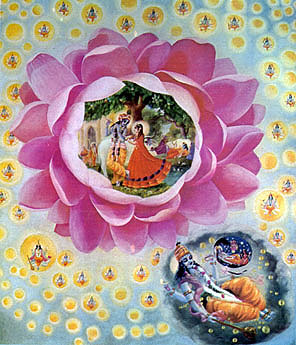
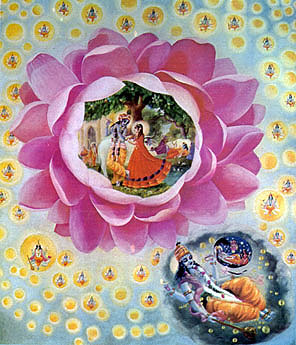
In picture; At the top Krishna is dancing with His purest devotees as a lover. On the lotus petals the Lord is reciprocating with His devotees as a son, as a friend and as a master. Below left, a devotee in the material world is associating with Krishna personally by painting His transcendental form. Next, an impersonalist, by his meditation, is merging with the brahmajyoti, the spiritual effulgence emanating from the Lord’s body. On the right a mystic yogi is walking on the water. On the far right a fruitive worker is receiving the fruits of his labor. (Picture and description taken from the Original 1972 Bhagavad-gita As It Is)

Bhagavad-gītā As It Is
By: His Divine Grace A. C. Bhaktivedanta Swami Prabhupada
Chapter 4 Transcendental Knowledge

TEXT 11

ye yathā māṁ prapadyante
tāṁs tathaiva bhajāmy aham
mama vartmānuvartante
manuṣyāḥ pārtha sarvaśaḥ

ye—all of them; yathā—as; mām—unto Me; prapadyante—surrender; tān—unto them; tathā—so; eva—certainly; bhajāmi—do I reward; aham—I; mama—My; vartma—path; anuvartante—do follow; manuṣyāḥ—all men; pārtha—O son of Pṛthā; sarvaśaḥ—in all respects.

TRANSLATION

All of them—as they surrender unto Me—I reward accordingly. Everyone follows My path in all respects, O son of Pṛthā.
PURPORT

Eveyone is searching for Kṛṣṇa in the different aspects of His manifestations. Kṛṣṇa, the Supreme Personality of Godhead, is partially realized in His impersonal brahmajyoti effulgence and as the all-pervading Supersoul dwelling within everything, including the particles of atoms. But Kṛṣṇa is only fully realized by His pure devotees. Consequently, Kṛṣṇa is the object of everyone’s realization, and thus anyone and everyone is satisfied according to one’s desire to have Him. In the transcendental world also, Kṛṣṇa reciprocates with His pure devotees in the transcendental attitude, just as the devotee wants Him. One devotee may want Kṛṣṇa as supreme master, another as his personal friend, another as his son, and still another as his lover. Kṛṣṇa rewards all the devotees equally, according to their different intensities of love for Him. In the material world, the same reciprocations of feelings are there, and they are equally exchanged by the Lord with the different types of worshipers. The pure devotees both here and in the transcendental abode associate with Him in person and are able to render personal service to the Lord and thus derive transcendental bliss in His loving service. As for those who are impersonalists and who want to commit spiritual suicide by annihilating the individual existence of the living entity, Kṛṣṇa helps also by absorbing them into His effulgence. Such impersonalists do not agree to accept the eternal, blissful Personality of Godhead; consequently they cannot relish the bliss of transcendental personal service to the Lord, having extinguished their individuality. Some of them, who are not situated even in the impersonal existence, return to this material field to exhibit their dormant desires for activities. They are not admitted in the spiritual planets, but they are again given a chance to act on the material planets. For those who are fruitive workers, the Lord awards the desired results of their prescribed duties, as the yajñeśvara; and those who are yogīs seeking mystic powers are awarded such powers. In other words, everyone is dependant for success upon His mercy alone, and all kinds of spiritual processes are but different degrees of success on the same path. Unless, therefore, one comes to the highest perfection of Kṛṣṇa consciousness, all attempts remain imperfect, as is stated in the Śrīmad Bhāgavatam:

akāmaḥ sarva-kāmo vā mokṣa-kāma udāradhīḥ
tīvreṇa bhakti-yogena yajeta puruṣaṁ param

“Whether one is without desire [the condition of the devotees], or is desirous of all fruitive results, or is after liberation, one should with all efforts try to worship the Supreme Personality of Godhead for complete perfection, culminating in Kṛṣṇa consciousness.” (Bhāg. 2.3.10)

Goloka Vrindavan The Spiritual Sky


Goloka Vrindavan

In this universe there are millions of planets, and there exist as many universes as mustard seeds in a mustard seed bag. There are innumerable universes coming out of the pores of Mahavishnu’s body when He exhales; and when He inhales, they all enter back into Him. And Mahavishnu is only a portion of Krishna.

And beyond this material world there is the spiritual world, full of innumerable, gigantic spiritual planets called Vaikunthas, which are all resting in the effulgence of Sri Krishna, who engages in divine pastimes in Goloka Vrindavana, the supreme and eternal home with transcendental delights.

The supreme abode of the Personality of Godhead, Krishna, is described in the Brahma-samhita as cintamani-dhama, a place where all desires are fulfilled. The supreme abode of Lord Krishna, known as Goloka Vrndavana, is full of palaces made of touchstone. There are also trees, called “desire trees,” that supply any type of eatable upon demand, and there are cows, known as surabhi cows, which supply a limitless supply of milk. In this abode, the Lord is served by hundreds of thousands of goddesses of fortune (Lakshmis), and He is called Govinda, the primal Lord and the cause of all causes.

Vedic literatures (Katha Upanisad 1.3.11) state that there is nothing superior to the abode of the Supreme Godhead, and that that abode is the ultimate destination (purushan na param kincit sa kastha parama gatih). When one attains to it, he never returns to the material world. Krishna’s supreme abode and Krishna Himself are nondifferent, being of the same quality. This Supreme abode of Lord Krishna, is shaped like the whorl of a lotus flower. Even when the Lord descends to any one of the mundane planets, He does so by manifesting His own abode as it is.

On this earth, Vrndavana, ninety miles southeast of Delhi, is a replica of that supreme Goloka Vrindavana located in the spiritual sky. When Krishna descended on this earth, He sported on that particular tract of land known as Vrindavana, comprising about eighty-four square miles in the district of Mathura, India.

Pasted from http://www.iskconbangalore.org/goloka-vrindavan

Radha Kunda


Radha Kunda

“The holy place known as Mathura is spiritually superior to Vaikuntha, the transcendental world, because the Lord appeared there. Superior to Mathura-puri is the transcendental forest of Vrndavana because of Krishna’s rasa-lila pastimes. And superior to the forest of Vrndavana is Govardhana Hill, for it was raised by the divine hand of Sri Krishna and was the site of His various loving pastimes. And, above all, the superexcellent Sri Radha-kunda stands supreme, for it is overflooded with the ambrosial nectarean prema of the Lord of Gokula, Sri Krishna. Where, then, is that intelligent person who is unwilling to serve this divine Radha-kunda, which is situated at the foot of Govardhana Hill?”

More

No one can know the Plan of the Lord

O King, no one can know the plan of the Lord [Śrī Krsna]. Even though great philosophers inquire exhaustively, they are bewildered. SB 1.9.13

Bhīṣmadeva was certainly satisfied by seeing the triumph of virtue, and he was glad to see King Yudhiṣṭhira on the throne, although he himself fought against him. Even a great fighter like Bhīṣma could not win the Battle of Kurukṣetra because the Lord wanted to show that vice cannot conquer virtue, regardless of who tries to execute it. Bhīṣmadeva was a great devotee of the Lord, but he chose to fight against the Pāṇḍavas by the will of the Lord because the Lord wanted to show that a fighter like Bhīṣma cannot win on the wrong side.

Premanjana “Seeing God”


Article written by Krishna’s Mercy . org

“Everyone is seeing God in His different aspects; the only difference is that the theist sees God as the Supreme Personality, the most beloved, Krishna, and the atheist sees the Absolute Truth as ultimate death.” (Shrila Prabhupada, Krishna, The Supreme Personality of Godhead, Vol 2, Ch 32)

“Have you seen God? Can you show Him to me?” These are some of the challenging questions often directed at those who are religiously inclined and those who are actively preaching the message of love and respect for the Lord found in India’s most famous religious text, the succinct and complete treatise on Vedic philosophy known as the Bhagavad-gita. Any time a preacher takes to kindly passing on information pertaining to spirituality, there will surely be skeptics, uninterested observers, and those who are not willing to listen. When engaged in ordinary conversation, wherein points and counterpoints are exchanged, generally no conclusion is reached in the end. Therefore in order to learn properly, one must take instruction from someone who has weight, a guru, or spiritual master, one who knows the truth as explained to them by previous authority figures. Yet even when hearing from a guru there is a natural urge to see proof, tangible evidence that God indeed exists. The devotees, those whose eyes have been anointed with transcendental love, see the influence of the Lord everywhere. Yet even the atheists, those who are staunchly against religious principles, are forced to see the influence of the same loveable Divine Entity at every turn, especially at the time that matters most: death.

More

The Spiritual World

The Spiritual World — And how to get there
Author Unknown

Krishna means the highest pleasure:

Krishna means the highest pleasure. We are all hankering after pleasure. We, the living entities, like Krishna, are full of consciousness, and we are looking for happiness. Krishna is perpetually happy, and if we associate with Krishna and cooperate with Him we will also become happy.

Krishna descends to this material world to show His pastimes in Vrndavana, which are full of happiness. When Lord Sri Krishna was in Vrndavana, His activities with His cowherd boy friends, with the gopis, with the inhabitants of Vrndavana and with the cows were all full of happiness. The total population of Vrndavana knew nothing but Krishna.

The purpose of Krishna’s pastimes in Vrindavan on this planet is so we can see such wonderful pastimes of Krishna and therefore come to understand something of what life in the spiritual world, the abode of Krishna, will be like when we go there.

More

Next Newer Entries

108 Imporant Slokas from the 1972 Bhagavad-gita As It Is

Click on image to go to Post

Click on image to go to Post

The Hare Krishna Cookbook

Songs of the Vaisnava Acaryas

Bhagavad-gita As It Is 1972 Edition “Online”

click on image

click on image to visit site

Srimad Bhagavatam Online

click on image

Raja-Vidya the King of Knowledge

click on image

click on image

Blog Stats

  • 4,551,423 hits

Enter your email address to subscribe to this blog and receive notifications of new posts by email.

Join 3,909 other subscribers

Important Slokas from the Brahma-samhita

click on image

click on image

Slokas from the Sri Isopanisad

click on image

click on image

Prayers By Queen Kunti (Slokas)

click on image

Gajendra’s Prayers of Surrender (Slokas)

click on image

A Short Statement of the Philosophy of Krishna Consciousness

click on image

click on image

July 9th Letter

click on image

click on image

The Hare Krishna Explosion

Reference Material/Study Guide

click on image

click on image

  • LINKS