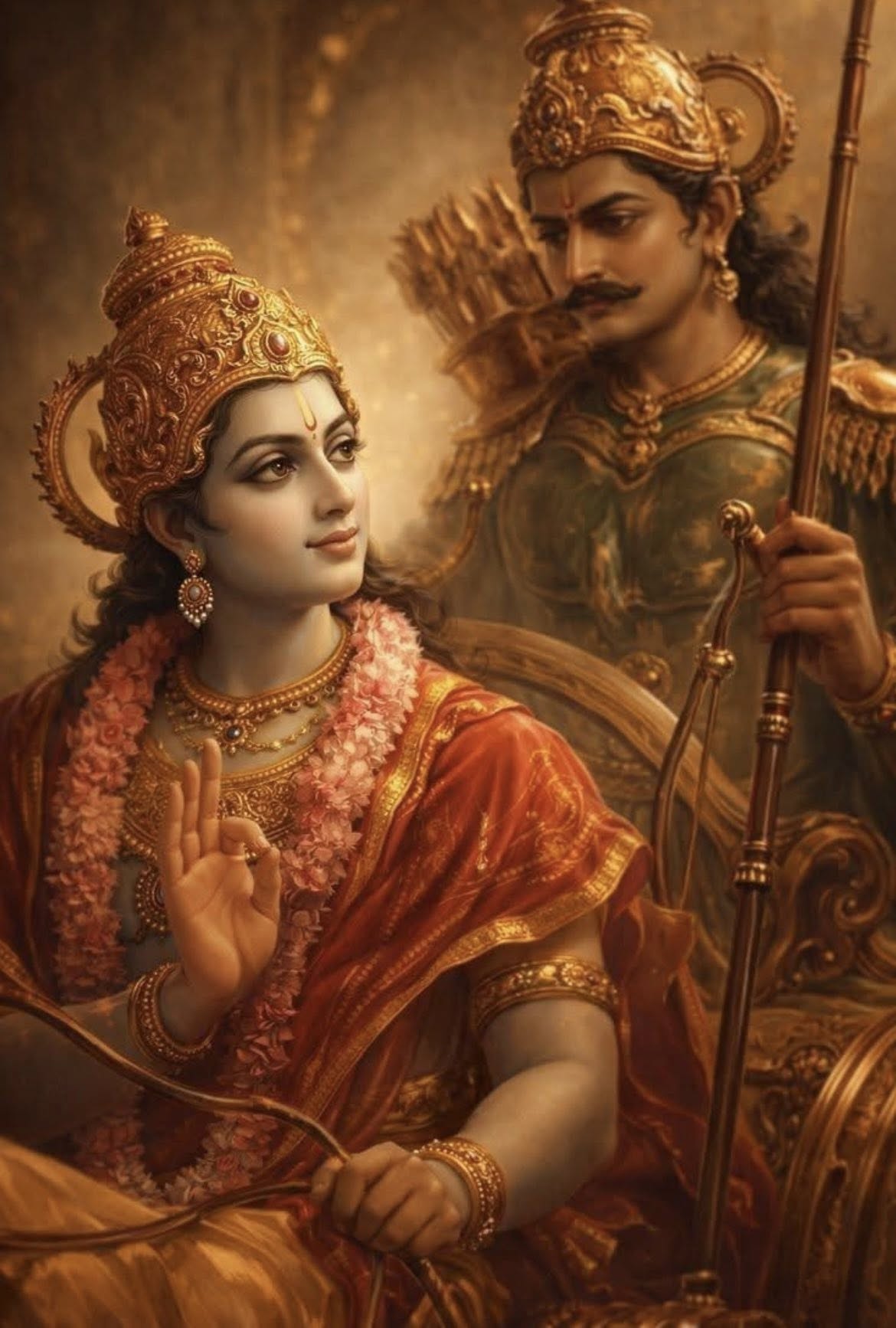
click on image to enlarge
I remember some years ago (1979), Bob Dylan released this song entitled “Gotta Serve Somebody”. I’m sure many of you remember it.
[Chorus]
But you’re going to have to serve somebody, yes indeed
You’re going to have to serve somebody
Well, it may be the devil or it may be the Lord
But you’re going to have to serve somebody
I chose to serve the Lord, Krishna. Service ts our eternal nature, our dharma. And like Bob says “You’re going to have to serve somebody”
The following are some quotes from the Srimad Bhagavatam, ant the Bhagavad-gita, on our eternal relationship (sanātana-dharma) with the Lord.
At the last stage of one’s life, one should be bold enough not to be afraid of death. But one must cut off all attachment to the material body and everything pertaining to it and all desires thereof. (SB 2.1.15)
The foolishness of gross materialism is that people think of making a permanent settlement in this world, although it is a settled fact that one has to give up everything here that has been created by valuable human energy. Great statesmen, scientists, philosophers, etc., who are foolish, without any information of the spirit soul, think that this life of a few years only is all in all and that there is nothing more after death. This poor fund of knowledge, even in the so-called learned circles of the world, is killing the vitality of human energy, and the awful result is being keenly felt. And yet the foolish materialistic men do not care about what is going to happen in the next life. The preliminary instruction in the Bhagavad-gītā is that one should know that the identity of the individual living entity is not lost even after the end of this present body, which is nothing but an outward dress only. As one changes an old garment, so the individual living being also changes his body, and this change of body is called death. Death is therefore a process of changing the body at the end of the duration of the present life. An intelligent person must be prepared for this and must try to have the best type of body in the next life. The best type of body is a spiritual body, which is obtained by those who go back to the kingdom of God or enter the realm of Brahman. (from purport)
Full text and purports
SB 2.1.15
अन्तकाले तु पुरुष आगते गतसाध्वसः ।
छिन्द्यादसङ्गशस्त्रेण स्पृहां देहेऽनु ये च तम् ॥१५॥
anta-kāle tu puruṣa
āgate gata-sādhvasaḥ
chindyād asaṅga-śastreṇa
spṛhāṁ dehe ‘nu ye ca tam
anta-kāle—at the last stage of life; tu—but; puruṣaḥ—a person; āgate—having arrived; gata-sādhvasaḥ—without any fear of death; chindyāt—must cut off; asaṅga—nonattachment; śastreṇa—by the weapon of; spṛhām—all desires; dehe—in the matter of the material tabernacle; anu—pertaining; ye—all that; ca—also; tam—them.
Translation
At the last stage of one’s life, one should be bold enough not to be afraid of death. But one must cut off all attachment to the material body and everything pertaining to it and all desires thereof.
Purport
The foolishness of gross materialism is that people think of making a permanent settlement in this world, although it is a settled fact that one has to give up everything here that has been created by valuable human energy. Great statesmen, scientists, philosophers, etc., who are foolish, without any information of the spirit soul, think that this life of a few years only is all in all and that there is nothing more after death. This poor fund of knowledge, even in the so-called learned circles of the world, is killing the vitality of human energy, and the awful result is being keenly felt. And yet the foolish materialistic men do not care about what is going to happen in the next life. The preliminary instruction in the Bhagavad-gītā is that one should know that the identity of the individual living entity is not lost even after the end of this present body, which is nothing but an outward dress only. As one changes an old garment, so the individual living being also changes his body, and this change of body is called death. Death is therefore a process of changing the body at the end of the duration of the present life. An intelligent person must be prepared for this and must try to have the best type of body in the next life. The best type of body is a spiritual body, which is obtained by those who go back to the kingdom of God or enter the realm of Brahman. In the second chapter of this canto, this matter will be broadly discussed, but as far as the change of body is concerned, one must prepare now for the next life. Foolish people attach more importance to the present temporary life, and thus the foolish leaders make appeals to the body and the bodily relations. The bodily relations extend not only to this body but also to the family members, wife, children, society, country and so many other things which end at the end of life. After death one forgets everything about the present bodily relations; we have a little experience of this at night when we go to sleep. While sleeping, we forget everything about this body and bodily relations, although this forgetfulness is a temporary situation for only a few hours. Death is nothing but sleeping for a few months in order to develop another term of bodily encagement, which we are awarded by the law of nature according to our aspiration. Therefore, one has only to change the aspiration during the course of this present body, and for this there is need of training in the current duration of human life. This training can be begun at any stage of life, or even a few seconds before death, but the usual procedure is for one to get the training from very early life, from the stage of brahmacarya, and gradually progress to the gṛhastha, vānaprastha and sannyāsa orders of life. The institution which gives such training is called varṇāśrama-dharma, or the system of sanātana-dharma, the best procedure for making the human life perfect. One is therefore required to give up the attachment to family or social or political life just at the age of fifty years, if not earlier, and the training in the vānaprastha and sannyāsa-āśramas is given for preparation of the next life. Foolish materialists, in the garb of leaders of the people in general, stick to family affairs without attempting to cut off relations with them, and thus they become victims of nature’s law and get gross bodies again, according to their work. Such foolish leaders may have some respect from the people at the end of life, but that does not mean that such leaders will be immune to the natural laws under which everyone is tightly bound by the hands and feet. The best thing is, therefore, that everyone voluntarily give up family relations by transferring attachment from family, society, country, and everything thereof to the devotional service of the Lord. It is stated herein that one should give up all desires of family attachment. One must have a chance for better desires; otherwise there is no chance of giving up such morbid desires. Desire is the concomitant factor of the living entity. The living entity is eternal, and therefore his desires, which are natural for a living being, are also eternal. One cannot, therefore, stop desiring, but the subject matter for desires can be changed. So one must develop the desires for returning back home, back to Godhead, and automatically the desires for material gain, material honor and material popularity will diminish in proportion to the development of devotional service. A living being is meant for service activities, and his desires are centered around such a service attitude. Beginning from the top executive head of the state down to the insignificant pauper in the street, all are rendering some sort of service to others. The perfection of such a service attitude is only attained simply by transferring the desire of service from matter to spirit, or from Satan to God.
SB 4.28.61
माया ह्येषा मया सृष्टा यत्पुमांसं स्त्रियं सतीम् ।
मन्यसे नोभयं यद्वै हंसौ पश्यावयोर्गतिम् ॥६१॥
māyā hy eṣā mayā sṛṣṭā
yat pumāṁsaṁ striyaṁ satīm
manyase nobhayaṁ yad vai
haṁsau paśyāvayor gatim
māyā—illusory energy; hi—certainly; eṣā—this; mayā—by Me; sṛṣṭā—created; yat—from which; pumāṁsam—a male; striyam—a female; satīm—chaste; manyase—you think; na—not; ubhayam—both; yat—because; vai—certainly; haṁsau—freed from material contamination; paśya—just see; āvayoḥ—our; gatim—factual position.
Translation
Sometimes you think yourself a man, sometimes a chaste woman and sometimes a neutral eunuch. This is all because of the body, which is created by the illusory energy. This illusory energy is My potency, and actually both of us—you and I—are pure spiritual identities. Now just try to understand this. I am trying to explain our factual position.
Purport
The factual position of both the Supreme Personality of Godhead and the living entity is qualitatively one. The Supreme Lord is the Supreme Spirit, the Supersoul, and the living entity is the individual spiritual soul. Even though both of them are original spiritual identities, the living entity forgets his identity when he comes in contact with material nature and becomes conditioned. At such a time he identifies himself as a product of the material nature. Because of the material body, he forgets that he is the eternal (sanātana) part and parcel of the Supreme Personality of Godhead. This is confirmed in this way: mamaivāṁśo jīva-loke jīva-bhūtaḥ sanātanaḥ [Bg. 15.7]. The word sanātana is found in several places in Bhagavad-gītā. Both the Lord and the living entity are sanātana (eternal), and there is also a place known as sanātana, beyond this material nature. The real residence of both the living entity and God is the domain of sanātana, not this material world. The material world is the temporary, external energy of the Lord, and the living entity is placed in this material world because he wanted to imitate the position of the Supreme Personality of Godhead. In this material world he tries to enjoy his senses to his best capacity. All the activities of the conditioned soul within this material world are perpetually taking place in different types of bodies, but when the living entity acquires developed consciousness, he should try to rectify his situation and again become a member of the spiritual world. The process by which one can return home, back to Godhead, is bhakti-yoga, sometimes called sanātana-dharma. Instead of accepting a temporary occupational duty based on the material body, one should take to the process of sanātana-dharma, or bhakti-yoga, so that he can put an end to this perpetual bondage in material bodies and return home, back to Godhead. As long as human society works on the basis of false material identification, all the so-called advancements of science and philosophy are simply useless. They only serve to mislead human society. Andhā yathāndhair upanīyamānāḥ [SB 7.5.31]. In the material world, the blind simply lead the blind.
Bg. 1.42
दोषैरेतैः कुलघ्नानां वर्णसङ्करकारकैः ।
उत्साद्यन्ते जातिधर्माः कुलधर्माश्च शाश्वताः ॥४२॥
doṣair etaiḥ kula-ghnānāṁ
varṇa-saṅkara-kārakaiḥ
utsādyante jāti-dharmāḥ
kula-dharmāś ca śāśvatāḥ
doṣaiḥ—by such faults; etaiḥ—all these; kula-ghnānām—of the destroyer of a family; varṇa-saṅkara—unwanted children; kārakaiḥ—by the doers; utsādyante—causes devastation; jāti-dharmāḥ—community project; kula-dharmāḥ—family tradition; ca—also; śāśvatāḥ—eternal.
Translation
Due to the evil deeds of the destroyers of family tradition, all kinds of community projects and family welfare activities are devastated.
Purport
The four orders of human society, combined with family welfare activities as they are set forth by the institution of the sanātana-dharma or varṇāśrama-dharma, are designed to enable the human being to attain his ultimate salvation. Therefore, the breaking of the sanātana-dharma tradition by irresponsible leaders of society brings about chaos in that society, and consequently people forget the aim of life—Viṣṇu. Such leaders are called blind, and persons who follow such leaders are sure to be led into chaos.
Text pasted from: https://prabhupada.io/archive



 The Hare Krishna Movement