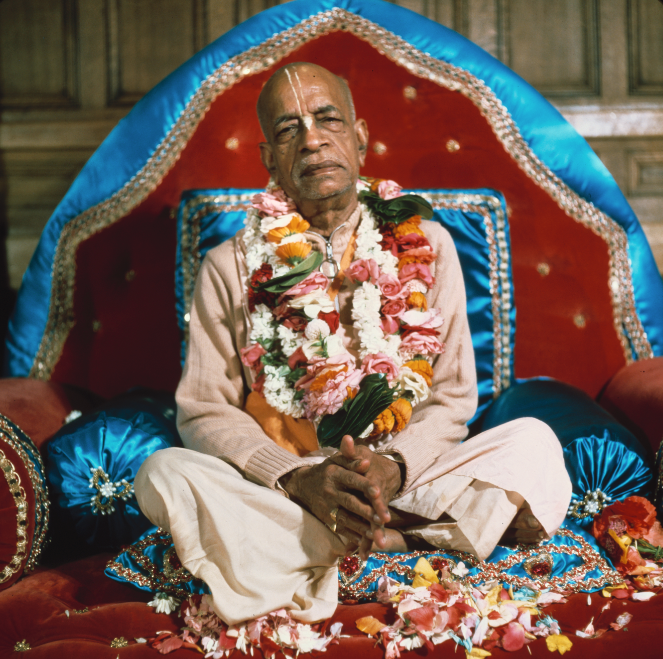
People often think that The Hare Krishna Movement (ISKCON) is a Hindu Religion, but it is not. Sometime back in 1968, one reporter asked Srila Prabhupada, “What is this Hare Krishna Movement?”. Srila Prabhupada replied: “We are not a buissness , we are not a Religion”.
…I am not very interested to establish a Hindu temple. Perhaps you know from the very beginning I never described my movement as Hindu religion. Religion means the bona fide process by which we understand God and the first class religion is that which teaches people to develop love for God. To know or accept the authority of God is one thing, but to love God is another. Generally, people are interested in material comforts and they make God as the supplying agent. This kind of devotion is not purified. It is contaminated by material desires, but when one is elevated to the position of giving everything to God out of love and affection, that is the first class position. We are teaching this philosophy in the name of Krishna Consciousness, and it is applicable to all sober persons. The Bhagavat principle is that because we can be happy simply by developing our dormant love of God, this is our first business. (Letter to: Mukunda June 3, 1969)
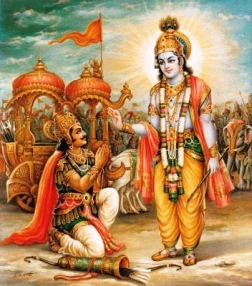
In the eighteenth Chapter of Bhagavad-gita, Lord Krishna in conclusion states:
sarva-dharmān parityajya
mām ekaṁ śaraṇaṁ vraja
ahaṁ tvāṁ sarva-pāpebhyo
mokṣayiṣyāmi mā śucaḥ
sarva-dharmān—all varieties of religion; parityajya—abandoning; mām—unto Me; ekam—only; śaraṇam—surrender; vraja—go; aham—I; tvām—you; sarva—all; pāpebhyaḥ—from sinful reactions; mokṣayiṣyāmi—deliver; mā—not; śucaḥ—worry.
TRANSLATION
Abandon all varieties of religion and just surrender unto Me. I shall deliver you from all sinful reaction. Do not fear. (Bg 18.66)
PURPORT
The Lord has described various kinds of knowledge, processes of religion, knowledge of the Supreme Brahman, knowledge of the Supersoul, knowledge of the different types of orders and statuses of social life, knowledge of the renounced order of life, knowledge of nonattachment, sense and mind control, meditation, etc. He has described in so many ways different types of religion. Now, in summarizing Bhagavad-gītā, the Lord says that Arjuna should give up all the processes that have been explained to him; he should simply surrender to Kṛṣṇa. That surrender will save him from all kinds of sinful reactions, for the Lord personally promises to protect him.
In the Eighth Chapter it was said that only one who has become free from all sinful reactions can take to the worship of Lord Kṛṣṇa. Thus one may think that unless he is free from all sinful reactions he cannot take to the surrendering process. To such doubts it is here said that even if one is not free from all sinful reactions, simply by the process of surrendering to Śrī Kṛṣṇa he is automatically freed. There is no need of strenuous effort to free oneself from sinful reactions. One should unhesitatingly accept Kṛṣṇa as the supreme savior of all living entities. With faith and love, one should surrender unto Him.
According to the devotional process, one should simply accept such religious principles that will lead ultimately to the devotional service of the Lord. One may perform a particular occupational duty according to his position in the social order, but if by executing his duty one does not come to the point of Kṛṣṇa consciousness, all his activities are in vain.
Anything that does not lead to the perfectional stage of Kṛṣṇa consciousness should be avoided. One should be confident that in all circumstances Kṛṣṇa will protect him from all difficulties. There is no need of thinking how one should keep the body and soul together. Kṛṣṇa will see to that. One should always think himself helpless and should consider Kṛṣṇa the only basis for his progress in life. As soon as one seriously engages himself in devotional service to the Lord in full Kṛṣṇa consciousness, at once he becomes freed from all contamination of material nature. There are different processes of religion and purificatory processes by cultivation of knowledge, meditation in the mystic yoga system, etc., but one who surrenders unto Kṛṣṇa does not have to execute so many methods. That simple surrender unto Kṛṣṇa will save him from unnecessarily wasting time. One can thus make all progress at once and be freed from all sinful reaction.
One should be attracted by the beautiful vision of Kṛṣṇa. His name is Kṛṣṇa because He is all-attractive. One who becomes attracted by the beautiful, all-powerful, omnipotent vision of Kṛṣṇa is fortunate. There are different kinds of transcendentalists—some of them are attached to the impersonal Brahman vision, some of them are attracted by the Supersoul feature, etc., but one who is attracted to the personal feature of the Supreme Personality of Godhead, and, above all, one who is attracted by the Supreme Personality of Godhead as Kṛṣṇa Himself, is the most perfect transcendentalist. In other words, devotional service to Kṛṣṇa, in full consciousness, is the most confidential part of knowledge, and this is the essence of the whole Bhagavad-gītā. Karma-yogīs, empiric philosophers, mystics, and devotees are all called transcendentalists, but one who is a pure devotee is the best of all. The particular words used here, mā śucaḥ, “Don’t fear, don’t hesitate, don’t worry,” are very significant. One may be perplexed as to how one can give up all kinds of religious forms and simply surrender unto Kṛṣṇa, but such worry is useless.
And in the Srimad Bhagavatam we find:
sa vai pumsam paro dharmo
yato bhaktir adhoksaje
ahaituky apratihata
yayatma suprasidati
“The supreme occupation, or dharma, for all humanity is that by which men can attain to loving devotional service unto the transcendental Lord. Such devotional service must be unmotivated and uninterrupted in order to completely satisfy the self.” (SB 1.2.6)
PURPORT
In this statement, Śrī Sūta Gosvāmī answers the first question of the sages of Naimiṣāraṇya. The sages asked him to summarize the whole range of revealed scriptures and present the most essential part so that fallen people or the people in general might easily take it up. The Vedas prescribe two different types of occupation for the human being. One is called the pravṛtti-mārga, or the path of sense enjoyment, and the other is called the nivṛtti-mārga, or the path of renunciation. The path of enjoyment is inferior, and the path of sacrifice for the supreme cause is superior. The material existence of the living being is a diseased condition of actual life. Actual life is spiritual existence, or brahma-bhūta existence, where life is eternal, blissful and full of knowledge. Material existence is temporary, illusory and full of miseries. There is no happiness at all. There is just the futile attempt to get rid of the miseries, and temporary cessation of misery is falsely called happiness. Therefore, the path of progressive material enjoyment, which is temporary, miserable and illusory, is inferior. But devotional service to the Supreme Lord, which leads one to eternal, blissful and all-cognizant life, is called the superior quality of occupation. This is sometimes polluted when mixed with the inferior quality. For example, adoption of devotional service for material gain is certainly an obstruction to the progressive path of renunciation. Renunciation or abnegation for ultimate good is certainly a better occupation than enjoyment in the diseased condition of life. Such enjoyment only aggravates the symptoms of disease and increases its duration. Therefore devotional service to the Lord must be pure in quality, i.e., without the least desire for material enjoyment. One should, therefore, accept the superior quality of occupation in the form of the devotional service of the Lord without any tinge of unnecessary desire, fruitive action and philosophical speculation. This alone can lead one to perpetual solace in His service.
We have purposely denoted dharma as occupation because the root meaning of the word dharma is “that which sustains one’s existence.” A living being’s sustenance of existence is to coordinate his activities with his eternal relation with the Supreme Lord Kṛṣṇa. Kṛṣṇa is the central pivot of living beings, and He is the all-attractive living entity or eternal form amongst all other living beings or eternal forms. Each and every living being has his eternal form in the spiritual existence, and Kṛṣṇa is the eternal attraction for all of them. Kṛṣṇa is the complete whole, and everything else is His part and parcel. The relation is one of the servant and the served. It is transcendental and is completely distinct from our experience in material existence. This relation of servant and the served is the most congenial form of intimacy. One can realize it as devotional service progresses. Everyone should engage himself in that transcendental loving service of the Lord, even in the present conditional state of material existence. That will gradually give one the clue to actual life and please him to complete satisfaction.



 The Hare Krishna Movement