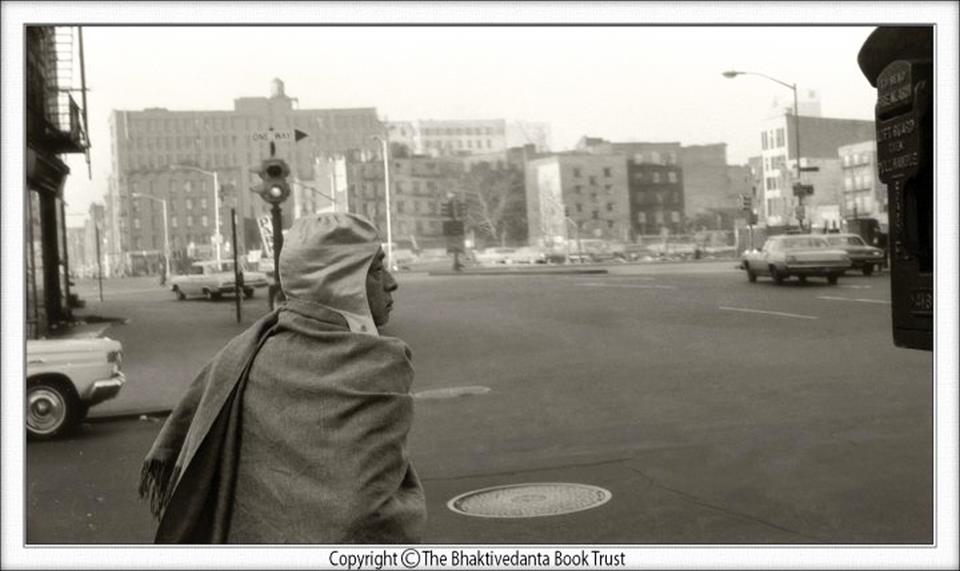
Earliest Recording of Srila Prabhupada in the Bhaktivedanta Archives
Its interesting to note that this lecture also became the Introduction to Bhagavad-gita As It Is
Prabhupāda:
om ajnana-timirandhasya jnananjana-salakaya
caksur unmilitam yena tasmai sri-gurave namah
sri-caitanya-mano-‘bhistam sthapitum yena bhtu-tale
svayam rupah kada mahyam dadati sva-padantikam
vande ‘ham sri-guroh sri-yuta-pada-kamalam sri-gurun vaisnavams’ ca
sri-rupam sagrajatam saha-gana-raghunathanvitam tam sa jivam
sadvaitam savadhutam parijana-sahitam krsna-caitanya-devam
sri-radha-krsna-padan saha-gana-lalita-sri-visakhanvitams’ ca
he krsna karuna-sindho dina-bandho jagat-pate
gopesa gopika kanta radha-kanta namo ‘stu te
tapta-kancana-gaurangi radhe vrndavanesvari
vrsabhanu-sute devi pranamami hari-priye
(jaya) sri-krsna-caitanya prabhu nityananda
sri-advaita gadadhara srivasadi-gaura-bhakta-vrnda
Hare Krishna, Hare Krishna
Krishna Krishna, Hare Hare
Hare Rama, Hare Rama
Rama Rama, Hare Hare
Bhagavad-gītā is known also Gītopaniṣad, the essence of Vedic knowledge, and one of the most important of the various Upaniṣads in Vedic literature. This Bhagavad-gītā, there are many commentations in English, and what is the necessity of another English commentation of the Bhagavad-gītā can be explained in the following way. One . . .
(break) One American lady, Mrs. Charlotte Leblanc, asked me to recommend an English edition of Bhagavad-gītā which she can read.
Of course, in America there are so many editions of English Bhagavad-gītā, but so far I have seen them, not only in America but also India, none of them can be said strictly as authoritative, because almost every one of them have expressed their own opinion through the commentation of the Bhagavad-gītā without touching the spirit of Bhagavad-gītā As It Is.
The spirit of Bhagavad-gītā is mentioned in the Bhagavad-gītā itself. It is just like this—if we want to take a particular medicine, then we have to follow the particular direction mentioned on the label of the medicine. We cannot take the particular medicine according to our own direction or by the direction of a friend, but we have to take the medicine under the direction given on the label of the bottle and as directed by the physician. Similarly, the Bhagavad-gītā also should be taken or accepted as it is directed by the speaker Himself.
The speaker of the Bhagavad-gītā is Lord Śrī Kṛṣṇa. He is mentioned in every page of the Bhagavad-gītā as the Supreme Personality of Godhead, Bhagavān. Of course, “bhagavān” is sometimes designated to any powerful person or any powerful demigod, but here bhagavān is certainly designated to Śrī Kṛṣṇa, a great personality, but at the same time we must know that Lord Śrī Kṛṣṇa, as He is confirmed by all the ācāryas . . . I mean to say, even Śaṅkarācārya, Rāmānujācārya, Madhvācārya, Nimbārka Svāmī and Śrī Caitanya Mahāprabhu and many others.
In India there were many authoritative scholars and ācāryas, I mean, authorities of the Vedic knowledge. All of them, including Śaṅkarācārya, has accepted Śrī Kṛṣṇa as the Supreme Personality of Godhead. The Lord Himself has also established Himself as the Supreme Personality of Godhead in the Bhagavad-gītā. He is accepted so in the Brahmā-saṁhitā and all Purāṇas, especially in the Bhāgavata Purāṇam:
kṛṣṇas tu bhagavān svayam (SB 1.3.28).
So therefore we should take Bhagavad-gītā as it is directed by the Personality of Godhead Himself. So in the Fourth Chapter of Bhagavad-gītā the Lord says:
imaṁ vivasvate yogaṁproktavān aham avyayamvivasvān manave prāhamanur ikṣvākave ‘bravīt (BG 4.1)
evaṁ paramparā-prāptamimaṁ rājarṣayo viduḥsa kāleneha mahatāyogo naṣṭaḥ parantapa (BG 4.2)
sa evāyaṁ mayā te ‘dyayogaḥ proktaḥ purātanaḥbhakto ‘si me sakhā cetirahasyaṁ hy etad uttamam (BG 4.3)
The idea is the Lord said to Arjuna that “This yoga, this system of yoga, Bhagavad-gītā, was first spoken by Me to the sun-god, and the sun-god explained to Manu. Manu explained to Ikṣvāku, and in that way, by disciplic succession, one after another, this yoga system is coming, and in course of time this system is now lost. And therefore, I am speaking to you the very same yoga system again, the very same old yoga system of Bhagavad-gītā, or Gītopaniṣad. Because you are My devotee and you are My friend, therefore it is possible for you only to understand.”
Now, the purport is that Bhagavad-gītā is a treatise which is specially meant for the devotee of the Lord. There are three classes of transcendentalists, namely the jñānī, the yogī and the bhakta, or the impersonalist or the meditator or the devotees. So here it is clearly mentioned, the Lord says to Arjuna that “I am speaking, or I am making you the first man of the paramparā. Because the old paramparā, or disciplic succession, is now broken, therefore I wish to establish again another paramparā in the same line of thought as it was coming down from the sun-god to others. So you, you take it and you distribute it.” Or “The system, the yoga system of Bhagavad-gītā, may now be distributed through you. You become the authority of understanding Bhagavad-gītā.”
Now, here is a direction that Bhagavad-gītā is especially instructed to Arjuna, the devotee of the Lord, the direct student of Kṛṣṇa. And not only that, he is intimately in touch with Kṛṣṇa as friend. Therefore Bhagavad-gītā is understood by a person who has similar qualities like Kṛṣṇa. That means he must be a devotee, he must be in relation, direct relationship with the Lord.
As soon as one becomes a devotee of the Lord, he has a direct relationship also with the Lord. That is a subject matter very long, but briefly it can be stated that a devotee is in relationship with the Supreme Personality of Godhead in five ways. One may be a devotee in a passive state, one may be a devotee in active state, one may be a devotee as a friend, one may be a devotee as parent, and one may be a devotee as conjugal lover.
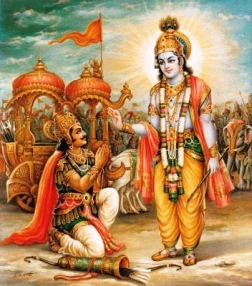
So Arjuna was a devotee in relationship with the Lord as a friend. The Lord can become a friend. Of course, this friendship and the conception of friendship which we have got in the mundane world, there is a gulf of difference. This is transcendental friendship, which . . . not that everyone will have the relationship with the Lord. Everyone has got a particular relationship with the Lord, and that particular relationship is evoked by the perfection of devotional service.
At the present status of our life we have not only forgotten the Supreme Lord, but also we have forgotten our eternal relationship with the Lord. Every living being, out of many, many millions and billions of living being, each and every living being has got a particular relationship with the Lord eternally. That is called svarūpa. Svarūpa. And by the process of devotional service one can revive that svarūpa of oneself, and that stage is called svarūpa-siddhi, perfection of one’s constitutional position. So Arjuna was a devotee and he was in touch with the Supreme Lord in friendship.
Now, this Bhagavad-gītā was explained to Arjuna, and how Arjuna accepted it, that should also be noted. How Arjuna accepted the Bhagavad-gītā is mentioned in the Tenth Chapter. Just like:
arjuna uvācaparaṁ brahma paraṁ dhāmapavitraṁ paramaṁ bhavānpuruṣaṁ śāśvataṁ divyamādi-devam ajaṁ vibhum (BG 10.12)
āhus tvām ṛṣayaḥ sarvedevarṣir nāradas tathāasito devalo vyāsaḥsvayaṁ caiva bravīṣi me (BG 10.13)
sarvam etad ṛtaṁ manyeyan māṁ vadasi keśavana hi te bhagavan vyaktiṁvidur devā na dānavāḥ. (BG 10.14)
Now, Arjuna says, after hearing Bhagavad-gītā from the Supreme Personality of Godhead, he accepts Kṛṣṇa as paraṁ brahma, the Supreme Brahman. Brahman. Every living being is Brahman, but the supreme living being, or the Supreme Personality of Godhead, is the Supreme Brahman, or supreme living being. And paraṁ dhāma.
Paraṁ dhāma means He is the supreme rest of everything. And pavitram. Pavitram means He is pure from material contamination. And He’s addressed as puruṣam. Puruṣam means the supreme enjoyer: śāśvatam, śāśvata means from very beginning, He’s the first person: divyam, transcendental: devam, the Supreme Personality of Godhead: ajam, never born: vibhum, the greatest.
Now, one may doubt, that because Kṛṣṇa was the friend of Arjuna, therefore he might say all these things to his own friend. But Arjuna, just to drive out this kind of doubts in the mind of the readers of Bhagavad-gītā, he establishes his proposition by the authorities.
He says that Lord Śrī Kṛṣṇa is accepted as the Supreme Personality of Godhead not only by himself, Arjuna, but He is so accepted by authorities like Nārada, Asita, Devala, Vyāsa. These personalities are great personalities in distributing the Vedic knowledge, accepted by all ācāryas.
Therefore Arjuna says that “Whatever You have spoken so far to me, I accept them as completely perfect.” Sarvam etad ṛtaṁ manye (BG 10.14): “I take it, I believe it that whatever You have spoken, they are all right. And Your personality, Your personality of Godhead, is very difficult to understand. And therefore You cannot be known by even the demigods. You cannot be known even by the demigods.” That means the Supreme Personality Godhead cannot be known even by greater personalities than the human being. And how a human being can understand Śrī Kṛṣṇa without becoming His devotee?
Therefore Bhagavad-gītā should be taken up in a spirit of devotee of Lord Śrī Kṛṣṇa. One should not think that he is equal, on the same level of Śrī Kṛṣṇa, or one should not think that He is an ordinary personality, maybe a very great personality. No. Lord Śrī Kṛṣṇa is the Supreme Personality of Godhead.
So at least theoretically, on the statement of Bhagavad-gītā or on the statement, assertion, of Arjuna, the person who is trying to understand the Bhagavad-gītā, we should accept Śrī Kṛṣṇa as the Supreme Personality of Godhead, and then, with that submissive spirit . . . unless one receives this Bhagavad-gītā in a submissive spirit and aural reception, it is very difficult to understand Bhagavad-gītā, because it is a great mystery.
So in this Bhagavad-gītā . . . we may survey what is this Bhagavad-gītā. This Bhagavad-gītā is meant for delivering persons . . . persons from the nescience of this material existence. Every man is in difficulty in so many ways, as Arjuna also was in difficulty in the matter of fighting the battle of Kurukṣetra. And as such, he surrendered unto Śrī Kṛṣṇa, and therefore this Bhagavad-gītā was spoken.
Similarly, not only Arjuna, but every one of us is always full of anxieties due to our this material existence. Asad-grahāt. It is . . . our existence is in the environment or atmosphere of nonexistence. But actually, we are not nonexistent. Our existence is eternal, but some way or other we are put into this asat. Asat means which does not exist.
Now out of so many human being who are actually inquiring about his position as to what he is, why he is put into this awkward position of suffering . . . unless one is awakened to this position that, “Why I am suffering? I do not want all these sufferings. I have tried to make a solution of all these sufferings, but I have failed,” unless one is in that position, he is not to be considered a perfect human being. Humanity begins when this sort of inquiries are awakened in one’s mind.
In the Brahma-sūtra this enquiry is called brahma-jijñāsā. Athāto brahma jijñāsā. And every activity of the human being is to be considered a failure without having this enquiry in his mind. So persons who have awakened this enquiry into his mind as to “What I am, why I am suffering, wherefrom I have come or where I shall go after death,” when these inquiries come, are awakened in the mind of a sane human being, then he is practically the right student for understanding Bhagavad-gītā.
And he must be śraddhāvān. Śraddhāvān. He must have respect, a fond respect in the Supreme Personality of Godhead. Such a person, as the ideal person was Arjuna. So Lord Kṛṣṇa, He descends, yadā yadā hi dharmasya glānir bhavati (BG 4.7). Just to establish the real purpose of life. When man forgets the real purpose of life, the mission of human form of life, then it is called dharmasya glāniḥ, the disturbance of the occupation of human being.
So in that circumstances, out of many, many human being, who awakens, one who awakens the spirit of understanding his position, for him this Bhagavad-gītā is spoken. We are just like swallowed by the tigress of nescience, and Lord being causelessly merciful upon the living entities, especially for the human being, He spoke Bhagavad-gītā, making His friend Arjuna as the student.
Arjuna was certainly, being an associate of Lord Kṛṣṇa, he was above all ignorance. But still, Arjuna was put into ignorance in the Battlefield of Kurukṣetra just to question about the problems of life to the Supreme Lord so that the Lord can explain them for the benefit of future generation of human being to chalk out the plan of his life and act in that way so that his life, his mission of human life, can be perfect.
So in this Bhagavad-gītā the subject matter is comprehending five different truths. The first truth is what is God. It is the preliminary study of the science of God. So that science of God is explained here. Next, the constitutional position of the living entities, jīva. Īśvara and jīva. The Lord, the Supreme Lord, He is called īśvara.
Īśvara means controller, and jīva, the living entities, are . . . jīvas, the living entities, they are not īśvara, or the controller. They are controlled. Artificially if I say that “I am not controlled, I am free,” this is not the sign of a sane man. A living being is controlled in every respect. At least, in his conditioned life he is controlled.
So in this Bhagavad-gītā the subject matter comprehends about the īśvara, the supreme controller, and about the controlled living entities and prakṛti, the nature, the material nature. And next, the time, duration of existence of the whole universe, or this manifestation of the material nature, and the duration of time, or the eternal time: and karma. Karma means activity.
Everything, the whole universe, whole cosmic manifestation, is full of different activities. The living being, especially, they are all engaged in different activities. So we have to study from the Bhagavad-gītā īśvara, what is God: jīva, what are these living entities: and prakṛti, what is this cosmic manifestation: and how it is controlled by time: and what are these activities.
Now out of these five subject matter, in the Bhagavad-gītā it establish that the Supreme Godhead, or Kṛṣṇa, or Brahman, or Paramātmā—you may call whatever you like—but the supreme controller. There is a supreme controller. So the supreme controller is the greatest of all. And the living beings, they are in quality like the supreme controller.
Just like the supreme controller, the Lord, He has control over the universal affairs, over the material nature, how the . . . it will be explained in the later chapters of Bhagavad-gītā that this material nature is not independent. She is acting under the direction of the Supreme Lord. Mayādhyakṣeṇa prakṛtiḥ sūyate sa-carācaram (BG 9.10): “This material nature is working under My direction,” mayādhyakṣeṇa, “under My superintendence.”
So we . . . we are mistaken. When we see wonderful things happening in the cosmic nature, we should know that behind these wonderful manifestations there is a controller. Nothing can be manifested without being controlled. It is childish to . . . not to consider about the controller.
Just like a very nice motorcar with very good speed and very good engineering arrangement is running on the street. A child may think that “How this motorcar is running without the help of any horse or any pulling agent?” But a sane man, or an elderly person, he knows that in spite of all engineering arrangements in the motorcar, without the driver it cannot move.
That engineering arrangement of a motorcar, or in electric powerhouse . . . now at the present moment it is the day of machinery, but we should always know that behind the machinery, behind the wonderful working of the machinery, there is a driver. So the Supreme Lord is the driver, adhyakṣa. He is the Supreme Personality under whose direction everything is working.
Now these jīva, or the living entities, they have been accepted by the Lord in this Bhagavad-gītā, as we’ll know it in later chapters, that they are parts and parcels of the Supreme Lord. Mamaivāṁśo jīva-bhūtaḥ (BG 15.7). Aṁśa means parts and parcels. Now, as a particle of gold is also particle, a drop of water of the ocean is also salty, similarly, we, the living entities, being part and parcels of the supreme controller, īśvara, Bhagavān, or Lord Śrī Kṛṣṇa, we have got, I mean to say, qualitatively all the qualities of the Supreme Lord in minute.
Because we are minute īśvara, subordinate īśvara. We are also trying to control. We are just trying to control over the nature. In the present days you are trying to control over the space: you are trying to float imitation planets.
So this tendency of controlling or creating is there because partially we have got that controlling tendency. But we should know that this tendency is not sufficient. We have the tendency of controlling over the material nature, lording it over the material nature, but we are not the supreme controller. So that thing is explained in the Bhagavad-gītā.
Then what is this material nature? The nature is also explained. The nature, material nature, is explained in the Bhagavad-gītā as inferior, inferior prakṛti. Inferior prakṛti. And the living entities are explained as the superior prakṛti.Prakṛti means which is controlled, which is under . . .
Prakṛti, real meaning of prakṛti is a woman or a female. Just like a husband controls the activities of his wife, similarly, the prakṛti is also subordinate, predominated. The Lord, the Supreme Personality of Godhead, is the predominator, and this prakṛti, both the living entities and the material nature, they are different prakṛtis, or predominated, controlled by the Supreme.
So according to Bhagavad-gītā, the living entities, although they are parts and parcels of the Supreme Lord, they are taken as prakṛti. It is clearly mentioned in the Seventh Chapter of the Bhagavad-gītā, yes, apareyam itas tu viddhi aparā (BG 7.5). This material nature is aparā iyam. Itas tu, and beyond this there is another prakṛti. And what is that prakṛti? Jīva-bhūta, these . . .
So this prakṛti, the constitution of this prakṛti, is constituted by three qualities: the mode of goodness, the mode of passion and mode of ignorance. And above these modes, three different kinds of modes, goodness, passion and, I mean to say, ignorance, there is eternal time. There is eternal time. And by combination of these modes of nature and under the control, under the purview, of this eternal time, there are activities. There are activities, which is called karma.
These activities are being done from time immemorial, and we are suffering or enjoying the fruits of our activities, just like in the present life also, we enjoy the activities, the fruits of our activities. Suppose I am a businessman and I have very . . . worked very hard with intelligence, and I have amassed a vast amount of bank balance. Now I am the enjoyer.
Similarly, suppose I started my business with a vast amount of money, but I failed to make a successful . . . I lost all the money. So I am sufferer. So similarly, in every field of our life we enjoy, we enjoy the result of our work. This is called karma.
So these things, īśvara, jīva, prakṛti, or the Supreme Lord, or the living entity, the material nature, the eternal time, and our different activities, these things are explained in the Bhagavad-gītā. Now out of these five, the Lord, the living entities, and the material nature and time, these four items are eternal. Now manifestation, manifestation of prakṛti, may be temporary, but it is not false.
Some philosophers say that this manifestation of material nature is false, but according to the philosophy of Bhagavad-gītā or according to the philosophy of the Vaiṣṇavas, they do not accept the manifestation of the world as false. They accept that the manifestation is real, but it is temporary.
It is just like a cloud takes place in the sky and the rainy season begins, and after the rainy season there are so many new green vegetation all over the field, we can see. And as soon as the rainy season is finished, then the cloud is vanquished. Generally, gradually, all this vegetation dry up and again the land becomes barren. Similarly, this material manifestation takes place at a certain interval.
We’ll understand it, we’ll know it, from the pages of the Bhagavad-gītā. Bhūtvā bhūtvā pralīyate (BG 8.19). This manifestation becomes magnificent at a certain interval, and again it disappears. That is the work of the prakṛti. But it is working eternally, therefore prakṛti is eternal.
It is not false. Because the Lord has accepted, mama prakṛti, “My prakṛti.” Apareyam itas tu viddhi me prakṛtiṁ parām (BG 7.5). Bhinnā prakṛti, bhinnā prakṛti, aparā prakṛti, this material nature is a separated energy of the Supreme Lord, and the living entities, they are also energy of the Supreme Lord, but they are not separated. They are eternally related.
So the Lord, the living entity, the nature—material nature—and time, they are all eternal. But the other item, karma, is not eternal. The effects of karma, or activity, may be very old. We are suffering or enjoying the results of our activities from a time immemorial, but still, we can change the result of our karma, or activity. That will depend on our perfect knowledge. We are engaged in various activities undoubtedly, but we do not know what sort of activities we shall adopt that will give us relief from the actions and reactions of all activities. That is also explained in the Bhagavad-gītā.
Now, the position of īśvara is supreme consciousness. Position of īśvara, or the Supreme Lord, is supreme consciousness. And the jīvas, or the living entities, being parts and parcels of the Supreme Lord, he is also conscious. A living entity is also conscious. The living entity is explained as prakṛti, energy, and the material nature is also explained as prakṛti, but amongst the two, one prakṛti, the jīvas, they are conscious: the other prakṛti is not conscious. That is the difference.
Therefore the jīva prakṛti is called superior, because the jīvas has consciousness similar to the Lord. The Lord is supreme consciousness. One should not claim that a jīva, a living entity, is also supremely conscious. No. A living being cannot be supremely conscious at any stage of his perfection. This is a misleading theory. This is misleading theory. But he is conscious. That’s all. But he is not supreme conscious.
The supreme conscious, it will be explained in the Bhagavad-gītā in the chapter where the distinction between the jīva and īśvara is explained. Kṣetra-kṣetra-jña. This kṣetra-jña has been explained that the Lord is also kṣetra-jña, or conscious, and the jīvas, or the living beings, they are also conscious.
But the difference is that a living being is conscious within his limited body, but the Lord is conscious of all bodies. Īśvaraḥ sarva-bhūtānāṁ hṛd-deśe ‘rjuna tiṣṭhati (BG 18.61). The Lord lives within the core of heart in every living being, therefore He is conscious of the psychic movements, activities, of the Lord . . . of the particular jīva. We should not forget.
It is also explained that the Paramātmā, the Supreme Personality of Godhead, is living in everyone’s heart as īśvara, as the controller, and He is giving direction. He is giving direction. Sarvasya cāhaṁ hṛdi sanniviṣṭhaḥ (BG 15.15) . . . everyone’s heart He is situated, and He gives direction to act as he desire. The living entity forgets what to do. First of all he makes his determination to act in a certain way, and then he is entangled in the actions and reactions of his own karma.
But after giving up one type of body, when he enters another type of body . . . just like we give up one kind of dress, one type of dress, for another type of dress, similarly, it is explained in this Bhagavad-gītā that vāsāṁsi jīrṇāni yathā vihāya (BG 2.22) . . . one, as one changes his different dresses, similarly the living entities, they are also changing different bodies, transmigration of the soul, and pulling on the actions and reactions of his past activities.
So these activities can be changed when a living being is in the mode of goodness, in sanity, and he understands what sort of activities he should adopt. And if he does so, then the whole action and reactions of his past activities can be changed. Therefore karma is not eternal. Other things, out of the four . . . five items—īśvara, jīva, prakṛti, kāla and karma—these four items are eternal, whereas the karma, the item known as karma, that is not eternal.
Now the conscious īśvara, the supreme conscious īśvara, and difference between the supreme conscious īśvara, the Lord, and the living being is, in the present circumstances, is like this. Consciousness, consciousness of . . . both of the Lord and the living entities, they are, this consciousness is transcendental. It is not that this consciousness is generated by the association of this matter. That is a mistaken idea.
The theory that consciousness develops under certain circumstances of material combination is not accepted in the Bhagavad-gītā. They cannot. Consciousness may be pervertedly reflected by the cover of material circumstances, just like light reflected through a colored glass may seem according to the color. Similarly, the consciousness of Lord, it is not materially affected. The Supreme Lord, just like Kṛṣṇa, He says that, mayādhyakṣeṇa prakṛtiḥ (BG 9.10).
When He descends in this material world, His consciousness is not materially affected. Had His consciousness been materially affected, He was unfit to speak about the transcendental subject matter in the Bhagavad-gītā. One cannot say anything about the transcendental world without being free from the materially contaminated consciousness. So the Lord was not materially contaminated. But our consciousness, at the present moments, is materially contaminated.
So whole thing, as the Bhagavad-gītā teaches, we have to purify the materially contaminated consciousness, and in that pure consciousness, the actions will be done. That will make us happy. We cannot stop. We cannot stop our activity. The activities are to be purified. And these purified activities are called bhakti. Bhakti means they are . . . they appear also just like ordinary activity, but they are not contaminated activities. They are purified activities.
So a ignorant person may see that a devotee is working like an ordinary man. But a person with poor fund of knowledge, he does not know that the activities of a devotee or the activities of the Lord, they are not contaminated by the impure consciousness of matter, impurity of the three guṇas, modes of nature, but transcendental consciousness.
So our consciousness is materially contaminated, we should know. Now, when we are such materially contaminated, that is called our conditioned stage. Conditioned stage. And the false ego, the false consciousness . . . the false consciousness is exhibited under the impression that, “I am one of the product of this material nature.” That is called false ego. The whole material activities, yasyātma-buddhiḥ kuṇape tri-dhātuke (SB 10.84.13).
Yasyātma-buddhiḥ kuṇape tri-dhātuke: one who is absorbed in the thought of bodily conception. Now, the whole Bhagavad-gītā was explained by the Lord because Arjuna represented himself with bodily conception. So one has to get free from the bodily conception of life. That is the preliminary activity for a transcendentalist who wants to get free, who wants to be liberated. And he has to learn first of all that he is not this material body.
So this consciousness, or material consciousness, when we are freed from this material consciousness, that is called mukti. Mukti, or liberation, means to become free from material consciousness. In the Śrīmad-Bhāgavata also the definition of liberation is said, muktir hitvānyathā rūpaṁ svarūpeṇa vyavasthitiḥ (SB 2.10.6).
Svarūpeṇa vyavasthitiḥ. Mukti means liberation from the contaminated consciousness of this material world and to become situated in pure consciousness. And the whole instruction, instruction of Bhagavad-gītā, is targeted to awaken that pure consciousness.
We’ll find in the last stage of the instruction of Bhagavad-gītā that Kṛṣṇa is asking Arjuna whether he is now in purified consciousness—whether he was in purified consciousness. The purified consciousness is to act according to the direction of the Lord. That is purified consciousness.
That is the whole sum and substance of purified consciousness. Consciousness is already there, but because we are part and parcels, therefore we are affected. There is affinity of being affected by the material modes. But the Lord, being Supreme, He is never affected. He is never affected. That is the difference between the Lord and the Supreme . . . Supreme Lord and the . . .
Now this consciousness is . . . what is this consciousness? This consciousness is that “I am.” What I am? When in contaminated consciousness this “I am” means that “I am the lord of all I survey.” This is impure consciousness. And “I am the enjoyer.” The whole material world is moving that every living being is thinking that, “I am the lord and I am the creator of this material world.” The consciousness has got two psychic movement, or two psychic division. One is that “I am the creator,” and the other is “I am the enjoyer.”
So the Supreme Lord is actually the creator and He is actually the enjoyer. And the living entities, being part and parcel of the Supreme Lord, he’s not actually the creator or the enjoyer, but he’s a cooperator. Just like the whole machine. The part of the machine is the cooperator. Is the cooperator. Or if we can study just the constitution of our body, now, in the body there are hands, there are legs, there are eyes and all these instruments working, but all these parts and parcels of the body, they are not enjoyer. The stomach is the enjoyer.
The leg is moving from one place to another. The hand is collecting, the hand is preparing foodstuff, and the teeth is chewing, and everything, all parts of body, are engaged in satisfying the stomach, because the stomach is the principle fact within the organization of this body. And everything should be given to the stomach. Prāṇopahārāc ca yathendriyāṇām (SB 4.31.14).
Just like you can see a tree green by pouring water in the root. Or you can become healthy . . . the parts of the body—the hands, the legs, the eyes, the ears, the fingers—everything keeps in healthy stage when the parts of the body cooperate with the stomach.
Similarly, the supreme living being, the Lord, He is the enjoyer. He is the enjoyer and He is the creator. And we, I mean to say, subordinate living beings, the products of the energy of the Supreme Lord, we are just to cooperate with Him. That cooperation will help. Just, for example, a good foodstuff taken by the fingers. If the fingers think that, “Why should we give it to the stomach? Let us enjoy,” that is a mistake. The fingers are unable to enjoy. If fingers want the fruit of enjoyment of that particular foodstuff, the fingers must put it into the stomach.
The whole arrangement is that the central figure, central figure of creation, central figure of enjoyment, is the Supreme Lord, and the living entities, they are simply cooperator. By cooperation, by cooperation they enjoy. The relation is just like the master and the servant.
If the master is satisfied, if the master is fully satisfied, the servants are automatically satisfied. That is the law. Similarly, the Supreme Lord should be satisfied, although the tendency for becoming creator and the tendency to enjoy this material world is . . . they are also in the living entities, because it is there in the Supreme Lord. He has created. He has created the manifested cosmic world. (break)
Therefore we shall find in this Bhagavad-gītā that the complete whole, comprising the supreme controller, the controlled living entities, the cosmic manifestation, the eternal time and the activities, all of them are completely explained. So the whole thing taking together completely is called the Absolute Truth. The complete whole, or the Supreme Absolute Truth, is therefore the complete Personality of Godhead Śrī Kṛṣṇa, as I have explained, that the manifestation are due to His different energies, and He is the complete whole.
The impersonal Brahman is explained in the Bhagavad-gītā that impersonal Brahman is also subordinate to the complete person. Brahmaṇo ‘haṁ pratiṣṭhā (BG 14.27). Impersonal Brahman is also. It is . . . the impersonal Brahman is more explicitly explained in the Brahma-sūtra as the rays. As there is the rays of the sunshine, sun planet, similarly, the impersonal Brahman is the shining rays of the Supreme Brahman, or the Supreme Personality of Godhead.
Therefore impersonal Brahman is incomplete realization of the absolute complete whole, and so also the conception of Paramātmā. These things are also explained. Puruṣottama-yoga. When we shall read the chapter of Puruṣottama-yoga it will be seen that the Supreme Personality, Puruṣottama, is above the impersonal Brahman and partial realization of Paramātmā.
The Supreme Personality of Godhead is called sac-cid-ānanda-vigrahaḥ. In the Brahma-saṁhitā, the beginning is started like this: īśvaraḥ paramaḥ kṛṣṇaḥsac-cid-ānanda-vigrahaḥanādir ādir govindaḥsarva-kāraṇa-kāraṇam (Bs 5.1)
“Govinda, Kṛṣṇa, is the cause of all causes. He is the primal Lord.” So the Supreme Personality of Godhead is sac-cid-ānanda-vigrahaḥ. Impersonal Brahman realization is the realization of His sat part, eternity. And Paramātmā realization is the realization of sat-cit, eternal knowledge part realization. But realization of the Personality of Godhead as Kṛṣṇa is realization of all the transcendental features like sat, cit and ānanda, in complete vigraha. Vigraha means form. Vigraha means form.
Avyaktaṁ vyaktim āpannaṁ manyante mām abuddhayaḥ (BG 7.24). People with less intelligence, they consider the Supreme Truth as impersonal. But He is a person, a transcendental person. This is confirmed in all Vedic literature. Nityo nityānāṁ cetanaś cetanānām (Kaṭha Upaniṣad 2.2.13).
So, as we are also persons, individual living being, we are person, we have got our individuality, we are all individual, similarly the Supreme Truth, the Supreme Absolute, He is also, at the ultimate issue, He is a person. But realization of the Personality of Godhead is realization of all the transcendental features like sat, cit and ānanda, in complete vigraha. Vigraha means form.
Therefore the complete whole is not formless. If He is formless or if He is less in any other thing, He cannot be complete whole. The complete whole must have everything within our experience and beyond our experience. Otherwise He cannot be complete.
The complete whole Personality of Godhead has immense potencies. Parāsya śaktir vividhaiva śrūyate (Śvetāśvatara Upaniṣad 6.8).
That is also explained in Bhagavad-gītā, how He is acting in different potencies. This phenomenal world, or the material world, where we are now put, is also complete by itself, because pūrṇam idam (Īśopaniṣad, Invocation).
The twenty-four elements of which, according to Sāṅkhya philosophy, the twenty-four elements of which this material universe is a temporary manifestation are completely adjusted to produce complete things which are necessary for the maintenance and subsistence of this universe.
No extraneous effort by any other unit is required for the maintenance of the universe. It’s at its own time, fixed up by the energy of the complete whole, and when the time is complete, these temporary manifestations will be annihilated by the complete arrangement of the complete.
There is complete facility for the small complete units, namely, the living entities, to realize the complete. And all sorts of incompleteness is experienced on account of incomplete knowledge of the complete. So the Bhagavad-gītā is the complete knowledge of the Vedic wisdom. The whole Vedic knowledge is infallible. There are different examples how we take Vedic knowledge as infallible.
Take, for example, so far the Hindus are concerned, and how they accept the Vedic knowledge as complete, here is an insignificant example. Just like the cow dung. The cow dung is the stool of an animal. According to smṛti, or Vedic wisdom, if one touches the stool of an animal he has to take his bath to purify himself. But in the Vedic scriptures the cow dung is stated as pure. Rather, impure place or impure things are purified by touch of the cow dung.
Now, if one argues how it is that in one place it is said that the stool of the animal is impure and another place it is said that the cow dung, which is also the stool of an animal, it is pure, so it is contradictory. But actually, it may appear to be contradictory, but because it is Vedic injunction, therefore for our practical purposes we accept it. And by that acceptance we are not committing mistake.
It has been found by modern chemist, modern science, one Dr. Lal Mohan Ghosa, he has very minutely analyzed the cow dung, and he has found that cow dung is a composition of all antiseptic properties. So similarly, he has also analyzed the water of the Ganges out of curiosity. So my idea is that Vedic knowledge is complete because it is above all doubts and all mistakes. So . . . and Bhagavad-gītā is the essence of all Vedic knowledge.
The Vedic knowledge is therefore infallible. It comes down through the perfect disciplic succession. Therefore Vedic knowledge is not a thing of research. Our research work is imperfect, because we are searching everything with imperfect senses. Therefore the result of our research work is also imperfect. It cannot be perfect. We have to accept the perfect knowledge.
The perfect knowledge is coming down, as it is stated in the Bhagavad-gītā, just we have begun, evaṁ paramparā-prāptam imaṁ rājarṣayo viduḥ (BG 4.2). We have to receive the knowledge from the right source in disciplic succession of spiritual masters beginning from the Lord Himself. So Bhagavad-gītā is spoken by the Lord Himself. And Arjuna, the . . . I mean to say, the student who took lessons of the Bhagavad-gītā, he accepted the whole story as it is, without any cutting.
That is also not allowed, that we accept a certain portion of Bhagavad-gītā and reject another portion. That is also not accepted. We must accept the Bhagavad-gītā without interpretation, without any cutting, and without our own whimsical participation in the matter, because it should be taken as the most perfect Vedic knowledge.
The Vedic knowledge is received from the transcendental sources, because the first word was spoken by the Lord Himself. The words spoken by the Lord is called apauruṣeya (not made by man), or not delivered by any person of the mundane world, who is infected with four principles of imperfectness.
A living being of the mundane world has four defective principles of his life, and they are: (1) that he must commit mistake, (2) he must be sometimes illusioned, (3) he must try to cheat others, and (4) he’s endowed with imperfect senses.
With all these four principles of imperfectness, one cannot deliver the perfect form of information in the matter of all-pervading knowledge. The Vedas are not like that.
The Vedic knowledge was imparted in the heart of Brahmā, the first created living being. And Brahmā in his turn disseminated the knowledge to his sons and disciples as they were originally received from the Lord. The Lord, being pūrṇam, or all-perfect, there is no chance of His becoming subjected to the laws of material nature. One should therefore be intelligent enough to know that except the Lord, nobody is the proprietor of anything within the universe. That is explained in the Bhagavad-gītā: ahaṁ sarvasya prabhavomattaḥ sarvaṁ pravartateiti matvā bhajante māṁbudhā bhāva-samanvitāḥ (BG 10.8)
The Lord is the original creator. He is the creator of Brahmā, He is the creator . . . that is also explained. He is the creator of Brahmā. In the Eleventh Chapter the Lord is addressed as prapitāmaha (BG 11.39).
Because Brahmā is addressed as pitāmaha, the grandfather, but He is the creator of the grandfather also. So nobody should claim to be the proprietor of anything, but he must accept things which are set aside by the Lord as his quota of maintenance.
Now, there are many examples how we have to utilize the allotment of the Lord. That is also explained in the Bhagavad-gītā. Arjuna, he decided in the beginning that he should not fight. That was his own contemplation.
Arjuna said to the Lord that it was not possible for him to enjoy the kingdom after killing his own kinsmen. And that point of view was due to his conception of the body. Because he was thinking that the body was himself and the bodily relatives—his brothers, his nephews, his father-in-law or his grandfather—they were expansion of his body, and he was thinking in that way to satisfy his bodily demands. And the whole thing was spoken by the Lord just to change the view. And he agreed to work under the direction of the Lord. And he said, kariṣye vacanaṁ tava (BG 19.73).
Therefore in this world the human being is not meant for quarreling like the cats and dogs. They must be intelligent enough to realize the importance of the human life and refuse to act like ordinary animal. He should . . . a human being should realize the aim of human life.
This direction is given in all the Vedic literature, and the essence is given in the Bhagavad-gītā. Vedic literature are meant for the human being and not for the cats and dogs. The cats and dogs can kill their eatable animals, and for that there is no question of sin on their part. But if a man kills an animal for the satisfaction of his uncontrolled taste, he must be responsible for breaking the laws of nature.
And in the Bhagavad-gītā it is clearly explained that there are three kinds of activities according to the different modes of nature: the activities of goodness, the activities of passion, the activities of ignorance. Similarly, there are three kinds of eatables also: eatables in goodness, eatables on passion, eatables on ignorance.
They’re all clearly described, and if we properly utilize the instructions of the Bhagavad-gītā, then our whole life will become purified and ultimately we shall (be) able to reach the destination: yad gatvā na nivartante tad dhāma paramaṁ mama (BG 15.6). That information is given in the Bhagavad-gītā, that beyond this spiritual . . . material sky, there is another, spiritual sky: that is called sanātana sky. In this sky, this covered sky, we find everything temporary. It is manifested, it stays for some time, gives us some by-product, and then it becomes dwindling and then vanishes. That is the law of this material world. You take this body, you take a fruit or anything what is created here, it has got its annihilation at the end.
So beyond this temporary world there is another world, for which the information is there, that paras tasmāt tu bhāvaḥ anyaḥ (BG 8.20). There is another nature which is eternal, sanātana. Which is eternal. And the jiva . . . jīva is also described as sanātana. Mamaivāṁśo jīva-bhūtaḥ jīva-loke sanātanaḥ (BG 15.7). Sanātana. Sanātana means eternal. And the Lord is also described as sanātana in the Eleventh Chapter.
So because we have got intimate relation with the Lord and we are all qualitatively one . . . the sanātana-dhama and the sanātana Supreme Personality and the sanātana living entities, they are on the same qualitatively plane. Therefore the whole target of Bhagavad-gītā is to revive our sanātana occupation, or sanātana . . . that is called sanātana-dharma, or eternal occupation of the living entity.
We are now temporarily engaged in different activities, and all these activities being purified, when we give up all these temporary activities, sarva-dharmān parityajya (BG 18.66), and when we take up the activity as desired by the Supreme Lord, that is called our pure life. (break)
This article was copied courtsey Vanisource . Vanisource is the collected teachings of His Divine Grace A. C. Bhaktivedanta Swami Prabhupada, including all the books, lectures, letters and conversations.
All the links lead back Vanisource



 The Hare Krishna Movement