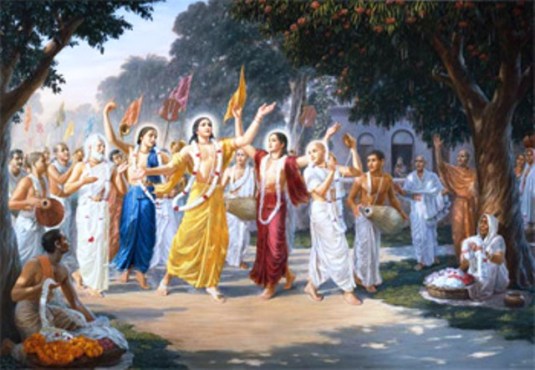
The Rising Sun and Moon

The Rising Sun and Moon
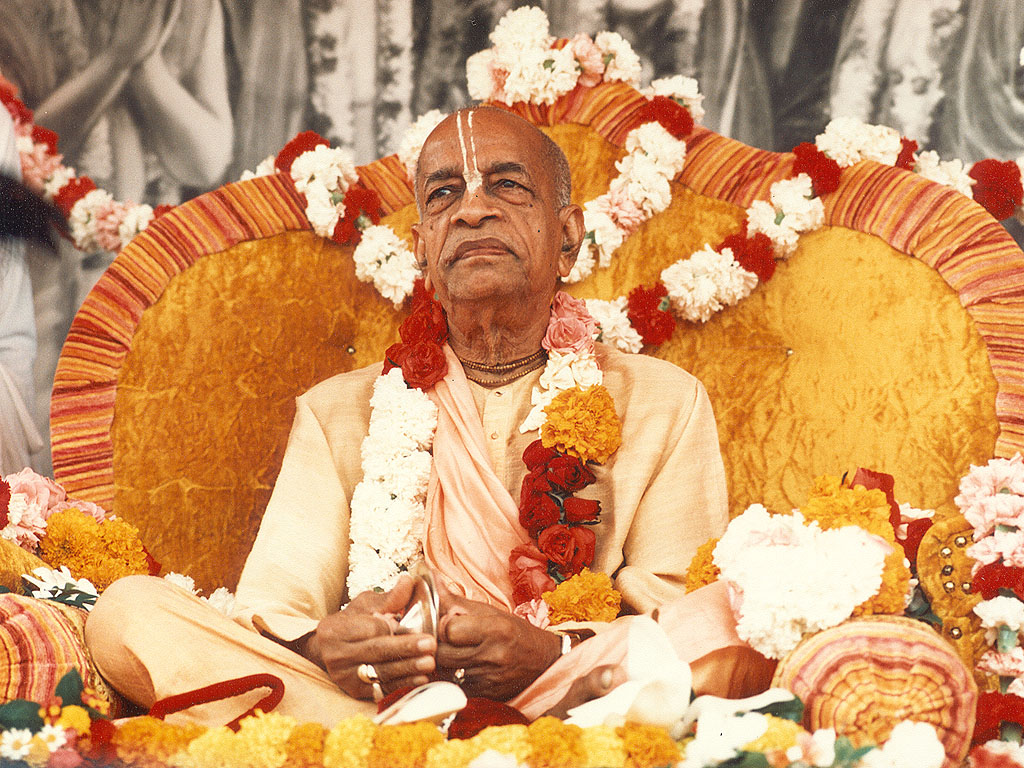
Lecture by His Divine Grace A.C. Bhaktivedanta Swami Prabhupada
Mayapur, India—March 26, 1975
Back to Godhead 2004, Vol.38, No. 4

vande sri-krsna-caitanya-
nityanandau sahoditau
gaudodaye puspavantau
citrau sandau tamo-nudau

“I offer my respectful obeisances unto Sri Krsna Caitanya and Lord Nityananda, who are like the sun and moon. They have arisen simultaneously on the horizon of Gauda [West Bengal] to dissipate the darkness of ignorance and thus wonderfully bestow benediction upon all.”—Sri Caitanya-caritamrta, Adi 1.2

SriKrsna Caitanya has many expansions, and the first is Lord Nityananda, who is Krsna’s brother, Balarama. We have to understand these things from the mahajanas, the great sages who are learned in the science of Krsna consciousness. Narottama Dasa Thakura, a mahajana, says, vrajendra-nandana yei, saci-suta hoilo sei, balarama hoilo nitai: “Sri Caitanya Mahaprabhu is Lord Krsna, the son of Nanda Maharaja, and Sri Nityananda Prabhu is Balarama.”

Sometimes foolish people say that Nityananda is an expansion of Radharani. That is not a fact. Nityananda is Balarama. We have to know from the mahajanas; we cannot manufacture our own ideas. That is blasphemy.

More

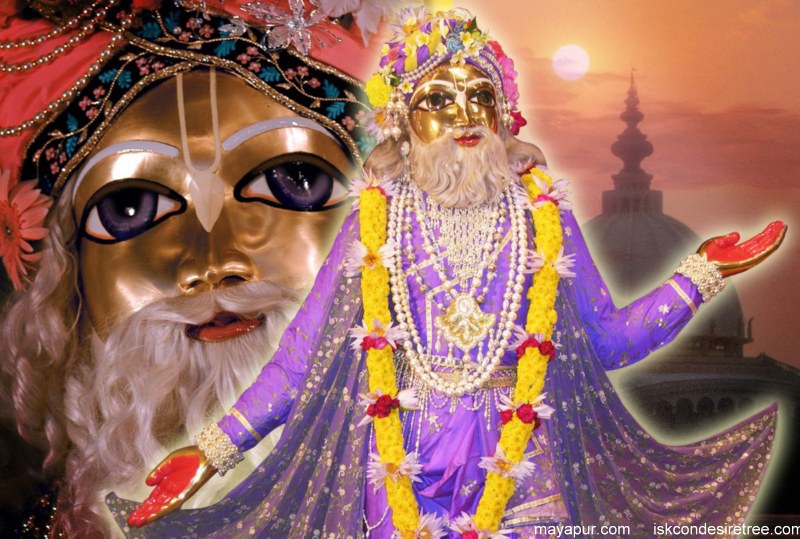
Nama Acharya Srila Haridas Thakur


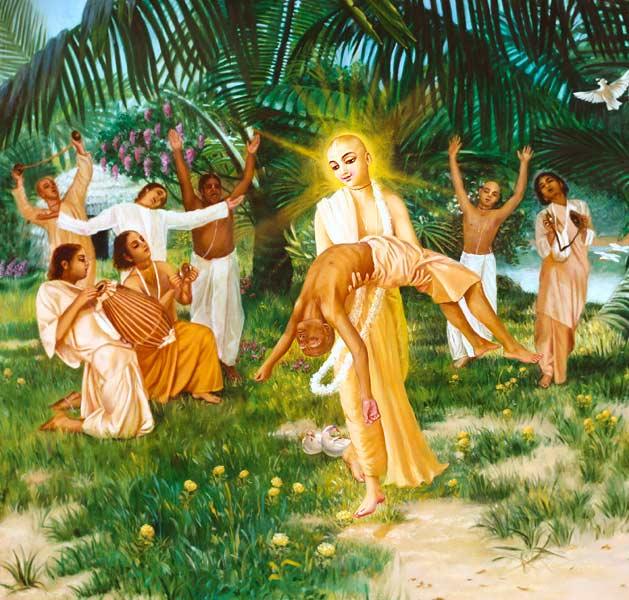
Haridas Thakur is considered to be the namacarya, the spiritual master in chanting the holy name of Krsna. Though he was born in a low class, Muslim family, Lord Caitanya’s devotees respected him as being better than the best of brahmanas. He would not eat or sleep until he finished his daily quota of chanting the name of Krsna 300,000 times. Along with Lord Nityananda, Haridas Thakur spread the chanting of Krsna’s name throughout Bengal. In Jagannatha Puri, where Haridas Thakur spent his later days, Lord Caitanya would regularly send him prasadam and discuss with him topics of Krsna. Haridas Thakur died chanting Krsna’s name in the presence of Sri Caitanya Mahaprabhu. After Haridas Thakur’s death, Lord Caitanya carried his body to the sea and with His own hands buried him in the sand.

Sri Caitanya-caritamrta – 1975 Edition
Antya-lila 3 Text49-
The Glories of Srila Haridasa Thakura

Śrī Caitanya Mahāprabhu derives great pleasure from glorifying His devotees, and among the devotees, Haridāsa Ṭhākura is the foremost.

The transcendental qualities of Haridāsa Ṭhākura are innumerable and unfathomable. One may describe a portion of them, but to count them all is impossible.

In Caitanya-maṅgala, Śrīla Vṛndāvana dāsa Ṭhākura has described the attributes of Haridāsa Ṭhākura to some extent.

No one can describe all the qualities of Haridāsa Ṭhākura. One may say something about them just to purify himself.

O devotees of Śrī Caitanya Mahāprabhu, please hear something about the qualities of Haridāsa Ṭhākura that Śrīla Vṛndāvana dāsa Ṭhākura has not described in detail.

After leaving his home, Haridāsa Ṭhākura stayed for some time in the forest of Benāpola.

Haridāsa Ṭhākura constructed a cottage in a solitary forest. There he planted a tulasī plant, and in front of the tulasī he would chant the holy name of the Lord 300,000 times daily. He chanted throughout the entire day and night.

Purport

The village of Benāpola is situated in the district of Yaśohara, which is now in Bangladesh. Benāpola is near the Banagāṅo station, which is at the border of Bangladesh and may be reached by the eastern railway from Shelda Station in Calcutta. Haridāsa Ṭhākura, being the ācārya of chanting the Hare Kṛṣṇa mahā-mantra, is called Nāmācārya Haridāsa Ṭhākura. From his personal Example we can understand that chanting the Hare Kṛṣṇa mantra and becoming highly elevated in Kṛṣṇa consciousness is very simple. Without difficulty one can sit down anywhere, especially on the bank of the Ganges, Yamunā or any sacred river, devise a sitting place or cottage, plant a tulasī, and before the tulasī chant the Hare Kṛṣṇa mahā-mantra undisturbed.

Haridāsa Ṭhākura used to chant the holy name on his beads 300,000 times daily. Throughout the entire day and night, he would chant the sixteen names of the Hare Kṛṣṇa mahā-mantra. One should not, however, imitate Haridāsa Ṭhākura, for no one else can chant the Hare Kṛṣṇa mahā-mantra 300,000 times a day. Such chanting is for the mukta-puruṣa, or liberated soul. We can follow his example, however, by chanting sixteen rounds of the Hare Kṛṣṇa mahā-mantra on beads every day and offering respect to the tulasī plant. This is not at all difficult for anyone, and the process of chanting the Hare Kṛṣṇa mahā-mantra with a vow before the tulasī plant has such great spiritual potency that simply by doing this one can become spiritually strong. Therefore we request the members of the Hare Kṛṣṇa movement to follow Haridāsa Ṭhākura’s example rigidly. Chanting sixteen rounds does not take much time, nor is offering respects to the tulasī plant difficult. The process has immense spiritual potency. One should not miss this opportunity.

Note: As Srila Prabhupada points out in his purport to Adi-lila 10, 43;

“Certainly the chanting of 300,000 holy names of the Lord is wonderful. No ordinary person can chant so many names, nor should one artificially imitate Haridāsa Ṭhākura’s behavior. It is essential, however, that everyone fulfill a specific vow to chant the Hare Kṛṣṇa mantra. Therefore we have prescribed in our Society that all our students must chant at least sixteen rounds daily. Such chanting must be offenseless in order to be of high quality. Mechanical chanting is not as powerful as chanting of the holy name without offenses.”

Krishna’s Flute


Sri Caitanya-caritamrta – 1975 Edition
By His Divine Grace A.C. Bhaktivedanta Swami Prabhupada
The Opulence and Sweetness of Lord Sri Krsna
Madhya 21.144

“The vibration of His flute is just like a bird that creates a nest within the ears of the gopīs and always remains prominent there, not allowing any other sound to enter their ears. Indeed, the gopīs cannot hear anything else, nor are they able to concentrate on anything else, not even to give a suitable reply. Such are the effects of the vibration of Lord Kṛṣṇa’s flute.”

PURPORT

The vibration of Kṛṣṇa’s flute is always prominent in the ears of the gopīs. Naturally they cannot hear anything else. Constant remembrance of the holy sound of Kṛṣṇa’s flute keeps them enlightened and enlivened, and they do not allow any other sound to enter their ears. Since their attention is fixed on Kṛṣṇa’s flute, they cannot divert their minds to any other subject. In other words, a devotee who has heard the sound of Kṛṣṇa’s flute forgets to talk or hear of any other subject. This vibration of Kṛṣṇa’s flute is represented by the Hare Kṛṣṇa mahā-mantra. A serious devotee of the Lord who chants and hears this transcendental vibration becomes so accustomed to it that he cannot divert his attention to any subject matter not related to Kṛṣṇa’s blissful characteristics and paraphernalia.

Pasted from; PrabhupadaBooks.com

The Spiritual Master

Śrī Caitanya-caritāmṛta
By His Divine Grace A. C. Bhaktivedanta Swami Prabhupada

Only out of His immense compassion does the Personality of Godhead reveal Himself as the spiritual master. Therefore in the dealings of an ācārya there are no activities but those of transcendental loving service to the Lord. He is the Supreme Personality of Servitor Godhead. It is worthwhile to take shelter of such a steady devotee, who is called āśraya-vigraha, or the manifestation or form of the Lord of whom one must take shelter.

Ādi-līlā Chapter One Text 46

ācāryaṁ māṁ vijānīyān
nāvamanyeta karhicit
na martya-buddhyāsūyeta
sarva-deva-mayo guruḥ

SYNONYMS

ācāryam—the spiritual master; mām—Myself; vijānīyāt—one should know; na avamanyeta—one should never disrespect; karhicit—at any time; na—never; martya-buddhyā—with the idea of his being an ordinary man; asūyeta—one should be envious; sarva-deva—of all demigods; mayaḥ—representative; guruḥ—the spiritual master.

TRANSLATION

“One should know the ācārya as Myself and never disrespect him in any way. One should not envy him, thinking him an ordinary man, for he is the representative of all the demigods.”

PURPORT

This is a verse from Śrīmad-Bhāgavatam (11.17.27) spoken by Lord Kṛṣṇa when He was questioned by Uddhava regarding the four social and spiritual orders of society. He was specifically instructing how a brahmacārī should behave under the care of a spiritual master. A spiritual master is not an enjoyer of facilities offered by his disciples. He is like a parent. Without the attentive service of his parents, a child cannot grow to manhood; similarly, without the care of the spiritual master one cannot rise to the plane of transcendental service.

The spiritual master is also called ācārya, or a transcendental professor of spiritual science. The Manu-saṁhitā (2.140) explains the duties of an ācārya, describing that a bona fide spiritual master accepts charge of disciples, teaches them the Vedic knowledge with all its intricacies, and gives them their second birth. The ceremony performed to initiate a disciple into the study of spiritual science is called upanīti, or the function that brings one nearer to the spiritual master. One who cannot be brought nearer to a spiritual master cannot have a sacred thread, and thus he is indicated to be a śūdra. The sacred thread on the body of a brāhmaṇa, kṣatriya or vaiśya is a symbol of initiation by the spiritual master; it is worth nothing if worn merely to boast of high parentage. The duty of the spiritual master is to initiate a disciple with the sacred thread ceremony, and after this saṁskāra, or purificatory process, the spiritual master actually begins to teach the disciple about the Vedas. A person born a śūdra is not barred from such spiritual initiation, provided he is approved by the spiritual master, who is duly authorized to award a disciple the right to be a brāhmaṇa if he finds him perfectly qualified. In the Vāyu Purāṇa an ācārya is defined as one who knows the import of all Vedic literature, explains the purpose of the Vedas, abides by their rules and regulations, and teaches his disciples to act in the same way.

More

When a Vaiṣṇava sees that another Vaiṣṇava is a recipient of the Lord’s mercy, he becomes very happy!

Sri Caitanya-caritamrta – 1975 Edition
By His Divine Grace A. C. Bhaktivedanta Swami Prabhupada
Madhya 1: The Later Pastimes of Lord Sri Caitanya Mahaprabhu

The spiritual master initiates the disciple to deliver him, and if the disciple executes the order of the spiritual master and does not offend other Vaiṣṇavas, his path is clear.

“There are many jealous people in the dress of Vaisnavas in this Krsna consciousness movement, and they should be completely neglected. There is no need to serve a jealous person who is in the dress of a Vaisnava.”

One should neglect an envious person. A preacher’s duty is to love the Supreme Personality of Godhead, make friendships with Vaiṣṇavas, show mercy to the innocent and reject or neglect those who are envious or jealous.

TEXT 218

dui jane prabhura kṛpā dekhi’ bhakta-gaṇe
‘hari’ ‘hari’ bale sabe ānandita-mane

SYNONYMS

dui jane—unto the two persons; prabhura—of the Lord; kṛpā—the mercy; dekhi’-seeing; bhakta-gaṇe—all the devotees; hari hari—the holy name of the Lord; bale—chant; sabe—all; ānandita—cheerful; mane—in the mind.

TRANSLATION

When all of the devotees saw the mercy of the Lord upon the two brothers, they were very much gladdened, and they began to chant the holy name of the Lord, “Hari! Hari!”
PURPORT

Śrīla Narottama dāsa Ṭhākura says, chāḍiyā vaiṣṇava sevā nistāra pāyeche kebā: unless one serves a Vaiṣṇava, he cannot be delivered. The spiritual master initiates the disciple to deliver him, and if the disciple executes the order of the spiritual master and does not offend other Vaiṣṇavas, his path is clear. Consequently Śrī Caitanya Mahāprabhu requested all the Vaiṣṇavas present to show mercy toward the two brothers, Rūpa and Sanātana, who had just been initiated by the Lord. When a Vaiṣṇava sees that another Vaiṣṇava is a recipient of the Lord’s mercy, he becomes very happy. Vaiṣṇavas are not envious. If a Vaiṣṇava, by the mercy of the Lord, is empowered by Him to distribute the Lord’s holy name all over the world, other Vaiṣṇavas become very joyful-that is, if they are truly Vaiṣṇavas. One who is envious of the success of a Vaiṣṇava is certainly not a Vaiṣṇava himself, but an ordinary mundane man. Envy and jealousy are manifested by mundane people, not by Vaiṣṇavas. Why should a Vaiṣṇava be envious of another Vaiṣṇava who is successful in spreading the holy name of the Lord? An actual Vaiṣṇava is very pleased to accept another Vaiṣṇava who is bestowing the Lord’s mercy. A mundane person in the dress of a Vaiṣṇava should not be respected but rejected. This is enjoined in the śāstra (upekṣā). The word upekṣā means neglect. One should neglect an envious person. A preacher’s duty is to love the Supreme Personality of Godhead, make friendships with Vaiṣṇavas, show mercy to the innocent and reject or neglect those who are envious or jealous. There are many jealous people in the dress of Vaiṣṇavas in this Kṛṣṇa consciousness movement, and they should be completely neglected. There is no need to serve a jealous person who is in the dress of a Vaiṣṇava. When Narottama dāsa Ṭhākura says chāḍiyā vaiṣṇava sevā nistāra payeche kebā, he is indicating an actual Vaiṣṇava, not an envious or jealous person in the dress of a Vaiṣṇava.

The Expansions of Advaita Ācārya

The order of the spiritual master is the active principle in spiritual life. Anyone who disobeys the order of the spiritual master immediately becomes useless. (Adi 12.10)

…the followers of Advaita Ācārya divided into two parties. Such disagreement among the disciples of one ācārya is also found among the members of the Gauḍīya Maṭha. In the beginning, during the presence of Oṁ Viṣṇupāda Paramahaṁsa Parivrājakācārya Aṣṭottara-śata Śrī Śrīmad Bhaktisiddhānta Sarasvatī Ṭhākura Prabhupāda, all the disciples worked in agreement; but just after his disappearance, they disagreed. One party strictly followed the instructions of Bhaktisiddhānta Sarasvatī Ṭhākura, but another group created their own concoction about executing his desires. Bhaktisiddhānta Sarasvatī Ṭhākura, at the time of his departure, requested all his disciples to form a governing body and conduct missionary activities cooperatively. He did not instruct a particular man to become the next ācārya. But just after his passing away, his leading secretaries made plans, without authority, to occupy the post of ācārya, and they split into two factions over who the next ācārya would be. Consequently, both factions were asāra, or useless, because they had no authority, having disobeyed the order of the spiritual master. Despite the spiritual master’s order to form a governing body and execute the missionary activities of the Gauḍīya Maṭha, the two unauthorized factions began litigation that is still going on after forty years with no decision. (Adi 12.8 purport)

More

Golden Avatar

Sri Caitanya-caritamrta – 1975 Edition
By His Divine Grace A.C.Bhaktivedanta Swami Prabhupada
Adi 3.52

TRANSLATION

“In the Age of Kali, intelligent persons perform congregational chanting to worship the incarnation of Godhead who constantly sings the name of Kṛṣṇa. Although His complexion is not blackish, He is Kṛṣṇa Himself. He is accompanied by His associates, servants, weapons and confidential companions.”

PURPORT

This text is from Śrīmad-Bhāgavatam (11.5.32). Śrīla Jīva Gosvāmī has explained this verse in his commentary on the Bhāgavatam, known as the Krama-sandarbha, wherein he says that Lord Kṛṣṇa also appears with a golden complexion. That golden Lord Kṛṣṇa is Lord Caitanya, who is worshiped by intelligent men in this age. That is confirmed in Śrīmad-Bhāgavatam by Garga Muni, who said that although the child Kṛṣṇa was blackish, He also appears in three other colors-red, white and yellow. He exhibited His white and red complexions in the Satya and Tretā ages respectively. He did not exhibit the remaining color, yellow-gold, until He appeared as Lord Caitanya, who is known as Gaura Hari.

Śrīla Jīva Gosvāmī explains that kṛṣṇa-varṇam means Śrī Kṛṣṇa Caitanya. Kṛṣṇa-varṇa and Kṛṣṇa Caitanya are equivalent. The name Kṛṣṇa appears with both Lord Kṛṣṇa and Lord Caitanya Kṛṣṇa. Lord Śrī Caitanya Mahāprabhu is the Supreme Personality of Godhead, but He always engages in describing Kṛṣṇa and thus enjoys transcendental bliss by chanting and remembering His name and form. Lord Kṛṣṇa Himself appears as Lord Caitanya to preach the highest gospel.

Lord Caitanya always chants the holy name of Kṛṣṇa and describes it also, and because He is Kṛṣṇa Himself, whoever meets Him will automatically chant the holy name of Kṛṣṇa and later describe it to others. He injects one with transcendental Kṛṣṇa consciousness, which merges the chanter in transcendental bliss. In all respects, therefore, He appears before everyone as Kṛṣṇa, either by personality or by sound. Simply by seeing Lord Caitanya one at once remembers Lord Kṛṣṇa. One may therefore accept Him as viṣṇu-tattva. In other words, Lord Caitanya is Lord Kṛṣṇa Himself.

Sāṅgopāṅgāstra-pārṣadam further indicates that Lord Caitanya is Lord Kṛṣṇa. His body is always decorated with ornaments of sandalwood and with sandalwood paste. By His superexcellent beauty He subdues all the people of the age. In other descents the Lord sometimes used weapons to defeat the demoniac, but in this age the Lord subdues them with His all-attractive figure as Caitanya Mahāprabhu. Śrīla Jīva Gosvāmī explains that His beauty is His astra, or weapon, to subdue the demons. Because He is all-attractive, it is to be understood that all the demigods lived with Him as His companions. His acts were uncommon and His associates wonderful. When He propagated the saṅkīrtana movement, He attracted many great scholars and ācāryas, especially in Bengal and Orissa. Lord Caitanya is always accompanied by His best associates like Lord Nityānanda, Advaita, Gadādhara and Śrīvāsa.

Śrīla Jīva Gosvāmī cites a verse from the Vedic literature which says that there is no necessity of performing sacrificial demonstrations or ceremonial functions. He comments that instead of engaging in such external, pompous exhibitions, all people, regardless of caste, color or creed, can assemble together and chant Hare Kṛṣṇa to worship Lord Caitanya. Kṛṣṇa-varṇaṁ tviṣākṛṣṇam indicates that prominence should be given to the name of Kṛṣṇa. Lord Caitanya taught Kṛṣṇa consciousness and chanted the name of Kṛṣṇa.

Therefore, to worship Lord Caitanya, everyone should together chant the mahā-mantra-Hare Kṛṣṇa, Hare Kṛṣṇa, Kṛṣṇa Kṛṣṇa, Hare Hare Hare Rāma, Hare Rāma, Rāma Rāma, Hare Hare. To propagate worship in churches, temples or mosques is not possible, because people have lost interest in that. But anywhere and everywhere, people can chant Hare Kṛṣṇa. Thus worshiping Lord Caitanya, they can perform the highest activity and fulfill the highest religious purpose of satisfying the Supreme Lord.

Śrīla Sārvabhauma Bhaṭṭācārya, a famous disciple of Lord Caitanya, said, “The principle of transcendental devotional service having been lost, Śrī Kṛṣṇa Caitanya has appeared to deliver again the process of devotion. He is so kind that He is distributing love of Kṛṣṇa. Everyone should be attracted more and more to His lotus feet, as humming bees are attracted to a lotus flower.”

Next Newer Entries

108 Imporant Slokas from the 1972 Bhagavad-gita As It Is

Click on image to go to Post

Click on image to go to Post

The Hare Krishna Cookbook

Songs of the Vaisnava Acaryas

Bhagavad-gita As It Is 1972 Edition “Online”

click on image

click on image to visit site

Srimad Bhagavatam Online

click on image

Raja-Vidya the King of Knowledge

click on image

click on image

Blog Stats

  • 4,573,608 hits

Enter your email address to subscribe to this blog and receive notifications of new posts by email.

Join 3,906 other subscribers

Important Slokas from the Brahma-samhita

click on image

click on image

Slokas from the Sri Isopanisad

click on image

click on image

Prayers By Queen Kunti (Slokas)

click on image

Gajendra’s Prayers of Surrender (Slokas)

click on image

A Short Statement of the Philosophy of Krishna Consciousness

click on image

click on image

July 9th Letter

click on image

click on image

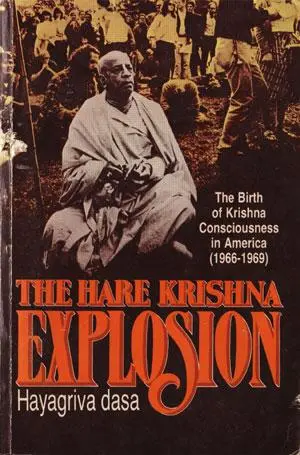
The Hare Krishna Explosion

Reference Material/Study Guide

click on image

click on image

  • LINKS