Sri Damodarastakam as explained by Visnujana Swami / Verse Eight

O Lord, the entire universe was created by Lord Brahma, who was born from Your abdomen, which was bound with a rope by Mother Yasoda. To this rope I offer my humble obeisances.

namas te ‘stu dāmne sphurad-dīpti-dhāmne
tvadīyodarāyātha viśvasya dhāmne
namo rādhikāyai tvadīya-priyāyai
namo ‘nanta-līlāya devāya tubhyam

namaḥ–obeisances; te–to You; astu–may there be; dāmne–unto the rope around Your waist; sphurat–splendrous; dīpti-dhāmne–unto the effulgent abode; tvadīya-udarāya–unto Your belly; atha–thus; viśvasya–of the entire universe; dhāmne–unto the shelter; namaḥ–obeisances; rādhikāyai–unto Rādhikā; tvadīya priyāyai–unto Your Beloved; namaḥ– obeisances; ananta-līlāya–unto Your limitless sportive pastimes; devāya– unto Your transcendental nature; tubhyam–unto You.

8) O Lord, the entire universe was created by Lord Brahma, who was born from Your abdomen, which was bound with a rope by Mother Yasoda. To this rope I offer my humble obeisances. I offer my obeisances to Your most beloved Srimati Radharani, and to Your unlimited pastimes.

At the conclusion of the prayer, obeisances are offered (namas te) to the Lord’s unique binding, His bodily limbs, His associates, and to the Lord Himself, in order to arouse the mood of bhakti. Even the rope that binds His belly (damne) receives worship. That rope is the abode of, or source of, effulgence (sphurad dipti-dhamne), and the poet here suggests that the rope is also the source of the all-pervading brahman effulgence.

Then, obeisances are offered to the Lord’s belly, which is bound by this wondrous rope (tvadiyodarayatha). What is that belly like? It is the abode or support of all the infinite universes in the creation (visvasya), including all the moving and non-moving living entities dwelling therein. A gigantic lotus flower that sustains the fourteen worlds sprouts from that belly and is the abode of Lord Brahma.

More

Devotional Service Surpasses All Liberation

Nārada then said, "Yes, you shall become trees, arjuna trees, and you will stand at the courtyard of Nanda Mahārāj. But Kṛṣṇa Himself will appear in time as the foster son of Nanda, and He will deliver you."


The story behind the two sons of Kuvera, Manigriva, and Nalakuvera, is they were puffed up on account of the opulence of their father, and so once on a heavenly planet they were enjoying themselves in a lake with some naked damsels of heaven. At that time the great saint Nārada Muni was passing on the road and was sorry to see the behavior of the sons of Kuvera. Seeing Nārada passing by, the damsels of heaven covered their bodies with cloth, but the two sons, being drunkards, did not have this decency. Nārada became angry with their behavior and cursed them thusly: “You have no sense, so it is better if you become trees instead of the sons of Kuvera.” Upon hearing this, the boys came to their senses and begged Nārada to be pardoned for their offenses. Nārada then said, “Yes, you shall become trees, arjuna trees, and you will stand at the courtyard of Nanda Mahārāj. But Kṛṣṇa Himself will appear in time as the foster son of Nanda, and He will deliver you.” In other words, the curse of Nārada was a benediction to the sons of Kuvera because indirectly it was foretold that they would be able to receive the favor of Lord Kṛṣṇa. After that, Kuvera’s two sons stood as two big arjuna trees in the courtyard of Nanda Mahārāj until Lord Dāmodara, in order to fulfill the desire of Nārada, dragged the milling pestle to which He was tied and struck the two trees, violently causing them to fall down. From out of these fallen trees came Nalakūvara and Maṇigrīva, who had by then become great devotees of the Lord.

The Nectar of Devotion – 1970 Edition
By His Divine Grace A.C. Bhaktivedanta Swami Prabhupada
Chapter 4

Devotional Service Surpasses All Liberation

How much a devotee is seriously attached to the devotional service of the Supreme Personality of Godhead can be understood from the statement of Mahārāj Pṛthu (Ādirāja) which is described in Śrīmad-Bhāgavatam, Fourth Canto, 20th Chapter, 21st verse. He prays to the Supreme Personality of Godhead thusly: “My dear Lord, if after taking liberation I have no chance of hearing the glories of Your Lordship, glories chanted by pure devotees from the core of their hearts in praise of Your lotus feet, and if I have no chance for this honey of transcendental bliss, then I shall never ask for liberation or this so-called spiritual emancipation. I shall simply always pray unto Your Lordship that You may give me millions of tongues and millions of ears so that I can constantly chant and hear of Your transcendental glories.”

The impersonalists desire to merge into the existence of the Supreme, but without keeping their individuality they have no chance of hearing and chanting the glories of the Supreme Lord. Because they have no idea of the transcendental form of the Supreme Lord there is no chance of their chanting and hearing of His transcendental activities. In other words, unless one is already beyond liberation, one cannot relish the transcendental glories of the Lord, nor can one understand the transcendental form of the Lord.

More

Sri Damodarastakam as explained by Visnujana Swami / Verse Two

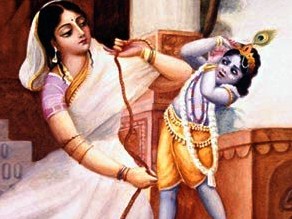
Mother Yasoda bound His belly with ropes, He shivered in fright and His pearl necklace shook.


rudantaḿ muhur netra-yugmaḿ mṛjantam
karāmbhoja-yugmena sātańka-netram
muhuḥ śvāsa-kampa-trirekhāńka-kaṇṭha-
sthita-graivaḿ dāmodaraḿ bhakti-baddham

rudantam–crying; muhuḥ–again and again; netra-yugmam–His two eyes; mṛjantam–rubbing; kara-ambhoja-yugmena–with His two lotus-like hands; sa-ātańka-netram–with very fearful eyes; muhuḥ–again and again; śvāsa–quick breathing and sighing; kampa–trembling; tri-rekhaańka-kaṇṭha–neck marked with three lines (just like a conchshell); sthita–situated; graiva–pearl necklaces and other neck-ornaments; dāma-udaram–unto He with a rope around His belly; bhakti-baddham– who is bound by devotion.

2) Upon seeing His mothers whipping stick, He cried and rubbed His eyes again and again with His two lotus hands. His eyes were fearful and His breathing quick, and as Mother Yasoda bound His belly with ropes, He shivered in fright and His pearl necklace shook. To this Supreme Lord, Sri Damodara, who is bound with His devotee’s love, I offer my humble obeisances.

Purport
The second verse continues describing the lila-visesa. He is crying (rudantam) because He sees the stick in Mother Yasoda’s hand. Perceiving that she may strike Him, He appears fearful, hoping her natural empathy may save Him from punishment. Due to fear, tears are forming in His eyes, so He rubs his eyes with his lotus-like hands in the normal manner of children to wipe away the tears that are beginning to flow.

Then (satanka-netram) His fearful eyes reveal how much He is dreading punishment. It also indicates His glancing here and there in great fear, trying to avoid being punished. The confidential pastime is revealed in this way. Therefore, due to his continual sobbing He is trembling, (muhuh svasa-kampa) and thus, (sthita-graiva) the pearl necklaces and earrings that adorn Him are also shaking.

More

Sri Damodarastakam as explained by Visnujana Swami

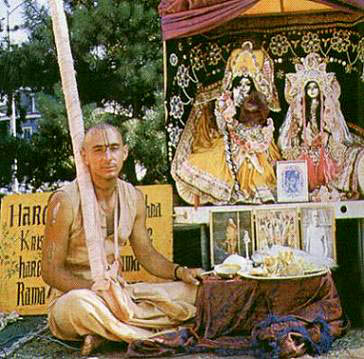
Vishnujana Swami with Radha Damodara

This will be an eight part series, with an explanation on each of the eight verses of the Sri Damodarastakam, given by Visnujana Swami. This eight sloka prayer is sung morning and evening during the month of Damodara, and which began today.

Sri Damodarastakam as explained by Visnujana Swami

namāmīśvaraḿ sac-cid-ānanda-rūpaḿ
lasat-kuṇḍalaḿ gokule bhrājamanam
yaśodā-bhiyolūkhalād dhāvamānaḿ
parāmṛṣṭam atyantato drutya gopyā

namāmi–I bow down; īśvaram–to the supreme controller; sat-cit-ānandarūpam–whose form is composed of eternity, knowledge and bliss; lasatkuṇḍalam–whose earrings play and swing; gokule bhrājamānam–who is splendrously manifest in Gokula; yaśodā-bhiyā–in fear of mother Yaśodā; ulūkalāt-dhāvamānam–who gets down from the wooden ricegrinding mortar and runs away; para-āmṛṣṭam–catching Him by the back; atyam–very much; tatam drutya–chasing after Him quickly; gopyā–by the gopī (Srī Yaśodā).

1) To the supreme controller who possesses an eternal form of blissful knowledge, whose glistening earrings swing to and fro, who manifested Himself in Gokula, who stole the butter that the gopis kept hanging from the rafters of their storerooms and who then quickly jumped up and ran in retreat in fear of Mother Yasoda, but was ultimately caught. To that Supreme Lord, Sri Damodara, I offer my humble obeisances.

Purport
The specific attributes of the Absolute Truth of the Lord, tattva-visesa, are addressed first. Satyavrata Muni begins with the offering of obeisances (namami) as an auspicious invocation, mangalacarana. He invokes the mercy of Lord Damodara to empower him to offer this prayer by the word isvara, the supreme controller. It also indicates that the Supreme Lord alone is worthy of the highest praise. It further implies the specific nature of devotional service, bhakti. The Lord manifests Himself in a form that embodies eternal existence, knowledge, and bliss. Thus, His supreme sovereignty is established.

The attribute of His enchanting beauty, rupa visesa, is described next. As He runs from Mother Yasoda, His earrings begin to swing back and forth lasat-kundalam. The earrings naturally sport upon His cheeks as He plays in the courtyard of Mother Yasoda. All the ornaments that adorn the Lord have become super-excellent by contact with His divine body, yet these earrings have attained superiority overall by the great fortune of constantly kissing His divine cheeks while swinging. They are glistening (lasanti) due to being enriched with the effulgence from the Lord’s complexion.

Uddhava describes Krishna’s beauty as so supremely enchanting that His transcendental body is the ornament of all ornaments.

Only in Gokula does Krishna display His most splendid pastimes that surpass all other manifestations of His excellence (gokule bhrajamanam) The word, gokule, indicates the place where cows and cowherds reside. The attributes of His family, parivara-visesa, thus further portray His unique excellence.
The last two lines of the verse describe the lila-visesa, the attributes of His excellent pastime as the butter thief. In fear of Mother Yasoda (yasoda-bhiya) He quickly runs away dhavamanam) from the mortar (ulukalat). Then, she also runs very swiftly (atyantato drutya).

“Krishna, at that time, was sitting on an upside-down wooden mortar for grinding spices and was distributing milk preparations, such as yogurt and butter, to the monkeys as He liked. Because of having stolen, He was looking all around with great anxiety, suspecting that He might be chastised by His mother. Mother Yasoda, upon seeing Him, very cautiously approached Him from behind. When Lord Sri Krishna saw His mother, stick in hand, He very quickly got down from the top of the mortar and began to flee as if very much afraid. Although yogis try to capture Him as Paramatma by meditation, desiring to enter into the effulgence of the Lord with great austerities and penance, they fail to reach Him. But Mother Yasoda, thinking that same Personality of Godhead Krishna, to be her son, began following Krishna to catch Him.

More
Sri Damodarastakam

He ran in retreat in fear of Mother Yasoda bus was ultimately caught, to that Supreme Lord, Sri Damodara, I offer my humble obeisances.


Sri Damodarastakam
By Sri Satyavrata Muni
From the original 1974 “Songs of the Vaisnava Acaryas” songbook

This eight sloka prayer is sung morning and evening during the month of Damodara.

namāmīśvaraḿ sac-cid-ānanda-rūpaḿ
lasat-kuṇḍalaḿ gokule bhrājamanam
yaśodā-bhiyolūkhalād dhāvamānaḿ
parāmṛṣṭam atyantato drutya gopyā

1) To the supreme controller who possesses an eternal form of blissful knowledge, whose glistening earrings swing to and fro, who manifested Himself in Gokula, who stole the butter that the gopis kept hanging from the rafters of their storerooms and who then quickly jumped up and ran in retreat in fear of Mother Yasoda, but was ultimately caught-to that Supreme Lord, Sri Damodara, I offer my humble obeisances.

rudantaḿ muhur netra-yugmaḿ mṛjantam
karāmbhoja-yugmena sātańka-netram
muhuḥ śvāsa-kampa-trirekhāńka-kaṇṭha-
sthita-graivaḿ dāmodaraḿ bhakti-baddham

2) Upon seeing His mothers whipping stick, He cried and rubbed His eyes again and again with His two lotus hands. His eyes were fearful and His breathing quick, and as Mother Yasoda bound His belly with ropes, He shivered in fright and His pearl necklace shook, To this Supreme Lord, Sri Damodara, who is bound with His devotee’s love, I offer my humble obeisances.

More

Next Newer Entries

108 Imporant Slokas from the 1972 Bhagavad-gita As It Is

Click on image to go to Post

Click on image to go to Post

The Hare Krishna Cookbook

Songs of the Vaisnava Acaryas

Bhagavad-gita As It Is 1972 Edition “Online”

click on image

click on image to visit site

Srimad Bhagavatam Online

click on image

Raja-Vidya the King of Knowledge

click on image

click on image

Blog Stats

  • 4,572,271 hits

Enter your email address to subscribe to this blog and receive notifications of new posts by email.

Join 3,906 other subscribers

Important Slokas from the Brahma-samhita

click on image

click on image

Slokas from the Sri Isopanisad

click on image

click on image

Prayers By Queen Kunti (Slokas)

click on image

Gajendra’s Prayers of Surrender (Slokas)

click on image

A Short Statement of the Philosophy of Krishna Consciousness

click on image

click on image

July 9th Letter

click on image

click on image

The Hare Krishna Explosion

Reference Material/Study Guide

click on image

click on image

  • LINKS