Preparing for Death

Chanakya Pandit says that “If you want to make spiritual advancement, then you should always think that “Death is next moment. Death is next moment.”

Excerpt from lecture on Srimad-Bhagavatam
Canto 1, Chapter 4, Text 25, Montreal, June 20, 1968
By His Divine Grace A. C. Bhaktivedanta Swami Prabhupada

Parikshit Maharaja, he was a powerful king. He was equipped with all, everything, but he did not counteract the curse [1]. He could counteract that curse. He was so powerful, but he accepted: “All right. I am cursed. I shall give up my life within seven days.” That means he took it as an opportunity that “I am going to death within seven days. That is certain. And I must prepare myself fully so that my next life I can approach Krishna.” So this is a good opportunity, that “I have got seven days’ time.” We haven’t got seven seconds’ time. We do not know. Nobody has served me notice. We find by practical experience that we are walking on the street—all of a sudden there is some accident, and we die. There is possibility. So the important point is that Maharaja Parikshit was fortunate enough to get seven days’ time before his death. But we do not know how much time is there for our death. So how much serious we shall be. Chanakya Pandit says that “If you want to make spiritual advancement, then you should always think that “Death is next moment. Death is next moment.” Because there is no guarantee when death is coming. If I think that death is next moment, that is not any utopian. The next moment may be my death. And Chanakya Pandit says, “But if you want to be materially happy, you should always think that ‘I shall never die,’ ” although it is false idea. Everyone will die.

More

The Rising Sun and Moon

The Rising Sun and Moon
Lecture by His Divine Grace A.C. Bhaktivedanta Swami Prabhupada
Mayapur, India—March 26, 1975
Back to Godhead 2004, Vol.38, No. 4

vande sri-krsna-caitanya-
nityanandau sahoditau
gaudodaye puspavantau
citrau sandau tamo-nudau

“I offer my respectful obeisances unto Sri Krsna Caitanya and Lord Nityananda, who are like the sun and moon. They have arisen simultaneously on the horizon of Gauda [West Bengal] to dissipate the darkness of ignorance and thus wonderfully bestow benediction upon all.”—Sri Caitanya-caritamrta, Adi 1.2

SriKrsna Caitanya has many expansions, and the first is Lord Nityananda, who is Krsna’s brother, Balarama. We have to understand these things from the mahajanas, the great sages who are learned in the science of Krsna consciousness. Narottama Dasa Thakura, a mahajana, says, vrajendra-nandana yei, saci-suta hoilo sei, balarama hoilo nitai: “Sri Caitanya Mahaprabhu is Lord Krsna, the son of Nanda Maharaja, and Sri Nityananda Prabhu is Balarama.”

Sometimes foolish people say that Nityananda is an expansion of Radharani. That is not a fact. Nityananda is Balarama. We have to know from the mahajanas; we cannot manufacture our own ideas. That is blasphemy.

More

Rādhāṣṭamī; Śrīmatī Rādhārāṇī’s Appearance Day

Rādhārāṇī is hari-priyā, very dear to Kṛṣṇa. So if we approach Kṛṣṇa through Rādhārāṇī, through the mercy of Rādhārāṇī, then it becomes very easy. If Rādhārāṇī recommends that “This devotee is very nice,” then Kṛṣṇa immediately accepts, however fool I may be. Because it is recommended by Rādhārāṇī, Kṛṣṇa accepts. Therefore in Vṛndāvana you’ll find all the devotees, they’re chanting more Rādhārāṇī’s name than Kṛṣṇa’s. Wherever you’ll go, you’ll find the devotees are addressing, “Jaya Rādhe.” You’ll find still in Vṛndāvana. They are glorifying Rādhārāṇī. They’re more interested, worshiping Rādhārāṇī. Because however fallen I may be, if some way or other I can please Rādhārāṇī, then it is very easy for me to understand Kṛṣṇa.

The devotees of the Lord in Vaikuntha want to see the Lord as most beautiful, but the devotees in Vrindavana want to see Radharani as even more beautiful than Krishna

Rādhāṣṭamī
Śrīmatī Rādhārāṇī’s Appearance Day
Lecture given by His Divine Grace A. C. Bhaktivedanta Swami Prabhupada
London, August 29, 1971

Prabhupāda: (chants maṅgalācaraṇa prayers) Today is birth, appearance day of Śrīmatī Rādhārāṇī, Rādhāṣṭamī. Fifteen days after Kṛṣṇa’s birth, Rādhārāṇī appeared. (pause) Rādhārāṇī is Kṛṣṇa’s pleasure potency. Rādhā-kṛṣṇa-praṇaya-vikṛtir hlādinī-śaktiḥ.  More

The Absolute Necessity of a Spiritual Master

The Absolute Necessity of a Spiritual Master
From; The Science of Self Realization
By His Divine Grace A.C. Bhaktivedanta Swami Prabhupada

In February 1936, in Bombay, India, the members of a reputed religious society, the Gauḍīya Maṭha, were astonished by the powerful and eloquent words of a young member who spoke in honor of his spiritual master, Śrīla Bhaktisiddhānta Sarasvatī Gosvāmī. Three decades later, the young speaker would become the world-renowned founder and spiritual master of the Kṛṣṇa consciousness movement. Śrīla Prabhupāda’s presentation is a memorable statement on the importance of the guru in spiritual life.

sākṣād-dharitvena samasta-śāstrair
uktas tathā bhāvyata eva sadbhiḥ
kintu prabhor yaḥ priya eva tasya
vande guroḥ śrī-caraṇāravindam

“In the revealed scriptures it is declared that the spiritual master should be worshiped like the Supreme Personality of Godhead, and this injunction is obeyed by pure devotees of the Lord. The spiritual master is the most confidential servant of the Lord. Thus let us offer our respectful obeisances unto the lotus feet of our spiritual master.”

Gentlemen, on behalf of the members of the Bombay branch of the Gauḍīya Maṭha, let me welcome you all because you have so kindly joined us tonight in our congregational offerings of homage to the lotus feet of the world teacher, Ācāryadeva, who is the founder of this Gauḍīya Mission and is the president-ācārya of Śrī Śrī Viśva-vaiṣṇava Rāja-sabhā—I mean my eternal divine master, Paramahaṁsa Parivrājakācārya Śrī Śrīmad Bhaktisiddhānta Sarasvatī Gosvāmī Mahārāja.

More

Śrī Vyāsa Pūjā Address New Vrindaban, September 2, 1972


Śrī Vyāsa Pūjā Address
New Vrindaban, September 2, 1972
by His Divine Grace A.C. Bhaktivedanta Swami Prabhupada

…So this Vyāsa-pūjā means one day in a year, on the birthday of the spiritual master, because he is representative of Vyāsa, he is delivering the same knowledge which has come down by disciplic succession without any change, he is offered the respect. This is called Vyāsa-pūjā…

Prabhupāda: Ladies and gentlemen, this ceremony… Of course, those who are my students, they know what is this ceremony. Those who are visitors, for their information, I may inform you something about this ceremony. Otherwise, it may not be misunderstood. A outsider may see it that “Why a person is being worshiped like God?” There may be some doubt. So this is the etiquette. This ceremony is called Vyāsa-pūjā. Vyāsa. Vyāsa means the original author of Vedic literature. He is incarnation of Nārāyaṇa. He gave us all Vedic knowledge. He received the knowledge from Nārada. Nārada received the knowledge from Brahma. Brahmā received the knowledge from Kṛṣṇa. So in this way, by disciplic succession, we get transcendental knowledge.

More

Balarāma means guru-tattva

Balarāma means guru-tattva. Balarāma represents guru. Yasya prasādād bhagavat-prasādaḥ. If we want to understand Caitanya Mahāprabhu, if we want to understand Kṛṣṇa, then we must take shelter of Balarāma. Nāyam ātmā bala-hinena labhyaḥ. This bala-hinena labhyaḥ, this Vedic injunction, means “Without the mercy of Balarāma you cannot understand, you cannot realize your spiritual identification. So that Balarāma comes as Nityānanda Prabhu. Balarāma hailā nitāi. Therefore we must take shelter of Balarāma.

Lecture given by His Divine Grace A.C. Bhaktivedanta Swami Prabhupada
Lord Nityānanda Prabhu’s Āvirbhāva Appearance Day
Bhuvaneśvara, February 2, 1977

Prabhupāda: So today, the appearance day of Nityānanda Prabhu… Nityānanda Prabhu is Baladeva, Baladeva-tattva.

vrajendra-nandana yei, śacī-suta haila sei,
balarāma haila nitāi

“Who was formerly the son of Nanda Mahārāja, He has appeared as the son of Śacīdevi.” Caitanya Mahāprabhu’s mother’s name was Śacīdevi. So Kṛṣṇa… Kṛṣṇa is Śrī Caitanya Mahāprabhu, and Balarāma is Nityānanda Prabhu. Now…

vrajendra-nandana yei, śacī-suta haila sei,
balarāma haila nitāi

So Balarāma… In the Vedic literature it is said, nāyam ātmā bala-hinena labhyaḥ; na bahunā śrutena. So bala means strength. Sometimes some rascal philosophers, they take it that bala means bodily strength. They propagate this philosophy that “Unless you are bodily stout and strong, you cannot achieve spiritual salvation. You must be very strong and stout and eat meat and fight, and then you’ll get next spiritual birth” No. This bala, this strength, is different. This is spiritual strength.

More

You Hear from the Authority, Krishna

You Hear from the Authority, Krishna

Excerpt from lecture on Bhagavad-gita 2.13
Pittsburgh, September 8, 1972
By His Divine Grace A. C. Bhaktivedanta Swami Prabhupada

So we request simply people that you accept this authoritative knowledge and try to assimilate it by your intelligence.

Our this Krishna consciousness movement is to propagate that “You hear from the authority, Krishna.” Krishna is the Supreme Personality of Godhead. It is accepted in the present age and in the past age. In the past age, great sages like Narada, Vyasa, Asita, Devala, very, very great stalwart scholars and sages, they accepted. In the Middle Age, say 1,500 years ago, all the acharyas like Shankaracharya, Ramanujacharya, Madhvacharya, Nimbarka… Practically, Indian Vedic civilization, it is still existing on the authority of these acharyas. And it is recommended in the Bhagavad-gita: acharyopasanam. If you want to learn factually things, then you should approach ahcarya. Acharyavan purusho veda, “One who has accepted acharya, he knows things as they are.” Acharyavan purusho veda. So we are receiving knowledge through the acharyas. Krishna spoke to Arjuna, Arjuna spoke to Vyasadeva. Arjuna actually did not speak to Vyasadeva, but Vyasadeva heard it, Krishna speaking, and he noted down in his book Mahabharata. This Bhagavad-gita is found in Mahabharata. So we accept the authorities of Vyasa. And from Vyasa, Madhvacharya; from Madhvacharya, so many disciplic succession, up to Madhavendra Puri. Then Madhavendra Puri to Ishvara Puri; from Ishvara Puri to Lord Chaitanyadeva; from Lord Chaitanyadeva to six Gosvamis; from six Gosvamis to Krishnadasa Kaviraja; from him, Shrinivasa Acharya; from him, Vishvanatha Chakravarti; from him, Jagannatha dasa Babaji; then Gaura Kishora dasa Babaji; Bhaktivinoda Thakura; my spiritual master [Srila Bhaktisiddhanta Sarasvati Thakur]. The same thing, we are preaching. That is Krishna consciousness movement. It is nothing new. It is coming down from the original speaker, Krishna, by disciplic succession. So we are reading this Bhagavad-gita. Not that I have manufactured some book and I am preaching. No. I am preaching Bhagavad-gita. The same Bhagavad-gita as it was first spoken forty millions of years ago to the sun-god and again it was repeated five thousand years ago to Arjuna. The same thing is coming down by disciplic succession, and the same thing is presented before you. There is no change.

More

Srimati Radharani is the pleasure potency of Krishna, Hare

Lectures on Bhagavad-gita As It Is, (Bhagavad-gita 4.10)
Calcutta, September 23, 1974
By His Divine Grace A. C. Bhaktivedanta Swami Prabhupada

By taking shelter of Krishna, one has to become absorbed in thinking of Krishna. That is not very difficult. Man-mana bhava mad-bhakto mad-yaji mam namaskuru [ Bhagavad-gita 18.65]. It is not at all difficult. You simply chant Hare Krishna mantra. You’ll be man-maya. This is so nice thing. Therefore Chaitanya Mahaprabhu has recommended,

harer nama harer nama harer namaiva kevalam
kalau nasty eva nasty eva nasty eva gatir anyatha [ Chaitanya-charitamrita Adi-lila 17.21]

So our request is… Everyone who is present here… Today is Radhastami. So pray to Radharani. And She is hare, hara. This hare, this word, is Radharani. Hara, Radharani. Radha or Hara: the same thing. So Hare Krishna. So we are praying to Radharani, “My Mother, Radharani, and Krishna.” Hare Krishna. “O Krishna, O the Lord.” Hare Krishna, Hare Krishna, the same thing, repetition. “O Radharani, O Krishna.” “O Radha-Krishna.” “Radhe-Krishna” or “Hare Krishna,” the same thing. Hare Krishna, Hare Krishna, Krishna Krishna, Hare Hare. Again addressing, “O Krishna, O Krishna, O Radharani.” Hare Rama. The same thing, again. Hare Rama. Rama is also Krishna. Rama is Rama, Rama is Balarama. They are all Krishna. Hare Rama, Hare Rama, Rama Rama, Hare Hare.

So this repetition of addressing Radha and Krishna or Hare Krishna is to pray, “My dear Lord, … and the energy, the spiritual energy of the Lord, kindly engage me in Your service.” That’s all. “I am now embarrassed with this material service. Please engage me in Your service.”

This is good sense. We are servants here. We are engaged in so many services. But it is not giving us comfort. Na trapa nopashanti. The service which we are rendering to others, they are not satisfied, I am not satisfied. This is material service. But if you give service to Krishna… Svalpam apy asya dharmasya trayate mahato bhayat. A little service can save you from the greatest danger. This is the formula.

More

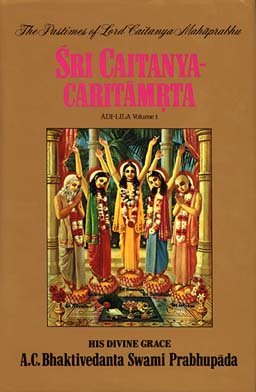
Sri Caitanya-caritāmṛta


Sri Caitanya-caritāmṛta
By HIs Divine Grace A.C. Bhaktivedanta Swami Prabhupada

(Originally delivered as five morning lectures on the Caitanya-caritāmṛta-the authoritative biography of Lord Caitanya Mahāprabhu by Kṛṣṇadāsa Kavirāja Gosvāmī-before the International Society for Krishna Consciousness, New York City, April 10-14, 1967.)

Introduction

The word caitanya means “living force.” As living entities, we can move, but a table cannot because it does not possess living force. Movement and activity may be considered signs or symptoms of the living force. Indeed, it may be said that there can be no activity without the living force. Although the living force is present in the material condition, it is not amṛta, immortal. The words caitanya-caritāmṛta, then, may be translated as “the character of the living force in immortality.”

But how is this living force displayed immortally? It is not displayed by man or any other creature in this material universe, for none of us are immortal in these bodies. We possess the living force, we perform activities, and we are immortal by our nature and constitution, but the material condition into which we have been put does not allow our immortality to be displayed. It is stated in the Kaṭha Upaniṣad that eternality and the living force belong both to ourselves and God. Although this is true in that both God and ourselves are immortal, there is a difference. As living entities, we perform many activities, but we have a tendency to fall down into material nature. God has no such tendency. Being all-powerful, He never comes under the control of material nature. Indeed, material nature is but one display of His inconceivable energies.

From the ground we may see only clouds in the sky, but if we fly above the clouds we can see the sun shining. From the sky, skyscrapers and cities seem very tiny; similarly, from God’s position this entire material creation is insignificant. The tendency of the conditioned living entity is to come down from the heights, where everything can be seen in perspective. God, however, does not have this tendency. The Supreme Lord is not subject to fall down into illusion (māyā), any more than the sun is subject to fall beneath the clouds. Because the Supreme Lord is not subject to illusion, He is unconditioned; because we, as finite living entities, are prone to fall into illusion, we are called conditioned. Impersonalist philosophers (Māyāvādīs) maintain that both the living entity and God Himself are under the control of māyā when they come into this material world. This may be true of the living entity, but it is not true of God, for in all instances the material energy is working under His direction. Those who think the Supreme Lord is subject to material conditioning are called fools by Kṛṣṇa Himself in the Bhagavad-gītā (9.11):

More

His Divine Grace Srila Bhaktisiddhanta Sarasvati Gosvami Prabhupada’s Appearance Day Lecture

His Divine Grace Srila Bhaktisiddhanta Sarasvati Gosvami Prabhupada’s
Appearance Day Lecture

Given by A.C. Bhaktivedanta Swami Prabhupada at Gorakhpur, February 15, 1971 , Evening
710215BA.GOR

Prabhupäda: Sri Bhaktisiddhanta Sarasvati Gosvami Mahäräja, my spiritual master, his advent day today. In 1922, I was at that time very much engaged in Congress activity. I was very much devout follower of Mahätmä Gandhi, and at that time, I was manager also in a very big chemical concern in Calcutta. Perhaps you may know, Dr. Bose’s laboratory. One of my friends—he’s still living, Sri Narendranath Mullik—he informed me that “One saintly person has come. Let us go and see.” At that time I was young man, and I did not care for very much about so-called saintly persons. Because in our house, my father used to receive so many sannyäsés, but some of them were not very to the standard, and due to my association with college friends, younger days, I lost my faith practically, although I was born in a Vaisnava family. My father was a pure Vaisnava. From my childhood, he gave me Rädhä-Kåñëa Deity for worshiping. A ratha… I was playing with my boyfriends, Ratha-yäträ, Òola, like that. My father encouraged. So I was trained up in this line, but in my youthful age, when I was college student, gradually, by their bad association or something, gradually, I lost my activities. But when this friend, Mr. Mullik, took me to Bhaktisiddhänta Sarasvati Gosvämi Mahäräja, he immediately asked me that, “You are educated young boys. Why don’t you take up Lord Caitanya’s message and preach in the Western world?” In the very first sight, he told me. At that time, I argued with him that “We are dependent nation, and who is going to hear about our message?” So he defeated my argument. (aside:) There is no necessity of closing. Yes. He defeated my argument. He was learned scholar. What I was? I was still boy. So I agreed (chuckles) that I was defeated. So after finishing our visit with Bhaktisiddhänta Sarasvati, I got some impression that “Here is a person who has taken Lord Caitanya’s message very seriously. Now it will be preached.” My friend asked my opinion, that “What is your opinion?” So I gave this opinion, that “Here is a person who has taken Lord Caitanya’s movement very seriously, and now it will be preached.”

More

Lord Nityananda’s Appearance Day Lecture

Lecture by Srila Prabhupada given on Lord Nityananda’s Appearance Day in Bhubaneswar, on February 2, 1977.

Srila Prabhupada: So today, is the appearance day of Lord Nityananda Prabhu…Nityananda Prabhu is Baladeva, Baladeva-tattva. Vrajendra nandana yei, saci suta haila sei, balarama haila nitai: “Who was formerly the son of Nanda Maharaja, He has appeared as the son of Sacidevi.” Caitanya Mahaprabhu’s mother’s name was Sacidevi. So Krsna… Krsna is Sri Caitanya Mahaprabhu, and Balarama is Nityananda Prabhu. Now… Vrajendra nandana yei, saci suta haila sei, balarama haila nitai. So Balarama… In the Vedic literature it is said, nayam atma bala-hinena labhyah na bahuna srutena. So bala means strength.

Sometimes some rascal philosophers, they take it that bala means bodily strength. They propagate this philosophy, that “Unless you are bodily stout and strong, you cannot achieve spiritual salvation. You must be very strong and stout and eat meat and fight, and then you’ll get next spiritual birth” No. This bala, this strength, is different. This is spiritual strength.

More

Back to Godhead


The following is an excerpt from the book “Science of Self Realization” by His Divine Grace A.C.Bhaktivedanta Swami Prabhupada.

If one protects the tender creeper of devotional service nicely, then gradually it will produce the fruit of unalloyed love for God. Unalloyed love for God means love that is not tinged by desire for material benefit, for mere philosophical understanding, nor for fruitive results. Unalloyed love is to know, “God is great, I am His part and parcel, and therefore He is my supreme lovable object.” This consciousness is the highest perfection of human life and the ultimate aim of all methods of self-realization.

If one reaches this point—God is my only beloved, Krishna is the only lovable object—then one’s life is perfect. And when one tastes that transcendental relationship with Krishna, then one feels real happiness. The devotional creeper will then be so strongly protected that just by catching it, one will be able to reach the supreme destination. If one climbs steadily up a tree, one eventually comes to the very top. Similarly, if one can achieve love of Godhead by catching that devotional creeper, there is no doubt that one will reach the transcendental abode of Krishna and will associate with Him personally, just as we are associating here, face to face.

God is not fictional or imaginary. He is as real as we are. (Actually, we are under illusion; we are living as if this body were our factual self, although this body is not at all reality, but only a temporary manifestation.) We dare to presume that there is no God or that He has no form. This mental speculation is due to a poor fund of knowledge. Lord Krishna and His abode exist, and one can go there, reach Him and associate with Him. That is a fact. Spiritual life means to be in association with the Supreme Lord and to exist in bliss and knowledge eternally. Such eternal association means to play with Krishna, to dance with and love Krishna. Or Krishna can become your child—whatever you like.

More

Anxiety


Everyone has a blazing fire within his heart–a blazing fire of anxiety. That is the nature of material existence. Always, everyone has anxiety; no one is free from it. Even a small bird has anxiety. If you give the small bird some grains to eat, he’ll eat them, but he won’t eat very peacefully. He’ll look this way and that way–”Is somebody coming to kill me?” This is material existence. Everyone, even a president like Mr. Nixon, is full of anxieties, what to speak of others. Even Gandhi, in our country–he was full of anxiety. All politicians are full of anxiety. They may hold a very exalted post, but still the material disease–anxiety–is there.

So if you want to be anxiety-less, then you must take shelter of the guru, the spiritual master. And the test of the guru is that by following his instructions you’ll be free from anxiety. This is the test. Don’t try to find a cheap guru or a fashionable guru. Just as you sometimes keep a dog as a fashion, if you want to keep a guru as a fashion–”I have a guru“–that will not help. You must accept a guru who can extinguish the blazing fire of anxiety within your heart. That is the first test of the guru.

The second test is, mahaprabhoh kirtana-nrtya-gita vaditra-madyan-manaso rasena. The second symptom of the guru is that he is always engaged in chanting, glorifying Lord Caitanya Mahaprabhu–that is his business. Mahaprabhoh kirtana-nrtya-gita. The spiritual master is chanting the holy name of the Lord and dancing, because that is the remedy for all calamities within this material world. (JSD 4.2 The Bona Fide Spiritual Master)

In this Krsna consciousness movement the activities are not material. They’re all spiritual. But still, because it is being enacted in the material world, we also have so much anxiety because we are in the material world, although that anxiety is also bhakti. It is nothing else. It is not material. When we are anxious how to protect a property, how to push on this movement, how people will take it, what line of action we shall take, this is also anxiety, but that anxiety is for Krsna. Therefore it is bhakti.

Even in Vrndavana there is anxiety. Radharani is in anxiety that “Krsna is not here. How Krsna will come?” The gopis are also in anxiety. Gopis are in so much anxiety that it is said when Krsna used to go to the forest for tending the cows, the gopis were thinking at home, “Krsna’s feet are so soft that we hesitate to take them on our breast, but He is now walking in the forest, and there are so many stones and pricks, and they are giving pain to Krsna’s lotus feet.” Thinking like this, the gopis fainted. This is gopi. Krsna is out of the village, and they are at home, and they are thinking of Krsna, and they fainted. This is also anxiety, so much anxiety they fainted, but it is for Krsna.

Therefore gopis are exalted. Ramya kecid upasana vraja-vadhu-varga virya kalpita. Sri Caitanya Mahaprabhu He recommends, “There is no better type of worshiping Krsna than it was planned by the gopis.” So there is also anxiety. So anxiety is spiritual anxiety and material anxiety. Spiritual anxiety means you are advancing in spiritual life, and material anxiety means you are going downhill. So cintam aparimeyam ca.

But the demons, materialistic persons, demon means materialistic person, are simply busy for temporary bodily comforts. They do not know anything else. The body is material. Therefore all their activities are for comfort of the body… That is demon, more or less. Therefore the demons are full of anxiety. Everyone has anxiety. Just like ordinary man he has got some anxiety: “How to maintain my family? How to get some money to maintain family?” like that. But the demons, their anxiety is unmeasurable, unlimited. You’ll find big, big businessmen. They have got very, very long project, “How to do this? How to do this? How to increase this factory? How to make it world-renowned?” and so on, so on, so on. There is no limit of anxiety. Cintam aparimeyam ca. Unlimited means they have no idea of future life, they do not believe there is life after death, mostly, at the present moment. Formerly they used to believe, even these asuras.

So anyway, cintam aparimeyam ca, that should be transferred to krsnacinta. Satatam kirtayanto mam yatantas ca drdha-vratah. If you always be busy in glorifying or chanting the holy name of the Lord, then your cinta, anxiety, is transferred. By same cinta… Cinta will go on; you cannot stop it. Mind you cannot stop thinking even for a moment. Either you shall think of this material life or you shall think of Krsna. So the Krsna consciousness means instead of thinking of this material life, you think of Krsna. Thinking is not to be stopped. That is not possible. You cannot stop thinking even for a moment. Simply you have to practice. Instead of thinking these material things, you think of Krsna. That is wanted. (750207BG.HAW Lectures)

So there is another world. That information is given here. Mayatite vyapi. Vyapi means very extensive. This whole material world is one-fourth of Krsna’s expansion, one-fourth. And that Vaikunthaloka is three-fourths. So therefore it is called vyapi. Vyapi means very extensive. We cannot calculate even this material existence. It is only one-fourth. Now, how it will be possible for us to calculate the vyapi vaikuntha-loka? Vyapi-vaikuntha-loka. Vaikuntha means… Vi means without, and kuntha means anxiety. So Vaikunthaloka means there is no anxiety. There is no anxiety. (750401CC.MAY Lectures)

His Divine Grace A.C. Bhaktivedanta Swami Prabhupada


Next Newer Entries

108 Imporant Slokas from the 1972 Bhagavad-gita As It Is

Click on image to go to Post

Click on image to go to Post

The Hare Krishna Cookbook

Songs of the Vaisnava Acaryas

Bhagavad-gita As It Is 1972 Edition “Online”

click on image

click on image to visit site

Srimad Bhagavatam Online

click on image

Raja-Vidya the King of Knowledge

click on image

click on image

Blog Stats

  • 4,612,876 hits

Enter your email address to subscribe to this blog and receive notifications of new posts by email.

Join 3,906 other subscribers

Important Slokas from the Brahma-samhita

click on image

click on image

Slokas from the Sri Isopanisad

click on image

click on image

Prayers By Queen Kunti (Slokas)

click on image

Gajendra’s Prayers of Surrender (Slokas)

click on image

A Short Statement of the Philosophy of Krishna Consciousness

click on image

click on image

July 9th Letter

click on image

click on image

The Hare Krishna Explosion

Reference Material/Study Guide

click on image

click on image

  • LINKS