DEC29
Written by: keshava
12/29/2009 7:24 PM 
 “After searching through all the Vedic literature one cannot find a method of religion more sublime for this age than the chanting of Hare Krishna.” (Kali-santarana Upanishad)
Question: “May I know the meaning of Hare Krishna and Hare Rama please?”
Answer: “Hare Krishna, Hare Krishna, Krishna Krishna, Hare Hare, Hare Rama Hare Rama, Rama Rama, Hare Hare” is known as the maha-mantra. Maha means great, and mantra means a series of words which are repeated to achieve a certain goal. The term mantra today is generally associated with a slogan or a saying that is intended to help keep a person’s mind focused on a particular task. However, mantras have their origin in the Vedas, the original religious scriptures for all of mankind.
 The Vedas were passed down by Lord Shri Krishna, the Supreme Personality of Godhead, at the beginning of creation. He imparted Vedic wisdom into the heart of Lord Brahma, the first created living entity. Lord Brahma is often referred to as being self-born since He did not take birth from the womb of a mother or father. But actually He appeared out of the lotus navel of Lord Krishna in His form as Lord Vishnu, thus God is technically his father. The Vedas are also known as the shrutis, meaning “that which is heard”. The Vedas were originally passed down through an oral tradition since the hearing process is very effective for the transmission of spiritual knowledge. The ultimate teaching of the Vedas is that this human form of life is meant for understanding God. Animals don’t have the capability of understanding concepts besides eating, sleeping, mating, and defending. The human brain was modeled in such a way as to allow it to take in religious information, and to then use that knowledge to engage indevotional service to the Lord. Human life is meant for dedicating every thought and deed to the Supreme Lord. The mind is always working, for one cannot stop thinking for even a second. At the same time, one must always work. The Vedas tell us to purify both of these activities by devoting them to the Supreme Lord Krishna.
Along with thoughts and deeds come words. The speech power of the human being should be utilized for offering nice prayers to God. This actually benefits the living entity more than it does God. This is because we human beings are happiest when we are connecting with God in a loving way. This is where mantras come in. The Vedas consist entirely of hymns and mantras. Each mantra has its own meaning and purpose. For example, one can recite certain mantras to achieve good health, a peaceful family life, and other material benefits. So in this sense, all mantras are not the same. The maha-mantra is considered one of the greatest mantras because it addresses God in a loving way. It is completely pure and free of any material contamination. One who chants this mantra without offenses, meaning without any material motives, will quickly achieve pure love for God.
The famous writer William Shakespeare declared that brevity is the soul of wit. The least amount of words we can use to convey a thought or idea, the better. The less time it takes to make a point, the more effective the message will be. The material senses are so strong that they constantly compete for attention with the mind. Because of this, our minds are always racing, jumping from one thought to another. To really make an impression on the mind, a petitioner needs to make their point in a quick and concise manner. The field of advertising is built around this model. Quick slogans and jingles are very effective because people are more likely to remember them. In a similar manner, it is better to offer prayers to God in a concise way. As mentioned before, offering prayers to the Lord actually benefits us more than it benefits Him. The Vedas describe God as atmarama, meaning one who is self-satisfied. He is in need of nothing, yet He is still kind enough to give attention to His devotees. Since His glories are limitless, one can spend their entire lifetime offering prayers to the Lord and still not come close to fully describing His glories.
“The Supreme Lord, the Personality of Godhead, is always unlimited, and His glories cannot be completely enumerated by anyone, even by a personality like Lord Brahma. It is said that Ananta, a direct incarnation of the Lord, has unlimited mouths, and with each mouth He has been trying to describe the glories of the Lord for an unlimited span of time, yet the glories of the Lord remain unlimited, and He therefore never finishes. It is not possible for any ordinary living entity to understand or to glorify the unlimited Personality of Godhead, but one can offer prayers or service to the Lord according to one’s particular capacity.” (Shrila Prabhupada, Shrimad Bhagavatam, 4.7.24, Purport)
 The perfect prayer is one that addresses God’s important attributes in a quick, concise, and loving way. Our main purpose in praying to God is to tell Him that we love Him. The least amount of words we can use to make our point, the better. Talk radio shows illustrate this principle of brevity. Radio hosts are constantly looking at the broadcast clock, for they have a limited number of minutes that they are on the air in each hour due to commercials and other network commitments. Therefore, these hosts must make the best use of their time. A talk show wouldn’t be complete without callers calling in and giving their opinions. The majority of these callers happen to be fans of the show, so they spend the first few minutes of their call praising the host. “Oh I love your show. I’ve been listening for years. You’ve changed my life, etc.” Now if only one caller per show said such things, it probably wouldn’t pose a problem. But most callers feel the need to praise the host in this way before actually getting to the reason for their call. So in order to save precious airtime, the hosts have developed certain catch phrases that the callers can use to get the same point across. Phrases such as “Boo-ya!…You’re a great American…Mega dittos” are all used by callers to address their beloved hosts. Though the phrases may be different, they all essentially mean the same thing. “I love the show. I hope it stays on the air. You’re great.”
The maha-mantra works the same way. By saying “Hare Krishna”, we’re really saying, “God, I love You. Thanks for letting me serve You and always think about You. I hope I never forget about You at any time in my life.” This is the simplest definition of the maha-mantra. The effectiveness of the mantra lies in the fact that it addresses both God and His energy. The word “Hare” refers to Hara, who is God’s energy. Lord Krishna is always seen with His pleasure potency expansion, Shrimati Radharani. Lord Rama is always seen with His wife Sita Devi, and Lord Narayana with Lakshmi Devi. God is the energetic and His devotees are His energy. Hara represents the perfection of the Lord’s energy, technically known as hladini-shakti; God’s pleasure potency.
When praying to God, it is important to address His devotees because that we are striving to become devotees ourselves. Devotees like Radhrani, Sita, Hanuman, Prahlada, etc. are our role models because they represent perfection in life. We can never be the energetic; that title is reserved for God. In fact, one of the reasons for our being in this material world is our desire to try to be God. We falsely believe that if we meditate enough, or accumulate enough riches, that we can one day become the strongest, wisest, most beautiful, or most famous. This actually can never be achieved because these perfections are reserved for God, whose is also known as Bhagavan, meaning one who possesses all fortunes. The great devotees are the trail blazers who have shown us how to achieve perfection in life. By uttering “Hare”, we pray to God’s energy to help us become pure devotees as well.
“I worship Govinda, the primeval Lord, who is inaccessible to the Vedas, but obtainable by pure unalloyed devotion of the soul, who is without a second, who is not subject to decay, is without a beginning, whose form is endless, who is the beginning, and the eternal purusha; yet He is a person possessing the beauty of blooming youth.” (Brahma-samhita, 5.33)
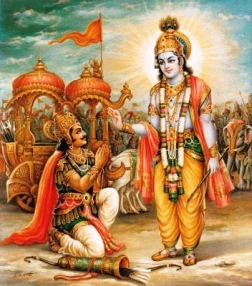
 Krishna and Rama are two of God’s primary names. According to authoritative scriptures such as the Shrimad Bhagavatam and Brahma-samhita, God has many forms, but Krishna is the original. Krishna means one who is all-attractive. He is also known as Madana-Mohan because He is capable of even attracting Cupid himself. Rama means one who gives pleasure. Rama can refer to Lord Ramachandra, Krishna’s incarnation during the Treta Yuga, or Lord Balarama, Krishna’s expansion who simultaneously appeared with Him during the Dvapara Yuga. Since Lord Balarama is considered non-different from God Himself, both definitions for Rama are valid, for they each refer to God.
“The holy name of Krishna is transcendentally blissful. It bestows all spiritual benedictions, for it is Krishna Himself, the reservoir of all pleasure. Krishna’s name is complete, and it is the form of all transcendental mellows. It is not a material name under any condition, and it is no less powerful than Krishna Himself. Since Krishna’s name is not contaminated by the material qualities, there is no question of its being involved with maya. Krishna’s name is always liberated and spiritual; it is never conditioned by the laws of material nature. This is because the name of Krishna and Krishna Himself are identical.” (Padma Purana)
The Vedas tell us that there is no difference between God and His name. This may seem strange to understand at first, but through constant recitation of the maha-mantra, we can begin to realize that this is indeed true. Simply calling out God’s names in a loving way means we are directly connecting with Him. The material world is a temporary place full of miseries. God, along with His names, forms, and pastimes, is completely the opposite. He is eternally blissful and full of knowledge. Lord Chaitanya, Krishna’s most recent incarnation, inaugurated the sankirtana movement, the congregational chanting of the names of God, some five hundred years ago. The maha-mantra was His mantra of choice due to its efficacy. He advised everyone to chant it regularly and to induce others to chant.
 Chanting God’s name is the only way to achieve perfection in the current age. We see evidence of this all around us. The beauty of “Hare Krishna” is that it can be recited by anyone, of any age, and any religious persuasion. Just as God is all-attractive, so are His names. The maha-mantra can be recited on a set of chanting beads (japa mala) to oneself, or it can be sung out loud with others. Either way, if we constantly keep Hare Krishna and Hare Rama on the tip of our tongue, we are sure to always be happy.