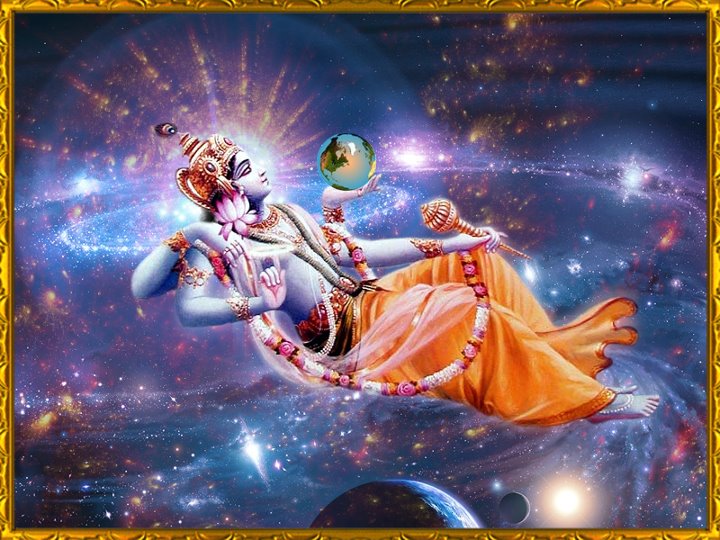
click on image to enlarge
Here is another word for your vaisnava vocabulary, acintya-bhedabheda-tattva. I was always facinated by this word because its meaning is inconceivable; simultaneous oneness and difference. Srila Prabhupada uses the example of the sun and the sunshine. The sunshine is not different from the sun as it is the engery of the sun, but when the sunshine is shinning in your room you cannot say the sun is in you room. Hence, one and different simultaneously. So similarly, God and His creation are one and different simultaneously One and Different.
Another example Srila Prabhupada uses is a drop of water from the ocean, has the same qualities as the ocean, in quality but not in quanitity. As living entities or as parts of God’s energy, we’re also equal in quality with God, but there’s a vast difference in quantity.
Achintya-bhedabheda-tattva refers to the inconceivable and simultaneous oneness and difference of the Supreme Person and His energies. This is one of the key points of theistic philosophy taught by Chaitanya Mahaprabhu. As parts of God’s energy, we’re also equal in quality with God, but there’s a vast difference in quantity. We’re each infinitesimal sparks of spiritual energy, and the Supreme Person, Krishna, is the infinite, supreme source of all energies.
Achintya-bhedabheda-tattva describes the relationship between the Supreme Lord and His energies, including individual souls, as both one with and different from Him simultaneously. This principle is beyond human comprehension, hence the “inconceivable” aspect.
From a lecture at a Christian Monastery – Melbourne April 06, 1972
…In the Vedas it is stated that: nityo nityānāṁ cetanaś cetanānāmeko bahūnāṁ vidadhāti kāmān (Kaṭha Upaniṣad 2.2.13)
“God is the supreme living being amongst all living beings.” Nityo nityanam: “And He’s the supreme eternal amongst all the eternals.” We are also eternal. Because we are part and parcel of God, we have got all the qualities of God. But because we are minute part and particle of God, therefore all the qualities of God are there in minute particle.
The example is just like the ocean. Ocean water is vast, and drop of ocean water, you analyze chemically, you will find all the chemical ingredients in that drop of water as there is in the water. The difference is of quantity. In the drop of water there is salt, and in the vast mass water in the ocean there is also salt. But the salt containing in the ocean water is very, very big quantity than the salt containing in the drop of water. And another example can be given—these are Vedic examples—just like the fire and the sparks of the fire. We have seen, experienced: when there is fire, sometimes there is some sound, phut!—immediately hundreds and thousands of sparks coming out. Now these sparks, they are also fire, but not as big as the original fire. But they are fire.
Therefore our philosophy, we, following the footsteps of Lord Caitanya Mahāprabhu: acintya bhedābheda-tattva. The difference is simultaneously we are one with God and different from God. One in quality. God is spirit, we are also spirit. He is Supersoul; we are individual. But God is great, and we are minute fragment. That is difference. Therefore, simultaneously we are one and different, one in quality but different in quantity. You accept also, “God is great.” And we say that nobody can be greater than God, neither anyone can be equal to God. That is our philosophy. Asama urdhva. Asama. Sama means equal. Nobody can be equal to God. That is not possible. God is one.


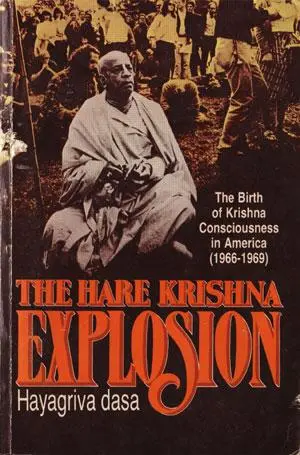

 The Hare Krishna Movement