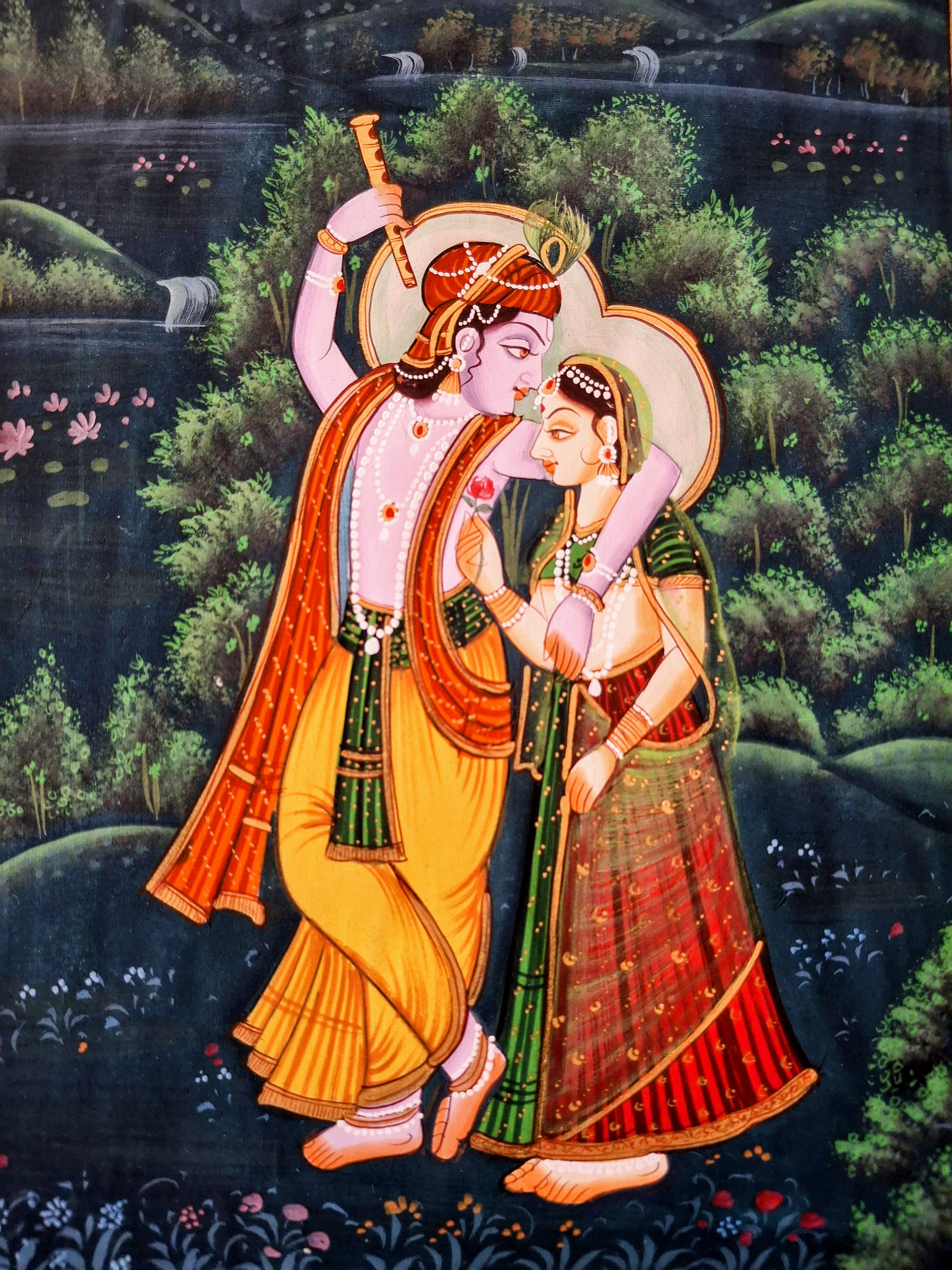
So we are finishing our series on the five types of relationships (rasa’s) with the Lord. Today we are exploring Devotional Service in Conjugal Love (Madhurya-rasa) as explained in chapter 44 of “The Nectar of Devotion”.
Because of the sensitive nature of this topic, we have posted the entire chapter from the the original 1970 edition of “The Nectar of Devotion”, by His Divine Grace A C Bhaktivedanta Swami Prabhupada.
A pure devotee’s attraction to Krsna in conjugal love is called devotional service in conjugal love. Although such conjugal feelings are not at all material, there is some similarity between this spiritual love and material activities. Therefore, persons who are interested only in material activities are unable to understand this spiritual conjugal love, and these devotional reciprocations appear very mysterious to them. Rupa Gosvāmī therefore describes conjugal love very briefly.
The impetuses of conjugal love are Krsna and His very dear consorts, such as Rādhārāṇī and Her immediate associates. Lord Krsnahas no rival: no one is equal to Him, and no one is greater than Him. His beauty is also without any rival, and because He excels all others in the pastimes of conjugal love, He is the original object of all conjugal love.
In the Gita-govinda by Jayadeva Gosvāmī one gopi tells her friend: “Kṛṣṇa is the reservoir of all pleasure within this universe. His body is as soft as the lotus flower. And His free behavior with the gopīs, which appears exactly like a young boy’s attraction to a young girl, is a subject matter of transcendental conjugal love.” A pure devotee follows in the footsteps of the gopīs and worships the gopīs as follows: “Let me offer my respectful obeisances to all the young cowherd girls, whose bodily features are so attractive. Simply by their beautiful attractive features they are worshiping the Supreme Personality of Godhead, Krsna.” Out of all the young gopīs, Śrīmatī Rādhārāṇī is the most prominent.
The beauty of Śrīmatī Rādhārāṇī is described as follows: “Her eyes defeat the attractive features of the eyes of the cakorī bird. When one sees the face of Rādhārāṇī, he immediately hates the beauty of the moon. Her bodily complexion defeats the beauty of gold. Thus, let us all look upon the transcendental beauty of Śrīmatī Rādhārāṇī.” Kṛṣṇa’s attraction for Rādhārāṇī is described by Krsna Himself thus: “When I create some joking phrases in order to enjoy the beauty of Rādhārāṇī, Rādhārāṇī hears these joking words with great attention; but by Her bodily features and counter words She neglects Me. And I even possess unlimited pleasure by Her neglect of Me, for She becomes so beautiful that She increases My pleasure one hundred times.” A similar statement can be found in Gita-govinda, wherein it is said that when the enemy of Kamsa, Śrī Krsna, embraces Śrīmatī Rādhārāṇī, He immediately becomes entangled in a loving condition and gives up the company of all other gopīs.
In the Padyavali of Rupa Gosvāmī it is stated that when the gopīs hear the sound of Kṛṣṇa’s flute, they immediately forget all rebukes offered by the elderly members of their families, their defamation and the harsh behavior of their husbands. Their only thought is to go out in search of Krsna. When the gopīs meet Krsna, the display of their exchanging glances as well as their joking and laughing behavior is called anubhava, or sub-ecstasy in conjugal love.
In the Lalita-madhava, Rupa Gosvāmī explains that the movements of Kṛṣṇa’s eyebrows are just like the Yamuna, and the smiling of Rādhārāṇī is just like the moonshine. When the Yamuna and the moonshine come in contact on the bank of the river, the water tastes just like nectar, and drinking it gives great satisfaction. It is as cooling as piles of snow. Similarly, in the Padyavali, one constant companion of Rādhārāṇī says, “My dear moon-faced Rādhārāṇī, Your whole body appears to be very content, yet there are signs of tears in Your eyes. Your speech is faltering, and Your chest is also heaving. By all these signs I can understand that You must have heard the blowing of Kṛṣṇa’s flute, and, as a result of this, Your heart is now melting.”
In the same Padyavali there is the following description, which is taken as a sign of frustration in conjugal love. Śrīmatī Rādhārāṇī said, “Dear Mr. Cupid, please do not excite Me by throwing your arrows at My body. Dear Mr. Air, please do not arouse Me with the fragrance of flowers. I am now bereft of Kṛṣṇa’s loving attitude, so under the circumstances, what is the use of My sustaining this useless body? There is no need for such a body by any living entity.” This is a sign of frustration in ecstatic love for Krsna.
Similarly, in Dana-keli-kaumudi, Śrīmatī Rādhārāṇī, pointing to Krsna, says, “This clever boy of the forest has the beauty of a bluish lotus flower, and He can attract all the young girls of the universe. Now after giving Me a taste of His transcendental body, He has enthused Me, and it is more than I can tolerate. I am now feeling like a female elephant who has been enthused by a male elephant!” This is an instance of jubilation in ecstatic love with Krsna.
Steady ecstasy of conjugal love is the original cause of bodily enjoyment. In the Padyavali this original cause of union is described when Rādhārāṇī tells one of Her constant companions: “My dear friend, who is this boy whose eyelids, dancing constantly, have increased the beauty of His face and attracted My desire for conjugal love? His ears are decorated with the buds of asoka flowers, and He has dressed Himself in yellow robes. By the sound of His flute, this boy has already made Me impatient.”
The conjugal love of Radha-Krsna is never disturbed by any personal consideration. The undisturbed nature of the conjugal love between Radha and Krsna is described thus: “Just a little distance away from Krsna was Mother Yasoda, and Krsna was surrounded by all of His friends. In front of His eyes there was Candrāvalī, and, at the same time, on a chunk of stone in front of the entrance to Braja, there was standing the demon known as Vṛṣāsura. But even in such circumstances, when Krsna saw Rādhārāṇī standing just behind a bush of many creepers, immediately His beautiful eyebrows moved just like lightning towards Her.”
Another instance is described as follows: “On one side of the courtyard the dead body of Śaṅkhāsura was lying, surrounded by many jackals. On another side were many learned brāhmaṇas who were all self-controlled. They were offering nice prayers, which were as soothing as the cool breeze in summer. In front of Krsna, Lord Baladeva was standing, causing a cooling effect. But even amidst all these different circumstances of soothing and disturbing effects, the lotus flower of ecstatic conjugal love that Krsna felt for Rādhārāṇī could not wither.” This love of Krsna for Rādhārāṇī is often compared to a blooming lotus: the only difference is that Kṛṣṇa’s love remains ever-increasingly beautiful.
Conjugal love is divided into two portions: vipralambha, or conjugal love in separation, and sambhoga, or conjugal love in direct contact. Vipralambha, separation, has three sub-divisions known as 1) pūrvarāga, or preliminary attraction, 2) mana, or seeming anger, and 3) pravasa, or separation by distance.
When the lover and the beloved have a distinct feeling of not meeting each other, that stage is called purva-raga, or preliminary attraction. In Padyavali Rādhārāṇī told Her companion, “My dear friend, I was just going to the bank of the Yamuna, and all of a sudden a very nice boy whose complexion is like a dark blue cloud became visible in front of My eyes. He glanced over Me in a way that I cannot describe. But since this has occurred, I am sorry that I can no longer engage My mind in the duties of My household affairs.” This is an instance of preliminary attraction for Krsna. In Śrīmad-Bhagavatam, Tenth Canto, 53rd Chapter, verse 2, Krsna told the messenger brahmana who came from Rukmini: “My dear brahmana, just like Rukmini I cannot sleep at night, and My mind is always fixed on her. I know that her brother Rukmi is against Me, and due to his persuasion, My marriage with her has been cancelled.” This is another instance of preliminary attraction.
As far as mana, or anger, is concerned, there is the following incident described in Gita-govinda: “When Śrīmatī Rādhārāṇī saw Krsna enjoying Himself in the company of several other gopīs, She became a little jealous because Her special prestige was being dimmed. Therefore, She immediately left the scene and took shelter in a nice flower bush where the black drones were humming. Then, hiding Herself behind the creepers, She began to express Her sorrow to one of Her consorts.” This is an instance of a seeming disagreement.
An example of pravasa, or being out of contact because of living in a distant place, is given in the Padyavaliī as follows: “Since the auspicious day when Krsna left for Mathura, Śrīmatī Rādhārāṇī has been pressing Her head on one of Her hands and constantly shedding tears. Her face is always wet now, and therefore there is no chance of Her sleeping even for a moment.” When the face becomes wet, the sleeping tendency is immediately removed. So when Rādhārāṇī was always weeping for Krsna because of His separation, there was no chance of Her getting any sleep for Herself. In the prahlada-samhita Uddhava says, “The Supreme Personality of Godhead, Govinda, panic-stricken due to being pierced by the arrows of Cupid, is always thinking of you [the gopīs], and He is not even accepting His regular lunch. Nor is He getting any proper rest.”
When the lover and beloved come together and enjoy one another by direct contact, this stage is called sambhoga. There is a statement in Padyavali as follows: “Kṛṣṇa embraced Śrīmatī Rādhārāṇī in such an expert manner that He appeared to be celebrating the dancing ceremony of the peacocks.”
Śrī Rupa Gosvāmī thus ends the fifth wave of his Ocean of the Nectar of Devotion. He offers his respectful obeisances to the Supreme Personality of Godhead who appeared as Gopala, the eternal form of the Lord.
Thus ends the Bhaktivedanta summary study of the third division of Bhaki-rasamrta-sindhu in the matter of the five primary relationships with Krsna.


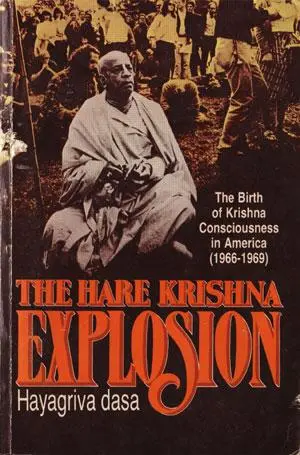

 The Hare Krishna Movement