Appearance of Lord Ramacharya (Rama Navami)

So today marks the appearance day of Lord Ramacandra, otherwise known as Rama-Navami. We honor it with a full day fast, followed by an nice vegetarian feast. It is nice to remember the Lord by extra chanting of His holy names, and with readings throughout the day of the glorious pastimes of the Lord.

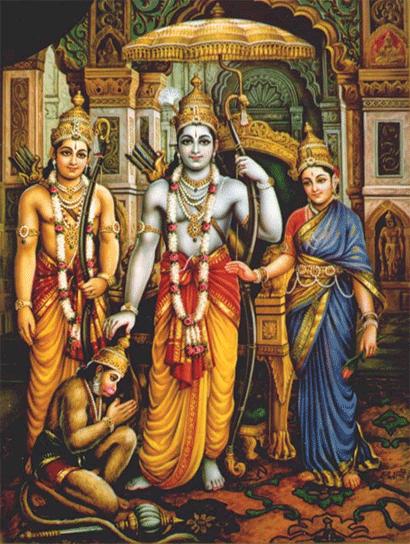
Ramachandra, or Lord Rama, is one of Krishna’s many avatars on earth. He appeared during a previous age, Treta-yuga, and ruled as emperor of the world. A chronicle of His activities is presented extensively in the epic Ramayana, and concisely in the ninth canto of the Srimad-Bhagavatam, a biography of Krishna’s many incarnations.

Ramachandra’s life is considered to be exemplary in every way. Followers of India’s Vedic culture see Him as the ideal king, the most powerful warrior, and the most faithful husband. It is said that He ruled His kingdom just as a loving father cares for his children. Lord Rama’s nobility, integrity, decency, and virtue are spoken of with reverence even today.

He appeared as the eldest son of Maharaja Dasarath, along with brothers Bharata, Lakshmana, and Shatrughna—also incarnations of the Supreme Person. He married Sita devi, daughter of King Janaka, after breaking the bow of Siva in the contest for Sita’s hand. On the day of Ramachandra’s coronation, however, due to royal intrigue, He was banished to the forest for fourteen years, and Lakshmana and Sita accompanied Him there.

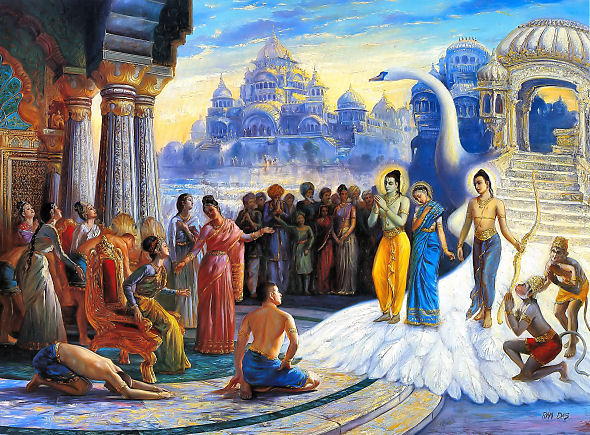
Ravana, king of Lanka, kidnapped Sita when Rama was absent from Their forest home. Subsequently, Rama and Lakshmana organized an army of forest-dwelling simians, vanaras—including the great devotee Hanuman— to attack Lanka. He then killed Ravana, rescued Sita, and triumphantly returned to His capital city, Ayodhya.

In the eighteenth incarnation, the Lord appeared as King Rāma. In order to perform some pleasing work for the demigods, He exhibited superhuman powers by controlling the Indian Ocean and then killing the atheist King Rāvaṇa, who was on the other side of the sea.” (Srimad Bhagavatam 1.3.22)

Full text and purport

More
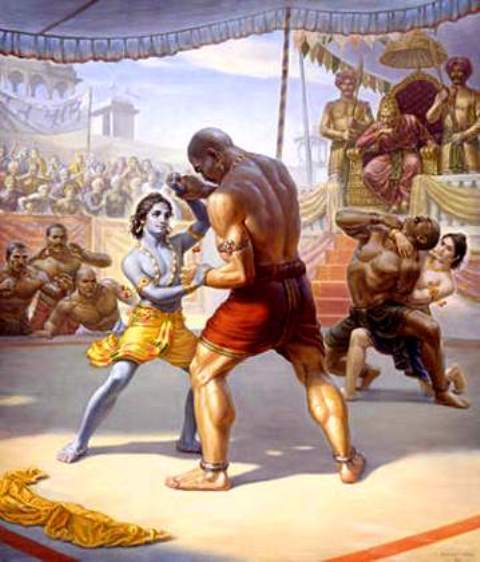
The Pastimes of the Supreme Lord, Rāmacandra

Lord Rama

In honor of the Appearance day of Lord Ramacandra, we are posting the entire tenth chapter from the ninth Canto of Srimad Bhagavatam entitled “The Pastimes of the Supreme Lord, Rāmacandra”.

Śrīmad-Bhāgavatam
By His Divine Grace A. C. Bhaktivedanta Swami Prabhupāda
Canto Nine, Chapter Ten

More

Transcendental Pastimes of the Supreme Lord

Who is there, desiring deliverance from the vices of the age of quarrel, who is not willing to hear the virtuous glories of the Lord?

His transcendental acts are magnificent and gracious, and great learned sages like Nārada sing of them. Please, therefore, speak to us, who are eager to hear about the adventures He performs in His various incarnations.

O wise Sūta, please narrate to us the transcendental pastimes of the Supreme Godhead’s multi-incarnations. Such auspicious adventures and pastimes of the Lord, the supreme controller, are performed by His internal powers.

We never tire of hearing the transcendental pastimes of the Personality of Godhead, who is glorified by hymns and prayers. Those who have developed a taste for transcendental relationships with Him relish hearing of His pastimes at every moment.

..There is a great difference between mundane stories, fiction, or history and the transcendental pastimes of the Lord. The histories of the whole universe contain references to the pastimes of the incarnations of the Lord. The Rāmāyaṇa, the Mahābhārata, and the Purāṇas are histories of bygone ages recorded in connection with the pastimes of the incarnations of the Lord and therefore remain fresh even after repeated readings. For example, anyone may read Bhagavad-gītā or the Śrīmad-Bhāgavatam repeatedly throughout his whole life and yet find in them new light of information. Mundane news is static whereas transcendental news is dynamic, inasmuch as the spirit is dynamic and matter is static. Those who have developed a taste for understanding the transcendental subject matter are never tired of hearing such narrations. (From Purport to SB 1.1.19)

Srimad Bhagavatam
By His Divine Grace A.C. Bhaktivedanta Swami Prabhupada
Canto 1, Chapter 1, Text 16-19

Full Text and Purport More

Rama Navami – The Appearance Day of Lord Rama


Rama Navami – the birthday of Lord Rama
Pasted from prabhupadanugas.eu

Rama Navami (Devanāgarī: राम नवमी) also known as Sri Rama Navami ( IAST SriRāma-navamī ). Sri Ram Navami is a great festival in India, celebrating the birth of Lord Rama to King Dasharatha and Queen Kausalya of Ayodhya. Rama is the 7th incarnation of the Dashavatara of Vishnu. The festival falls in the Shukla Paksha on the Navami, the ninth day of the month of Chaitra in the Hindu calendar. Thus it is also known as Chaitra Masa Suklapaksha Navami, and marks the end of the nine-day Chaitra-Navratri celebrations.

More

108 Imporant Slokas from the 1972 Bhagavad-gita As It Is

Click on image to go to Post

Click on image to go to Post

The Hare Krishna Cookbook

Songs of the Vaisnava Acaryas

Bhagavad-gita As It Is 1972 Edition “Online”

click on image

click on image to visit site

Srimad Bhagavatam Online

click on image

Raja-Vidya the King of Knowledge

click on image

click on image

Blog Stats

  • 4,649,254 hits

Enter your email address to subscribe to this blog and receive notifications of new posts by email.

Join 3,893 other subscribers

Important Slokas from the Brahma-samhita

click on image

click on image

Slokas from the Sri Isopanisad

click on image

click on image

Prayers By Queen Kunti (Slokas)

click on image

Gajendra’s Prayers of Surrender (Slokas)

click on image

A Short Statement of the Philosophy of Krishna Consciousness

click on image

click on image

July 9th Letter

click on image

click on image

The Hare Krishna Explosion

Reference Material/Study Guide

click on image

click on image

  • LINKS