Sri Caitanya-Caritamrta Adi Lila 7.22

Sri Caitanya-Caritamrta Adi Lila 7.22
By His Divine Grace A.C. Bhaktivedanta Swami Prabhupada

TRANSLATION

Śrī Pañca-tattva themselves danced again and again and thus made it easier to drink nectarean love of Godhead. They danced, cried, laughed and chanted like madmen, and in this way they distributed love of Godhead.

PURPORT

People generally cannot understand the actual meaning of chanting and dancing. Describing the Gosvāmīs, Śrī Śrīnivāsa Ācārya stated, kṛṣṇotkīrtana-gāna-nartana-parau: not only did Lord Caitanya Mahāprabhu and His associates demonstrate this chanting and dancing, but the six Gosvāmīs also followed in the next generation. The present Kṛṣṇa consciousness movement follows the same principle, and therefore simply by chanting and dancing we have received good responses all over the world. It is to be understood, however, that this chanting and dancing do not belong to this material world. They are actually transcendental activities, for the more one engages in chanting and dancing, the more he can taste the nectar of transcendental love of Godhead.

Arsha Prayoga Part II

Arsha Prayoga Part II
By Sriman Locanananda Prabhu

Srila Prabhupada’s desire was to see his books translated into all of the major languages of the world. By 1970, numerous centers had opened in countries outside of the United States and translation work had begun in Germany, France, Canada, South America and Japan. When the German devotees undertook the translation of the Srimad Bhagavatam, they discovered what they thought were grammatical discrepancies in the original English. The translators reasoned that if their spiritual master could publish his books with flaws included, then their own translation work could also contain mistakes and no harm would be done. In a very strongly-worded letter, Srila Prabhupada chastised his disciples for thinking they could imitate their spiritual master and explained that to avoid this offense, they must follow the principle of arsha prayoga.

One should not see mistakes in the books written by his spiritual master, nor should one think he is able take the same liberties taken by him. His Divine Grace warned his disciples that only if they were able to spread Krishna consciousness all over the world as he had done could discrepancies in their translation work be overlooked, otherwise not.

More

Mantra Rock

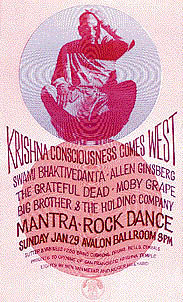
Mantra Rock Concert

“Sunday, January 29, 1967 marked the major spiritual event of the San Francisco hippie era, and Srila Prabhupada, who was ready to go anywhere to spread Krishna Consciousness, was there.

The Grateful Dead, Moby Grape, Janis Joplin and Big Brother and the Holding Company, Jefferson Airplane, Quicksilver Messenger Service — all the new-wave San Francisco bands — had agreed to appear with Srila Prabhupada at the Avalon Ballroom’s Mantra-Rock Dance, proceeds from which would go to the local Hare Krishna temple.

Thousands of hippies, anticipating an exciting evening, packed the hall.

At about 10 p.m., Srila Prabhupada and a small entourage of devotees arrived amid uprorious applause and cheering by a crowd that had waited weeks in great anticipation for this moment. Srila Prabhupada was given a seat of honor onstage and was introduced by Allen Ginsberg, who explained his own realizations about the Hare Krishna maha-mantra and how it had spread from the small storefront in New York to San Francisco.

The chanting started slowly but ryhthmically, and little by little it spread throughout the ballroom, enveloping everyone. Hippies got to their feet, held hands, and began to dance as enormous, pulsing pictures of Krishna were projected around the walls of the ballroom in perfect sync with the beat of the mantra.

By the time Srila Prabhupada stood and began to dance with his arms raised, the crowd was completely absorbed in chanting, dancing and playing musical instruments they had brought for the occasion.

As the tempo speeded up, the chanting and dancing became more and more intense, spurred on by a stageful of top rock musicians, who were as charmed by the magic of the maha-mantra as the amateur musicians had been at the Tompkins Square kirtanas only a few weeks before.
The chant rose; it seemed to surge and swell without limit. When it seemed it could go no further, the chanting stopped. Srila Prabhupada offered prayers to his spiritual master into the microphone and ended-by saying three times, “All glories to the assembled devotees!” The Haight-Ashbury neighborhood buzzed with talk of the mantra-Rock Dance for weeks afterward.

Allen Ginsberg later recalled, “We sang Hare Krishna all evening. It was absolutely great — an open thing. It was the height of the Haight-Ashbury spiritual enthusiasm.”

The King of Knowledge


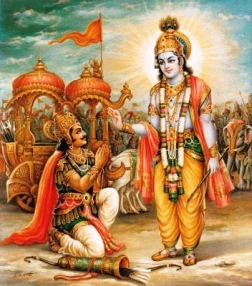
Just knowing “I am not this body but am spirit soul” is not sufficient. We have to escape this entanglement of material nature. This is called mukti, liberation. Out of many thousands of persons who are in self-knowledge as to what and who they are, only one or two may be actually liberated.

And out of many thousands who are liberated, only one or two may understand what and who Krishna is. So understanding Krishna is not such an easy job. Thus in this age of Kali, an age characterized by ignorance and chaos, liberation is out of the reach of practically everyone.

One has to go through the whole ordeal of becoming civilized, then religious, and then one has to perform charities and sacrifices and come to the platform of knowledge, then to the stage of liberation, and finally, after liberation, to the understanding of what Krishna is. This process is also indicated in Bhagavad-gita:

brahma-bhutah prasannatma
na socati na kanksati
samah sarvesu bhutesu
mad-bhaktim labhate param

“One who is thus transcendentally situated at once realizes the Supreme Brahman. He never laments or desires to have anything; he is equally disposed to every living entity. In that state he attains pure devotional service unto Me.” (Bg. 18.54)

More

Kirtan: Ancient Medicine for Modern Man

Kirtan: Ancient Medicine for Modern Man
By Hansadutta Prabhu 

 The singing and dancing of Hare Krishna is known as Kirtan. My spiritual master Srila Prabhupada said, “This is not ordinary dancing; this is the dancing of the soul, a soul awakened to his original consciousness, Krishna consciousness.” There is no motive in performing Kirtan. It is the song and dance of ecstasy, the dance of the soul. The soul is dancing; therefore the body is dancing. Actually, the body cannot dance without the soul. A body without the soul is a dead body.

More

Next Newer Entries

108 Imporant Slokas from the 1972 Bhagavad-gita As It Is

Click on image to go to Post

Click on image to go to Post

The Hare Krishna Cookbook

Songs of the Vaisnava Acaryas

Bhagavad-gita As It Is 1972 Edition “Online”

click on image

click on image to visit site

Srimad Bhagavatam Online

click on image

Raja-Vidya the King of Knowledge

click on image

click on image

Blog Stats

  • 4,612,871 hits

Enter your email address to subscribe to this blog and receive notifications of new posts by email.

Join 3,906 other subscribers

Important Slokas from the Brahma-samhita

click on image

click on image

Slokas from the Sri Isopanisad

click on image

click on image

Prayers By Queen Kunti (Slokas)

click on image

Gajendra’s Prayers of Surrender (Slokas)

click on image

A Short Statement of the Philosophy of Krishna Consciousness

click on image

click on image

July 9th Letter

click on image

click on image

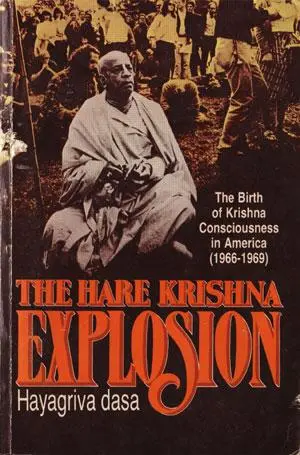
The Hare Krishna Explosion

Reference Material/Study Guide

click on image

click on image

  • LINKS