Nityanavanavāyamāna

It is said that it is the nature of a devotee to constantly apply his mind, energy, words, ears, etc., in hearing and chanting about Kṛṣṇa. This is called Kṛṣṇa consciousness, and for one who is rapt in hearing and chanting Kṛṣṇa, the subject matter never becomes hackneyed or old. That is the significance of transcendental subject matter in contrast to material subject matter. Material subject matter becomes stale, and one cannot hear a certain subject for a long time; he wants change. But as far as transcendental subject matter is concerned, it is called nityanavanavāyamāna. This means that one can go on chanting and hearing about the Lord and never feel tired but will remain fresh and eager to hear more and more.

…” Lord Kṛṣṇa brought His friends to the bank of the Yamunā and addressed them as follows: ’My dear friends, just see how this spot is very nice for taking lunch and playing on the soft sandy Yamunā bank. You can see how the lotus flowers in the water are beautifully blown and how they distribute their flavor all around. The chirping of the birds along with cooing of the peacocks, surrounded by the whispering of the leaves in the trees, combine and present sound-vibrations that echo one another. And this just enriches the beautiful scenery created by the trees here. Let us have our lunch in this spot because it is already late and we are feeling hungry. Let the calves remain near us, and let them drink water from the Yamunā. While we engage in our lunch-taking, the calves may engage in eating the soft grasses that are in this spot.’“

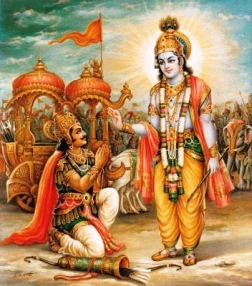
On hearing this proposal from Kṛṣṇa, all the boys became very glad and said, ”Certainly, let us all sit down here to take our lunch.“ They then let loose the calves to eat the soft grass. Sitting down on the ground and keeping Kṛṣṇa in the center, they began to open their different boxes brought from home. Lord Śrī Kṛṣṇa was seated in the center of the circle, and all the boys kept their faces toward Him. They ate and constantly enjoyed seeing the Lord face to face. Kṛṣṇa appeared to be the whorl of a lotus flower, and the boys surrounding Him appeared to be its different petals. The boys collected flowers, leaves of flowers and barks of trees and placed them under their different boxes, and thus they began to eat their lunch, keeping company with Kṛṣṇa. While taking lunch, each boy began to manifest different kinds of relations with Kṛṣṇa, and they enjoyed each other’s company with joking words. While thus enjoying lunch with His friends, Lord Kṛṣṇa’s flute was pushed within the belt of His cloth, and His bugle and cane were pushed in on the left-hand side of His cloth. He was holding a lump of foodstuff prepared with yogurt, butter, rice and pieces of fruit salad in His left palm, which could be seen through His petal-like finger joints. The Supreme Personality of Godhead, who accepts the results of all great sacrifices, was laughing and joking, enjoying lunch with His friends in Vṛndāvana. And thus the scene was being observed by the demigods from heaven. As for the boys, they were simply enjoying transcendental bliss in the company of the Supreme Personality of Godhead. (excerpted from: KRSNA Book Chapter 13 entitled “The Stealing of the Boys and Calves by Brahmā”)

Incarnation of Sound

Why Chant Hare Krishna?
By Sriman Hansadutta Prabhu

God is absolute, and therefore anything directly connected with Him, such as His holy name, form, pastimes, paraphernalia and entourage, is identical with Him. In the material world of duality, objects are different from their names. A thirsty man’s cry–“Water! Water! Water!”–will never satisfy his thirst, because the name water and the substance water are completely different. In the absolute world, however, there are no such differences. There an object and its name, or a person and his name, are one. Therefore, simply by vibrating the holy name of God, one associates with God directly.

nama chintaminih krishnash
chaitanya-rasa-vigrahah
pumah shuddho nitya-mukto
‘bhinnatvan nama-naminoh

The holy name of Krishna is like a transcendental touchstone, for it is Krishna Himself, the reservoir of all pleasure. Krishna’s name is complete, and it is the form of transcendental mellows. It is always pure and liberated from all material contamination. This is because the name of Krishna and Krishna Himself are identical.–Padma Purana

Lord Chaitanya Mahaprabhu, an incarnation of Krishna, recommended that one chant the maha-mantra twenty-four hours a day and thus make one’s life perfect. He said:

One can chant the holy name of God in a humble state of mind, thinking himself lower than the straw in the street. One should be more tolerant than a tree, devoid of all sense of false prestige, and always ready to offer all respects to others. In such a humble state of mind one can chant the holy name of the Lord constantly.–Shikshastaka, Verse 3

Chanting Hare Krishna gradually frees one from material concepts and elevates one to samadhi, a trance-like state in which one realizes the Supersoul (Paramatma, or Krishna residing in the heart) through his transcendental mind and intelligence. God realization is the goal of yoga. The living entity is called jivatma (the atomic self), and Krishna is called Paramatma (the Supreme Self). In perfect Krishna consciousness, one realizes the eternal relationship between the atomic soul and the Supreme Soul, Krishna, without misidentifying himself with the Supreme.

In this age, the best method of practicing yoga is to chant and hear the holy names of God, as found in the maha-mantra: Hare Krishna, Hare Krishna, Krishna Krishna, Hare Hare/ Hare Rama, Hare Rama, Rama Rama, Hare Hare. This is the beginning of bhakti-yoga, or Krishna consciousness. There are no hard and fast rules for chanting. One can chant at any time or in any place. One need not give up his job or family, because the chanting automatically purifies one’s life, adjusting unwanted and unnecessary difficulties. The authorized scriptures of the world’s civilized nations give various names for God, but the Vedic scriptures especially recommend the chanting of Hare Krishna, Hare Krishna, Krishna Krishna, Hare Hare/ Hare Rama, Hare Rama, Rama Rama, Hare Hare. We therefore humbly request you to chant this maha-mantra and be happy.

108 Imporant Slokas from the 1972 Bhagavad-gita As It Is

Click on image to go to Post

Click on image to go to Post

The Hare Krishna Cookbook

Songs of the Vaisnava Acaryas

Bhagavad-gita As It Is 1972 Edition “Online”

click on image

click on image to visit site

Srimad Bhagavatam Online

click on image

Raja-Vidya the King of Knowledge

click on image

click on image

Blog Stats

  • 4,572,015 hits

Enter your email address to subscribe to this blog and receive notifications of new posts by email.

Join 3,906 other subscribers

Important Slokas from the Brahma-samhita

click on image

click on image

Slokas from the Sri Isopanisad

click on image

click on image

Prayers By Queen Kunti (Slokas)

click on image

Gajendra’s Prayers of Surrender (Slokas)

click on image

A Short Statement of the Philosophy of Krishna Consciousness

click on image

click on image

July 9th Letter

click on image

click on image

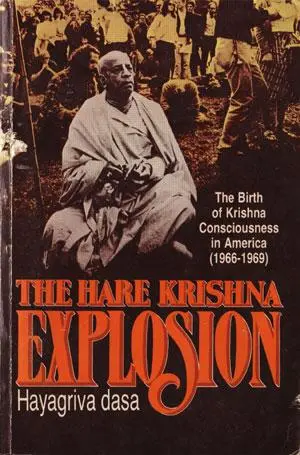
The Hare Krishna Explosion

Reference Material/Study Guide

click on image

click on image

  • LINKS