Letter to Yamuna

(click on photo to enlarge)

Dear Yamuna,

Please accept my blessings. I have received your letter of January 18, and studied the contents.

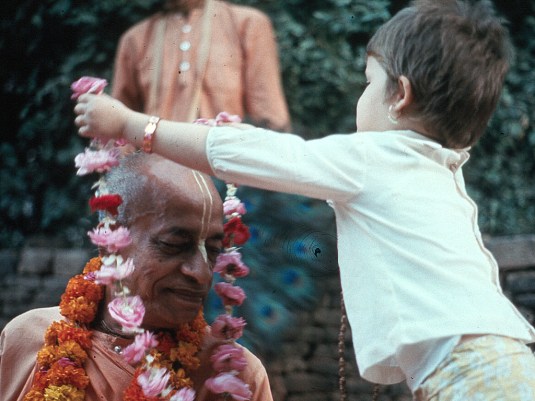
The picture of your Radha Krishna deities is very good. They appear to be like the Radha Govinda deities of Mullick Thakur which I used to see from my childhood.

Yes, go on with your program. Live a simple life. Take a little milk and food grains, chant Hare Krishna and worship Sri Sri Radha Krishna deity, that’s all. That will make you perfect.

Hoping this finds you in good health.

Your ever well-wisher,
A.C. Bhaktivedanta Swami

Smte. Yamuna devi dasi
Sri Sri Radha Vanabehari Mandir
Murphy, Oregon 97533
ACBS/sdg

Characteristics of Pure Devotional Service

Nectar of Devotion
By: His Divine Grace A. C. Bhaktivedanta Swami Prabhupada
Chapter One

Characteristics of Pure Devotional Service

In Śrīmad-Bhāgavatam, Third Canto, Twenty-ninth Chapter, verses 12 and 13, Śrīla Kapiladeva, while instructing His mother, has given the following characteristics of pure devotional service: “My dear mother, those who are My pure devotees, and who have no desire for material benefit or philosophical speculation, have their minds so much engaged in My service that they are never interested in asking Me for anything—except to be engaged in that service. They do not even beg to live in My abode with Me.”

There are five kinds of liberation, namely to become one with the Lord, to live with the Supreme Lord on the same planet, to have the same features as the Lord, to enjoy the same opulences as the Lord and to live as a companion of the Lord. A devotee, what to speak of rejecting material sense gratification, does not even want any of the five kinds of liberation. He is satisfied simply by discharging loving service to the Lord. That is the characteristic of pure devotion.

In the above statement by Kapiladeva from Śrīmad-Bhāgavatam, the actual position of a pure devotee is described, and the primary characteristics of devotional service are also defined. Further characteristics of devotional service are described by Rūpa Gosvāmī with evidences from different scriptures. He states that there are six characteristics of pure devotional service, which are as follows:

(1) Pure devotional service brings immediate relief from all kinds of material distress.

(2) Pure devotional service is the beginning of all auspiciousness.

(3) Pure devotional service automatically puts one in transcendental pleasure.

(4) Pure devotional service is rarely achieved.

(5) Those in pure devotional service deride even the conception of liberation.

(6) Pure devotional service is the only means to attract Kṛṣṇa.

Kṛṣṇa is all-attractive, but pure devotional service attracts even Him. This means that pure devotional service is even transcendentally stronger than Kṛṣṇa Himself, because it is Kṛṣṇa’s internal potency.

More

Enter, Srila Prabhupada (Chapter 13)

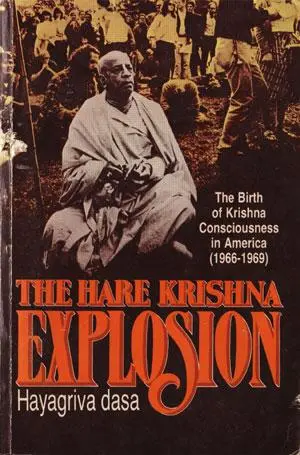
The Hare Krishna Explosion
by Hayagriva das

Part III: New Vrindaban, 1968-1969
Chapter 13

Enter, Srila Prabhupada

In his long absence, Swamiji’s words haunt me: “Although I am practically on the path of death, still I cannot forget my publications. I wish that if I live or die, you will take very serious care for my publications.“

We are bewildered trying to keep the ISKCON ship afloat, subsisting on the only supplies left—the holy names, the words, the taped lectures, the few books and pamphlets, the memories and photographs.

“Although I am practically on the path of death….”

(Swamiji always said “practically” for “actually.”)

His publications! The Word in English! Before me sits the first complete draft of Bhagavad-gita As It Is, ready for final English revision. “It must be published at once,” he told us repeatedly. “Either get some publisher, or we print it ourselves. Complete it quickly.”

Leaving San Francisco, even revising the manuscript on the plane, I return to New York to work with Brahmananda, who is still hounding publishers.

In Matchless Gifts, we carry on, keeping silent vigil for reports on Swamiji’s condition. Every day, we wait for a letter from Swamiji himself, signed in a large, firm hand, “Your ever well-wisher, A.C. Bhaktivedanta Swami.”

Soon letters from Kirtanananda begin to arrive. Word spreads. Swamiji and Kirtanananda were detained overnight in London because someone on the plane was infected with smallpox. A twenty-four hour quarantine. They were accomodated in a hotel by the airline. In the morning, Swamiji was feeling much better, and they were in Moscow in three hours.

Swamiji was not impressed by the stark silence of the Moscow airport. Nor by the peasant women mopping the floor, nor by the Marxist tracts. Women should be protected, and in every society there exists the four castes. How can the sudras, the working class be expected to dominate government? The four castes were proclaimed eternal by Krishna Himself. Mr. Marx cannot arbitrarily abolish them. Such is the illusion of demons.

“We stayed in Moscow about an hour,” Kirtanananda writes, then reboarded and were in Delhi by midnight. We arrived in the middle of the monsoons, so when we got off the plane, the hot and humid Indian air hit us. It was like walking into a scorching brick wall.”

More
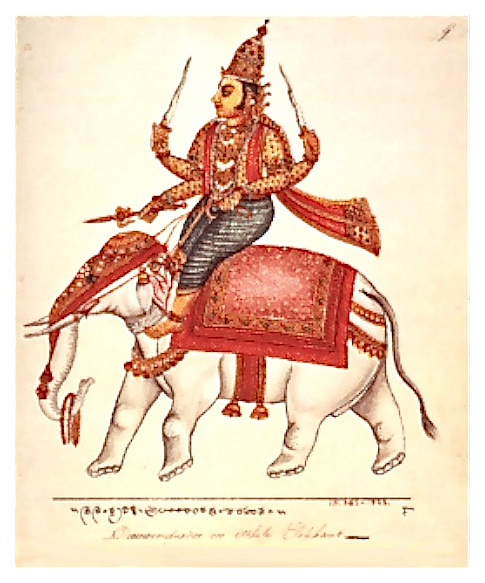
King Indra’s fall from Heaven

King Indra cursed to become a Hog

Taken from the Srimad Bhagavatam Canto 3, Chapter 30, Text 5-6
By His Divine Grace A.C. Bhaktivedanta Swami Prabhupada

“The conditioned living entity is satisfied in his own particular species of life; while deluded by the covering influence of the illusory energy, he feels little inclined to cast off his body, even when in hell, for he takes delight in hellish enjoyment.”

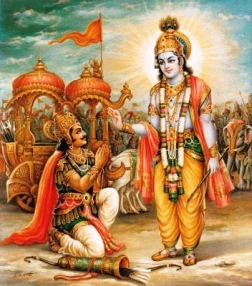
It is said that once Indra, the King of heaven, was cursed by his spiritual master, Bṛhaspati, on account of his misbehavior, and he became a hog on this planet. After many days, when Brahmā wanted to recall him to his heavenly kingdom, Indra, in the form of a hog, forgot everything of his royal position in the heavenly kingdom, and he refused to go back. This is the spell of māyā. Even Indra forgets his heavenly standard of life and is satisfied with the standard of a hog’s life. By the influence of māyā the conditioned soul becomes so affectionate towards his particular type of body that if he is offered, “Give up this body, and immediately you will have a king’s body,” he will not agree. This attachment strongly affects all conditioned living entities. Lord Kṛṣṇa is personally canvassing, “Give up everything in this material world. Come to Me, and I shall give you all protection,” but we are not agreeable. We think, “We are quite all right. Why should we surrender unto Kṛṣṇa and go back to His kingdom?” This is called illusion, or māyā. Everyone is satisfied with his standard of living, however abominable it may be.

Such satisfaction with one’s standard of living is due to deep-rooted attraction for body, wife, home, children, animals, wealth and friends. In such association, the conditioned soul thinks himself quite perfect.

This so-called perfection of human life is a concoction. Therefore, it is said that the materialist, however materially qualified he may be, is worthless because he is hovering on the mental plane, which will drag him again to the material existence of temporary life. One who acts on the mental plane cannot get promotion to the spiritual. Such a person is always sure to glide down again to material life. In the association of so-called society, friendship and love, the conditioned soul appears completely satisfied.

Next Newer Entries

108 Imporant Slokas from the 1972 Bhagavad-gita As It Is

Click on image to go to Post

Click on image to go to Post

The Hare Krishna Cookbook

Songs of the Vaisnava Acaryas

Bhagavad-gita As It Is 1972 Edition “Online”

click on image

click on image to visit site

Srimad Bhagavatam Online

click on image

Raja-Vidya the King of Knowledge

click on image

click on image

Blog Stats

  • 4,648,650 hits

Enter your email address to subscribe to this blog and receive notifications of new posts by email.

Join 3,893 other subscribers

Important Slokas from the Brahma-samhita

click on image

click on image

Slokas from the Sri Isopanisad

click on image

click on image

Prayers By Queen Kunti (Slokas)

click on image

Gajendra’s Prayers of Surrender (Slokas)

click on image

A Short Statement of the Philosophy of Krishna Consciousness

click on image

click on image

July 9th Letter

click on image

click on image

The Hare Krishna Explosion

Reference Material/Study Guide

click on image

click on image

  • LINKS