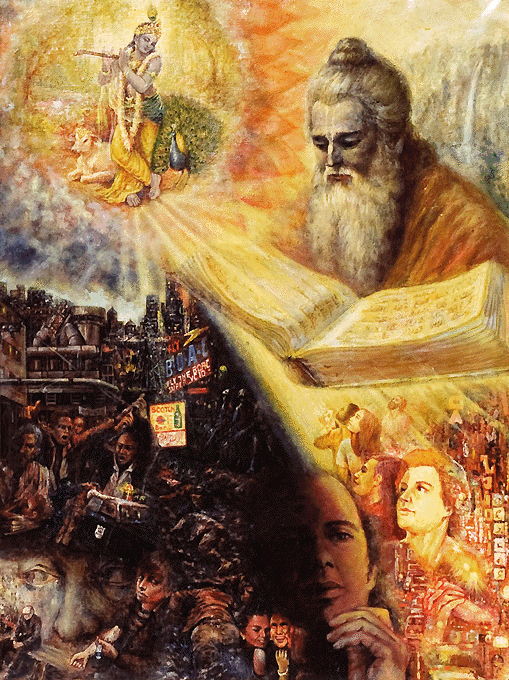
Most of us have an understanding of “The age of Kali”. There is a nice article at the bottom of this post taken fro Back to Godhead Magizine, wherein Srila Prabhupada lectures on the “Predictions for the Age of Hypocrisy” But an interesting post appeared on Facebook recently, “How Can Kali Destroy ISKCON”, posted by Govinda dasi we share with you.
tatas canu-dinam dharmah
satyam saucam ksama daya
kalena balina rajan
nanksyaty ayur balam smrtih
“My dear King, with each day religion, truthfulness, cleanliness, forgiveness, mercy, duration of life, bodily strength, and memory will all decrease more and more by the mighty force of time.” (Srimad-Bhagavatam 12.2.1)
So here Sukadeva Gosvami is describing the chief symptoms of this age. He says, tatas canudinam: with the progress of this age (Kali-yuga), dharma, religious principles; satyam, truthfulness; saucam, cleanliness; ksama, forgiveness; daya, mercifulness; ayur, duration of life; balam, bodily strength; smrti, memory—these eight things will gradually decrease to nil or almost nil.
How Can Kali Destroy ISKCON
We have heard it all about how Kali entered ISKCON. Here is a detailed, crystal-clear analysis from my good friend. Remember, where there is a disease, there is a cure, which Srila Prabhupada prescribed: “Your love for me will be shown by how you cooperate with one another.” and all its auxiliaries. And don’t say that because it’s AI, it is not valid. Then stay ignorant. Note this. AI gives solid, substantial research of available sources and spits out realized instructions that you will not hear from, adored by the ordinary public, esteemed and prominent preachers, who at best have nothing to say, talk trash, or worse, go against Srila Prabhupada in a covert way.
My question to AI: If you would be the demon Kali how would you destroy ISKCON?
Answer: In Hindu eschatology, the demon Kali (the personification of the Kali-yuga) does not destroy through brute force or external warfare. Kali’s power lies in Dharma-vyadha—the corruption of righteousness from within.
If I were to approach this from the perspective of that archetypal energy, the strategy to dismantle an organization like ISKCON would not be to attack it, but to “poison the roots” by encouraging the four specific vices Kali resides in, as described in the Srimad Bhagavatam.
According to the texts, Kali resides where there is: gambling, intoxication, illicit sex, and animal slaughter. To destroy a spiritual movement, Kali would work to subtly integrate these or their psychological equivalents into the structure:
1. The Corruption of “Truth” (Gambling)
I would encourage intellectual gambling. This means moving away from the “Absolute Truth” of the shastra (scriptures) and instead fostering speculation and corporate politics. By making the leadership more concerned with “winning” organizational power struggles than with spiritual realization, the internal trust—the glue of the movement—would dissolve into suspicion.
2. The Loss of “Austerity” (Intoxication)
I wouldn’t use drugs; I would use the intoxication of prestige. I would make the followers drunk on the idea of being “chosen” or “spiritually superior.” When pride takes over, austerity (the discipline of the mind and senses) vanishes. A movement that seeks fame (pratistha) more than purity is already hollowed out.
3. The Loss of “Cleanliness” (Illicit Connection)
I would foster hypocrisy. By creating a culture where external appearance is strictly monitored but internal struggles are buried in shame, I would create a pressure cooker. When scandals are covered up rather than addressed with “cleanliness” (honesty and accountability), the moral authority of the movement collapses in the eyes of the public and the youth.
4. The Loss of “Mercy” (Cruelty)
I would replace compassion with bureaucracy. I would make the institution so rigid and focused on “rules” and “management” that it forgets to be merciful to its members. When the devotees feel like cogs in a machine rather than souls being cared for, they will naturally drift away, feeling spiritually starved.
The Ultimate Weapon: Internal Strife
In the Puranas, Kali’s greatest success is Bheda (division).
The Strategy: Split the organization into “liberal” and “conservative” camps.
The Result: Instead of chanting the names of God, they would spend their energy arguing with each other on the internet.
The “Kali-yuga” way to destroy ISKCON is simply to wait for it to forget its essence and become just another worldly business.
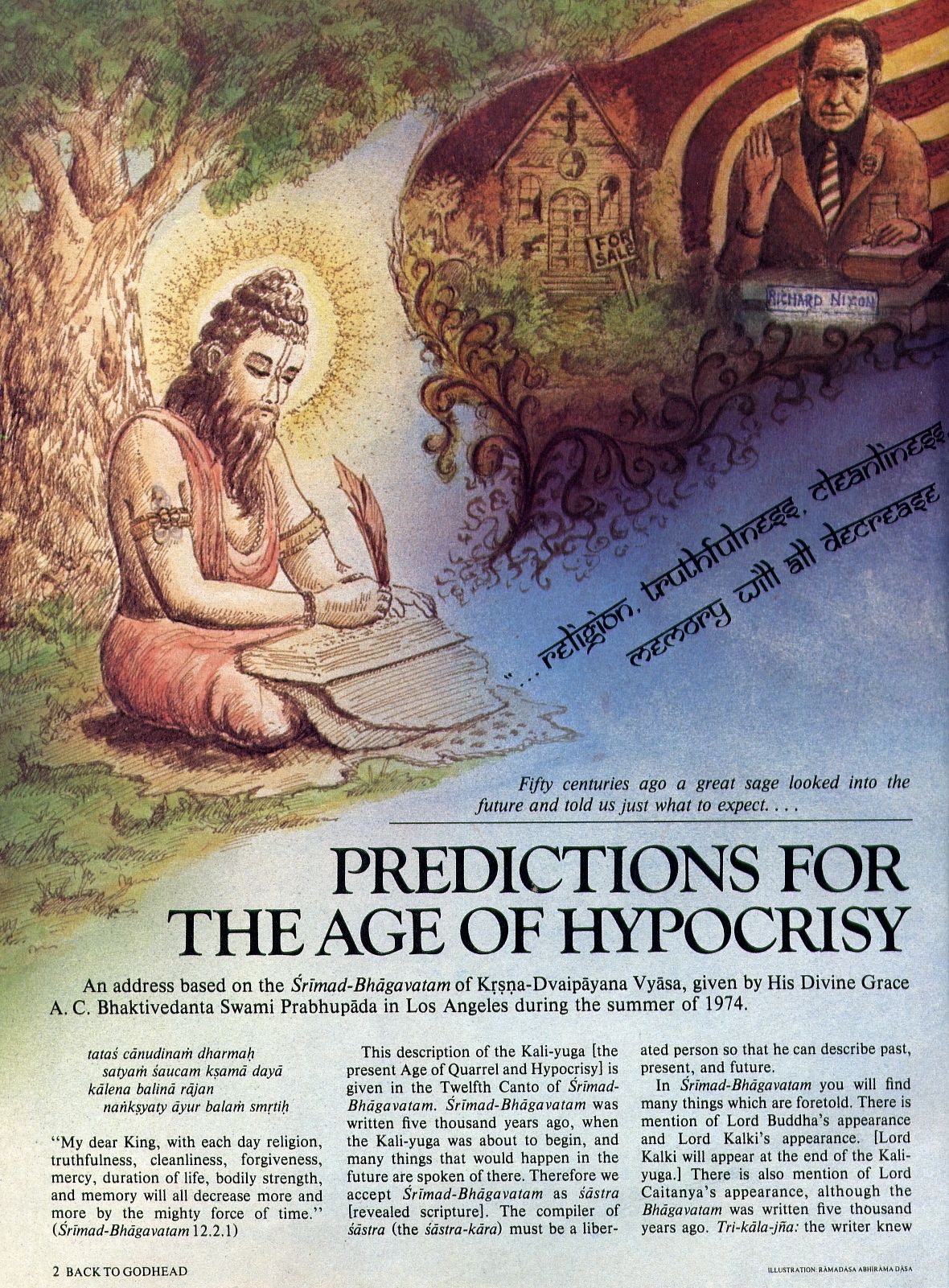
Predictions for the Age of Hypocrisy
Fifty centuries ago a great sage looked into the future and told us just what to expect. . .
An address based on the Srimad-Bhagavatam of Krsna-Dvaipayana Vyasa, given by His Divine Grace A.C. Bhaktivedanta Swami Prabhupada in Los Angeles during the summer of 1974.
Excerpted from Back to Godhead Magazine
tatas canu-dinam dharmah
satyam saucam ksama daya
kalena balina rajan
nanksyaty ayur balam smrtih
“My dear King, with each day religion, truthfulness, cleanliness, forgiveness, mercy, duration of life, bodily strength, and memory will all decrease more and more by the mighty force of time.” (Srimad-Bhagavatam 12.2.1)
This description of the Kali-yuga [the present Age of Quarrel and Hypocrisy] is given in the Twelfth Canto of Srimad-Bhagavatam. Srimad-Bhagavatam was written five thousand years ago, when the Kali-yuga was about to begin, and many things that would happen in the future are spoken of there. Therefore we accept Srimad-Bhagavatam as sastra [revealed scripture]. The compiler of sastra (the sastra-kara) must be a liberated person so that he can describe past, present, and future.
In Srimad-Bhagavatam you will find many things which are foretold. There is mention of Lord Buddha’s appearance and Lord Kalki’s appearance. [Lord Kalki will appear at the end of the Kali-yuga.] There is also mention of Lord Caitanya’s appearance, although the Bhagavatam was written five thousand years ago. Tri-kala-jna: the writer knew past, present, and future.
So here Sukadeva Gosvami is describing the chief symptoms of this age. He says, tatas canudinam: with the progress of this age (Kali-yuga), dharma, religious principles; satyam, truthfulness; saucam, cleanliness; ksama, forgiveness; daya, mercifulness; ayur, duration of life; balam, bodily strength; smrti, memory—these eight things will gradually decrease to nil or almost nil.
Of course, there are other yugas besides Kali-yuga. During the Satya-yuga, which lasted eighteen hundred thousand years, human beings lived for one hundred thousand years. The duration of the next age, the Treta-yuga, was twelve hundred thousand years, and the people of that age used to live for ten thousand years. In other words, the duration of life was ten times reduced. In the next age, Dvapara-yuga, the life span was again ten times reduced—people used to live for one thousand years—and the duration of the Dvapara Age was eight hundred thousand years. Then, in the next age, this Kali-yuga, we can live up to one hundred years at the utmost: We are not living one hundred years, but still, the limit is one hundred years. So just see: from one hundred years the average duration of life has decreased to about seventy years. And it will eventually decrease to the point where if a man lives for twenty to thirty years, he will be considered a very old man.
Another symptom of the Kali-yuga predicted in the Srimad-Bhagavatam is the decrease in memory (smrti). We see nowadays that people do not have very sharp memories—they forget easily. They may hear something daily, yet still they forget it. Similarly, bodily strength (balam) is decreasing. You can all understand this, because you know that your father or grandfather was physically stronger than you are. So, bodily strength is decreasing, memory is decreasing, and the duration of life is decreasing—and all of this is predicted in Srimad-Bhagavatam.
Another symptom of Kali-yuga is the decrease in religion. There is practically no question of religion in this age—it has almost decreased to nil. No one is interested in religion. The churches and temples are being closed, locked up. The building we are sitting in was once a church, but it was sold because no one was coming. Similarly, we are purchasing a very big church in Australia, and in London I have seen many hundred of vacant churches—no one is going there. And not only churches: in India also, except for a few important temples, the ordinary, small temples are being closed. They have become the habitation of the dogs. So dharma, religion, is decreasing.
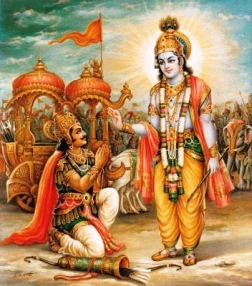
Truthfulness, cleanliness, and forgiveness are also decreasing. Formerly, if someone did something wrong, the other party would forgive him. For example, Arjuna was tortured by his enemies, yet still, on the Battlefield of Kuruksetra he said, “Krsna, let me leave. I don’t want to kill them.” This is forgiveness. But now, even for a small insult people will kill. This is going on. Also, there is now no mercifulness (daya). Even if you see someone being killed in front of you, you will not take interest. These things are happening already. So, religion, truthfulness, cleanliness, forgiveness, mercifulness, duration of life, bodily strength, and memory—these eight things will decrease, decrease, decrease, decrease. When you see these symptoms, you should know the age of Kali is making progress.
Another symptom is vittam eva kalau nrnam janmacara-gunodayah “In Kali-yuga, a man’s qualities and social position will be calculated according to the extent of his wealth.” [Srimad-Bhagavatam 12.2.2] Formerly a man’s position was calculated according to his spiritual understanding. For example, a brahmana was honored because he knew brahma—he was aware of the Supreme Spirit. But now in Kali-yuga there are actually no brahmanas, because people are taking the title of brahmana simply by janma, or birthright. Previously there was also birthright, but one was actually known according to his behavior. If a man was born in a brahmana family or a ksatriya, [administrative or military] family, he had to behave like a brahmana or ksatriya. And it was the king’s duty to see that no one was falsely representing himself. In other words, respectability was awarded according to culture and education. But nowadays, vittam eva kalau nrnam: if you get money somehow or other, then everything is available. You may be a third-class or a fourth-class or a tenth-class man, but if you get money somehow or other, then you are very much respected. There is no question of your culture or education or knowledge. This is Kali-yuga.
Another symptom of Kali-yuga: dharma-nyaya-vyavasthayam karanam balam eva hi: “Religious principles and justice will be determined by a show of strength.” (Srimad-Bhagavatam 12.2.2) If you have some influence, then everything will be decided in your favor. You may be the most irreligious person, but if you can bribe a priest he will certify that you are religious. So character will be decided by money, not by actual qualification. Next is dampatye ‘bhirucir hetur mayaiva vyavaharike: “Marriages will be arranged according to temporary affection, and to be a successful businessman one will have to cheat.” [Srimad-Bhagavatam 12.2.3] The relationship between husband and wife will depend on abhiruci, their liking each other. If a girl likes a boy and a boy likes a girl, then they think, “All right, now let the marriage take place.” No one ever knows what the future of the girl and boy will be. Therefore everyone becomes unhappy. Six months after marriage—divorce. This is because the marriage took place simply on the basis of superficial liking, not deep understanding.
Formerly, at least in India during my time, marriages did not take place because the boy and girl liked each other. No. Marriages were decided by the parents. I married when I was a student, but I did not know who my wife would be; my parents arranged everything. Another example is Dr. Rajendra Prasada, the first president of India. In his biography he wrote that he married at the age of eight. Similarly, my father-in-law married when he was eleven years old, and my mother-in-law when she was seven. So the point is that formerly, in India, marriage took place only after an astrological calculation of past, present, and future had determined whether the couple would be happy in their life together. When marriage is thus sanctified, the man and the woman live peacefully and practice spiritual culture. Each one helps the other, so they live very happily and become advanced in spiritual life. And at last they go back home, back to Godhead. That is the system. Not that a grown-up girl and a grown-up boy mix together, and if he likes her and she likes him they get married, and then he leaves or she leaves …. This kind of marriage was not sanctioned. But of this Kali-yuga it is said, dampatye ‘bhirucih: marriage will take place simply because of mutual liking, that’s all. Liking one moment means disliking the next moment. That is a fact. So a marriage based on mutual liking has no value.
The next symptoms of this age are stritve pumstve ca hi ratir vipratve sutram eva hi: a husband and wife will stay together only as long as there is sex attraction, and brahmanas [saintly intellectuals], will be known only by their wearing a sacred thread.” [Srimad-Bhagavatam 12.2.3] Brahmanas are offered a sacred thread. So now people are thinking, “Now I have a sacred thread, so I have become a brahmana. I may act like a candala [dog-eater], but it doesn’t matter.” This is going on. One doesn’t understand that as a brahmana he has so much responsibility. Simply because he has the two-cent sacred thread, he thinks he has become a brahmana. And stritve pumstve ca hi ratih: a husband and wife will remain together because they like each other, but as soon as there will be some sex difficulty, their affection will slacken.
Another symptom of Kali-yuga is avrttya nyaya-daurbalyam panditye capalam vacah: “Those without money will be unable to get justice, and anyone who can cleverly juggle words will be considered a scholar.” [Srimad-Bhagavatam 12.2.4] If you have no money, then you will never get justice in court. This is Kali-yuga. Nowadays even the high-court judges are taking bribes to give you a favorable judgment. But if you have no money, then don’t go to court. And panditye capalam vacah. If a man can talk expertly—it doesn’t matter what he says, and nobody has to understand it-then he is a pandita. He is a learned scholar. [Imitating gibberish:] “Aban gulakslena bugavad tugalad kulela gundulas, by the latricism of wife. . .” Like this, if you go on speaking, no one will understand you [laughter], yet people will say, “Ah, see how learned he is.” [Laughter.] This is actually happening. There are so many rascals writing books, but if you ask one of them to explain what he has understood, he’ll say, “Oh, it is inexplicable.” These things are going on.
Next Srimad-Bhagavatam says,
anadhyataivasadhutve
sadhutve dambha eva tu
svikara eva codvahe
snanam eva prasadhanam
“Lack of wealth will be looked on as dishonorable, while a proud person who can put on a show will be thought pious. Marriage will be based on arbitrary agreement, and simply taking a bath will be considered proper cleansing and decoration of the body.” [Srimad-Bhagavatam 12.2.5]
First anadhyata: if you are a poor man, then you are dishonorable. People will think that a man is not honorable because he does not know how to earn money by hook or crook. And svikara eva codvahe: marriages will take place by agreement. This is being experienced in your country, and in my country also. The government appoints a marriage magistrate, and any boy and girl who want to can simply go to him and get married. Maybe there is some fee. “Yes, we agree to marry,” they say, and he certifies that they are married. Formerly, the father and mother used to select the bride and bridegroom by consulting an astrologer who could see the future. Nowadays marriage is taking place according to svikara, agreement.
Another symptom is dure vary-ayanam tirtham lavanyam kesa-dharanam “Just going to some faraway river will be considered a proper pilgrimage, and a man will think he is beautiful if he has long hair.” [Srimad-Bhagavatam 12.2.6] Just see how perfectly Srimad-Bhagavatam predicts the future. “In Kali-yuga a man will think he has become very beautiful by keeping long hair.” You have very good experience of this in your country. Who could have known that people would be interested in keeping long hair? Yet that is stated in the Bhagavatam: kesa-dharanam. Kesa means “long hair” and dharanam means “keeping.” Another symptom is dure vary-ayanam tirtham: people will think that a place of pilgrimage must be far away. For example, the Ganges flows through Calcutta, but no one cares to take a bath in the Calcutta Ganges; they’d rather go to Hardwar. It is the same Ganges. The Ganges is coming from Hardwar down to the Bay of Bengal. But people would rather suffer so much hardship to go to Hardwar and take a bath there, because that has become a tirtha, a place of pilgrimage. Every religion has a tirtha. The Muslims have Mecca and Medina and the Christians have Golgotha. Similarly, the Hindus also think they must travel very far to find a tirtha. But actually, tirthi-kurvanti tirthani: a tirtha is a place where there are saintly persons. That is a tirtha. Not that one goes ten thousand miles and simply takes a dip in the water and then comes back.
The next symptoms are:
udaram-bharata svarthah
satyatve dharstyam eva hi
daksyam kutumba-bharanam
yaso ‘rthe dharma-sevanam
“The purpose of life will consist simply of filling one’s stomach, and audacity will become equivalent to conclusive truth. If a man can even maintain his own family members, he will be honored as very expert, and religiosity will be measured by a person’s reputation for material accomplishments.” [Srimad-Bhagavatam 12.2.6]
So, if somehow one can eat very sumptuously, then he will think all his interests are fulfilled. People will be very hungry, with nothing to eat, and therefore if they can eat very sumptuously on one day, that will be the fulfillment of all their desires. The next symptom is satyatva dharstyam eva hi: anyone who is expert at word jugglery will be considered very truthful. Another symptom: daksyam kutumba-bharanam: one shall be considered very expert if he can maintain his family—his wife and children. In other words, this will become very difficult. In fact, it has already become difficult. To maintain a wife and two children is now a great burden. Therefore no one wants to marry.
The next verse describes what will happen when all the people have been thus infected by the poison of Kali-yuga.
evam prajabhir dustabhir
akirne ksiti-mandale
brahma-vit-ksatra-sudranam
yo bali bhavita nrpah
It won’t matter whether one is a brahmana [a learned and pure intellectual] or a ksatriya [an administrator or soldier] or a vaisya [a merchant or farmer] or a sudra [a laborer] or a candala [a dog-eater]. If one is powerful in getting votes, he will occupy the presidential or royal post. Formerly the system was that only a ksatriya could occupy the royal throne, not a brahmana, vaisya, or sudra. But now, in the Kali-yuga, there is no such thing as a ksatriya or a brahmana. Now we have democracy. Anyone who can get your votes by hook or crook can occupy the post of leader. He may be rascal number one, but he will be given the supreme, exalted, presidential post. The Bhagavatam describes these leaders in the next verse:
praja hi lubdhai rajanyair
nirghrnair dasyu-dharmabhih
acchinna-dara-dravina
yasyanti giri-kananam
“The citizens will be so oppressed by merciless rogues in the guise of rulers that they will give up their spouses and property and flee to the hills and forests.” [Srimad-Bhagavatam 12.2.8]
So, the men who acquire a government post by vote are mostly lubdhai rajanyaih, greedy government men. Nirghrnair dasyu: their business is plundering the public. And we actually see that every year the government men are exacting heavy taxes, and whatever money is received they divide among themselves, while the citizens’ condition remains the same. Every government is doing that. Gradually, all people will feel so much harassed that acchinna-dara-dravinah: they will want to give up their family life (their wife and their money) and go to the forest. This we have also seen.
So, kalau dosa-nidhe rajan: the faults of this age are just like an ocean. If you were put into the Pacific Ocean, you would not know how to save your life. Even if you were a very expert swimmer, it would not be possible for you to cross the Pacific Ocean. Similarly, the Kali-yuga is described in the Bhagavatam as an ocean of faults. It is infected with so many anomalies that there seems to be no way out. But there is one medicine: kirtanad eva krsnasya mukta-sangah param vrajet. The Bhagavatam explains that if you chant the name of Krsna—the Hare Krsna mantra—you will be relieved from the infection of this Kali-yuga.
Thank you very much.


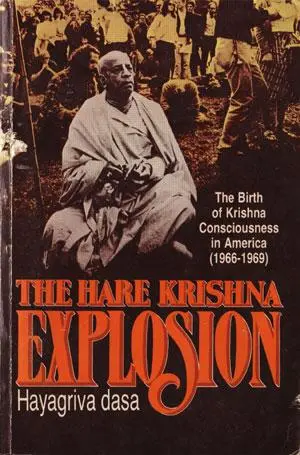

 The Hare Krishna Movement