
So we are continuing our series on the five types of relationships (rasa’s) with the Lord. Today we are exploring the Fraternal Devotional stage of Love of God (Sakhya-rasa) as explained in chapter 41 of “The Nectar of Devotion”. Also included in todays post are some select verses from the Bhagavad-gita describing Arjuna’s friendship with Krishna.
When a devotee is permanently situated in devotional service, and by different symptoms of ecstasy he has developed and matured a fraternal mellow or flavor in relationship with the Personality of Godhead, his feeling is called fraternal love of Godhead.
The impetus for such fraternal love of God is God Himself. When one is liberated and discovers his eternal relationship with the Supreme Lord, the Lord Himself becomes the impetus for increasing fraternal love. The eternal associates of the Lord in Vrindavan have described this as follows: “The Lord, Hari, whose bodily hue is like the indranīla jewel, whose smiling is as beautiful as the kunda flower, whose silk dress is as yellow as golden autumn foliage, whose chest is beautified with garlands of flowers and who is always playing upon His flute-this enemy of the Agha demon is always attracting our hearts by wandering about Vrindavan.”
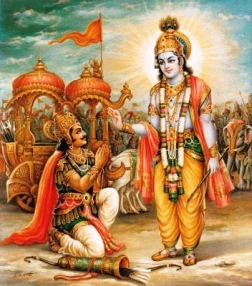
There are similar statements of fraternal love expressed outside the jurisdiction of Vrindavan. When the sons of Pandu, headed by Mahārāj Yudhisthira, saw Krishna in His four handed form on the battlefield of Kuruksetra, holding His conchshell, disc, club and lotus flower, they completely forgot themselves and became merged in the ocean of nectarean happiness. This shows how the sons of Pandu-King Yudhisthira, Bhima, Arjuna, Nakula and Sahadeva-were all caught up in fraternal love for Krishna.
From the Bhagavad-gita we are reminded of Arjuna’s friendship with Krishna.
I have in the past addressed You as “O Kṛṣṇa,” “O Yādava,” “O my friend,” without knowing Your glories. Please forgive whatever I may have done in madness or in love. I have dishonored You many times while relaxing or while lying on the same bed or eating together, sometimes alone and sometimes in front of many friends. Please excuse me for all my offenses. (Bg 11. 41-42)
PURPORT
Although Kṛṣṇa is manifested before Arjuna in His universal form, Arjuna remembers his friendly relationship with Kṛṣṇa and is therefore asking pardon and requesting Him to excuse him for the many informal gestures which arise out of friendship. He is admitting that formerly he did not know that Kṛṣṇa could assume such a universal form, although He explained it as his intimate friend. Arjuna did not know how many times he may have dishonored Him by addressing Him as “O my friend, O Kṛṣṇa, O Yādava,” etc., without acknowledging His opulence. But Kṛṣṇa is so kind and merciful that in spite of such opulence He played with Arjuna as a friend. Such is the transcendental loving reciprocation between the devotee and the Lord. The relationship between the living entity and Kṛṣṇa is fixed eternally; it cannot be forgotten, as we can see from the behavior of Arjuna. Although Arjuna has seen the opulence in the universal form, he could not forget his friendly relationship with Kṛṣṇa.
You are the Supreme Lord, to be worshiped by every living being. Thus I fall down to offer You my respects and ask Your mercy. Please tolerate the wrongs that I may have done to You and bear with me as a father with his son, or a friend with his friend, or a lover with his beloved.
PURPORT
Kṛṣṇa’s devotees relate to Kṛṣṇa in various relationships; one might treat Kṛṣṇa as a son, one might treat Kṛṣṇa as a husband, as a friend, as a master, etc. Kṛṣṇa and Arjuna are related in friendship. As the father tolerates, or the husband or master tolerates, so Kṛṣṇa tolerates. (Bg 11. 44)
Sometimes the different names, forms, paraphernalia and transcendental qualities provoke fraternal love: For instance, Kṛṣṇa’s nice dress, the all-auspicious symptoms on His body, His strongly-built body, His knowledge of different languages, His learned teachings in the Bhagavad-gita, His uncommon genius in all fields of endeavor, His exhibition of expert knowledge, His mercy, His chivalry, His behavior as a conjugal lover, His intelligence, His forgiveness, His attraction for all kinds of men, His opulence and His happiness-all provoke fraternal love.
In the Śrīmad-Bhagavatam, Tenth Canto, 12th Chapter, 10th verse, Śukadeva Gosvāmī tells King Pariksit: “My dear King, Krishna is the Supreme Personality of Godhead to the learned transcendentalist, He is the supreme happiness for the impersonalist, He is the supreme worshipable Deity for the devotee, and He is just like an ordinary boy to one who is under the spell of maya. And just imagine-these cowherd boys are now playing with the Supreme Person as though they are on an equal level! By this anyone can understand that these boys must have accumulated heaps of the results of pious activities to enable them to associate with the Supreme Personality of Godhead in such intimate friendship.”
Amongst the groups of different friends of Krishna, some are well-known from various scriptures, and some are well-known by popular tradition. There are three divisions amongst Kṛṣṇa’s friends: some are eternally in friendship with Krishna, some are elevated demigods, and some are perfected devotees. In all of these groups there are some who by nature are fixed in Kṛṣṇa’s service and are always engaged in giving counsel; some of them are very fond of joking and naturally cause Krishna to smile by their words; some of them are by nature very simple, and by their simplicity they please Lord Krishna; some of them create wonderful situations by their activities, apparently against Krishna; some of them are very talkative, always arguing with Krishna and creating a debating atmosphere; and some of them are very gentle and give pleasure to Krishna by their sweet words. All of these friends are very intimate with Krishna, and they show expertise in their different activities, their aim always being to please Krishna.



 The Hare Krishna Movement