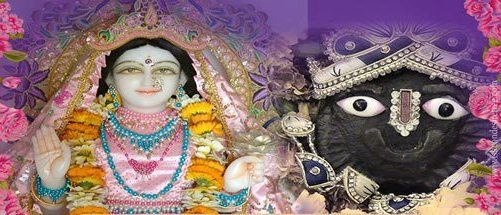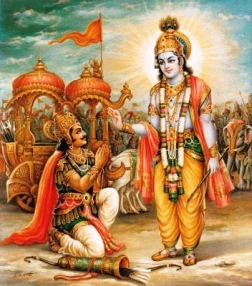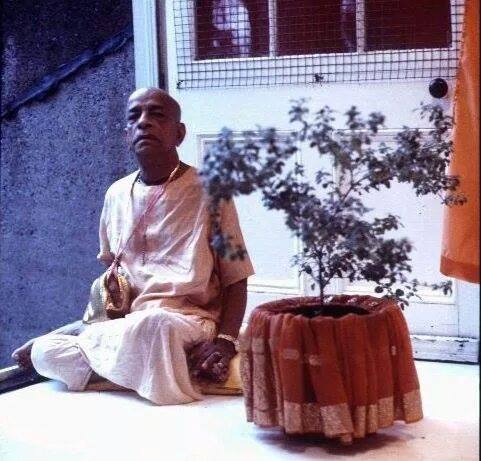
Prabhupada: Tulasi Devi is a pure devotee of Krishna and she should be treated with the same respect given to all Krishna’s pure devotees. Simply by worshiping her faithfully, a devotee can get himself free of from all material miseries. In the Nectar of Devotion I have given two verses from the Skanda Purana, one of which is: “Tulasi is auspicious in all respects. Simply by seeing, simply by touching, simply by remembering, simply by praying to, simply by bowing before, simply by hearing about, or simply by sowing the tree, there is always auspiciousness. Anyone who comes in touch with the Tulasi tree in the above mentioned ways lives eternally in the Vaikuntha world.” So from this verse we can understand how pure is the service which Tulasi offers to Sri Krishna. So we should always endeavor after becoming servant of Tulasi Devi. I do not know who has taught you that part of a Tulasi plant may be cut off and then replanted? From the Tulasi plant you can cut off only leaves for offering them to Krishna, never for cutting and planting. That is an offense. The manjaris (seeds) can be offered in water and it makes the water fragrant and tasteful. And the manjaris can be planted for growing new Tulasi plants. Yes, the prayer you have enclosed is bona fide. Tulasi Devi never goes back to Godhead, she is always with Godhead. She is a pure devotee and thus she has appeared on this planet to render service to Krishna by being offered in all temples throughout the world by being offered up to the lotus feet of Krishna. ( Letter to: Radhavallabha — Bombay 6 January, 1972)
Tulasi Devi
14 Oct 2023 Leave a comment
in A. C. Bhaktivedanta Swami Prabhupada, Tulasi Tags: letter by Srila Prabhupada, manjaris, pure devotee, Tulasi, Tulasi devi, tulasi plants
Srimati Tulasi devi (praṇāmas) Prayers
16 Jan 2014 Leave a comment
in Sri Tulasi Pranama, Srimati Tulasi Devi, Tulasi Tags: auspiciousness, devotional service to tulasi, Lord Kesava, namo namah tulasi krsna preyasi nomo mamah, o goddess, Spiritual world, Sri Tulasi devi, Srila Prabhupada, Srimati Tulasi Devi, Tulasi, tulasi is all auspicious, tulasi tree, Vrnda, vrndayai tulasi devyai, you bestow devotional service to Krsna
“Tulasi is auspicious in all respects. Simply by seeing, simply by touching, simply by remembering, simply by praying to, simply by bowing before, simply by hearing about, or simply by sowing this tree, there is always auspiciousness. Anyone who comes in touch with the Tulasi tree in the above mentioned ways lives eternally in the spiritual world.” (—Srila Prabhupada, The Nectar of Devotion)
Śrī Tulasī-praṇāma
(oṁ) vṛndāyai tulasī-devyai priyāyai keśavasya ca
kṛṣṇa-bhakti-prade devi satyavatyai namo namaḥ
I offer my repeated obeisances unto Vṛndā, Śrīmatī Tulasī-devī, who is very dear to Lord Keśava.
O goddess, you bestow devotional service to Kṛṣṇa and you possess the highest truth.
The Rivers Ganges and Yamuna
24 Jun 2013 Leave a comment
in A.C. Bhaktivedanta Swami Prabhupada, Ganges, Srimad Bhagavatam Tags: A.C. Bhaktivedanta Swami Prabhupada, amartya, baby Krsna, Ganges, Ganges River, Gokula, Krsna's lotus feet, sacred rivers, sanctified, SB 1.19.6, Srimad Bhagavatam, transcendental, Tulasi, tulasi leaves, Yamuna, Yamuna river
click on image to enlarge
…Both the Ganges and the Yamunā are amartyā (transcendental) rivers, but the Yamunā is still more sanctified for the following reasons.
…And as far as sanctity is concerned, the River Yamunā is more directly connected with Lord Kṛṣṇa than the Ganges. The Lord sanctified the River Yamunā from the beginning of His transcendental pastimes in the world. While His father Vasudeva was crossing the Yamunā with the baby Lord Kṛṣṇa for a safe place at Gokula on the other bank of the river from Mathurā, the Lord fell down in the river, and by the dust of His lotus feet the river at once became sanctified. It is especially mentioned herein that Mahārāja Parīkṣit took shelter of that particular river which is beautifully flowing, carrying the dust of the lotus feet of Lord Kṛṣṇa, mixed with tulasī leaves. Lord Kṛṣṇa’s lotus feet are always besmeared with the tulasī leaves, and thus as soon as His lotus feet contact the water of the Ganges and the Yamunā, the rivers become at once sanctified. The Lord, however, contacted the River Yamunā more than the Ganges. (from purport to SB 1.19.6)
Full verse and purport More
Marriage of Shalagrama and Tulasi
27 Nov 2012 Leave a comment
in Festivals, Srimati Tulasi Devi, Tulasi-saligram Vivaha Tags: festivals, Lakshmi-Narayana, mandapa, marriage of Shalagrama and Tulasi, Narada-pancaratra, Saligram, Sri Padmanabha gosai, Tulasi, Tulasi-Saligram Vivaha, Veda, yajna-kunda
Marriage of Shalagrama and Tulasi
(Tulasi-Saligram Vivaha)
Written by Sri Padmanabha Gosai
Shri Vasishthaji said that what I have heard in ancient times from Lord Brahma about the marriage of Tulasi I will now describe according to what is written in the Narada-pancaratra. First one should plant Tulasi either in the house or the forest, and after three years one may perform her marriage. The auspicious times when one may perform the marriage of Shalagrama and Tulasi are described as follows. When the sun is moving in the north, Jupiter and Venus are rising, in the month of Kartika, from the Ekadashi to the full moon in the month of Magha, and when constellations that are auspicious for marriage appear, especially the full moon day. – First one should arrange a place for sacrifice (yajna-kunda) under a canopy (mandapa). Then after performing shanti-vidhana, one should install sixteen goddesses, and do the shraddha ceremony for his female maternal ancestors.
Mother Ganges
16 Jul 2012 Leave a comment
in Ganges, Holy Places of Pilgrimage Tags: bhagavad-gita, Ganges, ganges river ganges, Holy places of pilgrimage, mother ganges, places of pilgrimage, pure devotees, sinful reactions, Srila Prabhupada, Tulasi
Some selected quotes on the river Ganges
Mother Ganges is worshiped by the water of the Ganges: a devotee takes a little water from the Ganges and offers it back to the Ganges. When the devotee takes the water, mother Ganges does not lose anything, and when the water is offered back, mother Ganges does not increase, but in this way the worshiper of the Ganges is benefited. Similarly, a devotee of the Lord offers the Lord patraṁ puṣpaṁ phalaṁ toyam—a leaf, flower, fruit or water—in great devotion, but everything, including the leaf, flower, fruit and water, belongs to the Lord, and therefore there is nothing to renounce or to accept. One must simply take advantage of the bhakti process because by following this process one does not lose anything but one gains the favor of the Supreme Person. (SB 9.9.12)
When there was a meeting of great sages at Naimiṣāraṇya, Sūta Gosvāmī was reciting Śrīmad-Bhāgavatam, and the importance of the Ganges was stated as follows: “The waters of the Ganges are always carrying the flavor of tulasī offered at the lotus feet of Śrī Kṛṣṇa, and as such the waters of the Ganges are ever flowing, spreading the glories of Lord Kṛṣṇa. Wherever the waters of the Ganges are flowing, all will be sanctified, both externally and internally.” ( Nectar of Devotion Chapter 7)
The Eight Names of Vrinda-devi
10 Nov 2011 Leave a comment
in Songs of the Vaisnava Acaryas, Srimati Tulasi Devi Tags: Asta-nama--satva, Krishna-jivani, pushpasara, Tulasi, visvapujita, Vrinda-devi, vrindavani

Asta-Nama-Stava from the Padma Purana The Eight Names of Vrinda-devi
On the full moon-day of Kartik Lord Sri Krishna Himself worships Srimati Tulasi-devi with this Mantra.
Vrindavani, vrinda, visvapujita, pushpasara, nandini, Krishna-jivani, visva-pavani, tulasi
VRINDAVANI – One who first manifested in Vrindavan.
VRINDA – The goddess of all plant and trees ( even if one Tulasi plant is present in a forest it can be called Vrindavana.)
VISHVAPUJITA – One whom the whole universe worships.
PUSHPASARA – The topmost of all flowers, without whom Krishna does not like to look upon other flowers.
NANDINI – Seeing whom gives unlimited bliss to the devotees.
KRISHNA-JIVANI – The life of Sri Krishna.
VISHVA-PAVANI – One who purifies the three worlds.
TULASI – One who has no comparison.
Anyone while worshiping Tulasi-devi chants these eight names will get the same results as one who performs the Ashvamedha sacrifice. And one who on the full-moon day of Kartika (Tulasi-devi’s appearance day) worships Her with this Mantra will break free from the bonds of this miserable world of birth and death, and very quickly attains Goloka Vrndavan. On the full moon-day of Kartik Lord Sri Krishna Himself worships Srimati Tulasi-devi with this Mantra.
One who remembers this Mantra will very quickly attain devotion to Lord Krishna’s Transcendental Lotus Feet.
Pasted from; http://www.vrindavan-dham.com/vrinda/songs-prayers.php
The Importance of Srimati Tulasī
14 Sep 2011 Leave a comment
in Spiritual World, Srimati Tulasi Devi Tags: Spiritual world, Srimad Bhagavatam, Srimati Tulasi Devi, Tulasi, tulasi garlands, tulasi leaves
The most important thing about the spiritual world is that there is no envy among the devotees there. This is true even among the flowers, which are all conscious of the greatness of tulasī.
Although flowering plants like the mandāra, kunda, kurabaka, utpala, campaka, arṇa, punnāga, nāgakeśara, bakula, lily and pārijāta are full of transcendental fragrance, they are still conscious of the austerities performed by tulasī, for tulasī is given special preference by the Lord, who garlands Himself with tulasī leaves.
Purport
The importance of tulasī leaves is very clearly mentioned here. Tulasī plants and their leaves are very important in devotional service. Devotees are recommended to water the tulasī tree every day and collect the leaves to worship the Lord. One time an atheistic svāmī remarked, “What is the use of watering the tulasī plant? It is better to water eggplant. By watering the eggplant one can get some fruits, but what is the use of watering the tulasī?” These foolish creatures, unacquainted with devotional service, sometimes play havoc with the education of people in general.
The most important thing about the spiritual world is that there is no envy among the devotees there. This is true even among the flowers, which are all conscious of the greatness of tulasī. In the Vaikuṇṭha world entered by the four Kumāras, even the birds and flowers are conscious of service to the Lord. (Srimad Bhagavatam)
The Worship of Srimati Tulasi Devi
08 Jun 2011 Leave a comment
in A.C. Bhaktivedanta Swami Prabhupada, Nectar of Devotion, Srimati Tulasi Devi Tags: Aspects of Transcendental Service, Srila Prabhupada, Srimati Tulasi Devi, The Nectar of Devotion, Tulasi, Vrnda devi
The Worship of Srimati Tulasi Devi
Tulasi is auspicious in all respects. Simply by seeing, simply by touching, simply by remembering, simply by praying to, simply by bowing before, simply by hearing about or simply by sowing this tree, there is always auspiciousness. Anyone who comes in touch with the tulasi tree in the above-mentioned ways lives eternally in the Vaikuntha world.
The Nectar of Devotion 1970 Edition
Chapter 11 Aspects of Transcendental Service
By His Divine Grace A. C. Bhaktivedanta Swami Prabhupada
In the Skanda Purāṇa there is a statement eulogizing the tulasī tree as follows: “Let me offer my respectful obeisances unto the tulasī tree, which can immediately vanquish volumes of sinful activities. Simply by seeing or touching this tree one can become relieved from all distresses and diseases. Simply by offering obeisances to and pouring water on the tulasī tree, one can become freed from the fear of being sent to the court of Yamarāj [the King of death, who punishes the sinful]. If someone sows a tulasī tree somewhere, certainly he becomes devoted to Lord Kṛṣṇa. And when the tulasī leaves are offered in devotion at the lotus feet of Kṛṣṇa, there is the full development of love of Godhead.”
In India every Hindu, even those not belonging to the Vaiṣṇava group, take special care of the tulasī tree. Even in great cities where it is very difficult to keep a tulasī tree, people are to be found very carefully keeping this plant. They water it and offer obeisances to it, because worship of the tulasī tree is very important in devotional service.
In the Skanda Purāṇa there is another statement about tulasī, as follows: “Tulasī is auspicious in all respects. Simply by seeing, simply by touching, simply by remembering, simply by praying to, simply by bowing before, simply by hearing about or simply by sowing this tree, there is always auspiciousness. Anyone who comes in touch with the tulasī tree in the above-mentioned ways lives eternally in the Vaikuṇṭha world.”