click on image to enlarge
It is late at night and I was searching for some late night reading…The Teachings of Lord Caitanya was there on the shelf, so I opened it and began to read the Introduction. The Introduction was originally delivered by Srila Prabhupada as five morning lectures on Caitanya-caritāmṛta before the International Society for Krishna Consciousness, New York City, April 10–14, 1967. This is the conclusion of the Introduction and proved to be a good choice for late night reading and an early morning post.
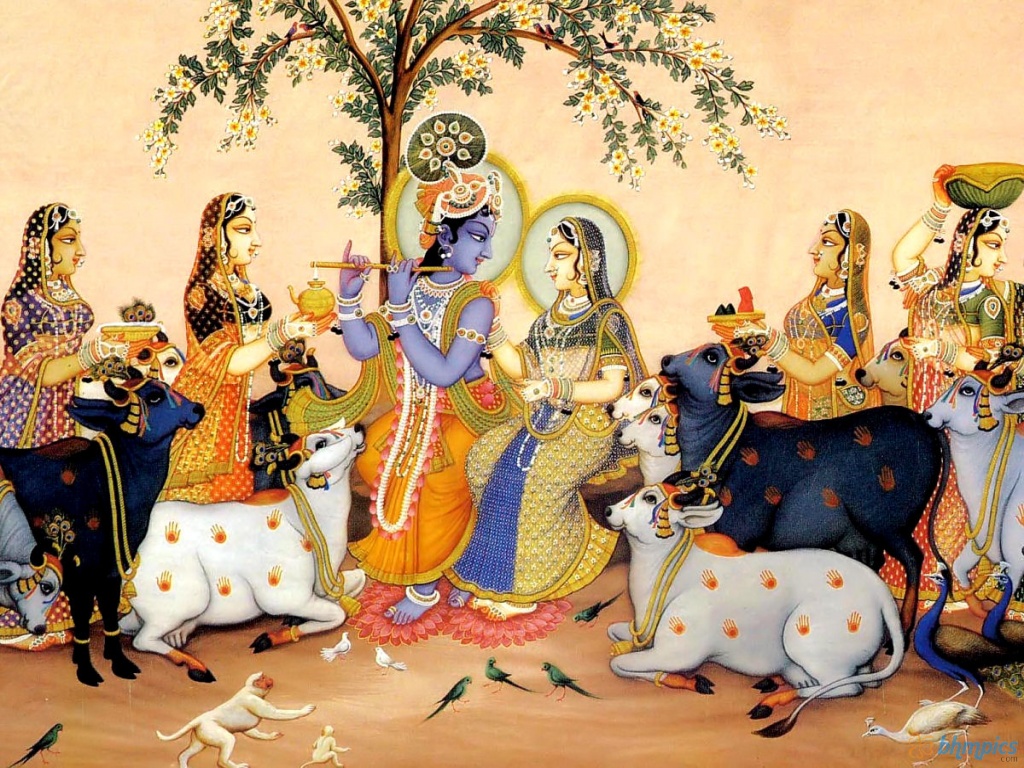
Kṛṣṇadāsa Kavirāja Gosvāmī petitions the blessings of Lord Gopīnātha: “May that Gopīnātha, the master of the gopīs, Kṛṣṇa, bless you. May you become blessed by Gopīnātha.” The author of the Caitanya-caritāmṛta prays that just as Kṛṣṇa attracted the gopīs by the sweet sound of His flute, He will also attract the reader’s mind by His transcendental vibration.
…Govinda resides eternally in Vṛndāvana. In the spiritual world of Vṛndāvana the buildings are made of touchstone, the cows are known as surabhi cows, givers of abundant milk, and the trees are known as wish-fulfilling trees, for they yield whatever one desires. In Vṛndāvana, Kṛṣṇa herds the surabhi cows, and He is worshiped by hundreds and thousands of gopīs, cowherd girls, who are all goddesses of fortune. When Kṛṣṇa descends to the material world, this same Vṛndāvana descends, just as an entourage accompanies an important personage. Because when Kṛṣṇa comes His land also comes, Vṛndāvana is not considered to exist in the material world. Therefore devotees take shelter of the Vṛndāvana in India, for it is considered to be a replica of the original Vṛndāvana. Although one may complain that no kalpa-vṛkṣa, wish-fulfilling trees, exist there, when the Gosvāmīs were there, kalpa-vṛkṣa were present. It is not that one can simply go to such a tree and make demands; one must first become a devotee. The Gosvāmīs would live under a tree for one night only, and the trees would satisfy all their desires. For the common man this may all seem very wonderful, but as one makes progress in devotional service, all this can be realized.





 The Hare Krishna Movement