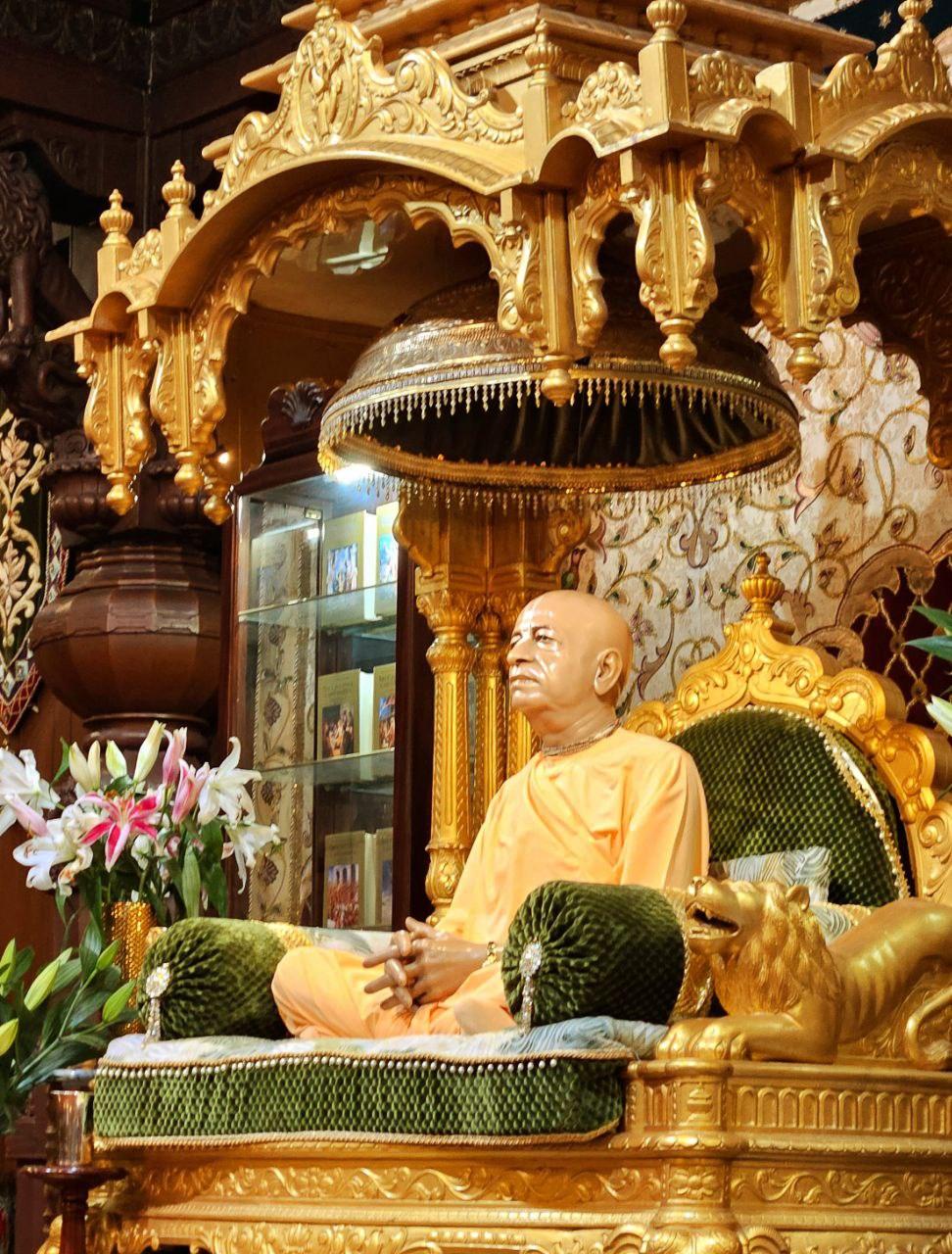
This morning I was reminded of something that I heard Srila Prabhupada say in a lecture. He was describing that Krishna Consciousness is very simple, you just need to do four things. Always think of Krishna, become His devotee, offer obeisances, and worship Him.
man-manā bhava mad-bhakto
mad-yājī māṁ namaskuru
mām evaiṣyasi yuktvaivam
ātmānaṁ mat-parāyaṇaḥ
mat-manāḥ—always thinking of Me; bhava—become; mat—My; bhaktaḥ—devotee; mat—My; yājī—worshiper; mām—unto Me; namaskuru—offer obeisances; mām—unto Me; eva—completely; eṣyasi—come; yuktvā evam—being absorbed; ātmānam—your soul; mat-parāyaṇaḥ—devoted to Me.
TRANSLATION
Engage your mind always in thinking of Me, offer obeisances and worship Me. Being completely absorbed in Me, surely you will come to Me. (Bhagavad-gita 9.34)
This verse is also repeated in the 16th Chapter:
man-manā bhava mad-bhakto
mad-yājī māṁ namaskuru
mām evaiṣyasi satyaṁ te
pratijāne priyo ’si me
man-manāḥ—thinking of Me; bhava—just become; mat-bhaktaḥ—My devotee; mat-yājī—My worshiper; mām—unto Me; namaskuru—offer your obeisances; mām—unto Me; eva—certainly; eṣyasi—come; satyam—truly; te—to you; pratijāne—I promise; prijaḥ—dear; asi—you are; me—My.
TRANSLATION
Always think of Me and become My devotee. Worship Me and offer your homage unto Me. Thus you will come to Me without fail. I promise you this because you are My very dear friend.
In this verse it is clearly indicated that Kṛṣṇa consciousness is the only means of being delivered from the clutches of this contaminated material world…Pure devotional service is the highest achievement of human society. (from purport)
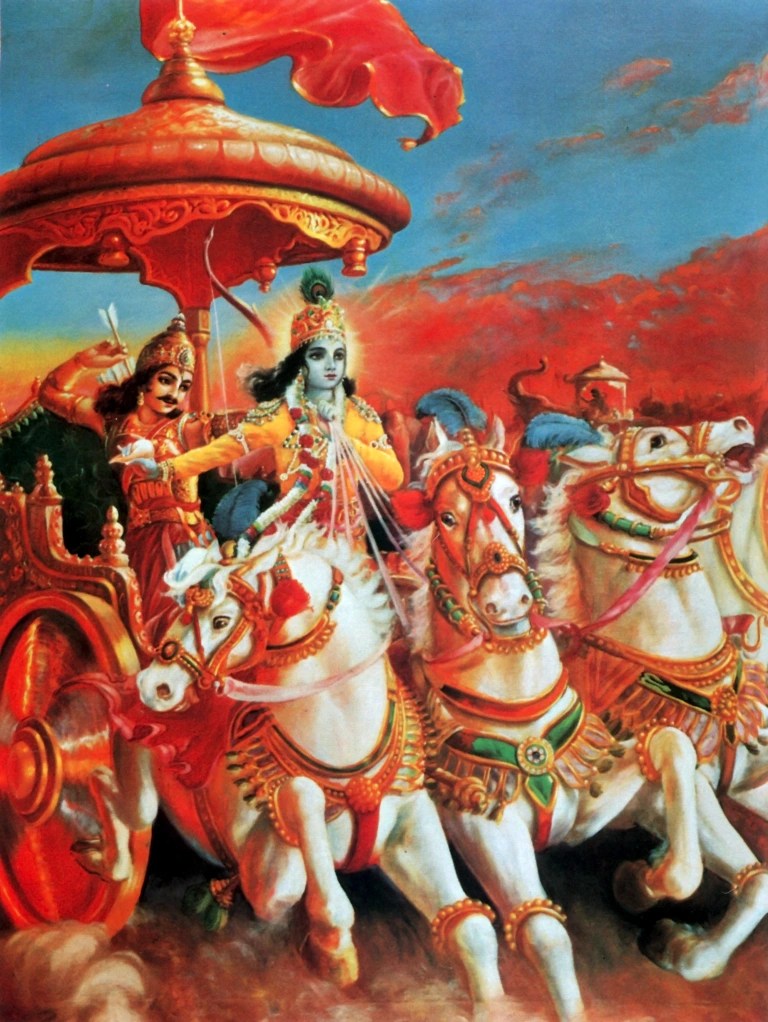
The most confidential part of knowledge is that one should become a pure devotee of Kṛṣṇa and always think of Him and act for Him. One should not become an official meditator. Life should be so molded that one will always have the chance to think of Kṛṣṇa. One should always act in such a way that all his daily activities are in connection with Kṛṣṇa. He should arrange his life in such a way that throughout the twenty-four hours he cannot but think of Kṛṣṇa. And the Lord’s promise is that anyone who is in such pure Kṛṣṇa consciousness will certainly return to the abode of Kṛṣṇa, where he will be engaged in the association of Kṛṣṇa face to face. This most confidential part of knowledge is spoken to Arjuna because he is the dear friend of Kṛṣṇa. Everyone who follows the path of Arjuna can become a dear friend to Kṛṣṇa and obtain the same perfection as Arjuna. (from purport)
These words stress that one should concentrate his mind upon Kṛṣṇa—the very form with two hands carrying a flute, the bluish boy with a beautiful face and peacock feathers in His hair. There are descriptions of Kṛṣṇa found in the Brahma-saṁhitā and other literatures. One should fix his mind on this original form of Godhead, Kṛṣṇa. He should not even divert his attention to other forms of the Lord. The Lord has multi-forms, as Viṣṇu, Nārāyaṇa, Rāma, Varāha, etc., but a devotee should concentrate his mind on the form that was present before Arjuna. Concentration of the mind on the form of Kṛṣṇa constitutes the most confidential part of knowledge, and this is disclosed to Arjuna because Arjuna is the most dear friend of Kṛṣṇa’s. (purport Bg. 16.65)
TEXT 66
sarva-dharmān parityajya
mām ekaṁ śaraṇaṁ vraja
ahaṁ tvāṁ sarva-pāpebhyo
mokṣayiṣyāmi mā śucaḥ
sarva-dharmān—all varieties of religion; parityajya—abandoning; mām—unto Me; ekam—only; śaraṇam—surrender; vraja—go; aham—I; tvām—you; sarva—all; pāpebhyaḥ—from sinful reactions; mokṣayiṣyāmi—deliver; mā—not; śucaḥ—worry.
TRANSLATION
Abandon all varieties of religion and just surrender unto Me. I shall deliver you from all sinful reaction. Do not fear.
PURPORT
The Lord has described various kinds of knowledge, processes of religion, knowledge of the Supreme Brahman, knowledge of the Supersoul, knowledge of the different types of orders and statuses of social life, knowledge of the renounced order of life, knowledge of nonattachment, sense and mind control, meditation, etc. He has described in so many ways different types of religion. Now, in summarizing Bhagavad-gītā, the Lord says that Arjuna should give up all the processes that have been explained to him; he should simply surrender to Kṛṣṇa. That surrender will save him from all kinds of sinful reactions, for the Lord personally promises to protect him.
In the Eighth Chapter it was said that only one who has become free from all sinful reactions can take to the worship of Lord Kṛṣṇa. Thus one may think that unless he is free from all sinful reactions he cannot take to the surrendering process. To such doubts it is here said that even if one is not free from all sinful reactions, simply by the process of surrendering to Śrī Kṛṣṇa he is automatically freed. There is no need of strenuous effort to free oneself from sinful reactions. One should unhesitatingly accept Kṛṣṇa as the supreme savior of all living entities. With faith and love, one should surrender unto Him.
According to the devotional process, one should simply accept such religious principles that will lead ultimately to the devotional service of the Lord. One may perform a particular occupational duty according to his position in the social order, but if by executing his duty one does not come to the point of Kṛṣṇa consciousness, all his activities are in vain.
Anything that does not lead to the perfectional stage of Kṛṣṇa consciousness should be avoided. One should be confident that in all circumstances Kṛṣṇa will protect him from all difficulties. There is no need of thinking how one should keep the body and soul together. Kṛṣṇa will see to that. One should always think himself helpless and should consider Kṛṣṇa the only basis for his progress in life. As soon as one seriously engages himself in devotional service to the Lord in full Kṛṣṇa consciousness, at once he becomes freed from all contamination of material nature. There are different processes of religion and purificatory processes by cultivation of knowledge, meditation in the mystic yoga system, etc., but one who surrenders unto Kṛṣṇa does not have to execute so many methods. That simple surrender unto Kṛṣṇa will save him from unnecessarily wasting time. One can thus make all progress at once and be freed from all sinful reaction.
One should be attracted by the beautiful vision of Kṛṣṇa. His name is Kṛṣṇa because He is all-attractive. One who becomes attracted by the beautiful, all-powerful, omnipotent vision of Kṛṣṇa is fortunate. There are different kinds of transcendentalists—some of them are attached to the impersonal Brahman vision, some of them are attracted by the Supersoul feature, etc., but one who is attracted to the personal feature of the Supreme Personality of Godhead, and, above all, one who is attracted by the Supreme Personality of Godhead as Kṛṣṇa Himself, is the most perfect transcendentalist. In other words, devotional service to Kṛṣṇa, in full consciousness, is the most confidential part of knowledge, and this is the essence of the whole Bhagavad-gītā. Karma-yogīs, empiric philosophers, mystics, and devotees are all called transcendentalists, but one who is a pure devotee is the best of all. The particular words used here, mā śucaḥ, “Don’t fear, don’t hesitate, don’t worry,” are very significant. One may be perplexed as to how one can give up all kinds of religious forms and simply surrender unto Kṛṣṇa, but such worry is useless.
Its so simple we can miss it.


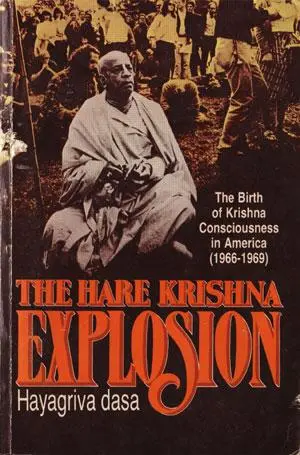

 The Hare Krishna Movement