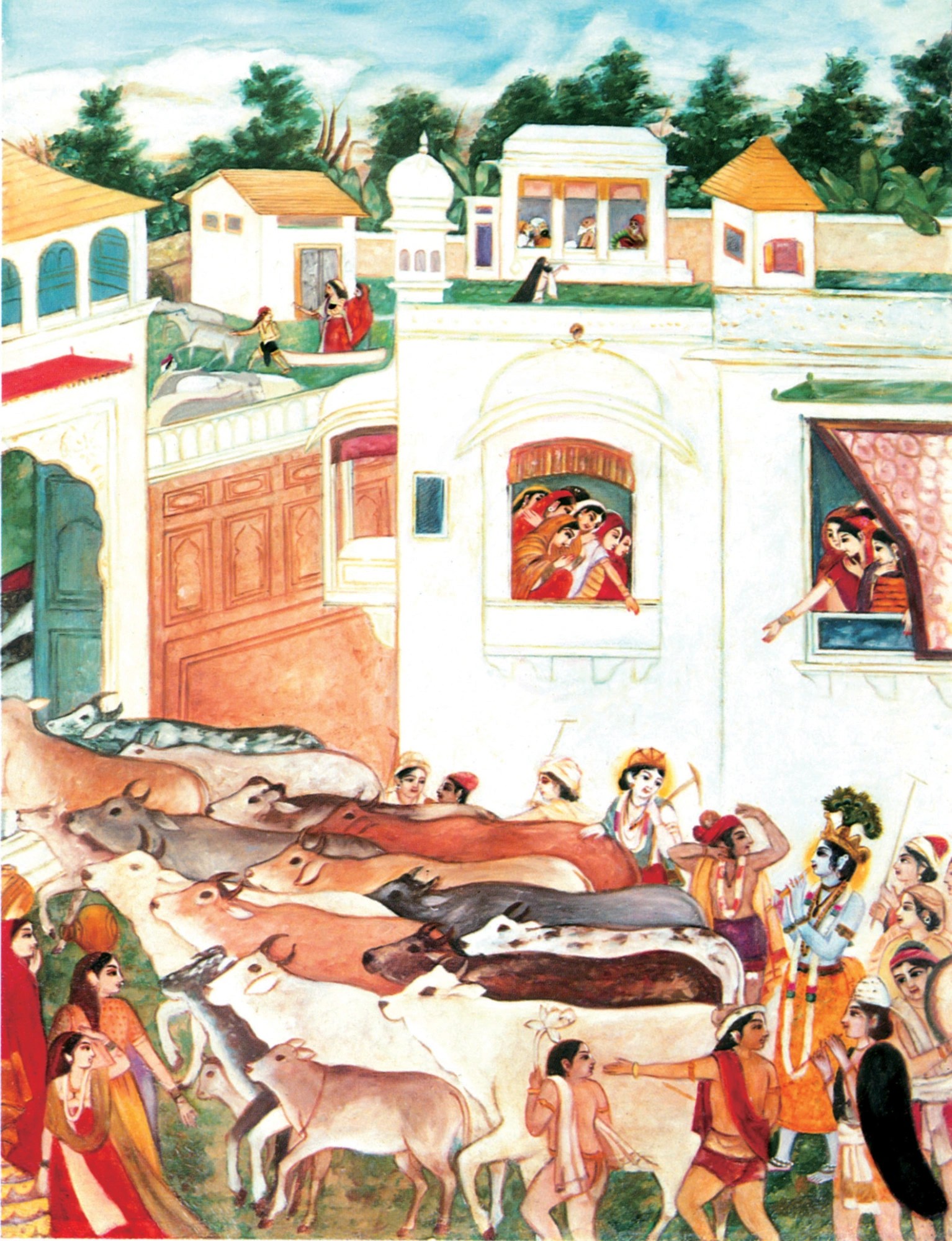
This morning I was thinking about the different relationships one can have with the Lord. In “The Nectar of Devotion”, Srila Prabhupada describes the five primary kinds of devotional service-namely, neutrality, servitude, fraternity, parenthood and conjugal love. Over the course of the next five posts, I want to explore these five primary relationships.
But for today, I want to start with this nice verse from the Bhagavad-gita, where these five types of relationships are mentioned in purport.
For one who remembers Me without deviation, I am easy to obtain, O son of Pṛthā, because of his constant engagement in devotional service. (Bg 8.14)
…Bhakti-yoga is very simple and pure and easy to perform. One can begin by simply chanting Hare Kṛṣṇa. Kṛṣṇa is very merciful to those who engage in His service, and He helps in various ways that devotee who is fully surrendered to Him so he can understand Him as He is. The Lord gives such a devotee sufficient intelligence so that ultimately the devotee can attain Him in His spiritual kingdom.
…Generally, the bhakti-yogīs are engaged in five different ways: 1) śānta-bhakta, engaged in devotional service in neutrality; 2) dāsya-bhakta, engaged in devotional service as servant; 3) sākhya-bhakta, engaged as friend; 4) vātsalya-bhakta, engaged as parent; and 5) mādhurya-bhakta, engaged as conjugal lover of the Supreme Lord. (from purport)
Full text and purport
Bhagavad-gita 8.14
ananya-cetāḥ satataṁ
yo māṁ smarati nityaśaḥ
tasyāhaṁ sulabhaḥ pārtha
nitya-yuktasya yoginaḥ
ananya-cetāḥ—without deviation; satatam—always; yaḥ—anyone; mām—Me (Kṛṣṇa); smarati—remembers; nityaśaḥ—regularly; tasya—to him; aham—I am; sulabhaḥ—very easy to achieve; pārtha—O son of Pṛthā; nitya—regularly; yuktasya—engaged; yoginaḥ—of the devotee.
TRANSLATION
For one who remembers Me without deviation, I am easy to obtain, O son of Pṛthā, because of his constant engagement in devotional service.
PURPORT
ln this verse the bhakti-yoga of the unalloyed devotees of the Supreme Godhead is described. The preceeding verses mention four different kinds of devotees—the distressed, the inquisitive, those who seek material gain, and the speculative philosophers. Different processes of liberation from material entanglement have also been described: karma-yoga, jñāna-yoga, and haṭha-yoga. But here bhakti-yoga, without any mixture of these, is mentioned. In bhakti-yoga the devotees desire nothing but Kṛṣṇa. The pure bhakti devotee does not desire promotion to heavenly planets, nor does he seek salvation or liberation from material entanglement. A pure devotee does not desire anything. In the Caitanya-caritāmṛta the pure devotee is called niṣkāma, which means he has no desire for self-interest. Perfect peace belongs to him alone, not to them who strive for personal gain. The pure devotee only wants to please the Supreme Lord, and so the Lord says that for anyone who is unflinchingly devoted to Him, He is easy to attain. The devotee can render service to any of the transcendental forms of the Supreme Lord, and he meets with none of the problems that plague the practitioners of other yogas. Bhakti-yoga is very simple and pure and easy to perform. One can begin by simply chanting Hare Kṛṣṇa. Kṛṣṇa is very merciful to those who engage in His service, and He helps in various ways that devotee who is fully surrendered to Him so he can understand Him as He is. The Lord gives such a devotee sufficient intelligence so that ultimately the devotee can attain Him in His spiritual kingdom.
The special qualification of the pure devotee is that he is always thinking of Kṛṣṇa without considering the time or place. There should be no impediments. He should be able to carry out his service anywhere and at any time. Some say that the devotee should remain in holy places like Vṛndāvana or some holy town where the Lord lived, but a pure devotee can live anywhere and create the atmosphere of Vṛndāvana by his devotional service. It was Śrī Advaita who told Lord Caitanya, “Wherever You are, O Lord—there is Vṛndavana.”
A pure devotee constantly remembers Kṛṣṇa and meditates upon Him. These are qualifications of the pure devotee for whom the Lord is most easily attainable. Bhakti-yoga is the system that the Gītā recommends above all others. Generally, the bhakti-yogīs are engaged in five different ways: 1) śānta-bhakta, engaged in devotional service in neutrality; 2) dāsya-bhakta, engaged in devotional service as servant; 3) sākhya-bhakta, engaged as friend; 4) vātsalya-bhakta, engaged as parent; and 5) mādhurya-bhakta, engaged as conjugal lover of the Supreme Lord. In any of these ways, the pure devotee is always constantly engaged in the transcendental loving service of the Supreme Lord and cannot forget the Supreme Lord, and so for him the Lord is easily attained. A pure devotee cannot forget the Supreme Lord for a moment, and similarly, the Supreme Lord cannot forget His pure devotee for a moment. This is the great blessing of the Kṛṣṇa conscious process of chanting the mahāmantra, Hare Kṛṣṇa.


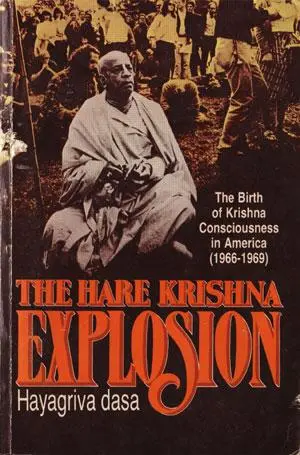

 The Hare Krishna Movement