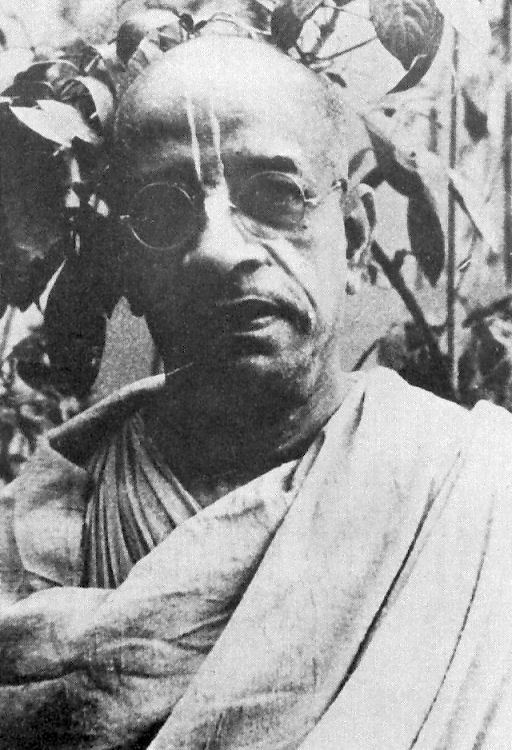
In honor of the Advent of Srimad Bhagavad-gita we are reprinting an Essay on the Bhagavad-gita written by Srila Prabhupada and published on the advent of Bhagavad-gita in 1948
Interpretations of Bhagavad-gita
Originally published c. 1948, on the auspicious observance of the advent of Srimad Bhagavad-gita.]
By His Divine Grace A.C. Bhaktivedanta Swami
It has become a luxurious fashion of the day, along with the progress of material civilization, that everyone can make his interpretation of the great Indian philosophy called the Bhagavad-gītā. This concise form of Vedic knowledge, known as the Gītopaniṣad, is acknowledged by all sections of transcendental scholars, in India especially, as the cream of all Upaniṣads and that of Vedānta-sūtras also. Scholars and ācāryas like Śrīpāda Śaṅkarācārya and some of his followers also could not leave out this very important book of knowledge, although such scholars of the Māyāvāda school did not acknowledge the bona fides of the Purāṇas. But the interpretation of Śrī Śaṅkarācārya differs from the interpretations of the Vaiṣṇava ācāryas headed by Śrī Ramanujācārya and Madhvācārya. There are innumerable interpretations of the Bhagavad-gītā in the market, and it is certainly a puzzling business to select which of the various interpretations shall be accepted as bona fide and which of them shall be rejected as mala fide.
In order to make a distinction between these two classes of bona fide and mala fide interpretations, we have to make an impartial study of the book, and such unbiased study only will make us able to discern the bona fide from the mala fide.
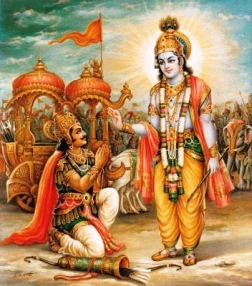
In this connection, we may first of all try to find out the origin of the Bhagavad-gītā. It is wrong to understand that The Bhagavad-gītā was first spoken in the battlefield of Kurukṣetra as it is a part of the great history of India, namely, the Mahābhārata. We can understand from the talks of Śrī Kṛṣṇa and Arjuna, as it is stated in the Bhagavad-gītā, that long, long before the battle of Kurukṣetra, this philosophy was once spoken by Śrī Kṛṣṇa to Vivasvān (the Sun), and from Vivasvān the knowledge was transferred to Manu, and from Manu it was transferred to King Ikṣvāku. And, in that way of disciplic succession, the knowledge has come down to generations after generations, but in course of time, such disciplic succession broke, and therefore, Śrī Kṛṣṇa again repeated the same yoga or transcendental knowledge to Arjuna. In the beginning of the 4th Chapter of Bhagavad-gītā, this fact is stated as follows:



 The Hare Krishna Movement