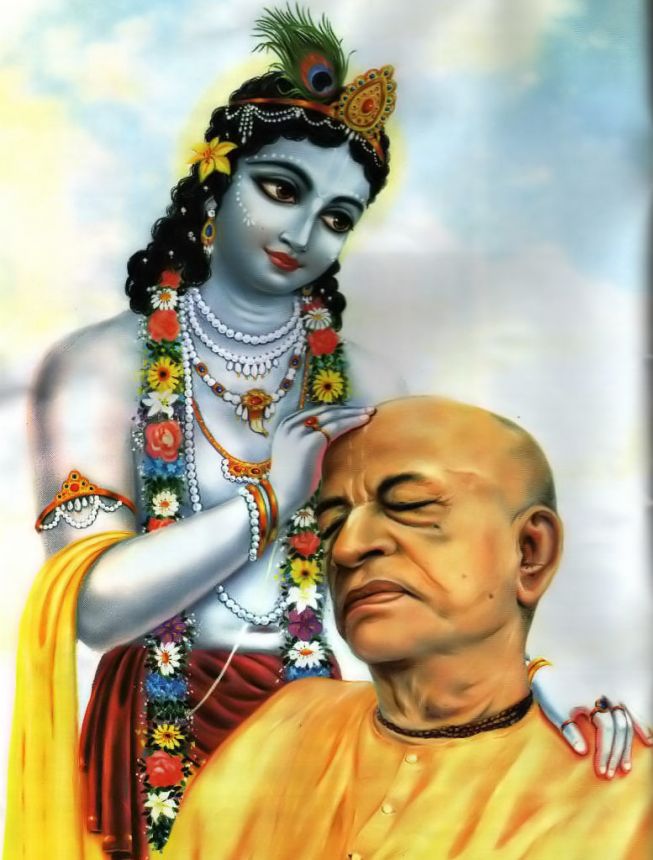
Last night I was having a discussion with a fellow vaisnava, and the following, important sloka, came up in the course of our conversation. I was reminded of a story that once Gurukrpa Swami asked Srila Prabhupada what was the most important sloka in our literature, and Srila Prabhupada responded:
yasya deve parā bhaktir
yathā deve tathā gurau
tasyaite kathitā hy arthāḥ
prakāśante mahātmanaḥ
“Only unto those great souls who have implicit faith in both the Lord and the spiritual master are all the imports of Vedic knowledge automatically revealed.” (Śvetāśvatara Upaniṣad 6.23)
I wanted to see how many times Srila Prabhupada used this sloka in his books and lectures so I went to Vani Quotes and did a search. It appears that this verse was used in:
Bhagavad-gita; 2 times
Srimad Bhagavatam; 11 times
Sri Caitanya-caritamrta; 12 times
Lectures; 43 times
Letters; 7 times
Morning Walks and Conversations; 22 times
Other books; twice
We share with you some of the the results of the Vani Quotes Research team, and thank Visnu Murti and Mayapur prabhu’s efforts.
Bhagavad-gita As It Is
BG 6.47, Purport:
It is by great fortune that one comes to Kṛṣṇa consciousness on the path of bhakti-yoga to become well situated according to the Vedic direction. The ideal yogī concentrates his attention on Kṛṣṇa who is called Śyāmasundara, who is as beautifully colored as a cloud, whose lotuslike face is as effulgent as the sun, whose dress is brilliant with jewels and whose body is flower-garlanded. Illuminating all sides is His gorgeous luster, which is called the brahma-jyotir. He incarnates in different forms such as Rāma, Nṛsiṁha, Varāha and Kṛṣṇa, the Supreme Personality of Godhead, and He descends like a human being, as the son of mother Yaśodā, and He is known as Kṛṣṇa, Govinda and Vāsudeva. He is the perfect child, husband, friend and master, and He is full with all opulences and transcendental qualities. If one remains fully conscious of these features of the Lord, he is called the highest yogi.
This stage of highest perfection in yoga can be attained only by bhakti-yoga, as is confirmed in all Vedic literature:
yasya deve parā bhaktir yathā deve tathā gurau tasyaite kathitā hy arthāḥ prakāśante mahātmanaḥ
“Only unto those great souls who have implicit faith in both the Lord and the spiritual master are all the imports of Vedic knowledge automatically revealed.” (ŚU 6.23)
BG 11.54, Purport:
Lord Caitanya was appreciated by Rūpa Gosvāmī as the most munificent man of charity because love of Kṛṣṇa, which is very difficult to achieve, was distributed freely by Him. So if one gives some amount of his money to persons involved in distributing Kṛṣṇa consciousness, that charity, given to spread Kṛṣṇa consciousness, is the greatest charity in the world. And if one worships as prescribed in the temple (in the temples in India there is always some statue, usually of Viṣṇu or Kṛṣṇa), that is a chance to progress by offering worship and respect to the Supreme Personality of Godhead. For the beginners in devotional service to the Lord, temple worship is essential, and this is confirmed in the Vedic literature (Śvetāśvatara Upaniṣad 6.23):
yasya deve parā bhaktir yathā deve tathā gurau tasyaite kathitā hy arthāḥ prakāśante mahātmanaḥ (ŚU 6.23)
One who has unflinching devotion for the Supreme Lord and is directed by the spiritual master, in whom he has similar unflinching faith, can see the Supreme Personality of Godhead by revelation. One cannot understand Kṛṣṇa by mental speculation. For one who does not take personal training under the guidance of a bona fide spiritual master, it is impossible to even begin to understand Kṛṣṇa. The word tu is specifically used here to indicate that no other process can be used, can be recommended, or can be successful in understanding Kṛṣṇa.
Srimad-Bhagavatam
SB 4.24.52, Purport:
The Lord is the supreme spiritual master, and the bona fide representative of the Supreme Lord is also a spiritual master. The Lord from within enlightens the devotees by the effulgence of the nails of His lotus feet, and His representative, the spiritual master, enlightens from without. Only by thinking of the lotus feet of the Lord and always taking the spiritual master’s advice can one advance in spiritual life and understand Vedic knowledge.
yasya deve parā bhaktir yathā deve tathā gurau tasyaite kathitā hy arthāḥ prakāśante mahātmanaḥ (ŚU 6.23)
Thus the Vedas (Śvetāśvatara Upaniṣad 6.23) enjoin that for one who has unflinching faith in the lotus feet of the Lord, as well as in the spiritual master, the real import of Vedic knowledge can be revealed.





 The Hare Krishna Movement